





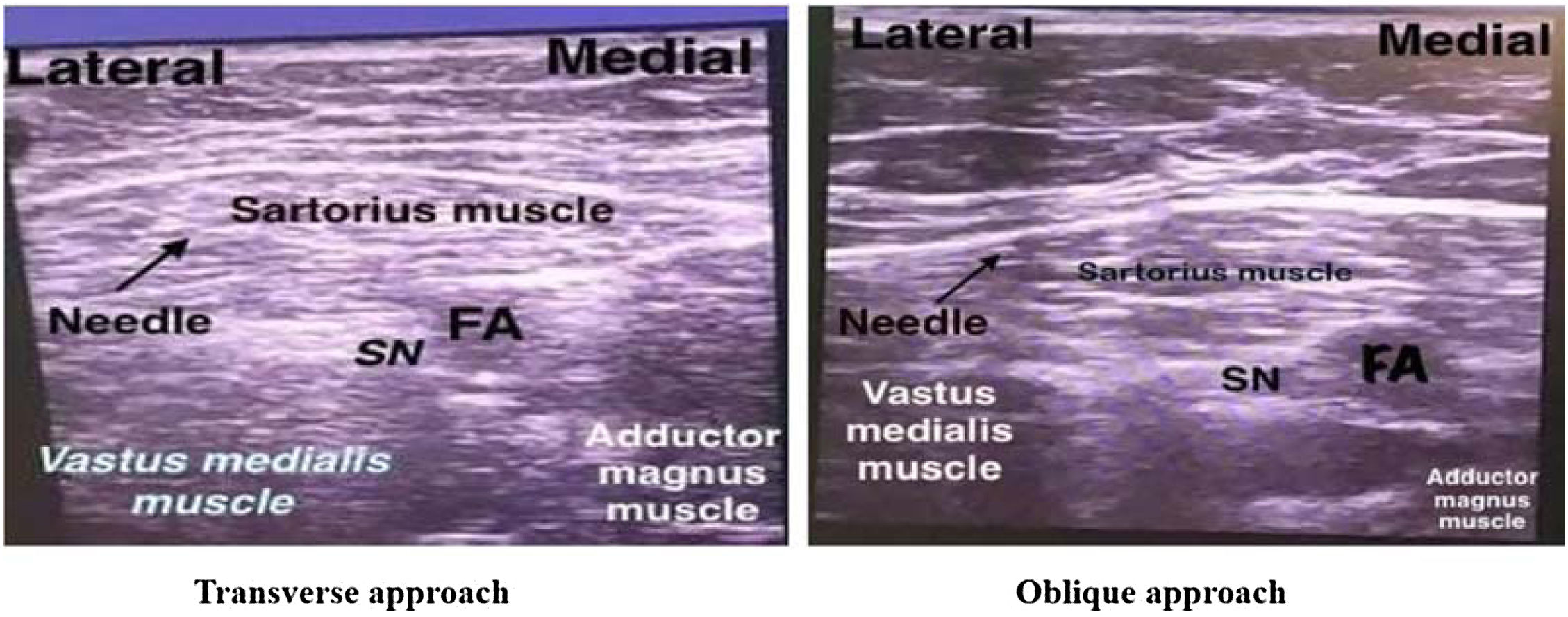


The transverse short-axis in-plane is the standard approach for ultrasound-guided perineural catheter insertion and threading during adductor canal block (BCA). We hypothesized that the oblique short-axis in-plane approach could simplify and speed up catheter insertion and threading by eliminating some technical difficulties.
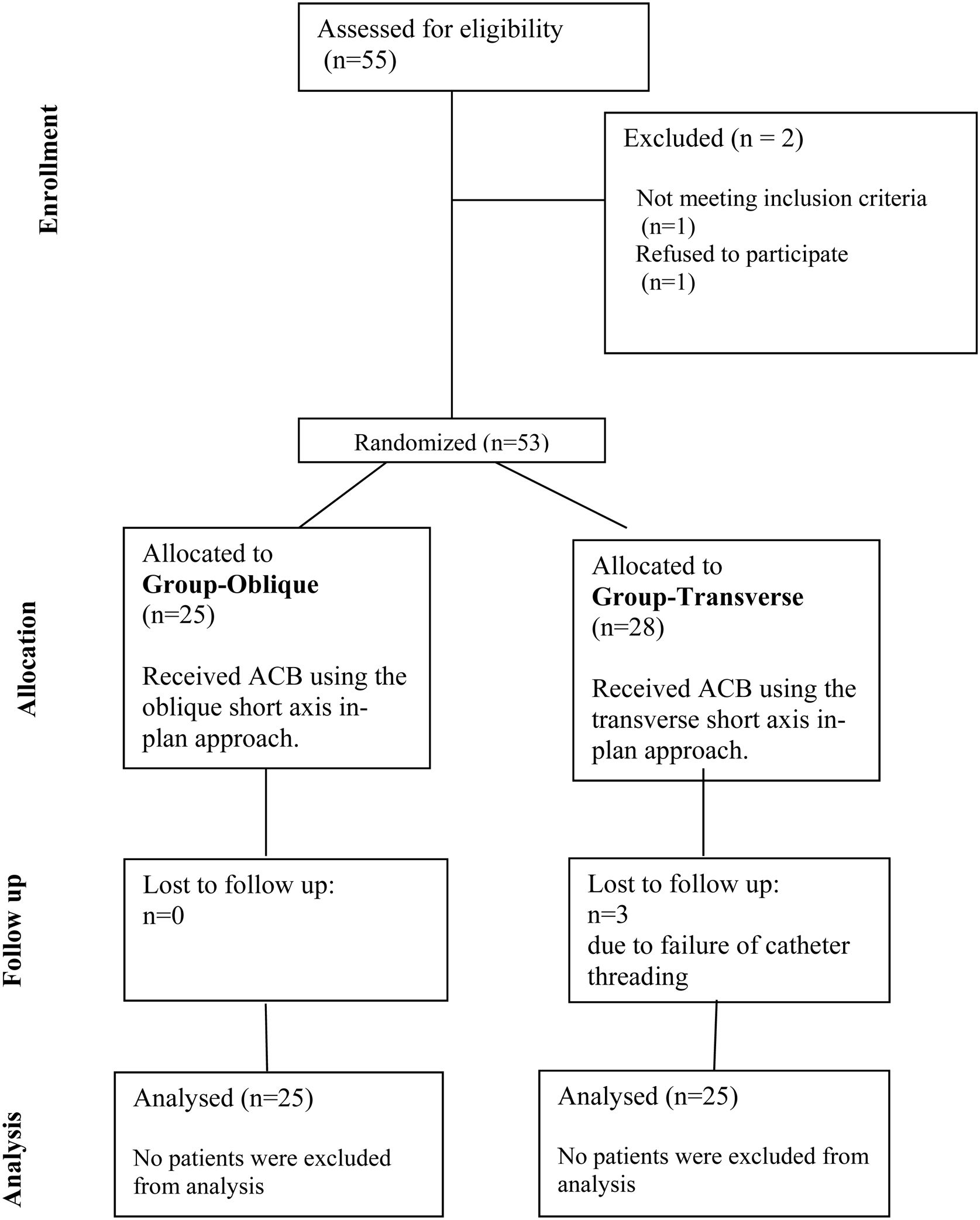
MethodsWe included 50 patients aged ≥18 years, ASA I and II, who were scheduled for unilateral knee arthroscopy under spinal anesthesia. We planned to use BCA with a perineural catheter for postoperative analgesia. After administering spinal anesthesia, the patients were randomly assigned to the oblique (oblique short-axis in-plane approach) or transverse (stamdard short-axis in-plane approach) groups. The primary endpoint was catheter insertion time. The secondary endpoints were catheter threading difficulty, and incidence of vascular puncture and catheter migration.
ResultsThe catheter insertion time was significantly shorter in the oblique group vs the transverse group (113.8 ± 49.2 s vs 185.8 ± 46.7 s, respectively, P < 0.001). Catheter threading was significantly easier in the oblique group, as shown by the lower threading difficulty score compared to the transverse group. Both groups were comparable in terms of the incidence of vascular puncture and catheter migration.
ConclusionIn patients who underwent knee arthroscopy under spinal anesthesia, the oblique short-axis in-plane approach for catheter insertion during BCA was faster and less technically challenging than the standard transverse short-axis in-plane approach.
El abordaje en el plano del eje corto transverso es el abordaje estándar para la inserción ecoguiada y el enhebrado del catéter perineural durante el bloqueo del canal del aductor (BCA). Conjeturamos que el abordaje en el plano del eje corto oblicuo podría simplificar y acelerar la inserción y el enhebrado del catéter, eliminando algunas dificultades técnicas.
MétodosIncluimos 50 pacienes de ≥18 años, ASA I y II, programados para artroscopia de rodilla unilateral con anestesia espinal. Planificamos el uso de BCA con catéter perineural para analgesia postoperatoria. Tras administrar anestesia espinal, se asignó aleatoriamente a los pacientes a los grupos oblicuo (abordaje oblicuo en el plano del eje corto) o transverso (abordaje transverso en el plano del eje corto estándar). El criterio de valoración primario fue el tiempo de inserción del catéter. Los criterios de valoración secundarios fueron la dificultad del enhebrado del catéter, y la incidencia de punción vascular y migración del catéter.
ResultadosEl tiempo de inserción del catéter fue significativamente menor en el grupo oblicuo vs al grupo transverso (113,8 ± 49,2 s vs 185,8 ± 46,7 s, respectivamente, P < 0,001). El enhebrado del catéter fue significativamente más fácil en el grupo oblicuo, según refleja la puntuación de dificultad del enhebrado, en comparación con el grupo transverso. Ambos grupos fueron comparables en términos de incidencia de punción punción vascular y migración del catéter.
ConclusiónEn los pacientes que recibieron artroscopia de rodilla con anestesia espinal, el abordaje oblicuo en el plano del eje corto para inserción del catéter durante el BCA fue más rápido y menos dificultoso técnicamente que el abordaje transerverso en el plano del eje corto estándar.

