metricas
covid
Revista Argentina de Microbiología / Argentinean Journal of Microbiology Most cited
Journal Information

Most cited

Data available in articles published since the year 2014

10
Growth, tolerance, and enzyme activities of Trichoderma strains in culture media added with a pyrethroids-based insecticide
Caliope Mendarte-Alquisira, Alejandro Alarcón, Ronald Ferrera-Cerrato
Rev Argent Microbiol. 2024;56:79-89
10
Highlights

  • Trichoderma spp. strains tolerate 200ppm of pyrethroids and carbamate insecticides.

  • Trichoderma spp. consortium growth in liquid culture with 100ppm of insecticide.

  • Insecticide promotes the release of proteins and peroxidases by Trichoderma spp.

  • Insecticide decreases chitinase and endoglucanase produced by Trichoderma spp.

Full text access
8
Distribution, seroprevalence and risk factors for bovine brucellosis in Brazil: Official data, systematic review and meta-analysis
Isis Daniele dos Santos Rocha, Inácio José Clementino, Débora Luise Canuto de Sousa, Clebert José Alves, Carolina de Sousa Américo Batista Santos, Sérgio Santos de Azevedo
Rev Argent Microbiol. 2024;56:153-64
8
Highlights

  • Pooled seroprevalence of bovine brucellosis in Brazil was 2% (95% CI: 1%, 3%).

  • Total sample size (number of animals evaluated) ranged from 109 to 686086.

  • Purchase of animals for breeding was the most frequent risk factor.

  • It is suggested broad surveys with updated seroprevalence data and risk factors.

Full text access
7
Health-promoting peptides in fermented beverages
Gisselle Raquel Apud, Irina Kristof, Silvana Cecilia Ledesma, Maria Gilda Stivala, Pedro Adrian Aredes Fernandez
Rev Argent Microbiol. 2024;56:336-45
7
Highlights

  • Fermented low-alcoholic beverages have special flavor and health benefits.

  • Health benefits of alcoholic fermented beverages are often attributed to peptides.

  • Lactic acid bacteria exhibit a proteolytic system that release bioactive peptides.

  • Bioactive peptides are also release by yeast metabolism and its autolysis.

Full text access
6
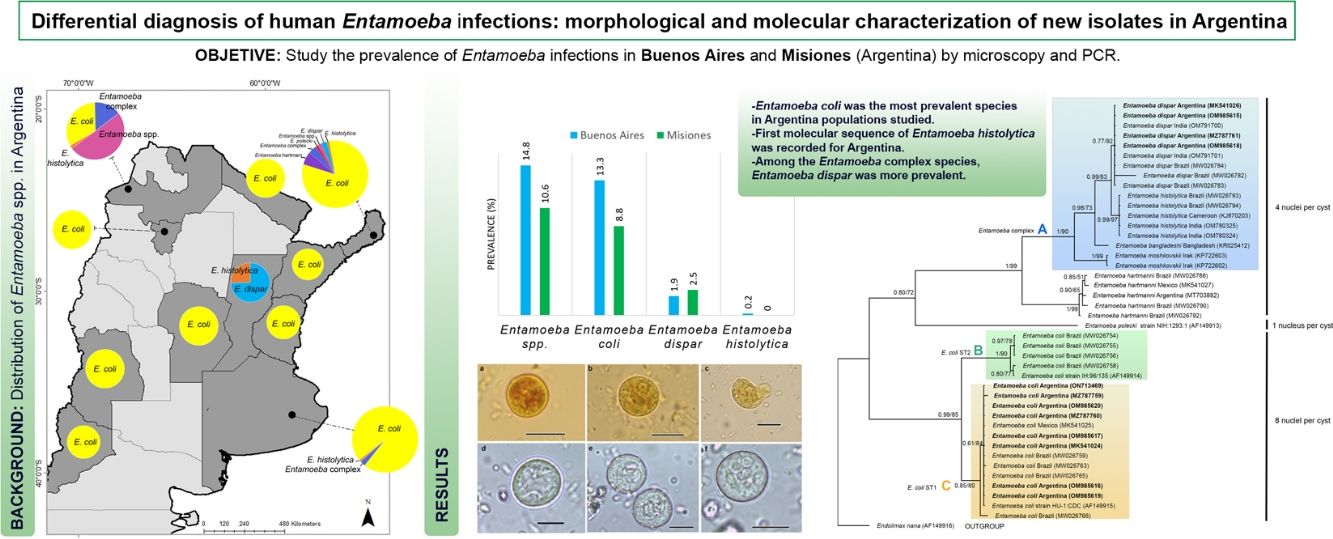
Differential diagnosis of human Entamoeba infections: Morphological and molecular characterization of new isolates in Argentina
Andrea Servián, María Lorena Zonta, Graciela T. Navone
Rev Argent Microbiol. 2024;56:16-24
6
Highlights

  • Entamoeba coli was the most prevalent species in Argentina populations studied.

  • First molecular sequence of Entamoeba histolytica was recorded for Argentina.

  • Among the Entamoeba complex species, Entamoeba dispar was more prevalent.

Full text access
6
Bacterial diversity using metagenomics of 16s rDNA in water kefir, an innovative source of probiotics for bee nutrition
María A. Rodríguez, Leticia A. Fernández, Marina L. Díaz, Cristian A. Gallo, Miguel Corona, Jay D. Evans, Francisco J. Reynaldi
Rev Argent Microbiol. 2024;56:191-7
6
Highlights

  • Microbial community composition of beverage and grain of Argentinian water kefir were significantly different.

  • The beverage of the water kefir showed higher level of microbial alpha diversity.

  • Water kefir may be an innovative source of probiotic strains for bee nutrition.

Full text access
5
Norovirus outbreaks in a nursery school in Buenos Aires, Argentina
Karina A. Gomes, Juan I. Degiuseppe, Juan A. Stupka
Rev Argent Microbiol. 2024;56:373-9
5
Highlights

  • Norovirus is the leading cause of acute gastroenteritis outbreaks.

  • Norovirus GI.3 [P13] is reported for the first time in Argentina.

  • The Sydney variant of Norovirus GII.4 [P16] circulates in Argentina, and it is associated with severe dehydration.

Full text access
4
Comparison of two MALDI-TOF MS systems for the identification of clinically relevant anaerobic bacteria in Argentina
Mirta Litterio, Liliana Castello, María Elena Venuta, Sofía Abel, Liliana Fernández-Canigia, María Cristina Legaria, Raquel Rollet, Daniela Vaustat, ... Claudia Barberis
Rev Argent Microbiol. 2024;56:33-61
4
Highlights

  • MALDI-TOF MS is especially useful for the identification of anaerobic bacteria.

  • It is useful for slow-growing microorganisms that are difficult to identify by traditional methods.

  • It is essential to update the databases by increasing the number of spectrum.

Full text access
4
Prevalence of Demodex spp. in patients with chronic blepharitis
Viviana Flores, Marina Ruf, Silvia Paola Abad Farfan, Andrea Vanessa Suárez Echávez, Dolores Pilar Bastard, Maria Celeste Puga, Luis Daniel Mazzuoccolo
Rev Argent Microbiol. 2024;56:74-8
4
Highlights

  • High prevalence of Demodex spp. blepharitis in patients older than 60 years old.

  • Meibomitis, dandruff, itching, epiphora were associated with blepharitis by Demodex spp.

  • Diagnosis of blepharitis by Demodex spp. allows for an adequate treatment.

Full text access
3
Reduction in the incidence of invasive infections caused by encapsulated bacteria after the onset of the COVID-19 pandemic
Leda Guzzi, Juan Manuel Sambade, Martin Diego Christin, Federico Rodriguez Cairoli, Alejandra Rodriguez, Silvia Vicario, Miriam Hinojosa Del Carpio, Juan Molinos, Pablo Dimitroff
Rev Argent Microbiol. 2024;56:62-8
3
Highlights

  • IIEB incidence dropped dramatically during the COVID-19 pandemic.

  • Reduction coincided with public health measures to contain the pandemic.

  • We observed low rates of SARS-COV2 and invasive S. pneumoniae coinfection.

  • Case fatality was higher in coinfected patients than in those presenting IPD.

Full text access
3
Feline sporotrichosis due to Sporothrix globosa in the Metropolitan region of Buenos Aires: A case study
Alejandro N. Etchecopaz, Katherine Hermida Alava, Miguel Scarpa, Adriana Duchene, Diego García Re, María Luján Cuestas
Rev Argent Microbiol. 2024;56:4-7
3
Highlights

  • First report of feline sporotrichosis due to S. globosa in Argentina.

  • Absence of zoonotic transmission through scratches from the sick cat is reported.

  • The cat received itraconazole 10mg/kg/day for 3 months with a favorable evolution.

Full text access