




The Dr Calatayud Grant in Editorial Fellowship of the Sociedad Española de Radiología Médica (Spanish Society of Medical Radiology—SERAM) has now been running for ten years. This is an achievement that should be a source of great satisfaction for the journal Radiología, for SERAM and, of course, for all its partners, and we are celebrating the milestone.
In addition to being the official magazine of SERAM and its vehicle for publishing reviews and scientific articles, the journal Radiología aims to act as a training tool for members and to promote research and editorial quality. To that end, in 2012, with Dr García Santos as editor-in-chief of the journal, SERAM and Radiología launched a joint initiative to create this grant for medical editing. They called it the Dr Calatayud Grant in Editorial Fellowship, in reference to the figure who founded Radiología in 1912, with the aim of recovering and highlighting the values and pillars that underpinned the creation of our journal.1
The main mission of the Dr Calatayud Grant in Editorial Fellowship is to transmit enthusiasm for an academic career to young radiologists who are in their first years of specialist practice and to promote research in radiology, as well as to promote our journal among radiologists and other medical specialists and to stimulate publications of high scientific quality. Another objective of this programme is to inspire a vocation for medical editing among young professionals by offering them the opportunity to learn how a journal works. The aim, therefore, is for the grant recipients to understand and participate in the editorial process and the circuit through which a manuscript goes from the moment it arrives at the journal to when it is reviewed and potentially accepted, edited and published.2 In this sense, the grant also helps to create a "pool of talent" to progressively incorporate new professionals who can collaborate with the journal and contribute to its progress.
In recent years, other scientific societies around the world, together with their official journals, have developed and implemented medical editing programmes for resident students or young doctors with great success. Some examples of this are the editorial fellowships of the Radiological Society of North America, the Lee F. Rogers International Fellowship in Radiology Journalism of the American Journal of Roentgenology, and the Albert L. Baert Editorial Fellowship of the European Society of Radiology. The general impression is that these initiatives tend to be quite well received among the medical community, since they stimulate research and academic careers, contribute to training in editing, which professionals are sometimes simply assumed to have, and encourage interaction and collaboration between professionals from different backgrounds, hospitals and regions, making them a very enriching initiative in many ways.3
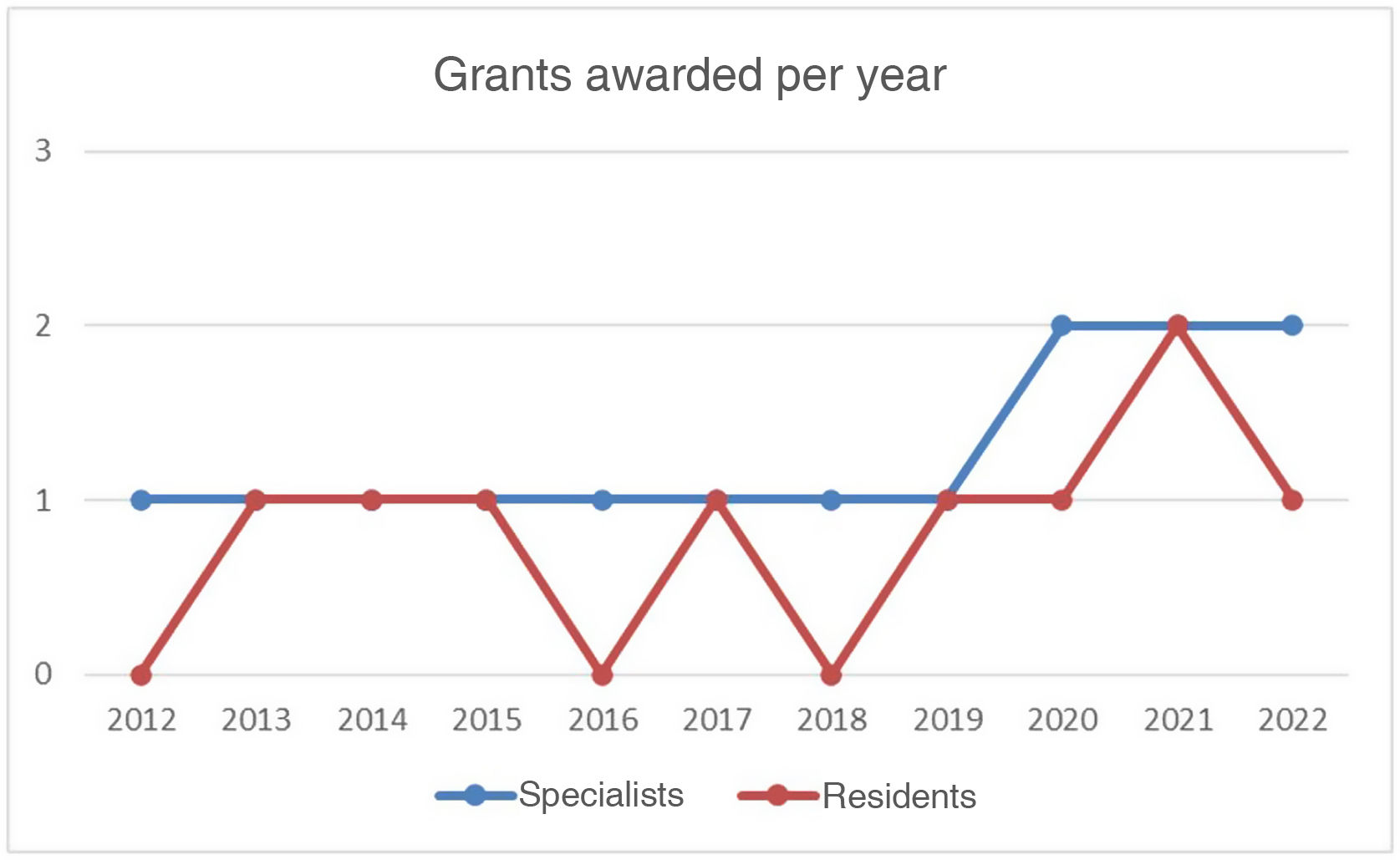
In these 10 years of the Dr Calatayud Grant in Editorial Fellowship, from 2012 to 2022, there have been a total of 23 grant recipients, consisting of specialists and residents. The pie chart in Fig. 1 details the distribution of grants awarded from 2012 to 2022. The number of grant recipients per year is reflected in the diagram in Fig. 2. Table 1 lists the year, grant type and name of grant recipients who have formed part of the programme since 2012.


Year, type of grant and name of the grant recipients included in the programme since 2012.
| Year | Type | Name |
|---|---|---|
| 2012 | Specialist | Lucía Flors Blasco |
| 2013 | Specialist | Antonio López Rueda |
| 2013 | Resident | Javier Fernández Jara |
| 2014 | Specialist | Daniel Castellón Plaza |
| 2014 | Resident | Ainhoa Viteri Jusue |
| 2015 | Specialist | Cristina García Villar |
| 2015 | Resident | Jose Andrés Guirola Ortiz |
| 2016 | Specialist | Gloria M. Coronado Vilca |
| 2017 | Specialist | Marta Drake Pérez |
| 2017 | Resident | Carmen Parra-Fariñas |
| 2018 | Specialist | Sara Lojo Lendoiro |
| 2019 | Specialist | Clara Morandeira Arrizabalaga |
| 2019 | Resident | Elena Marín Díez |
| 2020 | Specialist | Pablo Rodríguez Carnero |
| 2020 | Specialist | Raquel Sánchez Oro |
| 2020 | Resident | María Leturia Etxeberria |
| 2021 | Specialist | Antonio Navarro Ballester |
| 2021 | Specialist | Alicia Victoria Gavilanes Vaca |
| 2021 | Resident | Antonio Jesús Láinez Ramos-Bossini |
| 2021 | Resident | Amaia Pérez del Barrio |
| 2022 | Specialist | Blanca Domenech Ximenos |
| 2022 | Specialist | Elena Serrano Alcalá |
| 2022 | Resident | Darío Herrán de la Gala |
We have been awarded the Dr Calatayud Grant in Editorial Fellowship for the 2022–2023 academic year, in the specialist category, and it has been a very beneficial and rewarding experience both on the personal and professional levels. First of all, this grant has given us the opportunity to meet and work in close contact with the current editor-in-chief of the journal Radiología, Dr Cristina García Villar, who, apart from treating us with great human warmth, has transmitted to us all her passion and motivation for the field of editing and her enthusiasm for the journal Radiología. Furthermore, during our stay in Cádiz with her we have learned about the mission of the editor-in-chief and the rest of those involved in the editorial board, and we have seen that their work is fundamental for the journal Radiología and also for our medical society.
Secondly, thanks to the grant and the editor-in-chief, we have had the opportunity to learn about the ins and outs of the journal's electronic system and editorial circuit, from the moment a manuscript is received to its publication, and to participate in peer reviews. We have felt an integral part of the editorial board, attending its meetings and seeing how objectives are met. In addition, the objectives of the grant programme include collaborating in the review of manuscripts as well as writing this editorial and a review article.
These tasks have helped to change our initial perspective of what it means to review and edit an article, and to give us a global overview. During this time we have put ourselves in the shoes of the reviewer, a figure we previously considered to be punctilious and perfectionist, and we have understood that her objective is to improve the quality and understanding of the manuscript, all in an impartial manner. We have also put ourselves in the shoes of the editors, a role that is very demanding and receives little recognition, whose mission it is to find experts for peer review (an endangered species) and based on their recommendations, even if they are sometimes conflicting, decide the fate of our manuscripts. And from the author's point of view, we have learned to review articles and, indirectly, to write them.
In short, the Dr Calatayud Grant in Editorial Fellowship of SERAM and the journal Radiología has reached the 10-year milestone, and we could not be more proud to have been part of the programme on its tenth anniversary. The success of the grant over the years highlights the excellent work done by the society and the journal to actively promote research and editing in radiology. That is why we encourage residents and radiologists with an interest in the worlds of publishing and science to apply for this grant.
FundingThis research was not supported by any grant.
Conflicts of interestThe authors declare that they have no conflicts of interest.


