



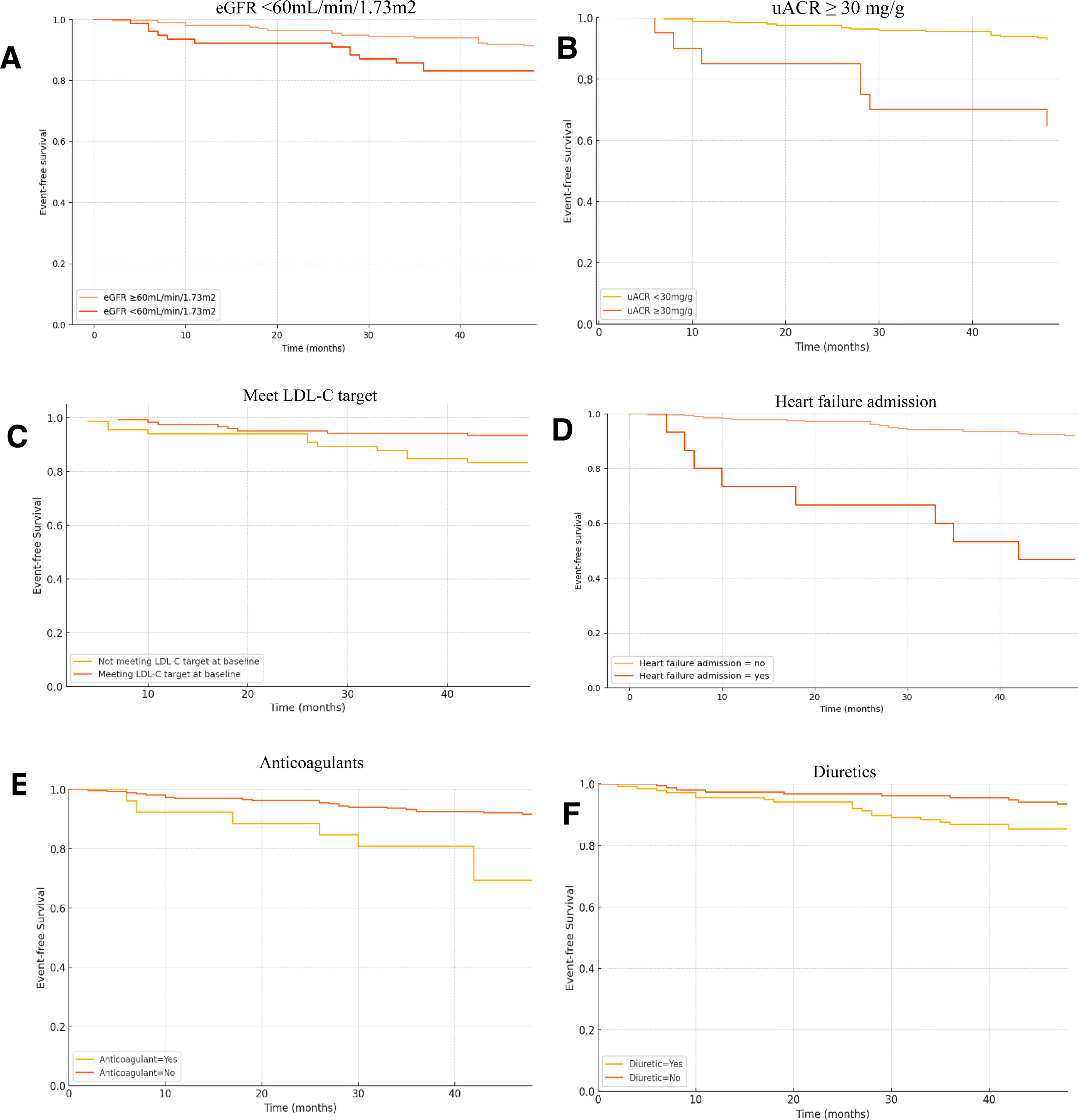
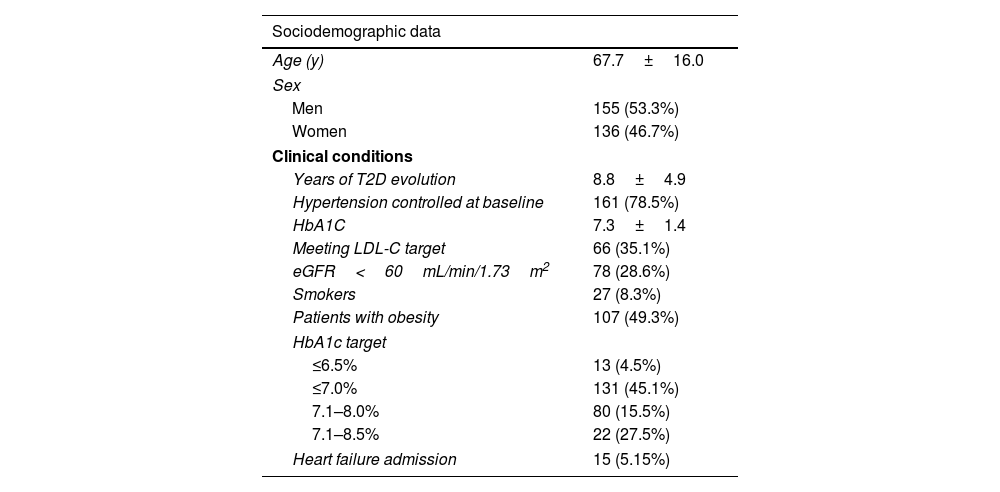
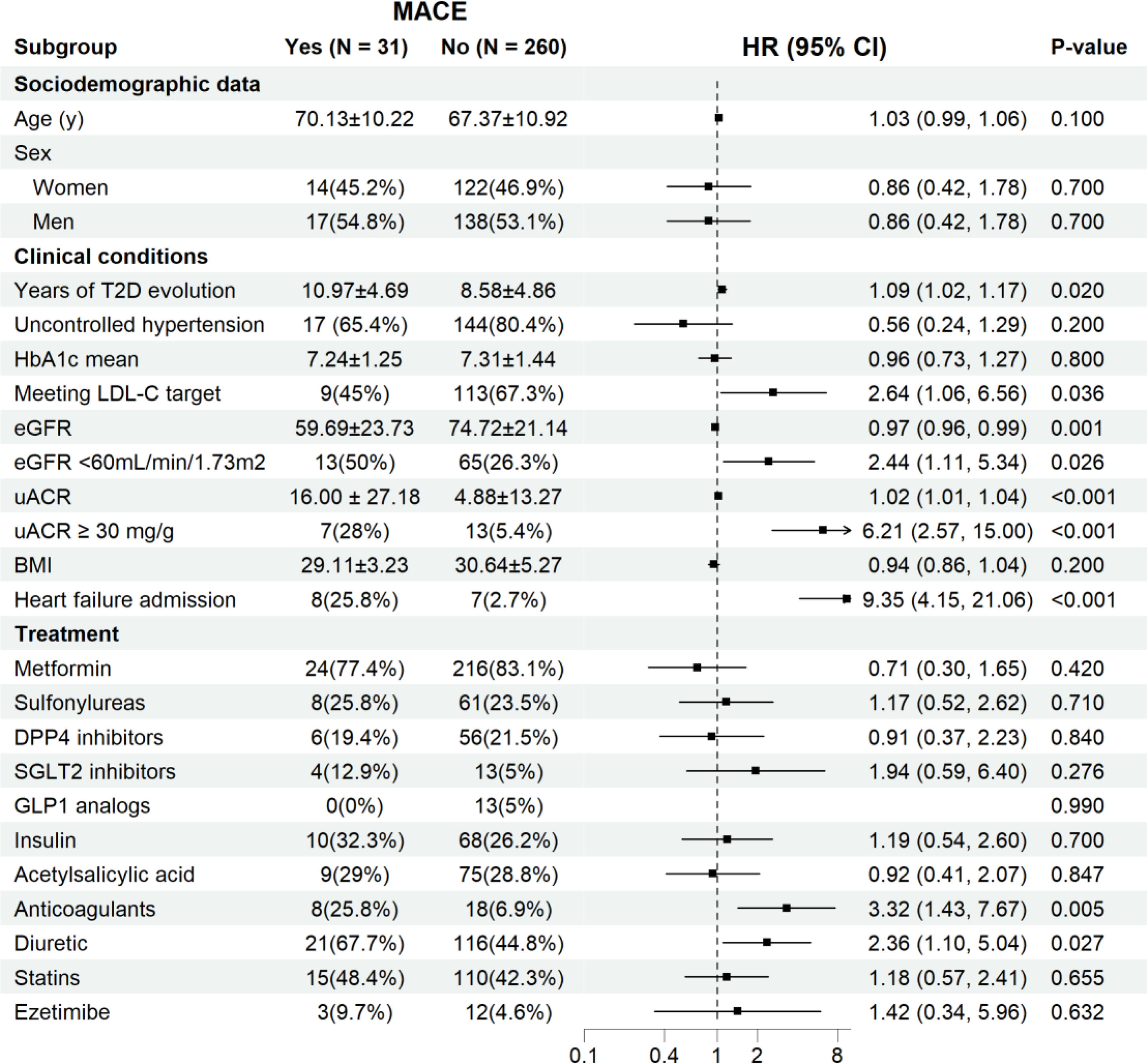

Large-scale studies (UKPDS and CALIBER) reported annual major adverse cardiovascular events (MACE) rates of 2.5–2.6% occurrence in patients with type 2 diabetes mellitus (T2D). However, data for different geographical locations in Spain are unknown. The aim of this study was to investigate the most common causes of MACE and the factors that contribute to its occurrence in patients with DM2 living in southern Spain.
MethodsIn this cohort study, 297 patients with T2D were monitored over 49 months to assess the occurrence of MACE (i.e., stroke, myocardial infarction, and/or cardiovascular death). Sociodemographic and clinical data (including cardiovascular disease risk factors and initial treatments) were collected to examine their impact on the incidence of MACE.
ResultsThe mean age of the cohort was 67.7 years, with a male predominance (53.3%) and an average T2D duration of 8.8 years. Over the 4-year follow-up, 10.7% of patients experienced a MACE, with myocardial infarction and cardiovascular death being the most prevalent events (both 38.7%). In multivariate analysis, each additional year of T2D evolution was associated with a 15% increased risk of MACE (HR=1.150 [1.006–1.314], p=0.041), while each unit increase in estimated glomerular filtration rate (eGFR) was linked to a 3.3% risk reduction (HR=0.967 [0.938–0.997], p=0.033).
ConclusionMyocardial infarction and cardiovascular death were the leading causes of MACE in T2D patients over a 4-year follow-up. Longer T2D duration and lower eGFR were the most significant risk factors. These findings underscore the need of closer monitoring and intensive treatment in patients with long-standing T2D and/or impaired renal function.
Estudios a gran escala como UKPDS y CALIBER informaron tasas anuales de eventos cardiovasculares mayores (MACE) que oscilaron entre 2,5-2,6% en pacientes con diabetes mellitus tipo 2 (DM2). Sin embargo, se desconocen las cifras relativas a distintas localizaciones geográficas españolas. El objetivo del presente trabajo fue investigar las causas más comunes de los MACE y los factores que contribuyen a su aparición en pacientes con DM2 que residen en el sur de España.
MétodosEstudio de cohortes, 297 pacientes con DM2 fueron seguidos durante 49 meses para evaluar la aparición de MACE (accidente cerebrovascular, infarto de miocardio y/o muerte cardiovascular). Se recogieron datos sociodemográficos y clínicos para examinar su impacto en la incidencia de MACE.
ResultadosLa edad media de la cohorte fue de 67,7 años, con predominio masculino (53,3%) y una duración media de la DM2 de 8,8 años. Durante los 4 años de seguimiento, el 10,7% de los pacientes experimentó MACE, siendo el infarto de miocardio y la muerte cardiovascular los eventos más prevalentes (ambos 38,7%). En el análisis multivariante, cada año adicional de evolución de la DM2 se asoció con un aumento del riesgo de MACE del 15% (HR=1,150 [1,006-1,314], P=0,041), mientras que cada unidad de aumento en la tasa de filtración glomerular estimada (eGFR) se relacionó con una reducción del riesgo del 3,3% (HR=0,967 [0,938-0,997], P=0,033).
ConclusiónEl infarto de miocardio y la muerte cardiovascular fueron las principales causas de MACE en pacientes con DM2 tras 4 años de seguimiento. Una mayor duración de la DM2 y una menor eGFR fueron los factores de riesgo más significativos. Estos hallazgos subrayan la necesidad de un seguimiento más estrecho y un tratamiento intensivo en pacientes con DM2 de larga evolución y/o deterioro de la función renal.

