







According to recent guidelines, the best approach for treatment of heart failure patients with preserved ejection function is still not defined. The aim of this study was to investigate how carvedilol therapy influences the survival rate, ejection fraction and NYHA class in these patients.
Patients and methodsWe conducted study on heart failure patients with preserved systolic function from the Croatian heart failure registry who were hospitalized in the period between 2005 and 2010. We enrolled patients with carvedilol listed as treatment on their discharge letters and patients who had been using carvedilol for at least 4 years, while for the control group we selected patients with no beta-blockers on their discharge letters (113 vs 204 respectively). The primary outcome was the overall survival rate and the secondary outcome was the change in ejection fraction of the left ventricle and NYHA class during the study.
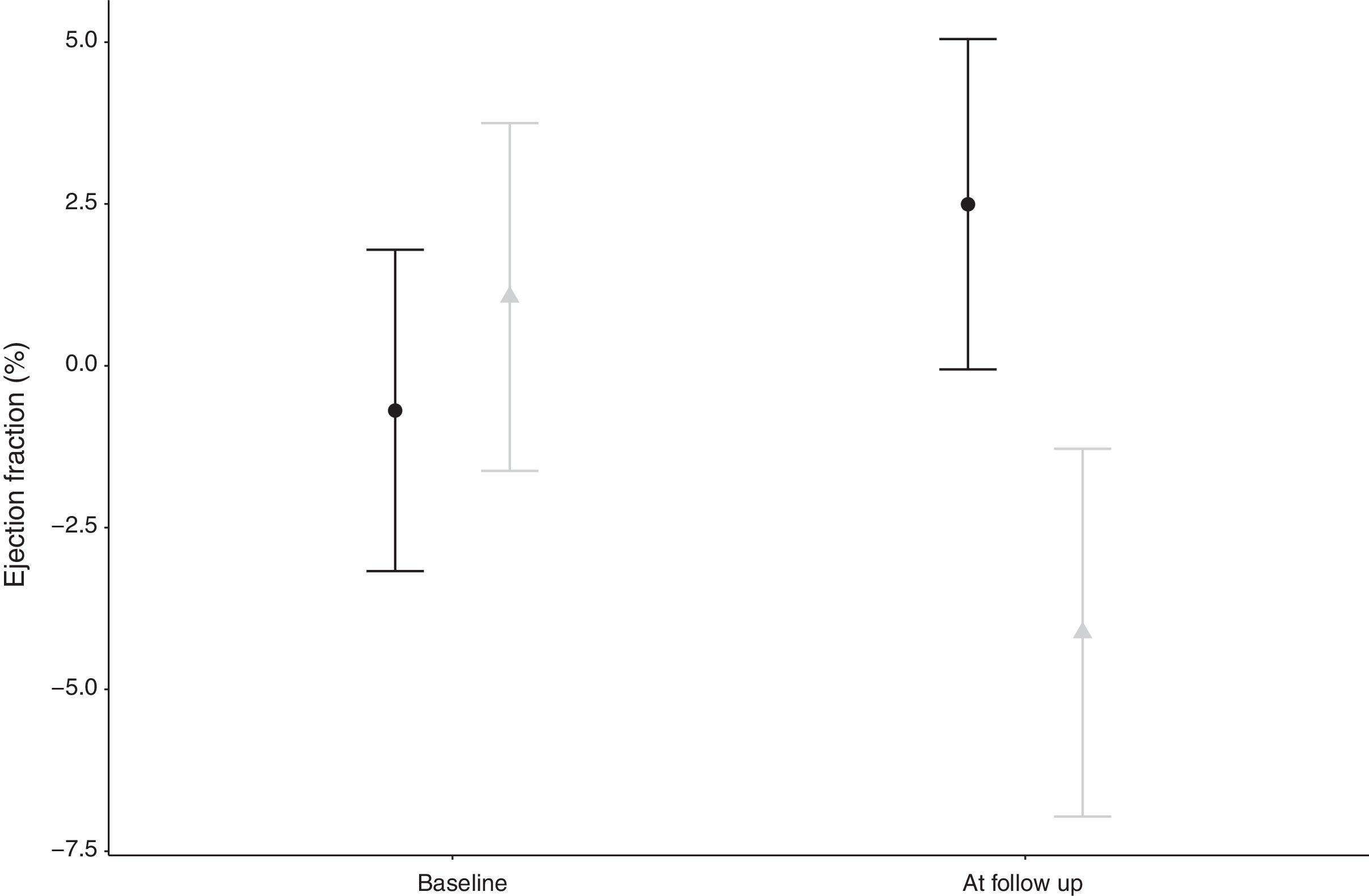
ResultsPatients in the carvedilol group had a higher overall survival rate compared to patients in the control group (chi-square=14.1, P<0.001). Patients in the carvedilol group in two measurements had a significantly higher ejection fraction compared to the control group (F=148.04, P<0.001). Also, patients in the carvedilol group showed improvement in NYHA class (chi-square=29.768, P<0.001).
ConclusionLong term carvedilol therapy appears to be associated with a higher overall survival rate, improvement in ejection fraction and NYHA class in heart failure patients with preserved ejection fraction.
Según directrices recientes, todavía no se ha definido el mejor modo de tratar pacientes con insuficiencia cardíaca con función de eyección preservada. El objetivo de este estudio fue investigar cómo la terapia con carvedilol influye en la tasa de supervivencia, la fracción de eyección y la clase NYHA en estos pacientes.
Pacientes y métodosA partir de los datos del registro croata de insuficiencia cardíaca, se realizó un estudio en pacientes con insuficiencia cardíaca con función sistólica preservada que fueron hospitalizados en el período de 2005 a 2010. Registramos a los pacientes que tuvieron carvedilol incluido en su tratamiento en las cartas de alta y a los pacientes que habían estado usando carvedilol durante al menos 4 años. Para el grupo de control, seleccionamos a los pacientes sin betabloqueantes en sus cartas de alta (113 versus 204, respectivamente). El resultado primario fue la tasa de supervivencia general, y el resultado secundario fue el cambio durante el estudio en la fracción de eyección del ventrículo izquierdo y la clase NYHA.
ResultadosLos pacientes del grupo con carvedilol tuvieron una tasa de supervivencia general más alta que los pacientes del grupo control (Chi-cuadrado=14,1; p<0,001). Los pacientes del grupo con carvedilol en 2 mediciones tuvieron una fracción de eyección significativamente mayor en comparación con el grupo control (F=148,04; p<0,001). Además, los pacientes en el grupo de carvedilol mostraron mejoría en la clase NYHA (Chi-cuadrado=29,768; p<0,001).
ConclusiónLa terapia con carvedilol a largo plazo parece estar asociada con una tasa de supervivencia general más alta y a una mejoría en la fracción de eyección y clase NYHA en pacientes con insuficiencia cardíaca con fracción de eyección preservada.

