






Acceptance criteria for kidney donors (KDs) have become more flexible over time, raising questions about their long-term consequences. The objective of this study was to evaluate changes in the baseline characteristics of accepted KDs and to analyze their evolution after donation.
MethodsA cohort study was conducted that included all KDs from our institution from 2010 to 2017. Baseline characteristics were compared by period and follow-up was carried out up to 10 years after donation.
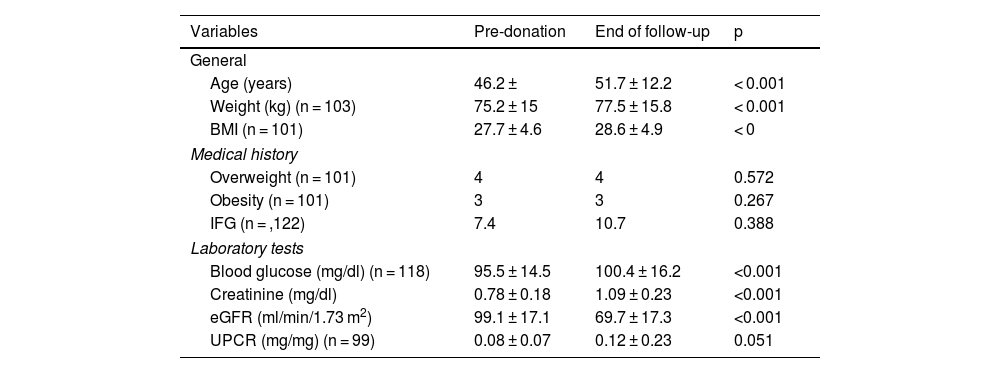
Results169 KDs aged 45.6 ± 12.2 years were included, mostly women (63.9%). The main comorbidity they presented was obesity (29.6%) and controlled arterial hypertension (10.7%). KDs showed significant differences in estimated glomerular filtration rate (eGFR) with lower values in the last study period (P = .002). Progression to chronic kidney disease (CKD) III-a was 31% (95% CI: 23.5-39.6) and III-b 3.9% (95% CI: 0.5-7.2). Related risk factors were age (HRa = 1.04; 95% CI: 1.01-1,07; P = .033) and pre-donation eGFR (HRa = 0,97; 95% CI: 0.95-0,99; P = .028). No patient progressed to CKD IV, V or died during follow-up.
ConclusionThere were subtle changes in the characteristics of the accepted KR. Age and baseline eGFR were independent predictors of progression to CKD III post-donation. The incidence of advanced CKD and mortality were null at 10 years of post-donation follow-up, so it seems to be a safe procedure in our environment in the long term.
Los criterios de aceptación en los donantes renales (DR) se han flexibilizado con el tiempo generando interrogantes sobre sus consecuencias a largo plazo. El objetivo de este estudio fue evaluar cambios en las características basales de los DR aceptados y analizar la evolución posterior a la donación.
MétodosSe realizó un estudio de cohorte que incluyó a todos los DR del periodo 2010–2017 de nuestra institución. Se compararon las características basales por periodos y se realizó un seguimiento hasta 10 años posterior a la donación.
ResultadosSe incluyeron 169 DR de 45,6 ± 12,2 años, en su mayoría mujeres (63,9%). La principal comorbilidad que presentaron fue la obesidad (29,6%) y la hipertensión controlada (10,7%). Los DR mostraron diferencias significativas en la tasa de filtrado glomerular estimada (TFGe) basal con valores menores en el último periodo de estudio (p = 0,002). La progresión a enfermedad renal crónica (ERC) III-a fue del 31% (IC95% = 23,5–39,6) y III-b del 3,9% (IC95% = 0,5–7,2). Los factores de riesgo relacionados fueron la edad (HRa = 1,04; IC95% 1,01−1,07; p = 0,033) y la TFGe previa a la donación (HRa = 0,97; IC95% = 0,95−0,99; p = 0,028). Ningún paciente progresó a ERC IV, V o falleció durante el seguimiento.
ConclusiónExistieron cambios sutiles en las características de DR aceptados. La edad y la TFGe basal fueron predictores independientes de progresión a ERC III post donación. La incidencia de ERC avanzada y la mortalidad fueron nulas a 10 años de seguimiento post donación, por lo que parece ser un procedimiento seguro en nuestro medio a largo plazo.

