







Referentiality is a common symptom in psychotic and also some non-psychotic disorders, but there are few existing measures for assessing it. A recently developed detailed measure for this purpose is the Ideas of Reference Interview Scale (IRIS), which however has only been validated in a Chinese population of first episode psychosis patients.
MethodsWe examined the reliability and validity of a Spanish version of the IRIS (IRIS-S) in 185 patients aged between 18 and 65 with schizophrenia or schizoaffective disorder.
ResultsThe IRIS-S showed internal consistency, with this being good or acceptable for the presence scale and its three subsidiary measures. Inter-rater reliability was good and test-retest reliability was also good, except for one subsidiary measure. Convergent reliability was demonstrated but was lower than expected.
ConclusionThe IRIS-S has acceptable psychometric properties when employed in patients with schizophrenia/schizoaffective disorder. Caution is necessary for its use outside psychotic disorders as it has not been examined in such populations.
Ideas and delusions of reference are common symptoms of schizophrenia, being seen in 55 % and 50 %, respectively, of patients with acute schizophrenia according to one large study, although they were present at lower rates (18 % and 14 %) in the chronic stage.1,2 Ideas of reference are also a feature of schizotypal personality disorder,3 where they may take forms that are difficult to distinguish from delusions of reference,4 and they are also a marked symptom of other disorders such as body dysmorphic disorder and the olfactory reference syndrome5; they are also recognized to occur in patients with social anxiety.6 Along with other so-called psychotic-like experiences, the occurrence of ideas of reference in the healthy population is currently a focus of considerable research interest.7
Rating of ideas and delusions of reference is typically brief in rating scales for schizophrenia – there is only a single relevant item in two leading scales, the Positive and Negative Syndrome Scale (PANSS) and the Scale for the Assessment of Positive Symptoms (SAPS), and a third scale, the Psychotic Symptoms Rating Scale (PSYRATS), which rates delusions and hallucinations, does not separate different categories of delusions. A self-report questionnaire, the Peters Delusions Inventory,8 which is based on a structured interview, the Present State Examination (PSE), only has three items concerning referential ideas and delusions. A more detailed self-report questionnaire (34 items) exists in the form of the Referential Thinking Scale9 which contains 34 items. However, this was developed to rate the referential ideation seen in patients with schizotypal personality disorder and specifically excludes psychotic forms of referentiality.
The Ideas of Reference Interview Scale (IRIS)10 is a 15-item semi-structured assessment interview developed to provide an interviewer-based detailed evaluation of referential experiences. It contains 15 items that assess self-referential experiences occurring during the previous month, and takes between 5 and 45 min to complete, depending on what the subject reports. It was developed to be used in patients with psychosis (see below) but in principle it can also be applied to patients with other disorders or even healthy individuals. It also permits the collection of data and contextual information about referential experiences.
The IRIS was developed and validated in a Chinese population of first-episode psychosis patients. The original version showed good psychometric properties, with a Cronbach alpha of 0.80 and high inter-rater reliability with an intraclass correlation (ICC) of 0.95. The present study reports the psychometric properties of a Spanish version of the IRIS in a population of patients with established schizophrenia and schizoaffective disorder.
MethodsTranslation processThe original Chinese and English versions of the IRIS were developed by the same author (Wong), who is bilingual in these languages and has formal training in psychology, psychiatry and translation. The English version was translated into Spanish by two researchers, who both have a good knowledge of English (SS and IA), with prior approval from the authors of the original scale. A final version of the scale (henceforward the IRIS-S) was discussed with a clinically experienced psychologist and psychiatrist, and subsequently back-translated into English by the same two researchers. Finally, the back translation was compared to the original English version by a researcher with expertise in schizophrenia (PJM), and no further changes were deemed necessary. The instructions for administration were also translated into Spanish.
ParticipantsThe study sample consisted of 185 patients aged between 18 and 65 with a DSM-5 diagnosis of schizophrenia or schizoaffective disorder, made based on clinical interviews and review of case notes. The sample included both in- and out-patients. Recruitment was carried out in Benito Menni CASM Hospital (Sant Boi de Llobregat, Barcelona), Sant Rafael Hospital (Barcelona), Gràcia CSMA (Barcelona), Mataró Hospital (Mataró) and Sagrat Cor Hospital (Martorell). Participants were excluded if there they had shown alcohol/substance abuse within 12 months prior to participation, were non-native Spanish speakers or had an estimated premorbid IQ below 70, as measured using the Word Accentuation Test (Test de Acentuación de Palabras, TAP) ,11,12 which requires pronunciation of low-frequency Spanish words whose accents have been removed.
ProcedureIRIS-S training and interviewingTwo evaluators (IA and SS) were trained in the administration and scoring of IRIS-S and the other scales used in this study. Training was provided by PJM in a workshop format that included didactic teaching, review of the instructions, and assessment of videorecorded patient interviews. The same two evaluators then rated five patients, whose scores were excluded from the statistical analyses under supervision from the same senior investigator.
The two evaluators then administered the IRIS-S to the remaining 180 patients. In the first, screening, part of the interview, questions were asked which addressed 15 referential themes that the subject may have had in the last month. Then, for each theme identified, four features were rated: presence, discrepancy, conviction and frequency. Presence is scored 0, 0.5 (when there were autoreferential experiences, but it was not possible to elicit a clear example) or 1 (where the subject had had autoreferential experiences and could give a clear example). When presence was scored as 1, a detailed explanation of a specific example was asked for (time, place, setting, background, people, actions, perceived intentions, and description of the context, content, and form of communication). Based on this, ratings on three 'dimensions' were then made. Discrepancy aims to capture the key referential element of significance being attached to non-specific environmental events. The interviewer evaluates how strongly the individual considers the experience as specifically directed at him/her. Discrepancy is lower (ie less severe) if the individual perceives a relatively specific piece of information as significant (eg an email sent to them from a friend); whereas it is higher if significance is attributed to nonspecific information (eg a statement on a social media platform). Conviction refers to the degree to which the subject maintains their interpretation of the self-referential experience/experiences. For this dimension, the evaluator has to consider the subject's willingness to consider alternative interpretations of the experience. Frequency rates the frequency of occurrence of the experience and other experiences in the same category over the past month. These three dimensions are all scored from 0 to 5, with anchor points.
Additional scales administeredOne of the two raters (IA) administrated the Positive and Negative Syndrome Scale (PANSS)13 and the Psychotic Symptom Rating Scales (PSYRATS)14 to the patients. The PANSS consists of 30 mental state items that are rated on a scale that ranges from 1 (absent) to 7 (extreme). There are three subscales, positive symptoms (7 items; range score=7–49), negative symptoms (7 items; range score=7–49) and general psychopathology (16 items; range score=16–112). The scale has good internal consistency in its Spanish version with a Cronbach's alpha of 0.62 for the positive scale, 0.92 for the negative scale and 0.55 for general psychopathology.15 The PSYRATS is an interview-based scale that includes 17 items to evaluate the severity and characteristics of auditory hallucinations (11 items) and delusions (6 items) in individuals with psychotic disorders. Individual items on both subscales are scored between 0 and 4. The Spanish version of the scale has been found to show good inter-rater reliability (Spearman’s rho = 0.80) and a fair degree of concurrent validity (Spearman’s rho = 0.51).16
Assessment of reliabilityTo assess inter-rater reliability, both evaluators jointly interviewed 19 patients and then independently rated the IRIS. Additionally, to assess intra-rater reliability, the same rater (IA) evaluated 22 patients approximately 7 days later.
Statistical analysisNormality of distribution was evaluated for the continuous sociodemographic and clinical variables and all IRIS-S subscales variables using the Shapiro-Wilk test. As all the socio-demographic, clinical and IRIS-S variables failed to show normal distributions, non-parametric analyses were applied.
Internal consistency was assessed using Cronbach's alpha17 for presence and the three IRIS-S dimensions (discrepancy, conviction, and frequency); values ranging from 0.7 to 0.95 are considered as acceptable.18 Additionally, Spearman correlations were calculated among the three dimensions and interpreted according to Schober & Schwarte 19 (i.e. <0.10, negligible; 0.10–.39, weak; 0.40–.69, moderate; 0.70–.89, strong; >0.90, very strong). Inter-rater and test-retest reliability were examined using the intraclass correlation coefficient (ICC).20 ICC values were interpreted according to Perinetti 21 (i.e. <0.50, poor; 0.50–0.75, fair; 0.75–0.90, good; >0.90, excellent).
Convergent validity was assessed by examining Spearman correlations between IRIS-S scales and delusion-relevant measures derived from the PANSS and the PSYRATS. From the PANSS we included the individual items P1 (delusions), P6 (suspiciousness), and GP9 (unusual thought content); we also examined correlations with the PANSS positive subscale. We also examined convergence with the delusions subscale from the PSYRATS.
Divergent validity was examined, again by means of Spearman correlations, using the PANSS negative and general psychopathology subscales. For the latter subscale, we also carried out a further analysis after excluding items that could potentially rate delusions: GP1 (somatic concerns), GP9 (unusual thought content) and GP3 (guilt feelings). Strength of correlation was interpreted according to Schober and Schwarte.19
All analyses were carried out using the jamovi statistical program version 2.3.28.0.22
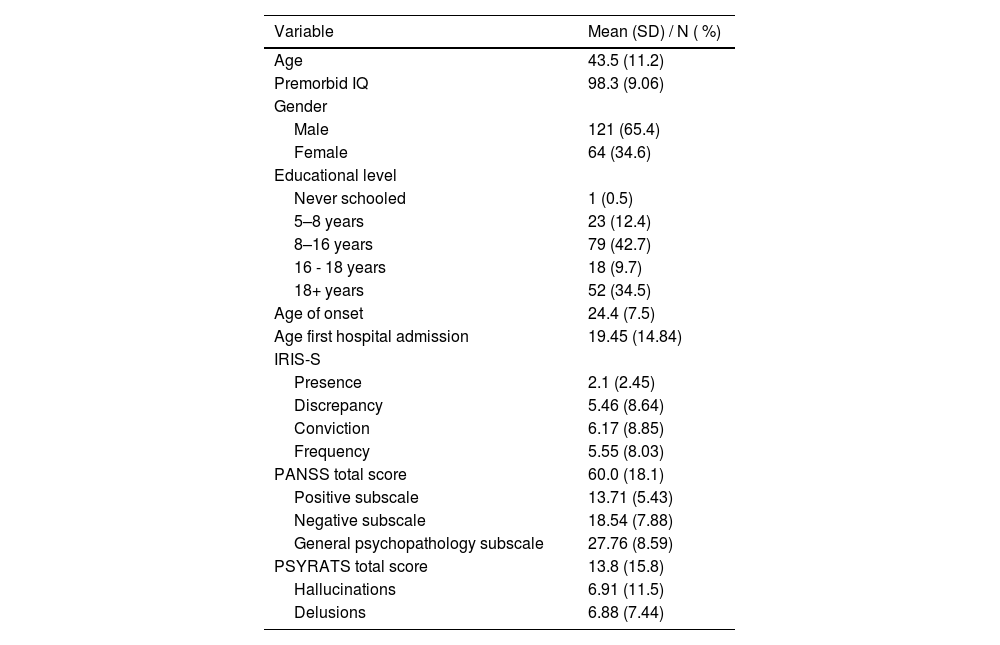
ResultsDemographics and clinical characteristicsThe final sample consisted of 185 patients. Sample size was determined following the recommended item-to-participant ratio of 10:1.23 Demographic and clinical data are summarized in Table 1. None of the patients were in their first episode, with the duration of illness ranging from 1 to 51 years (mean 18.6).
Descriptive, sociodemographic and clinical characteristics of the sample (N = 185).
Abbreviations: TAP: Test de Acentuación de Palabras. IRIS-S: Ideas of Reference Interview Scale Spanish version; SR: Self Referential; PANSS: Positive and Negative Syndrome Scale; PSYRATS: Psychotic Symptom Rating Scales.
The mean IRIS-S presence score was 2.1 ± 2.45, similar to that in the original Chinese study of 2.08±1.43. Other score distributions are shown in Table 2.
Score distribution on IRIS-S.
| Score (range) | Mean | Median | SD | Max | Min |
|---|---|---|---|---|---|
| Presence (0–15) | 1.98 | 1.0 | 2.35 | 10 | 0 |
| Discrepancy | |||||
| Sum (0–75) | 4.93 | 1 | 7.72 | 39 | 0 |
| Conviction | |||||
| Sum (0–75) | 5.63 | 2 | 8.1 | 38.0 | 0 |
| Frequency | |||||
| Sum (0–75) | 5.16 | 1 | 7.56 | 38.0 | 0 |
Abbreviations: IRIS: Ideas of Reference Interview Scale Spanish Version; SR: Self Referential.
In our sample, the most common themes reported by the patients were 'being gossiped about without identifiable content' and 'being looked at', each reported by >20 % of the patients. 'Being avoided/approached' was present in >15 % of the sample. Following these, 'being talked about with identifiable content,' and 'gestures/facial' were also prevalent. See Table 3.
Prevalence of individual themes in patients experiencing referential ideation (endorsement of presence score of 1).
Cronbach's alpha for the IRIS-S presence score (0–15) was 0.81, indicating a high level of homogeneity among the items. Internal consistency was also calculated for the three IRIS-S dimensions, with results being acceptable (discrepancy: α=0.80; conviction: α=0.77; frequency α= 0.74). Additionally, correlations between the three dimensions were strong (Spearman’s rho = 0.92–0.98) (Table 4).
Inter-rater reliabilityThis was assessed in a subsample of 19 patients who were assessed independently by the two raters on the same day. It fell into the ‘excellent’ range for IRIS-S presence with an ICC of 0.96 (p<.001). The ICCt was 'good' for each of the three IRIS-S dimensions (discrepancy: 0.87, p<.003; conviction: 0.80, p<.002; frequency: 0.84, p<.002).
Test-retest reliabilityA subsample of 22 patients were re-assessed 7 days after the first evaluation by the same rater. Test-retest reliability was in the ‘good’ range for the IRIS-S presence score with an ICC of 0.85 (p<.001). Two of the IRIS-S scores also showed a good test-retest reliability (conviction: 0.75, p<.001; frequency: 0.75, p<.001), but test-retest reliability was only fair for discrepancy (0.71, p<.001).
Convergent validityAs can be seen from Table 5, correlations between IRIS presence score and the three dimensions of discrepancy, conviction and frequency, and the three individual PANSS delusion items were significant in all but two cases, but tended to be in the ‘weak’ range for items P6 (suspiciousness) and GP9 (unusual thought content). The correlations were generally stronger but still ‘weak’ for the positive subscale from the PANSS, and in most cases were ‘weak’ or ‘moderate’ for the PSYRATS delusions subscale score and item P1 of the PANSS.
Convergent validity of the IRIS-S (N = 180).
Abbreviations: IRIS-S: Ideas of Reference Interview Scale Spanish Version; PANSS: Positive and Negative Syndrome Scale; PSYRATS: Psychotic Symptom Rating Scales. PANSS items are P1 – delusions, P5 – grandiosity, P6 – suspiciousness and GP9 – unusual thought content.
*. Correlation significant at p < 0.05.
**. Correlation significant at p < 0.01.
As expected, the PANSS negative subscale score showed no correlation with any IRIS-S scores (see Table 6). However, the PANSS general psychopathology score showed weak positive correlations with all dimensions of the IRIS-S apart from discrepancy and frequency.
Divergent validity of the IRIS-S (N = 180).
| PANSS negative | PANSS gen. psychopathology | PANSS gen. psychopathology (modified) | |
|---|---|---|---|
| Presence | −0.01 | 0.28** | 0.22* |
| Discrepancy | −0.06 | 0.18 | 0.14 |
| Conviction | −0.02 | 0.22* | 0.18 |
| Frequency | −0.04 | 0.20 | 0.15 |
Abbreviations: IRIS: Ideas of Reference Interview Scale Spanish version; SR: Self Referential; PANSS: Positive and Negative Syndrome Scale. Modified PANSS gen. psychopathology: total score excluding items: GP1 - somatic concerns, GP9 - unusual thought content and GP3 - guilt feelings.
*. Correlation significant at p < 0.05.
**. Correlation significant at p < 0.01.
It can also be seen from Table 6 that the correlations between the IRIS-S measures and PANSS general psychopathology all became weaker after removing the three potentially delusion-rating items (unusual thought content, somatic concerns and guilt feelings) from the summed score, although that with presence remained significant-.
DiscussionThe aim of this study was to translate a new, detailed rating scale for ideas and delusions of reference, the IRIS, into Spanish and examine its psychometric properties in patients with schizophrenia and schizoaffective disorder. The results demonstrated high internal consistency for the overall presence score and its three dimensions, and good inter-rater and test-retest reliability for the scale. The IRIS-S also showed evidence of convergent and divergent validity, in the sense that scores on the different measures it generates were significantly correlated with several positive symptom and delusion measures, but were uncorrelated with negative symptom scores. Correlations with the general psychopathology showed a less clear pattern, but they were generally weak and decreased after removing three items (unusual thought content, somatic concerns and guilt feelings) that have the potential to rate delusions. Given that we examined IRIS-S in a sample of patients with largely chronic illnesses (mean duration 18.6 years), our study also serves to extend the utility of the scale beyond early psychosis, where it was originally validated, to schizophrenia/schizoaffective disorder as a whole.
We found high internal consistency for the total score and its three dimensions, with Cronbach’s alphas of 0.81 for the presence score, and results in the acceptable range for the other three dimensions (discrepancy: α=0.80; conviction: α=0.77; frequency α= 0.74). Additionally, correlations between the three dimensions were strong (Spearman’s rho = 0.92–0.98). These results are broadly similar to those of the original validation of the scale by Wong et al. (2012): in a sample of 137 outpatients with early psychosis they found an α=0.80 (for an ‘overall’ score combining presence and the three dimensions of discrepancy, frequency and conviction); their correlations between dimensions were in the range of ρ=0.82 and ρ=0.93.
In our study, the interrater reliability, measured by intraclass correlations, was slightly lower than in the original Chinese version of the scale. However, it was still in the ‘good’ range (presence: ICC=0.96; discrepancy: 0.87; conviction: ICC=0.80; frequency: ICC=0.84). Test-retest reliability was not examined in the original validation study of the IRIS but was acceptable in our study. There was a minor qualification to this conclusion in that the discrepancy dimension only showed a fair test-retest reliability. This could indicate that the discrepancy score is not as robust a measure as the other three measures derived from the IRIS-S, for example because it is relatively subjective (see description in the Methods), or alternatively that this aspect of referentiality is genuinely susceptible to fluctuation over hours or days.
Our findings with respect to convergent and divergent validity were in the expected directions but require some comment with regard to the former. Specifically, while significant correlations were found between the IRIS-S and other symptom measures that would be expected to sensitive to presence of ideas and/or delusions of reference, these were only in the weak range according to the metric proposed by Schober and Schwarte 19. This reservation applies especially to the PANSS items P6, suspiciousness where correlations were in the range of 0.21 to 0.26, and GP9, unusual thought content, where they were in the range of 0.12 to 0.22. With respect to suspiciousness, it is possible that the low values here might have reflected that fact that this PANSS item actually rates principally persecutory ideas and delusions (‘Unrealistic or exaggerated ideas of persecution, reflected in cautious and suspicious attitudes, exaggerated alertness and suspicion, or overt delusions that others are out to harm them’), and so may not capture referential ideation per se. In fact, most of the anchor points for this PANSS item refer explicitly to persecution and not to referentiality. It is unclear why we found very low correlations with unusual thought content, although it is possible that this reflected a tendency to rate non-delusional odd beliefs and/or delusions that are not rateable anywhere else in the PANSS.
A similar argument can be made for the weak to moderate correlations between the different IRIS-S scores and the PSYRATS delusions score – the latter scale rates all delusions and so patients without referential delusions but who have other delusions will score on this scale. The finding of only weak correlations between the IRIS-S and the PANSS positive symptom score is what would be expected given that this subscale also includes items a range of non-referential delusions, hallucinations and formal thought disorder.
In conclusion, the IRIS-S has good psychometric properties in patients with schizophrenia and schizoaffective disorder, showing high internal consistency, good reliability and acceptable levels of convergent validity. Convergent validity was lower than expected, although there could be reasons for this. It is possible that use of different comparison measures, for example the Ideas of Reference subscale of the Schizotypal Personality Questionnaire (SPQ),24 as employed by Wong et al. (2012), would have yielded better evidence of convergent validity. Another limitation of the study is that we examined patients with diagnoses of schizophrenia and schizoaffective disorder and so the scale should not be considered to be validated outside schizophrenia spectrum disorder. Finally, for obvious reasons we included only patients who gave informed consent. This may therefore have excluded some patients with pronounced ideas of reference – eg the most severely ill and/or suspicious – potentially limiting the generalizability of the findings.
Ethical considerationsThe study was conducted in accordance with the guidelines of the Declaration of Helsinki.25 The study was approved by the Benito Menni CASM Hospital Ethics Committee (Comité d’Ètica i Investigació Clínica de Germanes Hospitalàries). All participants received a study information sheet and gave written consent to participate in the study.
FundingThis work was supported by the CIBERSAM and the Catalonian Government (2014-SGR-1573 and 2017-SGR-1271 to FIDMAG). AAS is funded by an FPU- ME predoctoral grant (FPU20/06,709). Also, by a grant from the Plan Nacional de I + D + i 2013–2016 and by the Instituto de Salud Carlos III, co-funded by European Union (ERDF/ESF, ‘Investing in your future’): Sara Borrell contract to MAGL (CD22/00,106) and Research Project to PJM (PI14/01,691, PI18/00,880), to RS (PI14/01,151, PI18/00,877) and to EP-C (PI14/01,148, PI21/00,416). PFC is funded by a “la Caixa” Junior Leader Fellowship (LCF/BQ/PR22/11,920,017).
The author(s) declared no potential conflicts of interest with respect to the research, authorship, and/or publication of this article.

