


metricas
covid
European Journal of Psychiatry Loneliness as a risk factor for dementia and its mediators: A longitudinal cohor...
Journal Information
Vol. 39. Issue 2.
(April - June 2025)
Share
Download PDF
More article options
Vol. 39. Issue 2.
(April - June 2025)
Original article
Loneliness as a risk factor for dementia and its mediators: A longitudinal cohort analysis of UK Biobank data
Visits
3
Marine Echeguta,
Corresponding author
, Natalie Shohama,b, Naaheed Mukadama,b
a UCL Division of Psychiatry, University College London, 1st Floor Maple House, 149 Tottenham Court Road, London W1T 7NF, UK
b Centre for Psychiatry and Mental Health, Wolfson Institute of Population Health, Queen Mary University of London (Whitechapel Campus), Yvonne Carter Building, 58 Turner Street, London E1 2AB, UK
This item has received
Article information
Abstract
Full Text
Bibliography
Download PDF
Statistics
Figures (10)
Show moreShow less
Additional material (1)
Tables (3)
Table 1. Baseline characteristics for complete case non-lonely cohort vs lonely cohort.
Tables
Table 2. Univariable and multivariable models illustrating the odds of developing dementia, according to baseline loneliness score.
Tables
Table 3. Fully adjusted mediation models – summary of coefficients.
Tables
Show moreShow less
Abstract
Background and objectives

Growing evidence suggests that the feeling of loneliness correlates positively with the incidence of dementia, motivating our study of their longitudinal association. Additionally, we sought potential mediators of the association, following the hypotheses that lonely individuals are prone to greater stress and follow less healthy lifestyles, therefore are at greater risk of developping dementia.

Methods

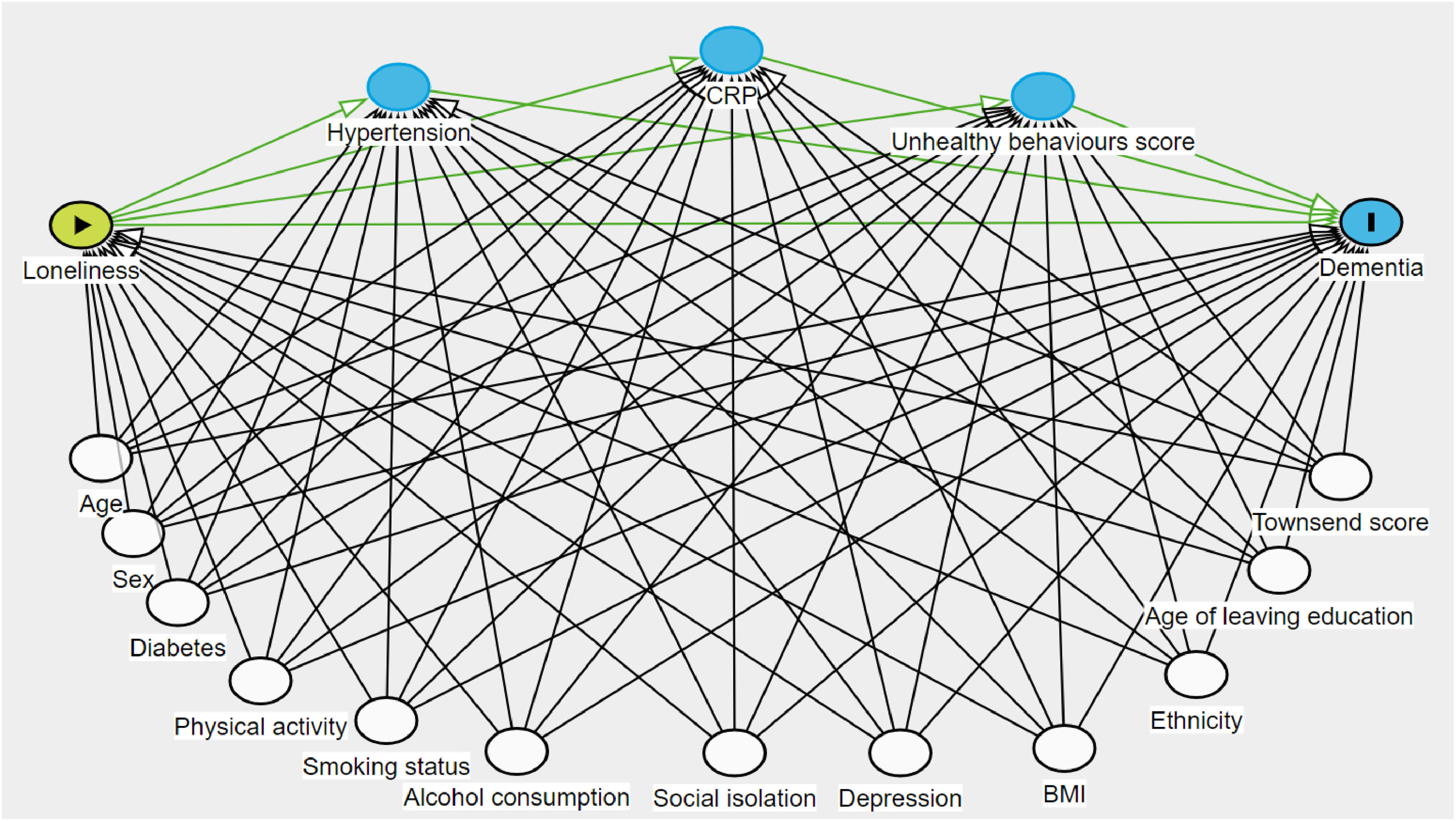
Using longitudinal cohort data from the UK Biobank, we conducted a logistic regression analysis with loneliness as exposure and dementia diagnosis as outcome, and progressively adjusted for putative confounders. In addition, we investigated through mediation models the respective contributions of physiological and behavioural factors to the association between loneliness and dementia diagnosis.

Results

The logistic regression models illustrated a significant positive association between loneliness and a subsequent dementia diagnosis, overall indicating a higher odds of developing dementia in the lonely population (Adjusted Odds Ratio (AOR) = 1.39; 95 % (Confidence Interval) CI 1.24 – 1.56, P < 0.001). The mediation models highlighted that there was very little evidence of mediation by hypertension and unhealthy behaviours, respectively explaining 1 % and 2 % of the effect of loneliness on dementia risk. No indication of mediation was seen between baseline CRP-levels and all-cause dementia. Every mediation model described a positive correlation between loneliness and each potential mediating factor, illustrating the widespread negative impact of loneliness on health.

Conclusion

Our findings confirm the association between loneliness and risk of dementia. They show minimal mediation by hypertension and unhealthy behaviours, highlighting the need for investigation into other potential mediators as targets for modification.

Keywords:
Dementia
Loneliness
UK Biobank
Epidemiology

Article

These are the options to access the full texts of the publication European Journal of Psychiatry
Subscriber
Subscriber

If you already have your login data, please click here .

If you have forgotten your password you can you can recover it by clicking here and selecting the option “I have forgotten my password”
Purchase
Purchase article

Purchasing article the PDF version will be downloaded

Purchase now
Contact
Phone for subscriptions and reporting of errors
From Monday to Friday from 9 a.m. to 6 p.m. (GMT + 1) except for the months of July and August which will be from 9 a.m. to 3 p.m.
Calls from Spain
932 415 960
Calls from outside Spain
+34 932 415 960
E-mail
Article options
Tools
Supplemental materials