


metricas
covid
European Journal of Psychiatry Clinical practice and metabolic consequences of olanzapine use in schizophrenia:...
Journal Information
Vol. 39. Issue 4.
(October - December 2025)
Share
Download PDF
More article options
Vol. 39. Issue 4.
(October - December 2025)
Clinical practice and metabolic consequences of olanzapine use in schizophrenia: results from a national survey in Spain
L.I. Muñoz-Manchadoa,
Corresponding author
leticia.munoz.sspa@juntadeandalucia.es

Correspondence author. Mental Health Inpatient Unit, University Hospital of Jerez de la Frontera, Trebujena Road, s/n. 11407, Jerez de la Frontera, Cádiz, Spain.
, M. Bernardob, J.M. Villagrán-Morenoa, E. Fernández-Egeac
a Unidad de Gestión clínica de Salud Mental, Área de Gestión Sanitaria Norte de Cádiz, Hospital Universitario de Jerez de la Frontera, Spain. Severe Mental Disorder Research Group, Department of Neuroscience, University of Cádiz. Instituto de Investigación e Innovación Biomédica de Cádiz (INiBICA), Cádiz, Spain
b Emeritus Consultant. Barcelona Clínic Schizophrenia Unit, Hospital Clínic, Institut d’Investigacions Biomèdiques August Pi I Sunyer (IDIBAPS), Barcelona, Spain
c Department of Psychiatry, University of Cambridge, Cambridge, United Kingdom y Cambridgeshire and Peterborough NHS Foundation Trust, Cambridge, United Kingdom
Article information
Abstract
Full Text
Bibliography
Download PDF
Statistics
Figures (2)
Tables (2)
Table 1. Initial, minimum, and adjusted doses for special patient groups. Special patients include individuals over 65 years of age and patients with renal or hepatic impairment. All results are expressed as percentages, N = 197.
Tables
Table 2. Prescribed olanzapine (Zyprexa) formulations: preference for orally disintegrating tablets was noted as the most commonly used formulation, while the long-acting injectable (LAI) was the least prescribed. All results are expressed as percentages, N = 197.
Tables
Show moreShow less
Additional material (1)
Abstract
Background and objectives

Schizophrenia is a psychiatric disorder with a global crude prevalence of approximately 23.6 million individuals and ranks among the top ten leading causes of disability worldwide. Antipsychotic medications, including olanzapine (Zyprexa), represent the most effective treatment option for these patients. This study aimed to assess the current prescribing patterns of olanzapine (Zyprexa).

Methods

To explore real-world prescribing patterns of olanzapine (Zyprexa), patient adherence, and the perceived incidence of adverse effects—especially metabolic syndrome—a structured, purpose-designed survey was distributed to psychiatrists across Spain.

Results

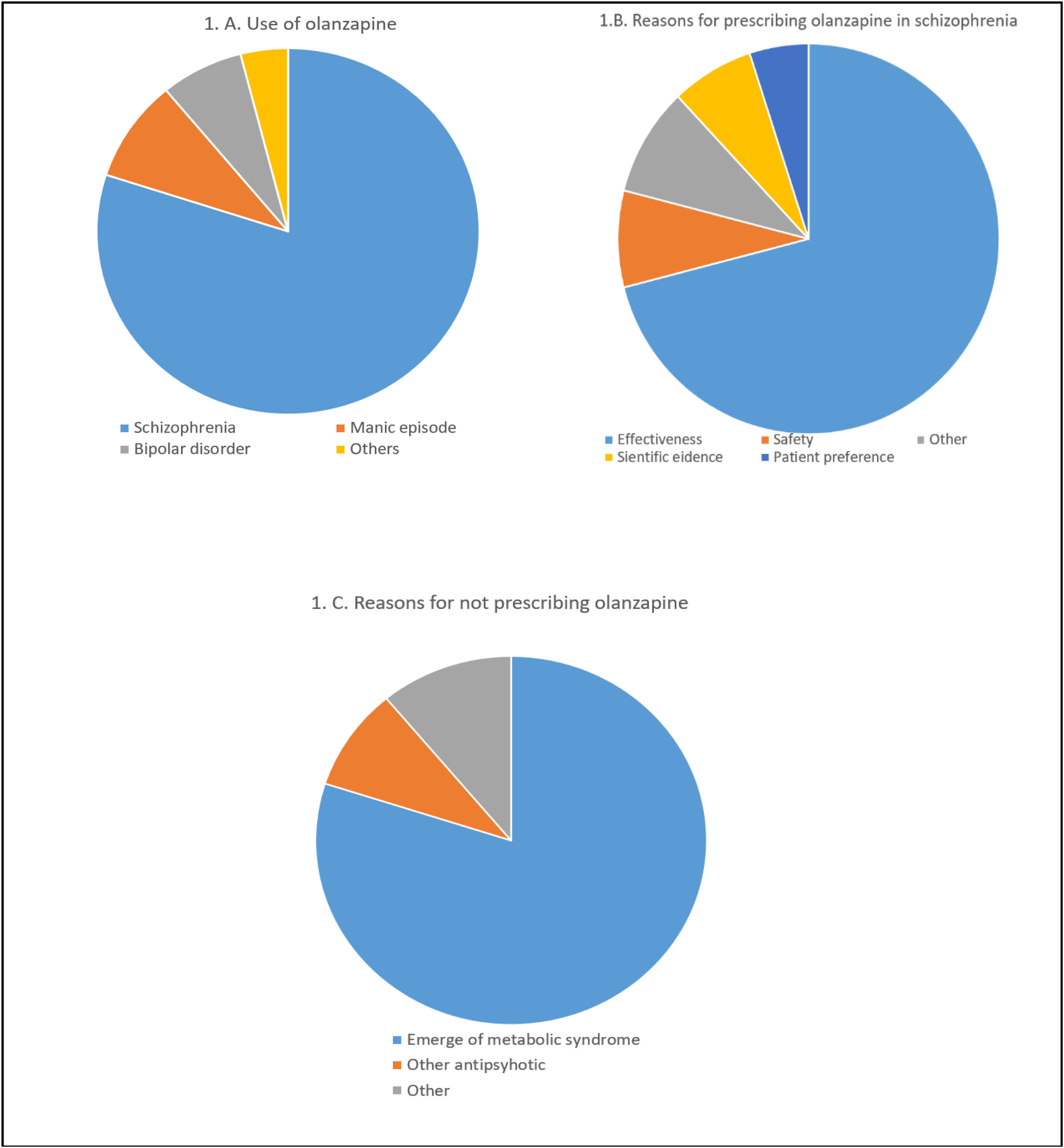
A total of 197 Consultant psychiatrists practising in Spain responded to a survey on olanzapine (Zyprexa) use patterns. olanzapine (Zyprexa) was noted for its high efficacy, rapid onset of action, and tolerability. The majority of psychiatrists (77.8 %) reported prescribing olanzapine (Zyprexa) primarily to patients aged 31–50 years. Regarding metabolic syndrome, out of 111 responses, 60.4 % (66 psychiatrists) considered olanzapine (Zyprexa) to be associated with a higher incidence of metabolic syndrome, which was reported to occur predominantly at an early stage (61.3 %).

Conclusions

Treatment adherence to olanzapine (Zyprexa) may be negatively affected by adverse events such as weight gain and the development of metabolic syndrome, which could serve as causal factors for treatment discontinuation. The implementation of both pharmacological and non-pharmacological strategies aimed at metabolic control may play a key role in optimizing the therapeutic management of schizophrenia.

Keywords:
Schizophrenia
Antipsychotics
Olanzapine
Metabolic syndrome

Article

These are the options to access the full texts of the publication European Journal of Psychiatry
Subscriber
Subscriber

If you already have your login data, please click here .

If you have forgotten your password you can you can recover it by clicking here and selecting the option “I have forgotten my password”
Purchase
Purchase article

Purchasing article the PDF version will be downloaded

Purchase now
Contact
Phone for subscriptions and reporting of errors
From Monday to Friday from 9 a.m. to 6 p.m. (GMT + 1) except for the months of July and August which will be from 9 a.m. to 3 p.m.
Calls from Spain
932 415 960
Calls from outside Spain
+34 932 415 960
E-mail
Article options
Tools
Supplemental materials