


metricas
Enfermedades Infecciosas y Microbiología Clínica (English Edition) Characterization of new HIV diagnoses made in hospital emergency departments thr...

Journal Information
Visits
515
Vol. 43. Issue 8.
Pages 459-544 (October 2025)
Original article
Full text access

Characterization of new HIV diagnoses made in hospital emergency departments through the “Leave Your Mark” program

Caracterización de los nuevos diagnósticos de VIH realizados en los servicios de urgencias hospitalarios a partir del programa “Deja tu huella”
Visits
515
Phillipe Calpe Delgadoa, Patricia Muñozb, Alberto Pizarro Portilloc, Virginia Álvarez Rodríguezd, Ángel Iván Díaz Saladoe, Isabel Arenas Berenguerf, Marta Álvarez Alonsog, Esther Gargallo Garcíah, Fátima Fernández Salgadoi, Alma Elena Real Martínj, Irene Cabrera Rodrigok, Anaura Carrasquel Regaladel, María Ángeles Moreno Planellesm, Margarita Jurado Oteron, Rodrigo Sanz Lorenteo, Luis Pérez Ordoñop, Ana Carrero Fernándezq, Juan González del Castillor,
Corresponding author
jgonzalezcast@gmail.com

Corresponding author.
, representing the Madrid HIV network
a Servicio de Urgencias, Hospital Universitario Puerta de Hierro, Madrid, Spain
b Servicio de Microbiología Clínica, Hospital Universitario Gregorio Marañón, Madrid, Spain
c Servicio de Urgencias, Hospital Universitario La Princesa, Madrid, Spain
d Servicio de Urgencias, Hospital Universitario de Getafe, Getafe, Spain
e Servicio de Urgencias, Hospital Universitario Infanta Cristina, Parla, Spain
f Servicio de Urgencias, Hospital Universitario La Paz, Madrid, Spain
g Servicio de Urgencias, Hospital Universitario de Fuenlabrada, Fuenlabrada, Spain
h Servicio de Urgencias, Hospital Universitario Gregorio Marañón, Madrid, Spain
i Servicio de Urgencias, Hospital Universitario de Móstoles, Móstoles, Spain
j Servicio de Urgencias, Hospital Universitario Fundación Alcorcón, Alcorcón, Spain
k Servicio de Urgencias, Hospital Universitario Severo Ochoa, Leganés, Spain
l Servicio de Urgencias, Hospital Universitario Ramón y Cajal, Madrid, Spain
m Servicio de Urgencias, Hospital Universitario Infanta Sofía, Madrid, Spain
n Servicio de Urgencias, Hospital Universitario Infanta Leonor, Madrid, Spain
o Servicio de Urgencias, Hospital Fundación Jiménez Díaz, Madrid, Spain
p Servicio de Urgencias, Hospital Universitario 12 de Octubre, Madrid, Spain
q Servicio de Urgencias, Hospital Universitario Príncipe de Asturias, Alcalá de Henares, Spain
r Servicio de Urgencias, IdISSC, Universidad Complutense, Madrid, Spain
Ver más
This item has received
Article information
Abstract
Full Text
Bibliography
Download PDF
Statistics
Figures (1)
fig0005
Tables (4)
Table 1. Geographical area of birth of new diagnoses.
Tables
Table 2. Emergency department diagnosis of new diagnoses.
Tables
Table 3. Patient characteristics according to birth country.
Tables
Table 4. Patient characteristics based on CD4 count at diagnosis.
Tables
Additional material (1)
Abstract
Introduction

The Leave Your Mark (DTH) program launched recommendations for HIV screening in emergency departments (ED) when patients presented with certain conditions. It is unknown whether the profile of patients diagnosed in the ED is similar to those reported for general population in epidemiological reports.

Methods

Retrospective study evaluating the characteristics of patients with new HIV diagnosed in 17 ED over a one-year period was developed. Demographic data (sex at birth, age, country of birth), sexual and risk behaviour, diagnosis in ED, number of emergency visits in previous five years, time from the ED to the specific HIV consultation, and from ED to start antiretroviral treatment were recorded. Information on the first CD4 and viral load was also collected.

Results

A total of 169 patients were included. There were 122 (72.2%) migrants, 57 (32.5%) heterosexual, and injection drug use was the transmission route in 14 (8.3%) cases. Data reported for the general population were 49.8%, 25.7%, and 1.7%, respectively. Late diagnosis was found in 80 (47.3%) patients (reported figures by the Ministry, 48.7%). Compared to Spanish, migrant were more frequently women (13.1% vs. 6.4%), heterosexual (38.5% vs. 21.3%), and had worse immunological status [median CD4 count of 310 (IQR 132–457) vs. 444 (IQR 215−607)].

Conclusion

ED can play a key role in diagnosing a different patient profile that may not seek care at other healthcare levels.

Keywords:
Human immunodeficiency virus (HIV)
Emergency department
Early diagnosis
HIV infection
Resumen
Introducción

El programa Deja Tu Huella (DTH) publicó unas recomendaciones para el cribado de VIH en los servicios de urgencias hospitalario (SUH) cuando los pacientes presentaban ciertas condiciones. Se desconoce si el perfil de los pacientes diagnosticados en los SUH es similar a no a los generales comunicados por las autoridades sanitarias.

Método

Estudio retrospectivo que evalúa las características de pacientes diagnosticados de VIH en 17 SUH durante un período de un año. Se registraron datos demográficos (sexo al nacer, edad, país de nacimiento), conducta sexual y de riesgo, el diagnóstico en el SUH, el número de asistencia en urgencias en los 5 años anteriores, el tiempo desde la asistencia hasta la consulta específica de VIH y desde la atención hasta el inicio del tratamiento antirretroviral. Se recopiló información sobre el recuento de CD4 y carga viral.

Resultados

Se incluyeron 169 pacientes. Hubo 122(72,2%) pacientes migrantes, 57(32,5%) eran heterosexuales y la vía de trasmisión fue la inyección de drogas en 14(8,3%). Los datos para población general eran de 49,8%,25,7% y 1,7%, respectivamente. Presentaron un diagnóstico tardío 80(47,3%) pacientes, similar a lo comunicado previamente por el Ministerio (48,7%). Los pacientes migrantes, respecto a los nacidos en España, son con más frecuencia mujeres (13,1% vs 6,4%), heterosexuales (38,5% vs 21,3%) y tienen una peor situación inmunológica al diagnóstico [mediana de CD4 de 310 (RIC 132–457) vs 444 (RIC 215−607)].

Conclusión

Los SUH pueden ser claves para el diagnostico de un perfil distinto de paciente que puede no acudir a otro nivel asistencial.

Palabras clave:
Virus de la inmunodeficiencia humana (VIH)
Servicios de urgencias
Diagnóstico precoz
Infección por VIH
Full Text
Introduction

In Spain, it is estimated that 7.5% of people living with HIV are unaware of their infection. In absolute numbers, between 136,436 and 162,307 people are infected with HIV, over 25,000 of whom are unaware of their serological status.1 On the other hand, almost half (48.6%) of new HIV diagnoses in Spain are made late (CD4 counts below 350 cells/μl in the first determination after diagnosis2,3; Late diagnosis among heterosexuals is especially concerning (57%). The consequences of hidden and late diagnosis are well known: worsening of the patient's prognosis and quality of life, a greater spread of the disease and higher costs for the health system.4–6

In 2010, the World Health Organization and the European Centre for Disease Prevention and Control introduced a programme to expand HIV diagnosis in all healthcare settings in Europe,7,8 with the aim of increasing the diagnosis of HIV infection and avoiding hidden infections, although this strategy has been inefficiently implemented.9

For these reasons, the Spanish Society of Emergency Medicine (SEMES) published recommendations for requesting non-urgent HIV serology during the patient care in hospital emergency services (EDs) when they present any of the following 6 conditions associated with an increase in the prevalence of HIV infection: sexually transmitted infection (STI), community-acquired pneumonia between 18 and 65 years of age, request for post-exposure prophylaxis, herpes zoster between 18 and 65 years of age, care for consequences derived from chemsex and mononucleoside syndrome.10 The recommendations were accompanied by a programme to facilitate their implementation ("Deja tu huella [Leave your mark]", DTH, for its Spanish initials11,12 which has recently released its results and updated the recommendations.13 By the end of 2023, there were 132 hospitals involved in the DTH project in 16 of the 17 Spanish autonomous communities, almost 130,000 serologies had been performed in the EDs and 1,620 new infections had been diagnosed, with a positivity rate of 1.2%.13

According to data from the Ministry of Health, the profile of HIV patients has changed in recent years. Sexual intercourse is the main mode of transmission in new diagnoses, late diagnosis is higher in cases of heterosexual transmission, both in men (58.5%) as in women (55.8%) and men who have sex with men (MSM) have the lowest rate of late diagnosis (40.3%).5 Emergency room screening could pave the way for diagnosing a range of profiles that may not be seen at other levels of care. The objective of this study is to describe the patient profile with a new HIV diagnosis in EDs to determine whether it differs from that reported by health authorities in their annual epidemiological reports, which describe the characteristics of all patients diagnosed at any level of care.

MethodsStudy design

A retrospective study was conducted to evaluate the profile of HIV patients diagnosed in 17 EDs in the Community of Madrid during a one-year period (2023) (Appendix B Annex 2). All patients with a new HIV diagnosis from a sample obtained during their care in the ED were included in the study.

Administrative data and medical records from the electronic records of the clinical microbiology departments and the ED were reviewed to automatically collect the number of patients with a new HIV diagnosis from samples obtained in the ED. By reviewing electronic medical records from the ED and the infectious disease clinic, we ensured they had no previous HIV diagnosis. Information on the study variables was collected from the medical history. The variables were recorded anonymously in a database created ad hoc for the study. The different criteria and parameters were previously defined by the group and then described to the members of each participating ED by the researcher at each centre.

Study variables

The total number of serologies requested from the ED in each centre was collected. For newly diagnosed patients, demographic data were collected (sex at birth, age, country of birth), sexual behaviour (MSM, heterosexual, bisexual), risky behaviour (multiple partners, prostitution, people who inject drugs [PID], risky sexual intercourse, partner with known HIV), diagnosis in the ED at the index visit, number of emergency department visits in the previous 5 years, time from ED visit to HIV-specific consultation and from emergency department visit to start of antiretroviral therapy. Information on the first CD4 count and viral load was collected. To assess late diagnosis, the rate of patients with CD4 less than 350 was calculated. cells/mm3. Presentation with advanced disease (PAD) was defined when the patient had a first CD4 count of less than 200 cells/mm3.

Statistical analysis

Discrete variables were expressed as absolute values and percentages, and continuous variables as mean and standard deviation (SD) or median and interquartile range (IQR) if not normally distributed. Differences between groups were assessed using the chi-square test (or Fisher's exact test, if necessary) for qualitative variables, and the Student's t-test (or the non-parametric Mann-Whitney test if not normally distributed) for quantitative variables. Analysis of variance (ANOVA) was used to compare the means of 3 or more groups.

Ethical considerations

The project was approved by the Independent Ethics Committee of Hospital Clínico San Carlos de Madrid (protocol HCSC/24/393-E). For this work, the ethical principles of the Declaration of Helsinki were followed.

Results

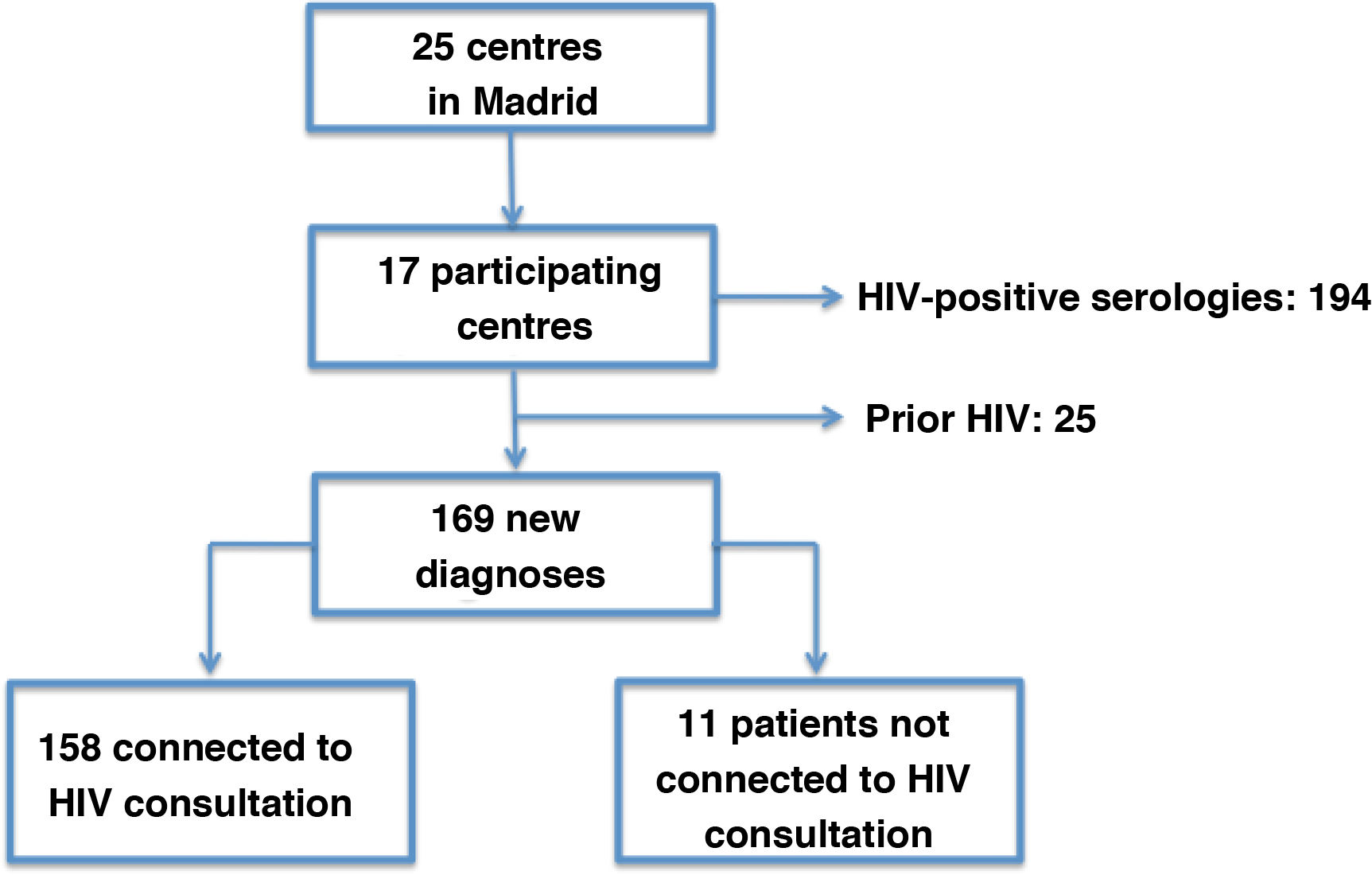
In the Autonomous Community of Madrid (CAM for its Spanish initials), there were 25 centres enrolled in the DTH program, 17 of which decided to participate in the study. The reference population of the participating centres was 5,407,920 people, representing 76.6% of the CAM population. The total number of serological tests performed at participating hospitals was 17,307, with a total of 194 positive results, 169 of which were new diagnoses, giving a positivity rate for new diagnoses of 0.98. 158 patients were able to connect with outpatient care for the start of treatment and follow-up (93.5%) (Fig. 1).

Figure 1.

Study flow chart.

Regarding the country of origin, 47 patients (27.8%) were born in Spain, while the majority were those originally from the Americas (96; 56.8%) (Table 1 and Appendix B Annex 2). The diagnoses established in the EDs during the care in which HIV serology was obtained are represented in Table 2. In this regard, 94 patients (55.6%) had a condition included in the SEMES recommendations for HIV screening.

Table 1.

Geographical area of birth of new diagnoses.

Country  N (%) 
Americas  96 (56.8) 
Africa  20 (11.8) 
Europe  6 (3.5) 
Spain  47 (27.8) 
Table 2.

Emergency department diagnosis of new diagnoses.

Diagnosis of pneumonia in Emergency Department  Frequency N 
Sexually transmitted infectiona  51 
Community-acquired pneumoniaa  19 
Mononucleosis-like syndromea  12 
Risky relationship  11 
Virosis 
Diarrhoea 
Chemsexa 
Exanthema 
Fever 
Post-exposure prophylaxisa 
Sexual assault 
Hepatitis 
Herpes zostera 
Adenopathies 
Anaemia 
Oesophageal candidiasis 
Herpes zoster 
Skin or soft-tissue infection 
Bacterial meningitis 
Bilateral pneumonia 
Constitutional syndrome 
Anal abscess 
Oral aphthosis 
Arthromyalgia 
Body packer 
Abdominal pain 
Anal fissure 
Focal neurological signs 
Influenza A 
Haemorrhoids 
Ileitis 
Mediastinitis 
Neutral 
Odynophagia 
Acute Pyelonephritis 
Kaposi sarcoma 
Thrombocytopenia 
Vomiting 
DTH Diagnoses n (%)  94 (55.62) 
Non-DTH Diagnoses n (%)  75 (44.38) 
a

Entity included in the "Deja tu huella [Leave Your Mark]" (DTH) programme.

The majority of patients were MSM (98; 58%), 57 (32.5%) of whom were heterosexual. In reference to risk behaviours, 101 (59.8%) had multiple sexual partners (the largest group), 26 (15.4%) denied any conduct and 4 (8.3%) were PID. Regarding medical assistance in the previous 5 years, 111 patients (65.7%) had gone to the emergency room at least once and 117 (69.2%) HIV serology had not been performed in the 5 years prior to diagnosis. The late diagnosis rate was 48.6% and PAD was 27.6%. Regarding referral to outpatient clinics and initiation of antiretroviral treatment, the median times were 4 days (IQR 1−9) and 8 (4−15) from the emergency room visit, respectively. Finally, 24 of the patients (14.2%) were admitted during the index visit and 4 (2.4%) died. Table 3 contains complete information on patient characteristics.

Table 3.

Patient characteristics according to birth country.

Variable  Total n = 169  Spain n = 47  Americas n = 96  Africa n = 20  p 
Age years; mean (SD)  34.9 (10.3)  34.7 (10.4)  34.0 (9.3)  39.0 (13.8)  0.145 
Male sex at birth, n (%)  150 (88.8)  44 (93.6)  88 (97.7)  14 (24.1)  0.008 
Sexual behaviour, n (%)          0.002 
MSM  98 (58.0)  34 (72.3)  58 (60.4)  3 (15)   
Heterosexual  57 (32.5)  10 (21.3)  29 (30.2)  15 (75)   
Bisexual  7 (4.1)  2 (4.3)  3 (3.1)  2 (10)   
Unknown  7 (4.2)  1 (2.1)  6 (6.3)  0 (0)   
Risk behaviour, n (%)          <0.001 
Multiple partners  101 (59.8)  28 (59.6)  60 (62.5)  10 (50)   
Denies risky behaviour  26 (15.4)  6 (12.8)  16 (16.7)  4 (20)   
Prostitution  15 (8.9)  0 (0)  7 (7.3)  6 (30)   
PID  14 (8.3)  6 (12.8)  7 (7.3)  0 (0)   
Risky sexual relationship  7 (4.1)  4 (8.5)  3 (3.1)  0 (0)   
Partner with HIV  6 (3.6)  3 (6.4)  3 (3.1)  0 (0)   
Diagnosis in Emergency Department, n (%)          0.493 
STIs  51 (30.2)  16 (34.0)  30 (31.2)  5 (25)   
CAP  19 (11.2)  3 (6.4)  11 (11.5)  2 (10)   
SMN  12 (7.1)  4 (8.5)  6 (6.2)  2 (10)   
Risky relationship  11 (6.5)  4 (8.5)  6 (6.2)  0 (0)   
Virosis  10 (5.9)  2 (4.3)  7 (7.3)  0 (0)   
Diarrhoea  8 (4.7)  3 (6.4)  3 (3.1)  2 (10)   
Herpes zoster  6 (3.6)  1 (2.1)  4 (4.2)  1 (5)   
Chemsex  4 (2.4)  1 (2.1)  3 (3.1)  0 (0)   
Exanthema  4 (2.4)  3 (6.4)  1 (1.0)  0 (0)   
Fever  4 (2.4)  3 (6.4)  0 (0)  1 (5)   
PEP  4 (2.4)  2 (4.3)  2 (2.1)  0 (0)   
Sexual assault  3 (1.8)  1 (2.1)  1 (1.0)  1 (5)   
Hepatitis  3 (1.8)  0 (0)  2 (2.1)  0 (0)   
Other  30 (17.8)  4 (8.5)  20 (20.8)  6 (30)   
Care visits 5 years, n (%)          0.011 
58 (34.3)  12 (25.5)  33 (34.4)  10 (50)   
35 (20.7)  5 (10.6)  26 (27.1)  3 (15)   
23 (13.6)  3 (6.4)  16 (16.7)  4 (20)   
21 (12.4)  11 (23.4)  8 (8.3)  2 (10)   
15 (8.9)  7 (14.9)  7 (7.3)  0 (0)   
6 (3.6)  2 (4.3)  3 (3.1)  0 (0)   
6 or more  11 (6.5)  7 (14.9)  3 (3.1)  1 (5)   
CD4 Median (IQR)  327 (146−524)  444 (215−607)  317 (106−479)  276 (150−382)  0.031 
CD4 < 350  80 (47.3)  19 (42.2)  48 (53.9)  11 (64.7)   
CD4 < 200  48 (28.4)  10 (22.2)  28 (31.5)  8 (47.1)   
Median VL (IQR)  144189 (31460−851219)  116000 (17771−561000)  177000 (47534−897575)  50480 (24974−1706777)  0.740 
Median ED-Cons Days (IQR)  4 (1−9)  3 (1−9)  4 (1−10)  5 (1−9)  0.237 
Median ED-treatment days (IQR)  8 (4−15)  8 (3−15)  9 (4−16)  5 (2−10)  0.372 
Not linked, n (%)  11 (6.5)  2 (4.25)  6 (6.25)  3 (15)  0.267 
Previous serology 5 years, n (%)  52 (30.8)  22 (46.8)  24 (25.0)  5 (25)  0.020 
Hospitalisation, n (%)  24 (14.2)  5 (10.6)  15 (15.6)  4 (20)  0.573 
Death, n (%)  4 (2.4)  1 (2.1)  3 (3.1)  0 (0)  0.707 

Cons: HIV consultation; SD: standard deviation; MSM: men who have sex with men; STI: sexually transmitted infection; CAP: community-acquired pneumonia; PID: people who inject drugs; PEP: post-exposure prophylaxis; SMN: mononucleoside syndrome; ED: emergency department.

When comparing the migrant population with the Spanish-born population, some differences were observed. Migrant patients were more often women, 3 (6.4%), 8 (8.3%) and 6 (30.0%) for Spain, America and Africa, respectively. There were differences in sexual behaviour (p = 0.002) and migrants tended to be heterosexual. Regarding risk behaviour, there were also differences (p < 0.001), with migrants more frequently denying having any and there was more prostitution. On the other hand, they had attended the ED less frequently in previous years (p = 0.011), fewer serologies had been performed (p = 0.020) and had a lower median CD4 count (p = 0.031). The diagnoses established in the ED were similar for all groups (p = 0.493). It is noteworthy that there were no differences in the link to outpatient services (p = 0.267), nor delay in the times until the first consultation (p = 0.237) or for the initiation of antiretroviral therapy (p = 0.372), with respect to the population born in Spain. The comparison between patients according to their origin is shown in Table 3.

Table 4 compares patients who at diagnosis had a CD4 count ≥350 cells/mm3 with those with <350 cells/mm3 or < 200 cells/mm3. Patients with a worse immune status were older (p = 0.018) and more frequently tended to be women (p = 0.070). Although no statistically significant differences were observed, there was a higher percentage of heterosexual patients among those with CD4 counts below 350 cells/mm3 (30 [37.5%] against 21 [27.3%]). Regarding the diagnoses established in the EDs, those with lower CD4 had a higher frequency of community-acquired pneumonia (6 [7.8%] against 13 [16.2%]), viral infections (6 [7.85%] against 3 [3.9%]) and other diagnoses in the grouping of those less frequent (21 [26.2%] against 7 [9.1%]). These patients had fewer serologies performed in the previous 5 years (p = 0.025), were admitted more frequently during the index visit (p < 0.001) and all 4 deaths occurred in patients with a CD4 count <200 cells/mm3.

Table 4.

Patient characteristics based on CD4 count at diagnosis.

Variable  CD4 > 350 N = 77  CD4 ≤ 350 N = 80  CD4 ≤ 200 N = 48  p (≤350 vs. <350 CD4)  p (≤200 vs. <350 CD4) 
Age years; mean (SD)  33.6 (9.9)  36.1 (10.4)  37.6 (10.3)  0.108  0.018 
Male sex at birth, n (%)  72 (93.5)  69 (86.2)  40 (83.3)  0.133  0.070 
Place of birth, n (%)        0.293  0.357 
Spain  26 (33.8)  19 (23.8)  10 (20.8)     
Americas  41 (53.2)  48 (60.0)  28 (58.3)     
Africa  6 (7.8)  11 (13.8)  8 (16.7)     
Other  4 (5.2)  2 (2.5)  2 (4.2)     
Sexual behaviour, n (%)        0.575  0.172 
MSM  49 (63.6)  44 (55.0)  25 (52.1)     
Heterosexual  21 (27.3)  30 (37.5)  22 (45.8)     
Bisexual  3 (3.9)  4 (5.0)  0 (0)     
Unknown  4 (5.2)  2 (2.4)  1 (2.1)     
Risk behaviour, n (%)        0.386  0.675 
Multiple partners  43 (55.8)  51 (63.7)  27 (56.2)     
Denies risky behaviour  10 (13.0)  14 (17.5)  10 (20.8)     
Prostitution  7 (9.1)  7 (8.8)  5 (10.4)     
PID  8 (10.4)  5 (6.2)  4 (8.3)     
Risky sexual relationship  4 (5.2)  2 (2.5)  1 (2.1)     
Partner with HIV  5 (6.5)  1 (1.2)  1 (2.1)     
Diagnosis in Emergency Department, n (%)        0.019  0.027 
STIs  28 (36.4)  20 (25.0)  8 (16.7)     
CAP  6 (7.8)  13 (16.2)  8 (16.7)     
SMN  5 (6.5)  6 (7.5)  3 (6.2)     
Risky relationship  8 (10.4)  3 (3.8)  2 (4.2)     
Virosis  3 (3.9)  6 (7.5)  4 (8.3)     
Diarrhoea  4 (5.2)  2 (2.5)  2 (4.2)     
Herpes zoster  3 (3.9)  3 (3.8)  3 (6.2)     
Chemsex  2 (2.6)  2 (2.5)  2 (4.2)     
Exanthema  1 (1.3)  3 (3.8)  1 (2.1)     
Fever  3 (3.9)  0 (0)  0 (0)     
PEP  3 (3.9)  0 (0)  0 (0)     
Sexual assault  1 (1.3)  1 (1.2)  0 (0)     
Hepatitis  3 (3.9)  0 (0)  0 (0)     
Other  7 (9.1)  21 (26.2)  15 (31.2)     
Previous serology 5 years, n (%)  29 (37.7)  21 (26.2)  9 (18.8)  0.125  0.025 
Hospitalisation, n (%)  3 (3.9)  21 (26.2)  14 (29.2)  <0.001  <0.001 
Deaths, n (%)  0 (0)  4 (5.0)  4 (8.3)  0.047  0.010 

SD: standard deviation; MSM: men who have sex with men; STI: sexually transmitted infection; CAP: community-acquired pneumonia; PID: people who inject drugs; PEP: post-exposure prophylaxis; SMN: mononucleoside syndrome.

Discussion

During the study period, 169 new diagnoses were made in the EDs, giving a positivity rate of 0.98%. This is above the 0.1% threshold indicating an efficient strategy.14 In 2023, a total of 681 new HIV diagnoses were reported in CAM,3 indicating that 24.82% were made in the ED. These data are consistent with the national data from the DTH programme, which show that 22% of diagnoses in Spain in 2023 were made in the ED.13

Regarding diagnoses in the ED, it is worth noting that 44.38% were made for diseases or conditions not included in the SEMES recommendations. This aspect has already been previously communicated and explained15 and regarded as a favourable progression resulting from the cultural shift that has occurred within EDs. This has led to heightened awareness among their professionals regarding the detection of this infection and has resulted in the publication of new guidelines that expand on previously considered assumptions.13

Some differences are observed when comparing the study results with the epidemiological reports published by the Ministry of Health3 and the CAM.16 Firstly, migrants represent the majority population among the diagnoses made in the EDs (72,2%), while data from the Ministry of Health and the CAM reflect that migrants represent 49.8% and 62.3% of new diagnoses. Secondly, the proportion of heterosexual patients diagnosed is higher in the ED (32.5%) than was communicated by the Ministry (25.7%) and by the CAM (15.4%). Thirdly, differences were observed in terms of the transmission route by PID, which in the ED reaches 8.3% and in the data from the Ministry and the CAM are < 2%. The care of patients with acute intoxication is frequent in EDs,17 with differences described in consumption patterns in HIV patients,18,19 while a limited level of knowledge among emergency professionals about chemsex has been observed.20

Finally, regarding the rate of patients with late diagnosis (47.3%), it is similar to that communicated by the Ministry (48.7%) and by the CAM (44.0%). The PAD rates were 28.4%; 27.2% and 21.2% in the ED, Ministry and the CAM, respectively. The median CD4 count among patients diagnosed in the emergency department was 327 (IQR 146−524), while data from the Ministry put it at 355 (IQR 182–550) and the CAM at 378 in 2023. Regarding the differences between patients with CD4 counts ≥350 cells/mm3 and patients with late diagnosis or PAD, differences were observed with respect to the diagnoses established at the index visit in the ED. In addition, hospitalization was more frequently required. Patients with PAD were older, more frequently tended to be female, and had less frequently undergone serology in the previous 5 years. Furthermore, all 4 deaths in the series occurred in these patients. Regarding migrants, no differences were observed in terms of late diagnosis or PAD, although the percentages for both groups were higher among migrants, and it is possible that statistical differences were not found due to the small sample size of the series. There were significant differences when comparing CD4 counts at diagnosis between migrants and those born in Spain: the former were in a worse immunological situation. The same justification could be found for the lack of statistical differences among heterosexuals, despite the fact that this group presented higher rates of late diagnosis and PAD. The higher frequency of late diagnosis and PAD in the female, migrant and heterosexual population has already been described in the epidemiological reports of the Ministry3 and the CAM.15

Furthermore, the data highlight the large number of emergency room visits these patients had received in the previous five years. Only one in three had never attended and only one in three had undergone a previous serology test in the past five years. We cannot determine whether previous visits were a missed opportunity for diagnosis, since the reason for the consultation has not been recorded, but it is known that one in three missed opportunities for diagnosis occurs in the ED,21 which is why these services could be crucial to HIV diagnosis. It is worth noting that only 14.2% of patients required admission, which highlights the importance of performing serology tests in the emergency department and ensuring that the opportunity to diagnose the patient is not missed.

The data presented reflect that almost half of the patients diagnosed in the emergency department meet the criteria for late diagnosis, which is in line with national and regional figures. One of the most worrying aspects is the high number of previous emergency room visits by patients diagnosed with HIV, indicating that these visits may have been missed opportunities for earlier diagnosis. In light of these findings, it is crucial to implement specific measures to improve early detection in emergency departments, such as: (1) automating screening based on risk factors, including automatic alerts in hospital IT systems to recommend ordering HIV serology tests in patients with indicative diagnoses; (2) implementing algorithms that identify patients with multiple visits to the emergency department without a previous diagnosis and recommend testing; (3) training healthcare personnel, including physicians and nurses, to reinforce the importance of screening at-risk populations and improve adherence to clinical guidelines; (4) reducing the barrier caused by the perceived "low clinical suspicion" regarding women and heterosexuals, given that these groups have a higher proportion of late diagnosis and PAD; (5) providing rapid HIV testing in emergency departments, especially for patients at risk of social exclusion, to facilitate diagnosis and ensure immediate linkage to specialised care in the event of a positive result. (6) review of missed diagnostic opportunities, implementing retrospective audits of patients subsequently diagnosed with HIV, to analyse whether there were previous visits with indicative symptoms that were not taken advantage of to request serology and develop improvement strategies based on the findings of these reviews, and (7) awareness and removal of barriers to testing, through awareness campaigns within the hospital to normalize the request for HIV testing as part of standard care in certain cases and ensure that the request for serology in the emergency department is an agile process without administrative obstacles that hinder its implementation. In short, the data obtained reinforce the need to optimize the screening strategy in EDs and implement measures that minimize missed diagnostic opportunities and promote early HIV detection, especially among the most vulnerable groups.

When comparing the data of the migrant population with those born in Spain, some differences are observed. There is a higher rate of women diagnosed among migrants, especially those from Africa; they are more often heterosexual; they are more likely to engage in prostitution; they had fewer visits to hospital emergency services; they had fewer HIV serologies in the five years prior to diagnosis, and migrants had a poorer immunological status in terms of CD4 count at diagnosis. One of the aspects highlighted in the DTH programme is that the emergency department is often the only level of care that patients at risk of social exclusion contact, and these data may highlight this circumstance. Finally, there were no differences in access to consultations or initiation of antiretroviral therapy, which demonstrates the equity of our public health system.

There is no international literature that shows the profiles of new diagnoses made in emergency departments, so in that sense, this study shows previously unreported information. In a study conducted in specialized infectious disease outpatient clinics in Seville,22 the profile of patients with late diagnosis or PAD was described over a 5-year study period. Transmission other than MSM and hospitalization at diagnosis were risk factors associated with late diagnosis. On the other hand, having a concomitant STI was associated with an early diagnosis. Our data show significantly higher rates of late diagnosis in patients requiring hospital admission and heterosexual transmission. STIs were also less common in patients with late diagnosis or PAD.

Limitations

Firstly, this is a retrospective study, with the inherent limitations associated with this type of design. Secondly, it is limited to a very specific area of Spain. However, the hospitals included provide healthcare to more than 5 million people and are both high- and low-complexity centres. However, due to population characteristics (the high degree of immigration in the CAM), there may be differences with other areas of Spain or Europe, which could make the results non-transferable to other geographic areas. Finally, there is a small number of patients included, so the statistical power to find differences may be conditioned by the sample size.

Conclusions

The DTH programme has identified a characteristic profile of patient diagnosed with HIV in CAM emergency services, highlighting the importance of proactive screening strategies in this setting. EDs can be key to diagnosing a distinct patient profile, one who may not seek medical care at another level.

Ethical responsibilities

All authors have confirmed their commitment to confidentiality and respect for patient rights in the author's responsibilities document, publication agreement, and assignment of rights to the journal.

Funding

This work was funded by a González Armengol grant awarded by SEMES. Gilead Sciences SLU collaborated with SEMES, but was not involved in the design of the study, the selection of authors, or the writing of the content of this document.

Declaration of competing interest

JGC has received research support and spoken at events organized by Meiji, Merck, Gilead, Thermo Fisher, ViroGates, GlaxoSmithKline, and Beckman Coulter over the past 5 years. LPO has participated as a speaker in activities organized by Gilead over the past 5 years. The remaining authors declaring having no conflicts of interest.

Annex 1. Members of the SEMES HIV Network

Ana Arribi, Clinical Microbiology Department, Hospital Clínico San Carlos, Madrid. María Dolores Montero Vega, Clinical Microbiology Department, Hospital Universitario La Paz, Madrid. Laura María Molina Esteban, Clinical Microbiology Department, Hospital Universitario de Fuenlabrada, Fuenlabrada. Roberto Alonso Fernández, Clinical Microbiology Department, Hospital Universitario Gregorio Marañón, Madrid. María Luisa Casas Losada, Clinical Analysis Department, Hospital Universitario Fundación Alcorcón, Alcorcón. Ainhoa Gutiérrez Cobos, Clinical Microbiology Department, Hospital Universitario La Princesa, Madrid. Juan Carlos Galán Montemayor, Clinical Microbiology Department, Hospital Universitario Ramón y Cajal, Madrid. Isabel García Bermejo, Clinical Microbiology Department, Hospital Universitario de Getafe, Getafe. Sara María Quevedo Soriano, Clinical Microbiology Department, Hospital Universitario Severo Ochoa, Leganés. Luz Balsalobre Arenas, Clinical Microbiology Department, Hospital Universitario La Princesa. Tamar Tavalan Zanon, Clinical Analysis Department. Hospital Universitario Infanta Leonor Marta del Palacio Tamarit, Emergency Department, Hospital Fundación Jiménez Díaz. Llanos Salar Vidal, Clinical Microbiology Department, Hospital Fundación Jiménez Díaz. Manuel Gil Mosquera, Accident and Emergency Department, Hospital 12 de Octubre. Francisco Jiménez Morillas, Emergency Department, Hospital Universitario 12 de Octubre. Rodrigo Pacheco Puig, Emergency Department, Hospital Universitario 12 de Octubre. Lorena Díez Domínguez, Emergency Department, Hospital Universitario Infanta Sofía. Maite del Cerro Saelices, Emergency Department, Hospital Universitario de Getafe, Getafe. Guillermina Bejarano Redondo, Emergency Department, Hospital Universitario La Paz, Madrid. Eva de las Nieves Rodríguez, Emergency Department, Hospital Universitario de Móstoles, Móstoles. José Antonio Sevillano Fernández, Emergency Department, Hospital Universitario Gregorio Marañón, Madrid. Ana Gallur Martínez, Emergency Department, Hospital Universitario Príncipe de Asturias, Alcalá de Henares. Manuel Linares Rufo, Clinical Microbiology Department, Hospital Universitario Príncipe de Asturias Alcalá de Henares.

Appendix A
Supplementary data

The following is Supplementary data to this article:

Icono mmc1.doc

References
[1]
Gobierno de España. Unidad de vigilancia del VIH y conductas de riesgo. Estimación del continuo de atención del VIH en España, 2021-2022. Accessed el 29 de Septiembre de 2024. Available from: https://www.sanidad.gob.es/ciudadanos/enfLesiones/enfTransmisibles/sida/vigilancia/docs/Infografia_Continuo_atencion_VIH_mayo_2023.pdf.
[2]
S. Moreno, J. Berenguer, M.J. Fuster-Ruizdeapodaca, M. Garcia Ontiveros.
Early diagnosis.
Enferm Infecc Microbiol Clin., 36 (2018), pp. 35-39
[3]
Unidad de vigilancia de VIH, ITS y hepatitis. Vigilancia Epidemiológica del VIH y sida en España 2023: Sistema de Información sobre Nuevos Diagnósticos de VIH y Registro Nacional de Casos de Sida. Centro Nacional de Epidemiología. Instituto de Salud Carlos III/ División de control de VIH, ITS, Hepatitis virales y tuberculosis. Ministerio de Sanidad. Madrid; noviembre 2024.
[4]
P. Sobrino-Vegas, S. Moreno, R. Rubio, P. Viciana, J.I. Bernardino, J.R. Blanco, et al.
Impact of late presentation of HIV infection on short-, mid- and long-term mortality and causes of death in a multicenter national cohort: 2004-2013.
J Infect., 72 (2016), pp. 587-596
[5]
Secretaría del Plan Nacional sobre el Sida/Centro Nacional de Epidemiología. Área de vigilancia de VIH y conductas de riesgo. Diagnóstico tardío de la infección por VIH: Situación en España. 2011. (Retrieved 15 June 2023). Available at: https://www.mscbs.gob.es/ciudadanos/enfLesiones/enfTransmisibles/sida/vigilancia/DiagnosticoTardio2011.pdf.
[6]
Nuñez O., Hernando, V., del Amo, J., Moreno, y C., Diaz, A. Estimación de las personas que viven con el VIH y de la fracción no diagnosticada de VIH en España, 2013. XVIII Congreso 13. Nacional sobre el Sida e ITS.Sevilla, 22-24 Marzo 2017. Abstract CO1.6. (Retrieved 20 July 2020). Available at: http://www.itcpostergallery.com/seisida2017/.
[7]
WHO Regional Office for Europe.
Scaling up HIV testing and counselling in the WHO European Region as an essential component of efforts to achieve universal access to HIV prevention, treatment, care and support.
[8]
European Centre for Disease Prevention and Control.
HIV testing: Increasing uptake and effectiveness in the European Union.
[9]
S.J. Bogers, S.H. Hulstein, M.F. Schim van der Loeff, G.J. de Bree, P. Reiss, J.E.A.M. van Bergen, HIV Transmission Elimination AMsterdam (H-TEAM) Consortium, et al.
Current evidence on the adoption of indicator condition guided testing for HIV in western countries: a systematic review and meta-analysis.
EClinicalMedicine., 35 (2021),
[10]
J. González Del Castillo, G. Burillo-Putze, A. Cabello, A. Curran, E. Jaloud Saavedra, P. Malchair, et al.
Recommendations for the early diagnosis of suspected human immunodeficiency virus infection in the emergency department and the referral of patients for follow-up: a consensus statement of the Spanish Society of Emergency Medicine (SEMES).
Emergencias., 32 (2020), pp. 416-426
[11]
Dejatuhuella website. Accessed el 13 Enero 2025). Available from: https://dejatuhuella.semes.org.
[12]
E. Miró, O. Miró, A. Varón, P. Marrón, C. Canóniga, P. Salgado, et al.
Impacto de una formación específica y generalizada de los profesionales de enfermería en el despistaje en urgencias de infección oculta por VIH: experiencia del proyecto “Urgències VIHgila”.
Emergencias., 36 (2024), pp. 188-196
[13]
J. González del Castillo, P. Llorens, P. Trenc, L. Piedrafita, N. Cabrera, et al.
Nuevas recomendaciones para el diagnóstico de infección por VIH en los servicios de urgencias a partir del análisis de resultados del programa “Deja tu Huella”.
Emergencias, 36 (2024), pp. 447-459
[14]
V.S. Prabhu, P.G. Farnham, A.B. Hutchinson, S. Soorapanth, J.D. Heffelfinger, M.R. Golden, et al.
Cost-effectiveness of HIV screening in STD clinics, emergency departments, and inpatient units: a model-based analysis.
PLoS One., 6 (2011),
[15]
Área de Vigilancia y Control de Enfermedades Transmisibles. Subdirección General de Vigilancia en Salud Pública Dirección General de Salud Pública Comunidad de Madrid. Informe Epidemiológica de Vigilancia de VIH/SIDA. Diciembre de 2024. Accessed el 13 de Enero de 2025. Available from: https://www.comunidad.madrid/sites/default/files/doc/sanidad/epid/informe_trimestral_vih_web.pdf.
[16]
J. González Del Castillo, E. Mirò, I. Miguens, P. Trenc, B. Espinosa, L. Piedrafita, Emergency HIV network investigators, et al.
Feasibility of a selective targeted strategy of HIV testing in emergency departments: a before-after study.
Eur J Emerg Med., 31 (2024), pp. 29-38
[17]
G. Vallecillo Sánchez, J. Chen Quin, A. Losada Parente, S. Ochoa, A. Smithson Amat, S. Anaya, et al.
Drogas de abuso asociadas a las intoxicaciones agudas: descripción global y análisis de las diferencias en mujeres atendidas en el servicio de urgencias.
Emergencias., 36 (2024), pp. 104-108
[18]
A. Losada, A. Supervía, G. Vallecillo, C. Petrus, D. Aranda, J. Chen, et al.
Intoxicaciones por drogas de abuso: características diferenciales en población VIH.
Emergencias., 35 (2023), pp. 103-108
[19]
J. Puiguriguer Ferrando.
Intoxicaciones y VIH: otra nueva oportunidad.
Emergencias., 35 (2023), pp. 85-86
[20]
M.E. Navarro-Aguilar, P. Trenc-Español, I. Pérez-Pañart, B. Gay-Sanz, B. Aladrén-Pérez, J. Navarro-Calzada, et al.
Conocimiento sobre chemsex y profilaxis prexposición contra el VIH (PREP) en los servicios de urgencias de Aragón.
Emergencias., 36 (2024), pp. 313-316
[21]
C. Gargallo-Bernad, F.J. Sangrós-González, P. Arazo-Garcés, R. Martínez-Álvarez, C. Malo-Aznar, A. Gargallo-Bernad, et al.
Missed opportunities in the diagnosis of human immunodeficiency virus infection in the Region of Aragon. Late diagnosis importance.
Enferm Infecc Microbiol Clin (Engl Ed), 37 (2019), pp. 100-108
[22]
Z.R. Palacios-Baena, M. Martín-Ortega, M.J. Ríos-Villegas.
Profile of new HIV diagnoses and risk factors associated with late diagnosis in a specialized outpatient clinic during the 2014-2018 period.
Med Clin (Barc)., 155 (2020), pp. 482-487
Copyright © 2025. Sociedad Española de Enfermedades Infecciosas y Microbiología Clínica
Article options
Tools
Supplemental materials

