



Dyslipidemias are a significant risk factor for cardiovascular diseases. In Peru, nutritional transition and lifestyle changes may be contributing to an increase in the incidence of these metabolic disorders, particularly among the working population.
ObjectiveTo determine the incidence of dyslipidemias and evaluate associated occupational factors in Peruvian workers.
MethodsA retrospective cohort study was conducted using electronic medical records from 4,200 workers attending an occupational health clinic between 2013 and 2022. Incidence rates of hypertriglyceridemia, hypercholesterolemia, and combined dyslipidemia were calculated. Specific occupational factors (type of work, sitting time, and night shift work) were analyzed using Cox regression models adjusted for age (with splines) and sex.
ResultsThe incidence of hypercholesterolemia (87.22 cases per 1,000 person-years; 95% CI: 79.99–94.45) was significantly higher than that of hypertriglyceridemia (65.71 cases per 1,000 person-years; 95% CI: 59.71–71.72). Combined dyslipidemia showed an incidence of 48.28 cases per 1,000 person-years (95% CI: 43.60–52.97). Workers in social services had a higher risk of developing dyslipidemias (aHR: 1.78; 95% CI: 1.27–2.49) compared to office workers. Prolonged sitting time (>4 h) was significantly associated with an increased risk of hypertriglyceridemia (aHR: 1.28; 95% CI: 1.05–1.56) and combined dyslipidemia (aHR: 1.42; 95% CI: 1.15–1.76).
ConclusionsThe high incidence of dyslipidemias—particularly hypercholesterolemia—may reflect the increasing consumption of ultra-processed foods and the ongoing nutritional transition in the Peruvian population. Occupational factors play a crucial role in the development of these metabolic disorders, highlighting the need for specific preventive strategies in the workplace.
Las dislipidemias constituyen un factor de riesgo significativo para enfermedades cardiovasculares. En Perú, la transición nutricional y los cambios en los estilos de vida podrían estar incrementando la incidencia de estas alteraciones metabólicas, especialmente en la población trabajadora.
ObjetivoDeterminar la incidencia de dislipidemias y evaluar los factores ocupacionales asociados en trabajadores peruanos.
MetodologíaEstudio de cohorte retrospectivo basado en registros médicos electrónicos de 4,200 trabajadores atendidos en una clínica ocupacional entre 2013 y 2022. Se calcularon las tasas de incidencia de hipertrigliceridemia, hipercolesterolemia y dislipidemia combinada. Se analizaron factores ocupacionales específicos (tipo de trabajo, tiempo sentado y trabajo nocturno) mediante modelos de regresión de Cox ajustados por edad (en splines) y sexo.
ResultadosLa incidencia de hipercolesterolemia (87.22 casos/1,000 personas-año; IC 95%: 79.99–94.45) fue significativamente mayor que la de hipertrigliceridemia (65.71 casos/1,000 personas-año; IC 95%: 59.71–71.72). La dislipidemia combinada presentó una incidencia de 48.28 casos/1,000 personas-año (IC 95%: 43.60–52.97). Los trabajadores de servicios sociales mostraron mayor riesgo de desarrollar dislipidemias (HRa: 1.78; IC 95%: 1.27–2.49) comparados con trabajadores de oficina. El tiempo sentado prolongado (>4 horas) se asoció significativamente con mayor riesgo de hipertrigliceridemia (HRa: 1.28; IC 95%: 1.05–1.56) y dislipidemia combinada (HRa: 1.42; IC 95%: 1.15–1.76).
ConclusionesLa alta incidencia de dislipidemias, particularmente hipercolesterolemia, refleja posiblemente el incremento en el consumo de alimentos ultraprocesados y la transición nutricional en la población peruana. Los factores ocupacionales juegan un papel determinante en el desarrollo de estas alteraciones metabólicas, subrayando la necesidad de implementar estrategias preventivas específicas en el ámbito laboral.
Dyslipidemias, characterized by abnormal blood lipid levels, are an important risk factor for cardiovascular diseases, the leading cause of mortality worldwide.1 In recent decades, changes in lifestyles and work patterns have contributed to the increased prevalence of these metabolic disorders, particularly in developing countries such as Peru.2
The work environment can significantly influence the lipid profile through various mechanisms. Occupational factors such as type of work, workplace sedentarism, and night shifts have been associated with metabolic alterations in several studies.3 Prolonged sitting time during the workday emerges as an independent risk factor for dyslipidemias, even in individuals who are physically active outside working hours.4 On the other hand, night work can alter the circadian rhythm, potentially affecting lipid metabolism through the deregulation of sleep and eating patterns.5
However, despite the growing evidence linking occupational factors with the risk of dyslipidemias,6,7 few longitudinal studies have evaluated this relationship in low- and middle-income countries, where epidemiological and nutritional transitions have unique characteristics.
Considering this knowledge gap, the present study aims to: (1) determine the prevalence of dyslipidemias in a cohort of Peruvian workers; (2) calculate the incidence rate of hypertriglyceridemia, hypercholesterolemia, and combined dyslipidemias; and (3) assess the association between specific occupational variables (type of work, sitting time, and night work) and the development of these lipid alterations. The results will provide valuable information for the design of preventive and intervention strategies in the Peruvian workplace setting.
MethodologyType and study designWe conducted a retrospective cohort observational study using electronic health records of workers evaluated at an occupational health clinic from 2014 through 2021.
Population, sample, and eligibility criteriaThe study sample included workers from various sectors, both men and women, who attended the occupational clinic for routine medical check-ups. The study population ranged from 18 to 65 years of age.
To ensure the relevance of the study and the accuracy of collected data, eligibility criteria were established. Workers were required to be active employees during the study period, to have completed the variables relevant to this analysis, and to have at least two evaluations separated by a minimum interval of one year.
For the analysis of the incidence rate of hypertriglyceridemia, hypercholesterolemia, and dyslipidemias, all participants with a previous diagnosis of these conditions—either self-reported or confirmed by laboratory tests—were excluded.
Variables and measurementThe primary variable of this study was the presence of alterations in the lipid profile, defined as elevated total cholesterol levels (hypercholesterolemia) ≥200 mg/dL (≥5.10 mmol/L), elevated triglyceride levels (hypertriglyceridemia) ≥150 mg/dL (≥1.81 mmol/L), or the presence of dyslipidemia, which was considered when both hypertriglyceridemia and hypercholesterolemia were jointly detected.8
For each participant, the time elapsed from the initial evaluation (considered time zero) to the last recorded evaluation was calculated in years. This variable was used to analyze follow-up duration. The events of interest were incidence of hypercholesterolemia, incidence rate of hypertriglyceridemia, and the incidence rate of dyslipidemias.
Occupational variables included:
- •
Type of occupation: participants were classified into office workers, manual workers, customer service or sales employees, health care professionals, and social service workers.
- •
Sedentary time during the workday: participants were divided into those who remained seated >4 h and those seated <3 h. This cutoff was based on the occupational assessment tool used in the clinic, which considers this threshold relevant due to the existence of part-time (4-h) workdays in Peru, in addition to traditional full-time (8-h) schedules.
- •
Night work: defined as work performed between 8:00 p.m. and 5:00 a.m.
Additionally, to describe the sample and its distribution, the following covariates were evaluated: age and sex (male and female). Alcohol consumption and smoking during the previous 30 days were recorded as “yes” or “no.” Nutritional status was determined by calculating BMI, considering normal weight as BMI < 25 kg/m2, overweight as BMI 25–30 kg/m2, and obesity as BMI > 30 kg/m2.9 Abdominal obesity was assessed by measuring waist circumference (WC); it was considered negative if < 88 cm in women and < 102 cm in men, and positive if exceeding these values.8
Biochemical parameters included glucose levels, defining normoglycemia as <100 mg/dL (5.6 mmol/L), impaired fasting glucose as 100–125 mg/dL, and hyperglycemia as ≥126 mg/dL.10 Blood pressure was defined as normal when systolic and diastolic values were <120/80 mmHg and as hypertension when values exceeded this range.11
Similarly, mean and standard deviation were calculated for the following variables across the whole sample: age, systolic blood pressure, diastolic blood pressure, waist circumference, glucose levels, cholesterol, and triglycerides.
ProceduresThe health center implemented a comprehensive program to evaluate the health status of workers at multiple timepoints—upon joining the company, during employment, and at contract termination.
Evaluation processes were divided into several steps, beginning with the recording of personal and occupational data in health records, creating a complete file for follow-up.
A full physical examination followed, including assessment of blood pressure, BMI, and WC. Three consecutive blood pressure measurements were taken at 5-minute intervals. Workers were seated with straight backs and feet flat on the floor after a rest period of at least 5 min. The measurement arm was held at heart level. A digital Omron device was used, and the final value was the mean of the last 2 readings. BMI was calculated using calibrated scales and stadiometers, with workers wearing light clothing and no shoes (BMI = weight (kg) / height (m2)). WC was measured in centimeres using a flexible tape placed at the midpoint between the last rib and the iliac crest.
The next step was the laboratory analysis for the evaluation of biochemical parameters. For this analysis, the worker was instructed to fast for, at least, 8 h. Blood was then drawn after prior disinfection of the area and with the necessary safety measures. Finally, the drawn blood was analyzed in a specialized laboratory, obtaining values for glucose, triglycerides, and total cholesterol.
To conclude, an interview was conducted to assess the worker’s habits and health history, including factors such as years in the job, hours spent sitting, alcohol consumption, and tobacco use to identify potential risk factors.
All the data obtained were integrated into a secure and reliable electronic storage system. Another point to highlight is that blinding was not required, as the results were obtained during the routine practice of health care personnel and were not linked to any specific research purpose.
Statistical analysisFor statistical analysis, the data originally collected in Excel spreadsheets underwent rigorous cleaning and validation. All analyses were performed using R Studio with the “survival,” “rms,” and “msm” packages in R version 4.1.0 or higher.
Initially, a descriptive analysis of baseline characteristics was performed. Categorical variables were expressed as absolute and relative frequencies, and continuous variables as means and standard deviations.
For the statistical analysis, the data originally collected in Excel spreadsheets were subjected to a rigorous cleaning and validation process. Subsequently, all analyses were performed using the statistical software R Studio, employing the packages survival, rms, and msm in R version 4.1.0 or higher.
Initially, an exhaustive descriptive analysis of the baseline characteristics of the study population was conducted. For categorical variables, absolute and relative frequencies were presented, whereas for continuous variables, measures of central tendency (mean) and dispersion (standard deviation) were calculated.
The incidence density per 1,000 person-years of follow-up was then calculated for each of the events of interest related to the above-mentioned lipid changes. For each estimate, 95% confidence intervals (CI) were provided. In addition, survival curves were generated for each of these changes, allowing for a clear visualization of the temporal progression of these events.
Regarding the analysis of occupational variables (type of work, sitting time, and night work), specific incidence rates were calculated for each change in the lipid profile. Cox regression models were constructed for each variable of interest, yielding adjusted hazard ratios (aHR) along with their respective 95%CI.
Of note, the selection of variables for the adjusted model was based on a meticulous analysis using a Directed Acyclic Graph (DAG).1 This analysis revealed that only sex and age acted as true confounders in the relationship between the occupational variables of interest and lipid profile changes. Other potential variables were identified as mediators or as non-participants in this specific causal relationship. For this reason, the final adjustment model included only sex as a categorical variable and age modeled using restricted cubic splines (rcs) with 3 knots to capture potential non-linear relationships.2
Ethical considerationsThis study was conducted under strict ethical standards, with formal authorization from the clinic for use of its worker database and approval from the Research Ethics Committee of Universidad Nacional Toribio Rodríguez de Mendoza (Chachapoyas, Peru). All information was fully anonymized, removing any data that could lead to participant identification. Access to the database was restricted exclusively to the primary research team, ensuring maximum confidentiality.
Given the retrospective and observational nature of the study, using data collected as part of routine medical care, additional informed consent was not required. All analyses and presentations of results were performed at an aggregated level, without any possibility of individual identification. In the interest of scientific transparency and reproducibility, anonymized data used in this study have been made available to the scientific community through an open-access repository.12 This approach ensures that our research adheres to international ethical standards while contributing responsibly and transparently to advances in occupational health.
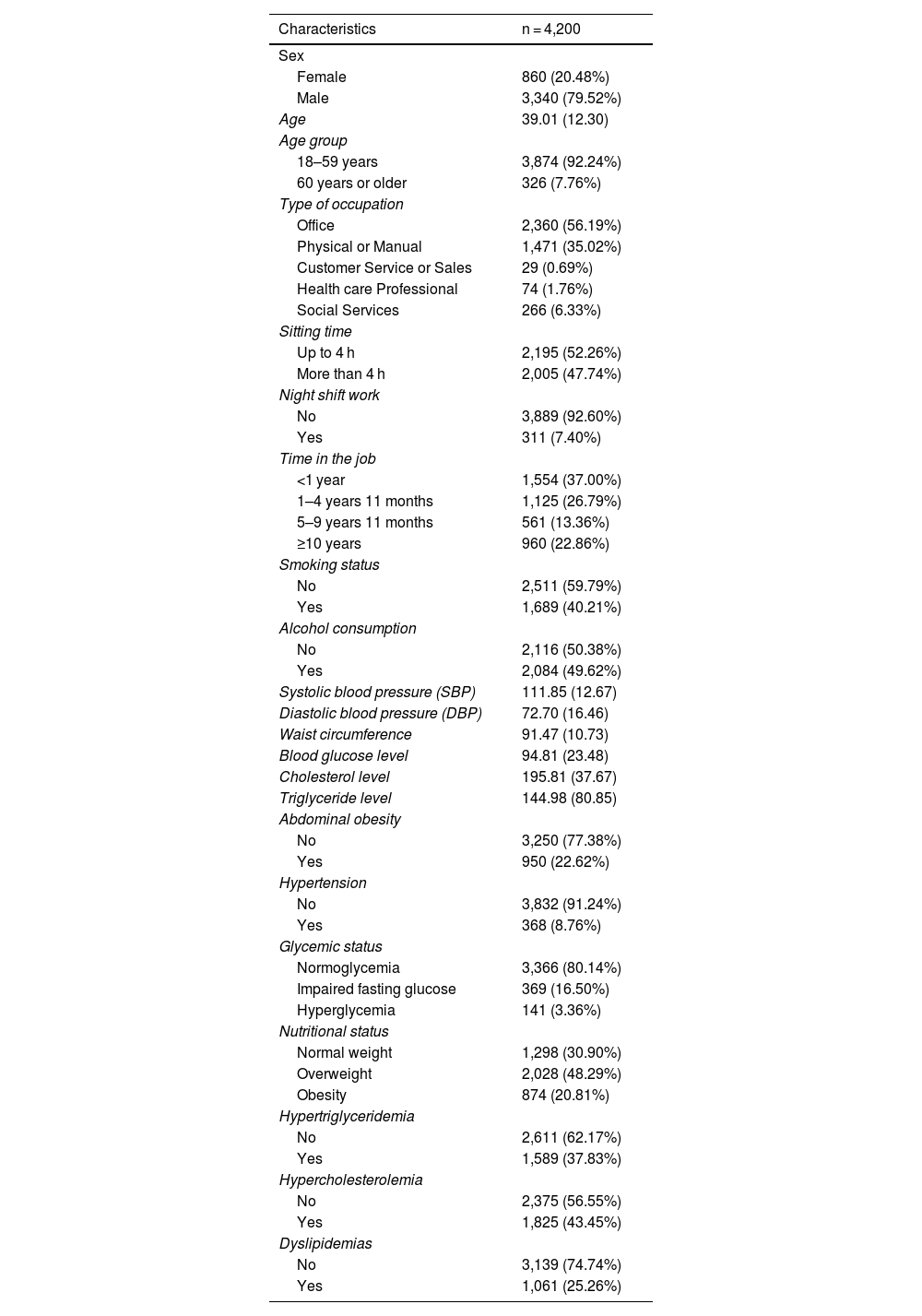
ResultsThe study included a sample of 4,200 participants. Of these, 79.52% were men. The mean age was 37 years (SD, 12.30), with most participants between 18 and 59 years of age (92.24%). Most individuals worked in office settings (56.19%), while nearly half spent >4 h per day seated (47.74%), and only a small percentage worked night shifts (7.40%). Regarding employment duration, 37% had been in their job for <1 year, whereas 22.86% had worked for >10 years. In terms of health conditions, 37.83% of participants had hypertriglyceridemia, and 53.45% showed hypercholesterolemia. Additionally, 25.26% presented both conditions simultaneously. The remaining characteristics are shown in Table 1.
Characteristics of the worker sample.
| Characteristics | n = 4,200 |
|---|---|
| Sex | |
| Female | 860 (20.48%) |
| Male | 3,340 (79.52%) |
| Age | 39.01 (12.30) |
| Age group | |
| 18–59 years | 3,874 (92.24%) |
| 60 years or older | 326 (7.76%) |
| Type of occupation | |
| Office | 2,360 (56.19%) |
| Physical or Manual | 1,471 (35.02%) |
| Customer Service or Sales | 29 (0.69%) |
| Health care Professional | 74 (1.76%) |
| Social Services | 266 (6.33%) |
| Sitting time | |
| Up to 4 h | 2,195 (52.26%) |
| More than 4 h | 2,005 (47.74%) |
| Night shift work | |
| No | 3,889 (92.60%) |
| Yes | 311 (7.40%) |
| Time in the job | |
| <1 year | 1,554 (37.00%) |
| 1–4 years 11 months | 1,125 (26.79%) |
| 5–9 years 11 months | 561 (13.36%) |
| ≥10 years | 960 (22.86%) |
| Smoking status | |
| No | 2,511 (59.79%) |
| Yes | 1,689 (40.21%) |
| Alcohol consumption | |
| No | 2,116 (50.38%) |
| Yes | 2,084 (49.62%) |
| Systolic blood pressure (SBP) | 111.85 (12.67) |
| Diastolic blood pressure (DBP) | 72.70 (16.46) |
| Waist circumference | 91.47 (10.73) |
| Blood glucose level | 94.81 (23.48) |
| Cholesterol level | 195.81 (37.67) |
| Triglyceride level | 144.98 (80.85) |
| Abdominal obesity | |
| No | 3,250 (77.38%) |
| Yes | 950 (22.62%) |
| Hypertension | |
| No | 3,832 (91.24%) |
| Yes | 368 (8.76%) |
| Glycemic status | |
| Normoglycemia | 3,366 (80.14%) |
| Impaired fasting glucose | 369 (16.50%) |
| Hyperglycemia | 141 (3.36%) |
| Nutritional status | |
| Normal weight | 1,298 (30.90%) |
| Overweight | 2,028 (48.29%) |
| Obesity | 874 (20.81%) |
| Hypertriglyceridemia | |
| No | 2,611 (62.17%) |
| Yes | 1,589 (37.83%) |
| Hypercholesterolemia | |
| No | 2,375 (56.55%) |
| Yes | 1,825 (43.45%) |
| Dyslipidemias | |
| No | 3,139 (74.74%) |
| Yes | 1,061 (25.26%) |
n (%); mean (SD).
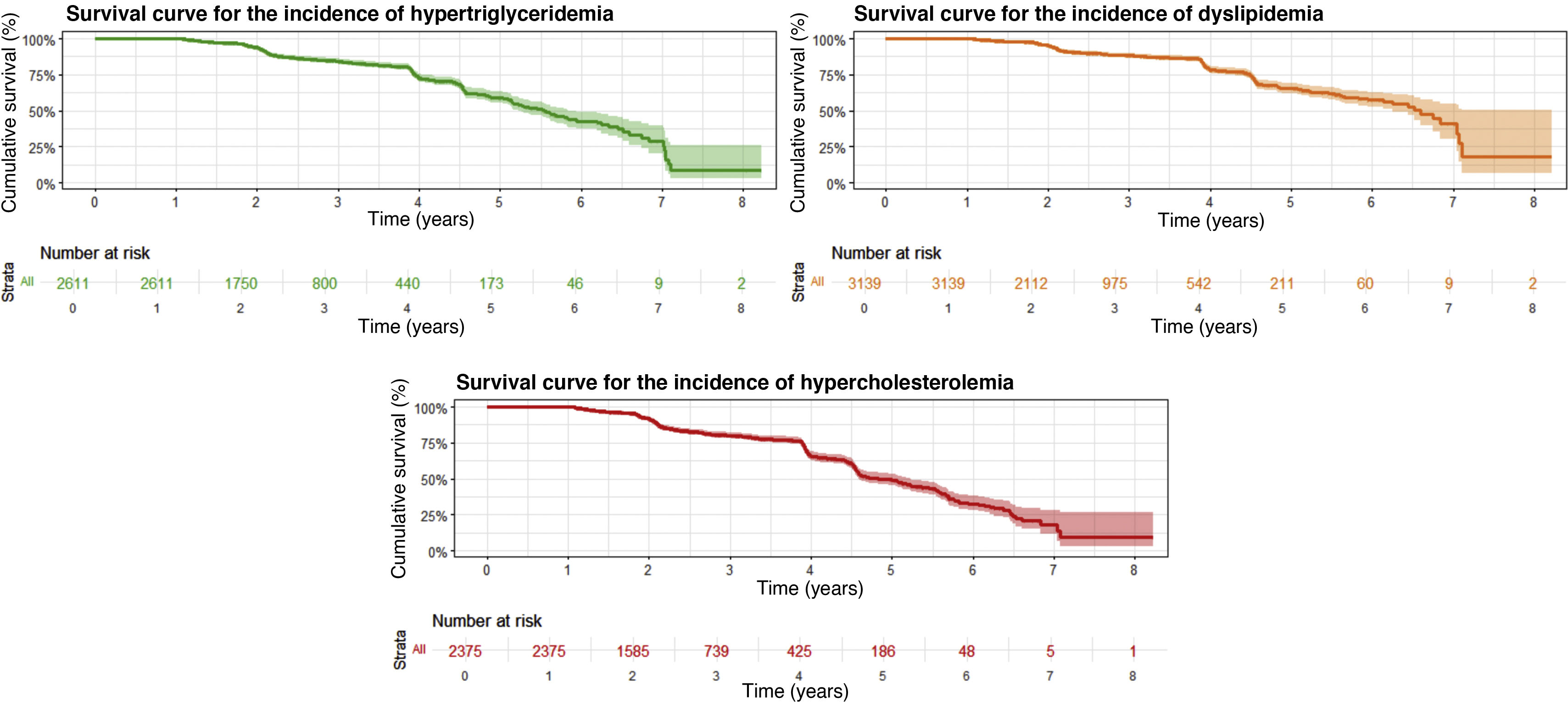
Fig. 1 presents six survival curves related to various dyslipidemias. For the hypertriglyceridemia curve, at baseline (year 0), 2,611 individuals were at risk, and the curve remained stable during the first year. Beginning in the second year, the incidence increased, and by the fourth year, 25% of the individuals had developed the condition. The slope became steeper thereafter, stabilizing between years 7 and 8, with 10% of the population remaining disease-free.
Regarding hypercholesterolemia, 2,375 individuals were at risk at baseline. During the first year, no new cases occurred. By the fourth year, 25% had developed the condition, reaching 50% by the fifth year. Between years 5 and 7, the slope became more pronounced, and by the eighth year, 90% of individuals were affected. The combined dyslipidemia curve began with 1,847 individuals at risk, with no new cases in the first year. Incidence increased gradually in the second year, reaching 10%. The slope remained constant between years 2 and 4 (30%) and increased significantly between years 4 and 7, reaching 95% of the population affected.
Incidence rate of lipid changesThe results showed considerable variability in incidence rates across the different dyslipidemias. Hypertriglyceridemia presented an incidence of 65.71 cases per 1,000 person-years (95%CI, 59.71–71.72), while hypercholesterolemia had a higher rate of 87.22 cases per 1,000 person-years (95%CI, 79.99–94.45). Combined dyslipidemia presented an incidence rate of 48.28 cases per 1,000 person-years (95%CI, 43.60–52.97). Complete analyses can be found in Table 2.
Incidence rate of lipid changes in peruvian workers.
| Measure | Incidence per 1,000 person-years (95%CI) | Number of cases | Follow-up time (years) |
|---|---|---|---|
| Incidence rate of Hypertriglyceridemia | 65.71 (59.71–71.72) | 460 | 7,000.01 |
| Incidence rate of Hypercholesterolemia | 87.22 (79.99–94.45) | 559 | 6,409.33 |
| Incidence rate of Dyslipidemia | 48.28 (43.60–52.97) | 408 | 8,450.10 |
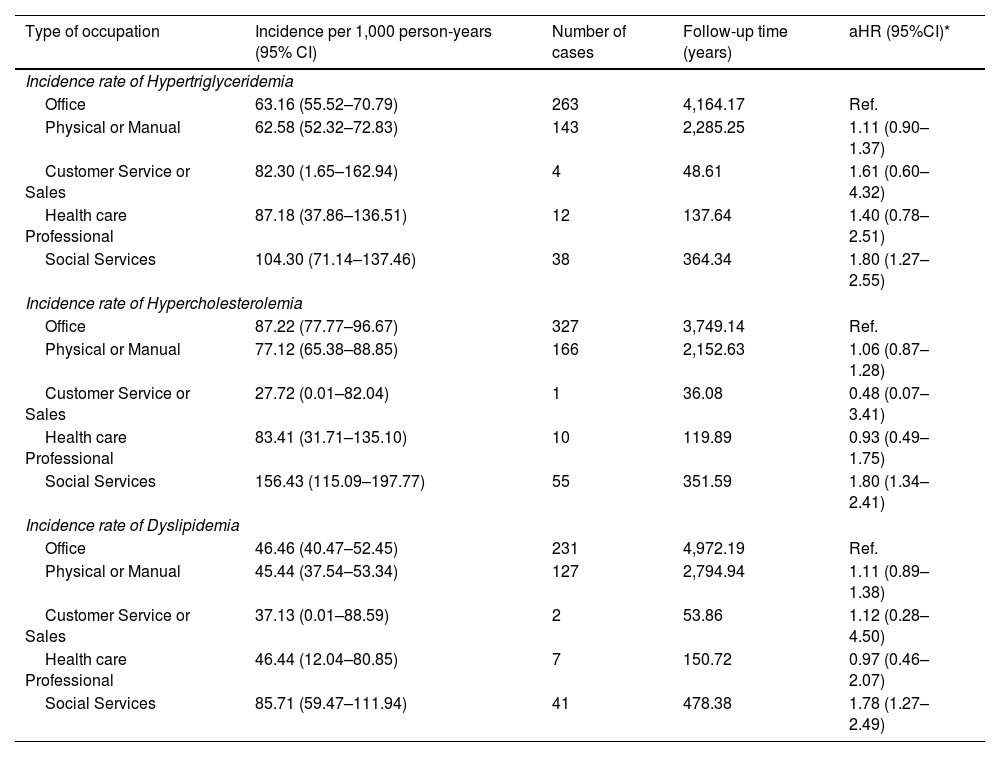
The results showed that social services workers had a significantly higher risk of developing hypertriglyceridemia (aHR, 1.80, 95%CI, 1.27–2.55), hypercholesterolemia (aHR, 1.80, 95%CI, 1.34–2.41), and overall dyslipidemia (aHR, 2.07, 95%CI, 1.50–2.85) vs office employees. The highest incidence rates were observed in this occupational group, with 87.18 (95%CI, 71.14–137.46), 156.43 (95%CI, 115.09–197.77), and 189.43 (95%CI, 134.08–244.78) cases per 1,000 person-years, respectively. Complete analyses are shown in Table 3.
Type of occupation as a determinant factor of lipid changes.
| Type of occupation | Incidence per 1,000 person-years (95% CI) | Number of cases | Follow-up time (years) | aHR (95%CI)* |
|---|---|---|---|---|
| Incidence rate of Hypertriglyceridemia | ||||
| Office | 63.16 (55.52–70.79) | 263 | 4,164.17 | Ref. |
| Physical or Manual | 62.58 (52.32–72.83) | 143 | 2,285.25 | 1.11 (0.90–1.37) |
| Customer Service or Sales | 82.30 (1.65–162.94) | 4 | 48.61 | 1.61 (0.60–4.32) |
| Health care Professional | 87.18 (37.86–136.51) | 12 | 137.64 | 1.40 (0.78–2.51) |
| Social Services | 104.30 (71.14–137.46) | 38 | 364.34 | 1.80 (1.27–2.55) |
| Incidence rate of Hypercholesterolemia | ||||
| Office | 87.22 (77.77–96.67) | 327 | 3,749.14 | Ref. |
| Physical or Manual | 77.12 (65.38–88.85) | 166 | 2,152.63 | 1.06 (0.87–1.28) |
| Customer Service or Sales | 27.72 (0.01–82.04) | 1 | 36.08 | 0.48 (0.07–3.41) |
| Health care Professional | 83.41 (31.71–135.10) | 10 | 119.89 | 0.93 (0.49–1.75) |
| Social Services | 156.43 (115.09–197.77) | 55 | 351.59 | 1.80 (1.34–2.41) |
| Incidence rate of Dyslipidemia | ||||
| Office | 46.46 (40.47–52.45) | 231 | 4,972.19 | Ref. |
| Physical or Manual | 45.44 (37.54–53.34) | 127 | 2,794.94 | 1.11 (0.89–1.38) |
| Customer Service or Sales | 37.13 (0.01–88.59) | 2 | 53.86 | 1.12 (0.28–4.50) |
| Health care Professional | 46.44 (12.04–80.85) | 7 | 150.72 | 0.97 (0.46–2.07) |
| Social Services | 85.71 (59.47–111.94) | 41 | 478.38 | 1.78 (1.27–2.49) |
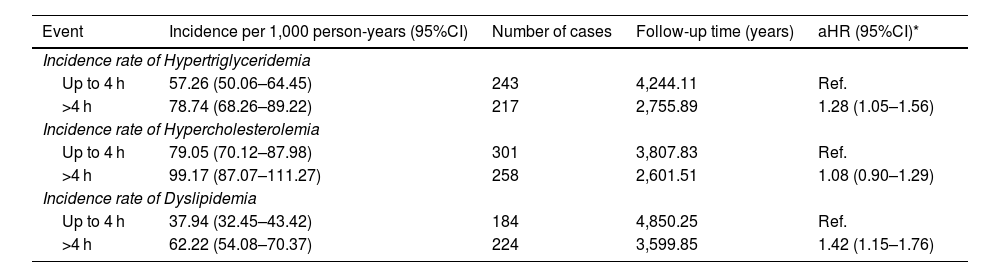
The findings revealed that workers who remained seated for more than four hours showed a significantly higher risk of developing hypertriglyceridemia (aHR, 1.28, 95%CI, 1.05–1.56), with an incidence rate of 78.74 cases per 1,000 person-years (95%CI, 68.26–89.22). However, for the remaining lipid profile variables, no significant risk was observed for other lipid alterations. Complete analyses are shown in Table 4.
Sedentary time as a determinant factor of lipid changes.
| Event | Incidence per 1,000 person-years (95%CI) | Number of cases | Follow-up time (years) | aHR (95%CI)* |
|---|---|---|---|---|
| Incidence rate of Hypertriglyceridemia | ||||
| Up to 4 h | 57.26 (50.06–64.45) | 243 | 4,244.11 | Ref. |
| >4 h | 78.74 (68.26–89.22) | 217 | 2,755.89 | 1.28 (1.05–1.56) |
| Incidence rate of Hypercholesterolemia | ||||
| Up to 4 h | 79.05 (70.12–87.98) | 301 | 3,807.83 | Ref. |
| >4 h | 99.17 (87.07–111.27) | 258 | 2,601.51 | 1.08 (0.90–1.29) |
| Incidence rate of Dyslipidemia | ||||
| Up to 4 h | 37.94 (32.45–43.42) | 184 | 4,850.25 | Ref. |
| >4 h | 62.22 (54.08–70.37) | 224 | 3,599.85 | 1.42 (1.15–1.76) |
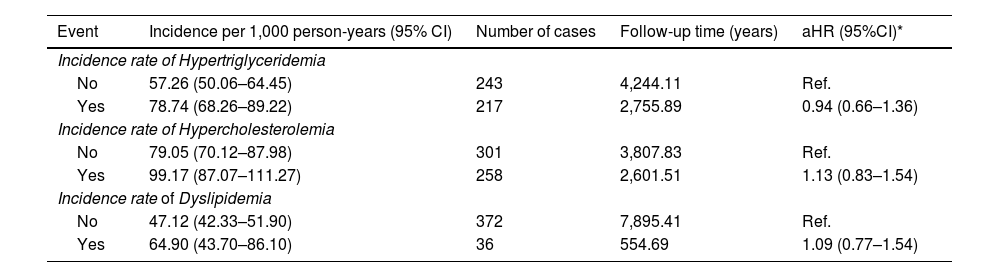
Although a significant association was not demonstrated, it is important to highlight that incidence rates were consistently higher among those performing night work vs those who did not—hypertriglyceridemia: 78.74 cases per 1,000 person-years (95%CI, 68.26–89.22), hypercholesterolemia: 99.17 cases per 1,000 person-years (95%CI, 87.07–111.27), and overall dyslipidemias: 64.90 cases per 1,000 person-years (95%CI, 43.70–86.10). Complete analyses are presented in Table 5.
Night work as a determinant factor of lipid changes.
| Event | Incidence per 1,000 person-years (95% CI) | Number of cases | Follow-up time (years) | aHR (95%CI)* |
|---|---|---|---|---|
| Incidence rate of Hypertriglyceridemia | ||||
| No | 57.26 (50.06–64.45) | 243 | 4,244.11 | Ref. |
| Yes | 78.74 (68.26–89.22) | 217 | 2,755.89 | 0.94 (0.66–1.36) |
| Incidence rate of Hypercholesterolemia | ||||
| No | 79.05 (70.12–87.98) | 301 | 3,807.83 | Ref. |
| Yes | 99.17 (87.07–111.27) | 258 | 2,601.51 | 1.13 (0.83–1.54) |
| Incidence rate of Dyslipidemia | ||||
| No | 47.12 (42.33–51.90) | 372 | 7,895.41 | Ref. |
| Yes | 64.90 (43.70–86.10) | 36 | 554.69 | 1.09 (0.77–1.54) |
This study of Peruvian workers revealed a high burden of dyslipidemias, with hypercholesterolemia notably more frequent than hypertriglyceridemia. Occupational factors showed a significant influence, with social services workers demonstrating the highest risk for all types of dyslipidemias assessed. Prolonged sitting time emerged as an independent risk factor for lipid alterations, whereas night work—although showing consistent trends toward increased risk—did not reach statistical significance after adjustments. Differences in incidence patterns between hypercholesterolemia and hypertriglyceridemia suggest distinct pathogenic mechanisms, possibly related to recent changes in dietary habits among the Peruvian population.13 These findings highlight the need to incorporate occupation-specific preventive strategies into workplace health programs.
Of note, this study deliberately focused on examining the association between specific occupational factors and the development of dyslipidemias, rather than traditional metabolic determinants. This methodological decision responds to a gap identified in the current scientific literature. While the relationship between metabolic variables (such as BMI, WC, and hyperglycemia) and dyslipidemias has been widely documented in previous studies,14 the influence of specific occupational factors has received considerably less attention, particularly in Latin American populations. Several studies have shown that factors such as type of work, workplace sedentarism, and shift schedules.
Prevalence of dyslipidemiasThe prevalence of dyslipidemias found in our study (56.02%) lies within an intermediate range compared with findings from previous research in various populations. Our results are consistent with those reported in a population-based study in Argentina, Chile, and Uruguay, which found a dyslipidemia prevalence of 58.4%.15 However, substantial variability in prevalence rates is seen across regions and populations. For example, our findings are considerably higher than those observed in Mexico, where prevalence was estimated at 36.7%,16 and notably lower than those reported in certain African populations, such as a study in Ethiopia revealing a prevalence of 66.7%.17 This variability underscores the importance of considering population-specific factors when interpreting and comparing dyslipidemia prevalence data.
Breaking down the specific components of dyslipidemia, our study found prevalences of 37.83% for hypertriglyceridemia and 43.45% for hypercholesterolemia. These figures are comparable, though slightly lower, than those reported in some international studies. For instance, a study in a Senegalese population found a hypertriglyceridemia prevalence of 41.9%,18 whereas in Jordan a rate of 44.3% was reported for hypercholesterolemia.19 In contrast, our findings are significantly higher than those observed in studies such as one conducted in Korea, where hypertriglyceridemia prevalence was 29.6%,19 or in a Latin American sample reporting a hypercholesterolemia prevalence of 24.4%.15 These differences may be attributable to variations in genetic, dietary, and lifestyle risk factors across the populations studied, as well as differing definitions of dyslipidemia across studies.
The high prevalence of dyslipidemias in our population of Peruvian workers is concerning and highlights the urgent need for prevention and management strategies. Our findings are particularly relevant in the occupational context, as recent studies have shown a correlation between work patterns (such as shift work) and alterations in the lipid profile.20 Additionally, the variability in prevalence rates across studies reinforces the need for population- and context-specific research. Factors such as urbanization, changes in dietary patterns, and physical activity associated with different types of work may be contributing to the high dyslipidemia rates observed in our sample.
These findings suggest the need for comprehensive approaches that address not only individual risk factors but also occupational and environmental aspects that may influence dyslipidemia development in working populations. Implementing occupational health programs that include regular lipid profile assessments, workplace-adapted dietary interventions, and strategies to promote physical activity could be crucial in addressing this public health issue. Furthermore, differences in work patterns—such as night shifts or extended workdays—should be considered, as they may have a significant impact on lipid metabolism and, consequently, on dyslipidemia risk.
Incidence rate of lipidic changesA particularly alarming finding of our study is the almost universal trajectory toward dyslipidemias observed in the survival curves. These show that, after seven to eight years of follow-up, approximately 90% of initially healthy individuals develop some form of dyslipidemia. This virtually inevitable progression raises fundamental questions about the environmental and occupational factors that may be contributing to this metabolic epidemic in the Peruvian working population.21 The speed and magnitude of this transition suggest that we may be facing a broader population phenomenon, possibly linked to rapid changes in the country’s food, work, and social environment. This pattern of “universalization” of dyslipidemias requires not only individual interventions, but also population-level approaches and urgent public policies that address the structural determinants of this trend.22
The high incidence rate of hypertriglyceridemia could be attributed to the persistence of aspects of the traditional Peruvian diet, which is rich in carbohydrates. High consumption of foods such as rice, potatoes, corn, and legumes can contribute to increased hepatic synthesis of triglycerides, especially when these carbohydrates are consumed in excess. On the other hand, the even higher incidence rate of hypercholesterolemia and its lower rate of normalization could be explained by the growing trend in recent years toward the consumption of ultra-processed foods and non-natural saturated fats. This change in eating habits, characteristic of the nutritional transition in developing countries such as Peru, is leading to an increase in the intake of saturated and trans fats, which have a direct and more lasting impact on serum cholesterol levels.21,23
The greater difficulty in achieving normocholesterolemia vs normotriglyceridemia could also be attributed to the nature of these dietary changes. Ultra-processed foods and non-natural saturated fats tend to have a more persistent effect on cholesterol levels, making them more difficult to reverse through lifestyle changes alone.24 In contrast, triglyceride levels are usually more sensitive to short-term dietary modifications, which could explain the greater ease of their normalization.25
This growing trend toward the consumption of ultra-processed foods and unhealthy fats in Peru not only explains the higher incidence rate of hypercholesterolemia but also underscores the importance of implementing prevention and management strategies that specifically address these changes in dietary patterns. It is crucial to develop interventions that promote a return to healthier aspects of the traditional diet, while educating the population about the risks associated with excessive consumption of ultra-processed foods.
Finally, although there may be reasons underlying these elevated incidence rates, it is important to add a critical point. The almost universal progression toward dyslipidemias observed in our cohort is striking, with approximately 90% of initially healthy individuals developing some lipid alteration over seven to eight years of follow-up. This phenomenon raises fundamental questions: are we facing a true metabolic epidemic among Peruvian workers, or could the current diagnostic cut-off points be overestimating the problem? The reference values used (≥200 mg/dL for total cholesterol and ≥150 mg/dL for triglycerides) are based primarily on studies conducted in Western populations, and their universal applicability has been questioned in recent research.26 Some studies suggest that cardiovascular risk thresholds associated with lipid levels may vary according to specific ethnic, dietary, and genetic characteristics of each population.27 This observation highlights the urgent need for studies that determine population-specific cut-off points for Peruvians, allowing for an adequate distinction between normal physiological variations and alterations with true pathological significance. However, the consistent association between occupational factors and the incidence of dyslipidemias in our study, regardless of the cut-off points used, reinforces the relevance of these findings for public and occupational health.
Occupational factors and lipid changesThe results of our study reveal significant associations between certain types of occupation and the risk of dyslipidemias, as well as their normalization. In particular, social services workers showed a higher risk of developing hypertriglyceridemia, hypercholesterolemia, and overall dyslipidemia. This finding is consistent with the study by Proper et al.,3 which found a higher prevalence of cardiovascular risk factors, including dyslipidemias, among workers in the social services sector. The authors attributed this phenomenon to the high level of work-related stress and irregular schedules characteristic of these occupations. Thus, these results reinforce the need to implement occupation-specific workplace health programs for this group of workers.
On the other hand, we observed that physical or manual activities were significantly associated with a higher likelihood of conversion from dyslipidemia to normolipidemia. This finding is consistent with the study by Koolhaas et al.,5 which demonstrated a protective effect of occupational physical activity vs cardiovascular diseases. Regular physical activity associated with manual jobs may be contributing to the improvement of the lipid profile, as suggested by Cabrera de León et al.4 in their review on the effects of sedentarism and physical activity on metabolic health.
Interestingly, while physical or manual activities showed a positive effect, the social services sector also demonstrated a protective effect on the conversion from dyslipidemia to normolipidemia. This seemingly contradictory finding could be explained by unmeasured factors in our study, such as differences in access to health care or adherence to treatment among occupational groups. Further research is needed to fully understand this phenomenon, as suggested by Kivimäki et al.28 in their review on the effects of work-related stress on cardiovascular health.
Finally, our study revealed that spending more than four hours seated during the workday is associated with a higher risk of hypertriglyceridemia. This finding is consistent with growing evidence on the negative effects of prolonged sedentarism on metabolic health. For example, Bellettiere et al.6 (2017) demonstrated a significant association between accumulated sitting time and cardiometabolic risk biomarkers. Our results reinforce the importance of implementing strategies to reduce sedentary time in the workplace, as suggested by Ekelund et al.7 in their meta-analysis on physical activity, sedentary time, and mortality.
These findings have important implications for occupational health and the prevention of cardiovascular diseases in the workplace. They suggest the need for occupation-specific interventions, the promotion of physical activity at work, and the implementation of strategies to reduce sedentary time. Furthermore, they underscore the importance of considering occupational factors in the assessment and management of dyslipidemia risk.
Importance of the study for public and occupational healthOur study has revealed alarming incidence rates of dyslipidemias in the Peruvian working population, with a rapid progression of lipid alterations. This highlights a worrying trend in the metabolic health of this population group. Early identification of these trends is crucial for public health, as it allows health authorities and policymakers to anticipate and plan large-scale preventive and therapeutic interventions. In addition, this information can serve as a basis for future research and for the development of more effective epidemiological surveillance programs.
The findings of our study underscore the importance of considering the work environment as a critical factor in the development of dyslipidemias. This has direct implications for occupational health, suggesting the need to implement workplace health programs that address not only the traditional risks associated with each occupation, but also metabolic risk factors. Companies and occupational health professionals can use these data to justify the implementation of workplace health promotion programs, including regular lipid profile assessments, nutritional counseling, and promotion of physical activity.
The difference observed in incidence rates between hypertriglyceridemia and hypercholesterolemia provides valuable information for designing specific interventions. Public and occupational health programs can now more precisely target dietary and lifestyle factors that contribute to each type of dyslipidemia. For example, interventions to reduce hypercholesterolemia could focus on decreasing the consumption of ultra-processed foods and non-natural saturated fats, whereas strategies to combat hypertriglyceridemia could focus on moderating the intake of refined carbohydrates.
From a public health and health economics perspective, our findings have significant implications. The high incidence rates of dyslipidemias suggest a potential future increase in the burden of cardiovascular diseases, which could have a substantial impact on health care costs and labor productivity. This information can be used by policymakers to justify investments in programs for the prevention and management of dyslipidemias, arguing that such investments could result in long-term cost savings in health care expenditures and improvements in workforce productivity.
Additionally, our study underscores the urgent need to improve education and awareness about the risks of dyslipidemias among both workers and health care professionals. The results can be used to develop more effective public health campaigns and continuing education programs for health care providers, ensuring they are better prepared to identify, prevent, and manage dyslipidemias in both occupational and community settings.
Finally, it must be acknowledged that the anthropometric and metabolic determinants identified in our cohort may have influenced the occupational associations observed. Baseline analysis revealed a considerable prevalence of metabolic risk factors: 20.81% obesity, 22.62% abdominal obesity, 8.76% arterial hypertension, and 19.86% glucose abnormalities. From a pathophysiological perspective, obesity—specifically abdominal obesity—induces insulin resistance, which in turn stimulates hepatic de novo lipogenesis and increases triglyceride synthesis through activation of the enzyme acetyl-CoA carboxylase.29 Simultaneously, insulin resistance reduces the activity of lipoprotein lipase, thereby decreasing triglyceride clearance and promoting the accumulation of atherogenic very low-density lipoprotein (VLDL) particles.30
In the specific occupational context, prolonged sedentarism (>4 h seated), observed in 47.74% of our cohort, may create an adverse pathophysiological cycle. Prolonged muscle inactivity reduces GLUT4-mediated glucose uptake, contributing to peripheral insulin resistance.31 This, combined with increased visceral adipose tissue typical of sedentary behavior, intensifies the release of free fatty acids into the liver, stimulating gluconeogenesis and VLDL synthesis.32 In addition, prolonged sitting is associated with reduced activity of muscular lipoprotein lipase, an enzyme essential for triglyceride metabolism.33
Social services workers, who exhibited a higher risk of dyslipidemias in our study, often experience a combination of occupational stress and irregular eating patterns. Chronic stress activates the hypothalamic-pituitary-adrenal axis, increasing cortisol levels, which stimulate hepatic lipogenesis and promote visceral fat accumulation.34 This process is amplified when combined with irregular meal schedules—common in social services jobs—which disrupt circadian rhythms of lipid metabolism and may increase nighttime cholesterol synthesis.35
Therefore, although our findings regarding occupational factors maintain independent relevance, it is likely that the synergistic interaction between occupational determinants and underlying pathophysiological mechanisms amplified the observed incidence rates. This understanding highlights the need for comprehensive preventive approaches that simultaneously address occupational risk factors and their metabolic consequences in the Peruvian working population.
Strengths and limitations of the studyOur study has several strengths and limitations that should be considered when interpreting the results. Among the strengths, the large sample size (4,200 participants) and longitudinal follow-up allowed for the calculation of incidence rates and the observation of dyslipidemia progression over time. Additionally, the inclusion of workers from various employment sectors provides a broad perspective on metabolic health in the Peruvian workforce. The use of standardized definitions for dyslipidemias and systematic data collection strengthens the internal validity of the study.
However, important limitations exist. First, as a study based on records from an occupational health clinic, there may be selection bias, as participants may not be fully representative of the general working population. Furthermore, although detailed data on diet and physical activity outside of work were not collected, these factors likely act as mediators rather than confounders in the relationship between occupation and dyslipidemias, meaning their absence does not compromise the validity of the occupational associations identified. Finally, although the study covered a substantial period, an even longer follow-up could provide additional insights into the long-term progression of dyslipidemias in this population.
Conclusions and recommendationsIn conclusion, our study reveals a high incidence of dyslipidemias among Peruvian workers, with marked differences between hypercholesterolemia and hypertriglyceridemia. These findings suggest that Peru’s nutritional transition—characterized by increased consumption of ultra-processed foods—may be significantly affecting the lipid profile of the working population. Occupational factors proved to be important determinants, with social services workers presenting higher risk and workplace sedentarism emerging as a key modifiable factor.
In response to these findings, we recommend implementing occupational health programs that include regular lipid profile assessments, dietary interventions tailored to the Peruvian context, and the promotion of physical activity in the workplace. It is crucial to develop public policies that address the nutritional transition by promoting a return to healthier aspects of the traditional Peruvian diet and regulating the consumption of ultra-processed foods. Additionally, further studies are recommended to examine in detail the specific occupational factors contributing to dyslipidemia development, as well as research evaluating the effectiveness of workplace interventions for the prevention and management of these conditions. Collaboration between employers, health care professionals, and policymakers will be essential to implement these recommendations and improve the cardiovascular health of the Peruvian workforce.
Informed consentBecause this study is based on secondary data analysis, informed consent was not required.
FundingThe study was funded by the Vice-Rectorate for Research of the Universidad Nacional Toribio Rodríguez de Mendoza de Amazonas.
Data availabilityThe data supporting the findings of this study are available at the following link: https://doi.org/10.6084/m9.figshare.27098296.v1.
None declared.


