
metricas
Endocrinología, Diabetes y Nutrición (English ed.) Gastroileal bypass reversal as a treatment for iatrogenic hyperparathyroidism an...
Journal Information
Vol. 72. Issue 10.
(December 2025)
Scientific letter
Full text access

Gastroileal bypass reversal as a treatment for iatrogenic hyperparathyroidism and refractory hypocalcemia

Reversión de bypass gastroileal como tratamiento de hiperparatiroidismo yatrogénico e hipocalcemia refractaria
Visits
570
Bryan-Josué Flores-Roblesa,
Corresponding author
bjflores@riojasalud.es

Corresponding author.
, Juan Antonio López Martína, María Jesús Chinchetru Ranedob, José Miguel Lázaro Guevarac, José Fernando Marín Díezd, Núria Guañabense
a Servicio de Reumatología, Hospital San Pedro, Logroño, La Rioja, Spain
b Servicio de Endocrinología, Hospital San Pedro, Logroño, La Rioja, Spain
c Departamento de Medicina Genética, McGill University Health Centre (MUHC), Montreal, Canada
d Servicio de Endocrinología y Nutrición, Hospital Universitario Quironsalud, Madrid, Spain
e Servicio de Reumatología, Hospital Clínic, IDIBAPS, Universitat de Barcelona, Barcelona, Spain
This item has received
Article information
Full Text
Bibliography
Download PDF
Statistics
Figures (1)
fig0005
Full Text

Hypoparathyroidism is an endocrinological disorder characterized by low parathyroid hormone (PTH) levels, resulting in hypocalcemia and hyperphosphatemia.1 The most common cause is accidental removal of the parathyroid glands during thyroid surgery.2 Deficiency of this hormone negatively affects quality of life and increases morbidity and mortality.2

Recombinant human PTH [rhPTH (1–34), teriparatide] is an osteoanabolic drug approved for the treatment of osteoporosis. In recent years, however, its benefits have been reported in chronic hypoparathyroidism when standard treatment with calcium and vitamin D supplementation is insufficient.3 Despite this, current guidelines do not recommend routine use due to lack of long-term efficacy data, and it has not received regulatory approval for hypoparathyroidism.

Patients undergoing bariatric surgery (bypass) have an increased risk of hypocalcemia due to impaired intestinal absorption. This risk is even greater following thyroidectomy.4 In this setting, some authors recommend bypass reversal to correct the metabolic disorder.5

We present the case of a patient on long-term teriparatide therapy (postsurgical hypoparathyroidism with severe hypocalcemia despite conventional treatment) who developed refractory hypocalcemia and disabling polyarticular pain with a “superscan” scintigraphic pattern, showing clinical, laboratory, and imaging improvement following reversal of bariatric surgery.

Case report

A 45-year-old woman with grade II obesity (BMI 37.39 kg/m²) underwent thyroidectomy in September 2008, developing postsurgical hypoparathyroidism (albumin-corrected calcium: 7.2 mg/dL, PTH < 6 pg/mL, calciuria > 500 mg/24 h, albumin 3.5 g/dL). Treatment was initiated with calcitriol 0.25 μg/day (up to 1.50 μg/day), calcium carbonate 2 g every 8 h, calcifediol 0.266 μg every 2 weeks, and hydrochlorothiazide 25 mg/day. With this regimen, she maintained clinical and biochemical stability for 7 years, without hypocalcemic symptoms prior to bariatric surgery.

In February 2016, she underwent bariatric surgery (bypass) by choice (BMI, 42.98 kg/m²). The procedure consisted of a gastroileal bypass with a functional loop on the proximal gastric segment of gastric bipartition: a 200-cm biliopancreatic limb and a 210-cm common channel.

Subsequently, she developed symptomatic hypocalcemia characterized by paresthesias of the hands and feet with a positive Trousseau sign, requiring multiple hospitalizations (albumin-corrected calcium <5.0 mg/dL, PTH < 3 pg/mL, albumin 3.3 g/dL) and treatment with IV calcium gluconate and magnesium phosphate.

In May 2016, teriparatide (20 μg SC every 12 h) was added to her regimen. Despite this, she continued to experience episodes of severe hypocalcemia and tetany, requiring hospital admissions in 2017 and 2020 for treatment adjustment.

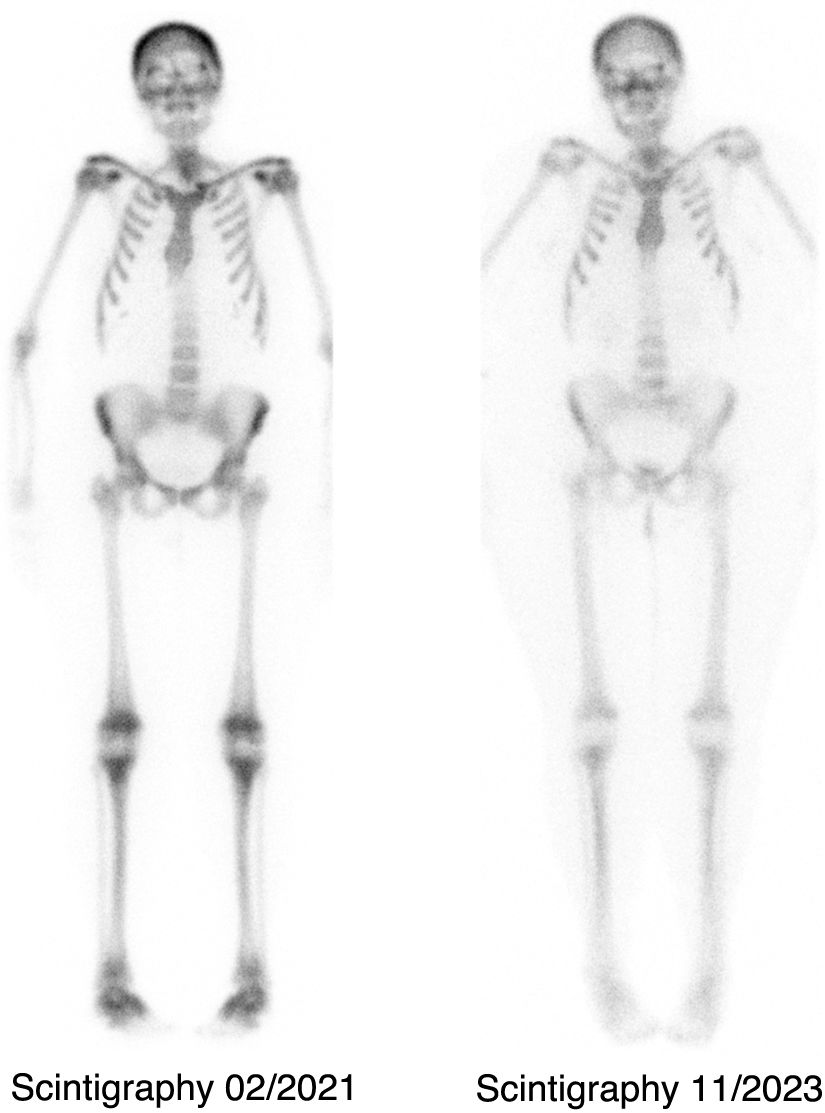
In March 2021, she was evaluated by rheumatology for diffuse polyarthralgia and lumbar pain of 2 months’ duration. Laboratory tests showed: albumin-corrected calcium 9.5 mg/dL, albumin 4.1 g/dL, magnesium 1.6 mg/dL, phosphate 4.4 mg/dL, alkaline phosphatase 149 U/L, 25-OH vitamin D 39.9 ng/mL, PTH < 6 pg/mL, calciuria 584 mg/24 h, phosphaturia 1035 mg/24 h, rheumatoid factor and anti-CCP negative, C-reactive protein 1 mg/L, ESR 10 mm/h. Radiography showed increased bone density and lytic lesions in the lumbar spine, shoulders, hips, and knees, all suggestive of hyperparathyroidism. Bone scintigraphy (99mTc-diphosphonates) demonstrated a metabolic “superscan” pattern with highest uptake in the calvaria, pelvis, and lower limbs (Fig. 1).

Figure 1.

Bone scintigraphy (99mTc-diphosphonates). Metabolic “superscan” pattern with increased activity in calvaria, pelvis, and lower limbs (left). Decreased uptake after 2 years of teriparatide discontinuation and gastroileal bypass reversal (right).

Given the persistence of calcium-phosphate metabolism disturbances despite treatment, iatrogenic bone lesions related to prolonged teriparatide use, and disabling joint symptoms, she was referred for gastroileal bypass reversal.

In September 2021, gastric bypass reversal was performed and teriparatide was discontinued. Thereafter, she experienced progressive improvement in axial/joint pain, decreased uptake on scintigraphy (Fig. 1), and stable calcium levels (11.4 mg/dL) with calciuria 182 mg/24 h. She has had no further episodes of tetany.

Hormone replacement therapy for chronic hypoparathyroidism with intact PTH (PTH 1–84) or its active fragment (PTH 1–34) represents a novel approach. PTH 1-84 has undergone full clinical development, including the REPLACE trial,6 and was approved by the FDA. Teriparatide (PTH 1–34), in contrast, lacks similar clinical trial development, with knowledge of its benefits and adverse effects limited to small series.7 Routine use is therefore not recommended. Replacement therapy with PTH analogues should be considered in patients with inadequate calcium control, normal serum calcium requiring >2.5 g/day supplementation, hypercalciuria, nephrocalcinosis, hyperphosphatemia, reduced glomerular filtration (<60 mL/min), or malabsorption syndromes such as gastroileal bypass.8

Despite its efficacy in morbid obesity, gastric bypass remains associated with a small subset of patients who develop uncontrollable nutritional complications. In these cases, reestablishing gastrointestinal continuity may be required.9 However, due to the risk of postoperative complications, this should be considered a last-resort therapy. Importantly, patients with prior thyroid surgery undergoing gastric bypass are at increased risk of refractory hypocalcemia.4 Two cases of Roux-en-Y bypass reversal for hypocalcemia in thyroidectomized patients have been reported, with discordant outcomes.10 To our knowledge, this is among the few reported cases of gastroileal bypass reversal in a thyroidectomized patient with clinical and biochemical improvement of refractory hypocalcemia.11,12

After nearly 4 years of teriparatide therapy, our patient developed clinical and radiographic features of hyperparathyroidism, despite suboptimal calcium control. Bone scintigraphy is not diagnostic but is useful for assessing skeletal involvement.13 In primary hyperparathyroidism, tracer uptake intensity appears to correlate with radiographic severity.11

To date, no cases have described long-term teriparatide therapy with joint symptoms, radiographic features of induced hyperparathyroidism (eg, “rugger-jersey spine”), and a “superscan” scintigraphic pattern, with progressive improvement following gastroileal bypass reversal.

Patients with postoperative hypoparathyroidism and bariatric surgery are at high risk of developing nutritional complications, including refractory postoperative hypocalcemia, particularly when the biliopancreatic limb is ≥200 cm (as in this case).14 Although replacement therapy with teriparatide in cases of chronic hypoparathyroidism may be a viable option when standard treatment has failed, it is not free of adverse effects and its long-term efficacy has not yet been established. In addition, its use is not recommended for periods longer than 2 years due to the risk of osteosarcoma and death observed in toxicology studies.15

Finally, gastric bypass reversal in these patients should be considered only as a last therapeutic resort due to the risk of postoperative complications. Therefore, long-term follow-up by an endocrinology specialist is of utmost importance.

References
[1]
M. Mannstadt, J.P. Bilezikian, R.V. Thakker, F.M. Hannan, B.L. Clarke, L. Rejnmark, et al.
Hypoparathyroidism.
Nat Rev Dis Primers., 3 (2017),
[2]
A.A. Khan, G. Guyatt, D.S. Ali, M.T. Collins, K. Dandurand, M. Mannstadt, et al.
Management of hypoparathyroidism.
J Bone Miner Res., 37 (2022), pp. 2663-2677
[3]
K.K. Winer, C.W. Ko, J.C. Reynolds, K. Dowdy, M. Keil, D. Peterson, et al.
Long-term treatment of hypoparathyroidism: a randomized controlled study comparing parathyroid hormone-(1-34) versus calcitriol and calcium.
J Clin Endocrinol Metab., 88 (2003), pp. 4214-4220
[4]
K. Corbeels, L. Verlinden, M. Lannoo, C. Simoens, C. Matthys, A. Verstuyf, et al.
Thin bones: vitamin D and calcium handling after bariatric surgery.
Bone Rep., 8 (2018), pp. 57-63
[5]
G.M. Campos, M. Ziemelis, R. Paparodis, D.B. Davis.
Laparoscopic reversal of Roux-en-Y gastric bypass: technique and utility for treatment of endocrine complications.
Surg Obes Relat Dis., 10 (2014), pp. 36-43
[6]
M. Mannstadt, B.L. Clarke, T. Vokes, M.L. Brandi, L. Ranganath, W.D. Fraser, et al.
Efficacy and safety of recombinant human parathyroid hormone (1‐84) in hypoparathyroidism (REPLACE): a double‐blind, placebo‐controlled, randomised, phase 3 study.
Lancet Diabetes Endocrinol., 1 (2013), pp. 275-283
[7]
G. Marcucci, L. Masi, L. Cianferotti, F. Giusti, C. Fossi, S. Parri, et al.
Chronic hypoparathyroidism and treatment with teriparatide.
Endocrine., 72 (2021), pp. 249-259
[8]
M.L. Brandi, J.P. Bilezikian, D. Shoback, R. Bouillon, B.L. Clarke, R.V. Thakker, et al.
Management of hypoparathyroidism: summary statement and guidelines.
J Clin Endocrinol Metab., 101 (2016), pp. 2273-2283
[9]
E. Chousleb, S. Patel, S. Szomstein, R. Rosenthal.
Reasons and operative outcomes after reversal of gastric bypass and jejunoileal bypass.
Obes Surg., 22 (2012), pp. 1611-1616
[10]
G. AlloMiguel, E. García Fernández, G. Martínez Díaz-Guerra, M.á Valero Zanuy, A. Pérez Zapata, F. De la Cruz Vigo, et al.
Recalcitrant hypocalcaemia in a patient with post-thyroidectomy hypoparathyroidism and Roux-en-Y gastric bypass.
Obes Res Clin Pract., 10 (2016), pp. 344-347
[11]
M. Manco, G. Nanni, V. Tondolo, A. Iaconelli, A.V. Greco, M. Castagneto, et al.
Hypocalcemia complicating near-total thyroidectomy in patients with coexisting lipid malabsorption due to biliopancreatic diversion.
Obes Surg., 14 (2004), pp. 1429-1434
[12]
P.M. Rojas-Marcos, M.A. Rubio, W.I. Kreskshi, L. Cabrerizo, A. Sánchez-Pernaute.
Severe hypocalcemia following total thyroidectomy after biliopancreatic diversion.
Obes Surg., 15 (2005), pp. 431-434
[13]
J. Murray, S.C. Favus.
Primer on the metabolic bone diseases and disorders of mineral metabolism.
Raven Press, (1993), pp. 14
[14]
N. Bandlamudi, G. Holt, Y. Graham, M. O’Kane, R. Singhal, C. Parmar, et al.
Malnutrition following one-anastomosis gastric bypass: a systematic review.
Obes Surg., 33 (2023), pp. 4137-4146
[15]
R.I. Gafni, J.S. Brahim, P. Andreopoulou, N. Bhattacharyya, M.H. Kelly, B.A. Brillante, J.C. Reynolds, et al.
Daily parathyroid hormone 1-34 replacement therapy for hypoparathyroidism induces marked changes in bone turnover and structure.
J Bone Miner Res., 27 (2012), pp. 1811-1820
Copyright © 2025. The Author(s)
Article options
Tools