



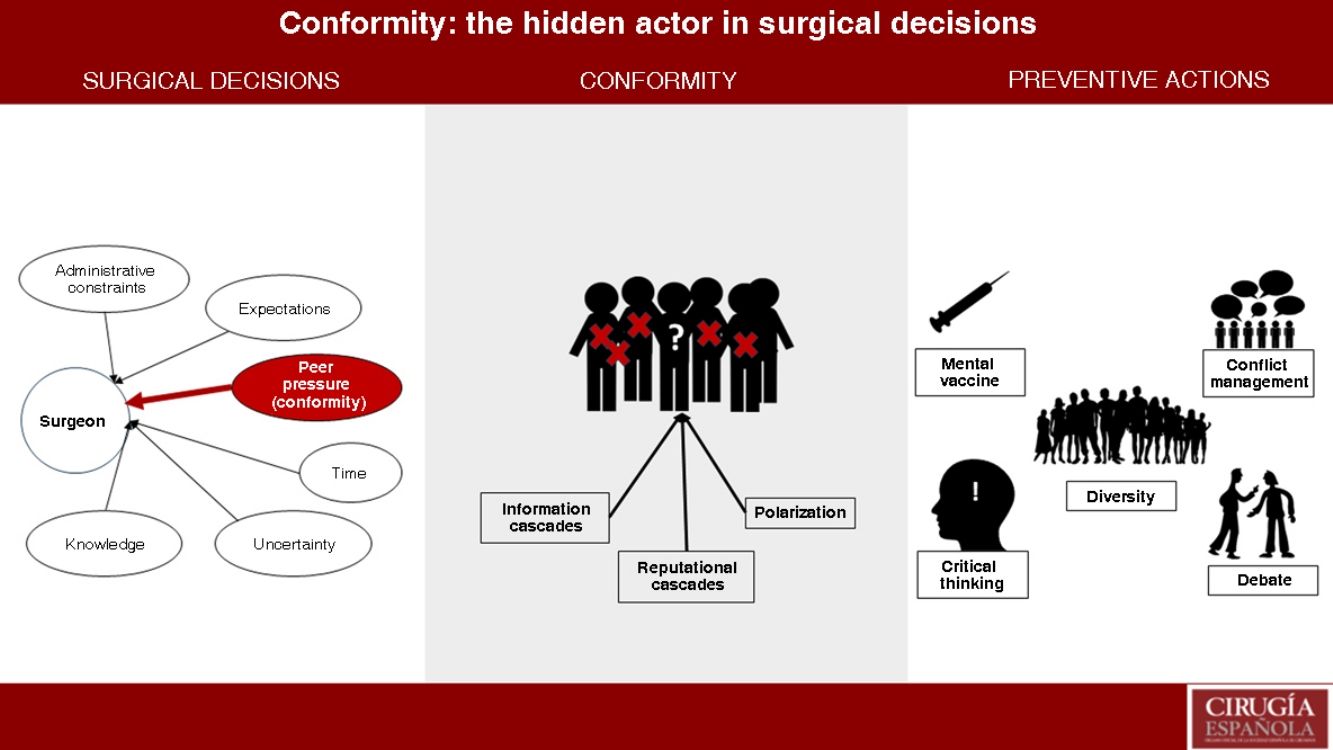
Conformity in decision making has a relevant impact in surgical environments. This manuscript reveals how group-based opinions can distort the surgeon's individual judgment, even in critical situations. Two key phenomena are analysed: communication cascades and group polarisation, which amplify conformity and lead to extreme and sometimes harmful decisions.
It is important to highlight the importance of evidence-based education, critical thinking, and diversification of information sources to counteract the negative effects of conformity. Self-identifying conformist tendencies, encouraging open debate, and implementing constructive dissent strategies can help mitigate the effects of conformity in decision-making. Reviewing authority models and promoting diversity in surgical settings may improve decision-making and the quality of patient care.
La conformidad en la toma de decisiones tiene impacto relevante en los entornos quirúrgicos. Este manuscrito revela cómo las opiniones grupales pueden distorsionar el juicio individual del cirujano, incluso en situaciones críticas. Se analizan dos fenómenos clave: las cascadas de comunicación y la polarización grupal, que amplifican la conformidad y conducen a decisiones extremas y, a veces, perjudiciales.
Es importante destacar la importancia de la educación basada en evidencias, el pensamiento crítico y la diversificación de fuentes de información para contrarrestar los efectos negativos de la conformidad. La auto identificación de tendencias conformistas, el fomento del debate abierto y la implementación de estrategias de disenso constructivo pueden ayudar a mitigar los efectos de la conformidad en la toma de decisiones. Revisar los modelos de autoridad y promover la diversidad en los entornos quirúrgicos puede mejorar la toma de decisiones y la calidad del cuidado del paciente.

Imagine being in a meeting discussing a complex surgical case, where a decision must be made. In addition to the common conditions of these meetings (short time, a lot of participants, uncertainty, diverse opinions, limited knowledge, administrative constraints, etc.), the modern surgeon must face another, much more subtle and usually ignored influence that can shape his or her decisions: Compliance with the group.1
This invisible phenomenon extends to all areas of surgical practice and every decision that is seemingly one's own may actually be influenced by the choices of those who have previously expressed their opinions. Although this situation is rarely discussed, it has broad implications for everyday practice. Understanding its dynamics is a must for every surgeon.
Conformity: a link between psychology, sociology and medicineSocial psychology, a field that combines psychology and sociology, studies how a person's thoughts, emotions, and behaviours are influenced by the presence and actions of others.2 To date, there is minimal information about the effect of compliance and how it influences the surgical decision-making process.
Conformity can be defined as the phenomenon in which a physician's decisions or choices are unduly influenced by the perceived or inferred opinions, behaviours, or experiences of other physicians, leading to alignment with prevailing beliefs or practices within their group, regardless of available data or personal values.1,3 Thus, a person ends up remaining silent and even changing his or her opinion on a particular issue, depending on the apparent consensus of the group or the opinions of the people in authority within it, regardless of the evidence that supports those opinions.
There are two common types of phenomena that explain conformity: communication cascades and polarisation.
Communication cascades within groupsSuppose you have been summoned to a meeting to discuss a case where there is uncertainty about particular conduct and you have been sent a summary of the case beforehand. Each of the attendees has some preference or private opinion about what would be the best option before starting the meeting. Once the discussion begins and the opinions of each participant are requested, each of the attendees is able to discover the opinions expressed by those who preceded them, that is, the opinions are now observable. In the course of the meeting, each of the participants is comparing their own opinion with that of the others (social influence).4
Cascades occur when an individual makes a decision or reaches a judgment influenced by the public opinions of those who preceded them, even if it is contrary to their own judgment. This cascade is informational, when the reason for changing one's opinion depends on the degree of information the individual possesses. If the surgeon has limited knowledge, he will prefer to accept the opinions of others rather than make a personal judgment, assuming that the knowledge that most have is more reliable.1 This cascade is reputational when the individual has accurate and sufficient information, but does not express their opinion because they want to avoid disapproval or gain the approval of the other participants. If the surgeon has an opinion already formed as to the treatment but the majority of participants have already supported a contrary alternative, they will prefer to support this group decision rather than give their opinion and cause discomfort or be seen as divergent or problematic.1
Group polarisationGroup polarisation is a phenomenon in which the decisions of groups tend to be more extreme than those of individual members of the group.1 This is explained by the fact that individuals tend to identify strongly with their respective groups (tribal identity), aligning their beliefs and values with those of their faction. Furthermore, due to the fact that groups have increasingly divergent views (amplified divergence), the space for commonalities is reduced. Thus, individual opinions within each group, including the most neutral ones, tend to become radicalised regardless of the quality of the arguments provided.
How do polarisation and cascades affect surgical decision-making?Polarisation limits access to information relevant to decision-making due to the creation of echo chambers that feed the circulation of erroneous data and distort perception (favouring information that validates pre-existing opinions and neglecting those that question them), encouraging the indiscriminate rejection of the reasons of the opposing group, even if they are logical and scientifically grounded.5 In some cases, the divergence of opinions and the search to "be right" leads to a more thorough scrutiny of surgical practices. This can lead to innovation, particularly in areas where traditional pathways have stagnated.
Information or reputational cascades may become a breeding ground for misinformation, perpetuating harmful behaviours and maintaining useless practices that jeopardise patient safety and hinder surgical progress. In some cases, these cascades can act as catalysts for development, rapidly disseminating the most effective practices. "Success cascades" trigger rapid dissemination of results and make it easier for more patients with similar conditions (favourable reputation) to undergo a certain treatment.
Why is this topic relevant to surgeons?Surgeons make decisions every day and at all times. If the effect of compliance is unknown, we will continue to participate in this process automatically and feed a practice that can be harmful. If, in addition, this happens within an academic environment, we will be transmitting obsolete knowledge to residents in training.
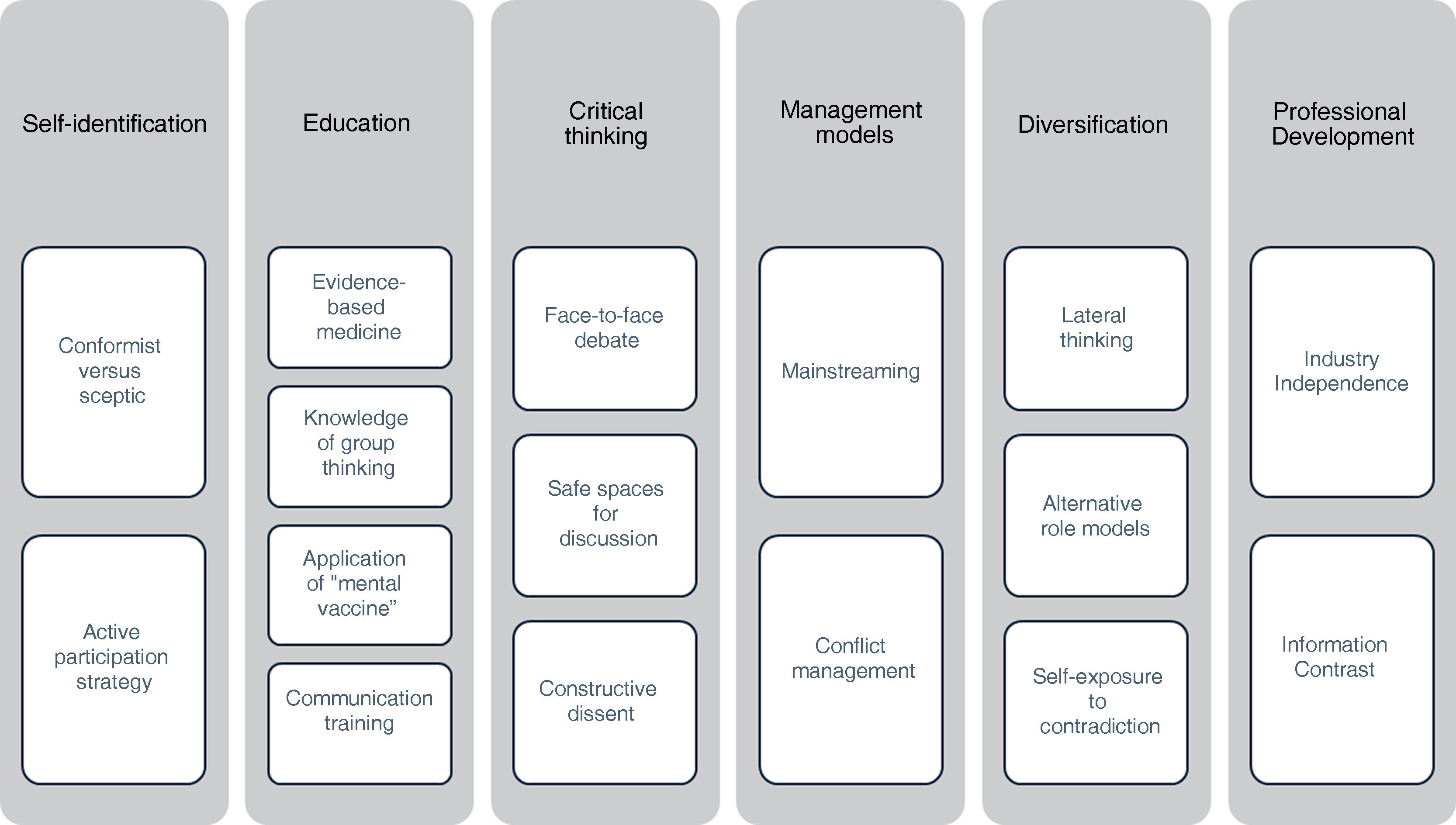
Mitigating the negative effects of compliance in decision-making requires an approach that includes several different actions: (Fig. 1)
Self-identification
Because some people are inherently conformist or sceptical, the first step is to determine beforehand which category you belong to. In this context, self-monitoring is a possible strategy to combat the intrinsic tendency towards conformity.6
EducationIt is essential to promote evidence-based education as it avoids information cascades and enables the surgeon to argue with accurate data. "Mental vaccine" techniques can be used, a sophisticated form of the old saying "don't swallow it all" that warns people that they might encounter misleading information and refutes misinformation before it is exposed.
Reflection and critical thinkingCritical thinking skills should be part of medical courses and debate should be encouraged. There is a need to return to scenarios where surgeons can freely discuss already established practices, challenge prevailing narratives, and openly contest the rationale behind decisions without fear of retaliation.7
Some methodologies used in administrative and policy disciplines such as constructive dissent must be introduced quickly into surgical practice.8
Models of leadership and authorityA culture of accepting questioning of decisions with scientific evidence should be fostered to reduce blind conformity to authority, empower surgeons who challenge existing stereotypes, and facilitate training in conflict management techniques within groups.9
DiversificationAll groups should promote a policy of diversification of sources of information. Creativity, problem-solving, and decision-making are considerably enhanced by diversity of thought,10 furthermore, the absence of dissenting voices can lead to a lack of consideration of innovative approaches.
Professional developmentIn every decision-making process, surgeons can be influenced by the behaviours and views of opinion leaders and must be attentive to contrasting the information provided with existing data to avoid manipulation.11
ConclusionUnderstanding how conformity influences group decisions is essential. This paper highlights the importance of understanding and addressing information and reputation cascades, as well as group polarisation, in surgical decision-making. The need for measures such as self-identification of conformist tendencies, evidence-based education, the promotion of critical thinking and the diversification of information sources is particularly highlighted. This underscores the importance of continuous professional development and the need to question norms and opinions to ensure informed and effective surgical practices.
Individual contribution of the authorsAlvaro Sanabria, Carlos Betancourt, Luis Carlos Dominguez: Conceptualisation, Methodology, Validation, Research, Data Curation, Formal analysis, Writing - Original Draft and Writing - Review & Editing
Conflict of interestThe authors have no conflict of interest.
FundingThis manuscript did not receive any funding.

