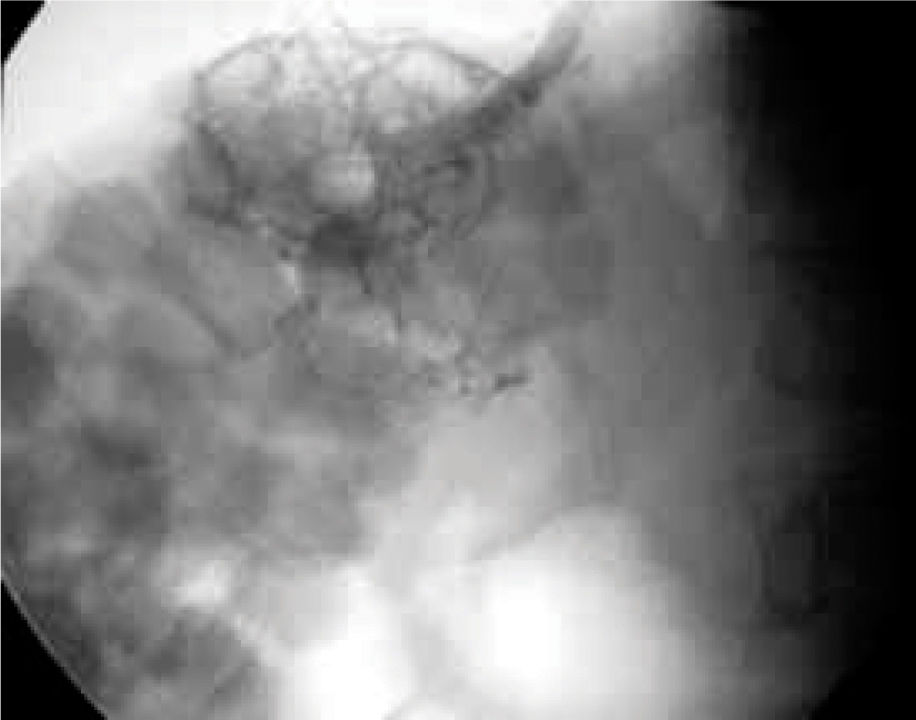
A 29 years old man with Budd-Chiari syndrome. Budd-Chiari syndrome is defined as hepatic venous outflow obstruction at any level from the small hepatic veins to the junction of the inferior vena cava and the right atrium, regardless of the cause of obstruction.1 It is caused mainly by thrombosis of the hepatic veins. The etiology of Budd-Chiari syndrome caused by hepatic vein thrombosis can be diverse, the hematological diseases associated are polycythemia vera and paroxysmal nocturnal hemoglobinuria. Other acquired risk factors for Budd-Chiari syndrome include antiphospholipid syndrome, abdominal trauma, the use of oral contraceptives, pregnancy, and so on.2 Budd-Chiari syndrome can be classified as primary (due to intrinsic intraluminal thrombosis or webs) or secondary (due to intraluminal invasion by a parasite or malignant tumour or due to extraluminal compression by an abscess, cyst or solid tumour).3 According to clinical presentation can be classified as fulminant, acute, subacute, or chronic. Therapy for patients with the Budd-Chiari syndrome includes medical management and the relief of hepatic venous outflow tract obstruction in order to prevent necrosis, with liver transplantation in selected patients, especially those with fulminant hepatic failure.4
Impact factor
The Impact Factor measures the average number of citations received in a particular year by papers published in the journal during the two preceding years.
© Clarivate Analytics, Journal Citation Reports 2025
Impact factor 2024
4.4
Citescore 2024
9.1
SJR
SRJ is a prestige metric based on the idea that not all citations are the same. SJR uses a similar algorithm as the Google page rank; it provides a quantitative and qualitative measure of the journal's impact.
See moreSJR 2024
1.011
SNIP
SNIP measures contextual citation impact by wighting citations based on the total number of citations in a subject field.
See moreSNIP 2024
1.057
View more metrics