





Nephrolithiasis is one of the most prevalent urological pathologies worldwide, with an increasing incidence and multifactorial etiology, particularly influenced by diet. Surgical interventions or extracorporeal shock wave lithotripsy (ESWL) are the cornerstone treatments. However, as emphasized by the EAU and AUA guidelines, post-surgical medical management is recommended to reduce recurrence risk. Phyllanthus niruri (PN), widely used in traditional medicine, has been extensively researched, yielding mixed results and presenting an opportunity to explore its role further. This review aims to evaluate PN’s potential in enhancing treatment efficacy and reducing stone recurrence.
Materials and methodsA systematic literature review was conducted, encompassing articles published from January 1994 to September 2022 in English and Spanish. The review included studies on humans and rats accessible through the authors’ institutional affiliations. Titles and abstracts were screened, and relevant studies were selected for in-depth analysis.
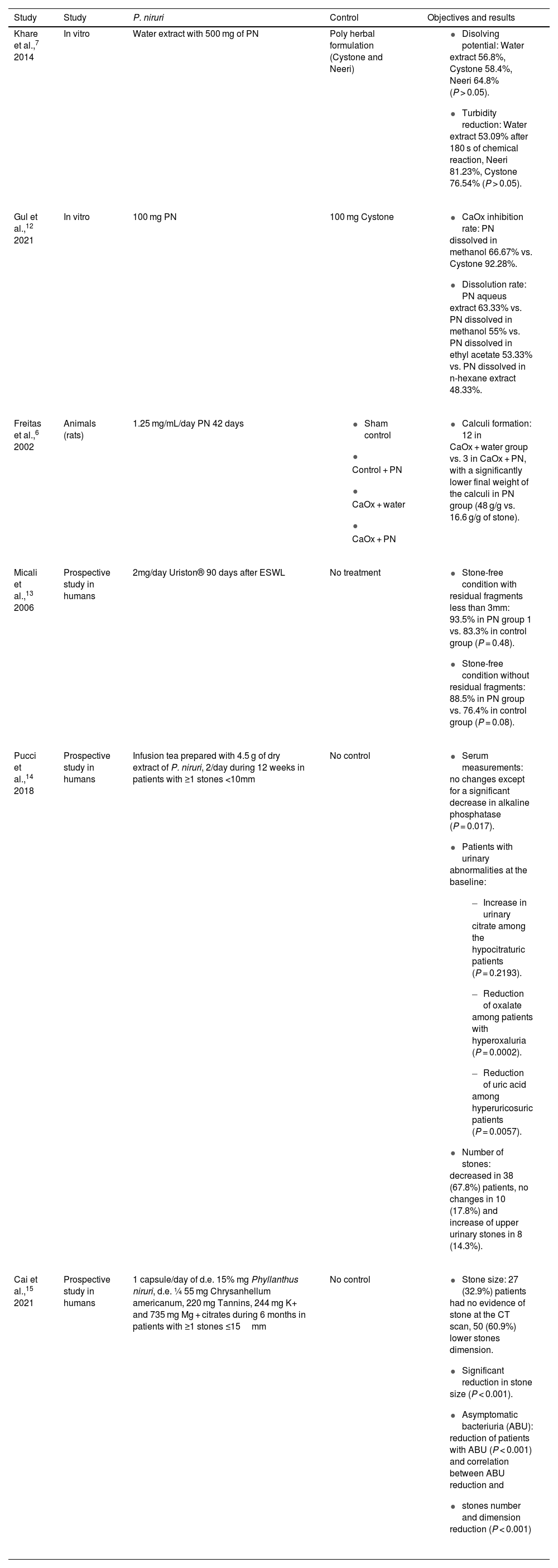
ResultsOut of the 16 selected studies, various mechanisms of action for PN were identified, such as promoting glycosaminoglycan (GAG) aggregation, inhibiting nucleation processes, and altering stone density to favor a stone-free state (SFR). Evidence consistently supports PN’s long-term safety, confirmed by serial measurements of serum electrolytes and liver function. Novel applications, such as PN as an adjuvant to ESWL, show benefits for lower renal pole stones.
ConclusionsGrowing evidence suggests that PN, when used alongside traditional interventions, is safe, without significant adverse effects, and may improve SFR outcomes after ESWL.
La nefrolitiasis es una de las patologías urológicas más prevalentes, con una incidencia en aumento y una etiología multifactorial muy influenciada por hábitos dietéticos. La cirugía y la litotricia extracorpórea por ondas de choque (LEOC) son la piedra angular del tratamiento, siendo el tratamiento médico postquirúrgico recomendado por las guías de la EAU y AUA para reducir el riesgo de recurrencia. Phyllanthus niruri (PN), usado en la medicina tradicional, ha sido ampliamente estudiado con resultados diversos. Por ello nuestro objetivo en este trabajo es evaluar el potencial de PN a la hora de reducir la recurrencia de litiasis.
Material y métodosRealizamos una revisión sistemática de la literatura, incluyendo artículos en inglés y español publicados entre enero 1994 y septiembre 2022. Esta revisión incluye estudios tanto en humanos como en ratas accesibles a través de las instituciones de los autores. Se realizó un primer cribado con títulos y resúmenes, y los estudios relevantes se seleccionaron para su análisis en profundidad.
ResultadosDe los 16 estudios seleccionados, se identificaron varios mecanismos de acción como promover la agregación de glucosaminoglucanos, inhibir la cristalización y modificando la densidad de las litiasis favoreciendo una mayor tasa libre de litiasis. La literatura apoya la PN como un tratamiento seguro a largo plazo, gracias a mediciones sobre la función renal y los electrolitos de los pacientes tratados. Además, indicaciones más novedosas como la PN antes de la LEOC, parece ofrecer beneficios en el tratamiento de las litiasis en grupo calicial inferior.
ConclusionesLas litiasis renales suponen una carga significativa para los sistemas sanitarios. La evidencia creciente sugiere que la PN, cuando se combina con los tratamientos estándar, es segura y no tiene efectos adversos significativos, ayudando además a mejorar la tasa libre de litiasis y los resultados después de la LEOC.

