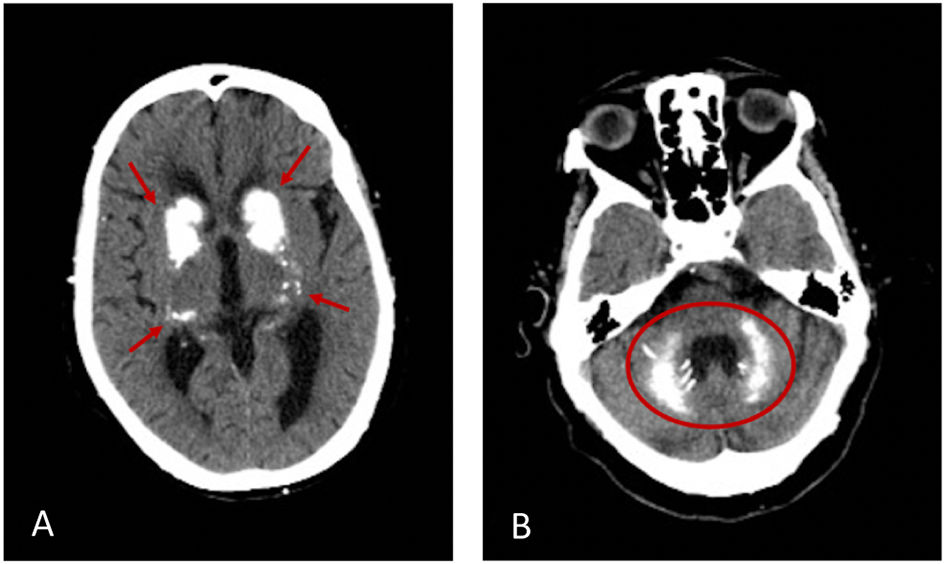
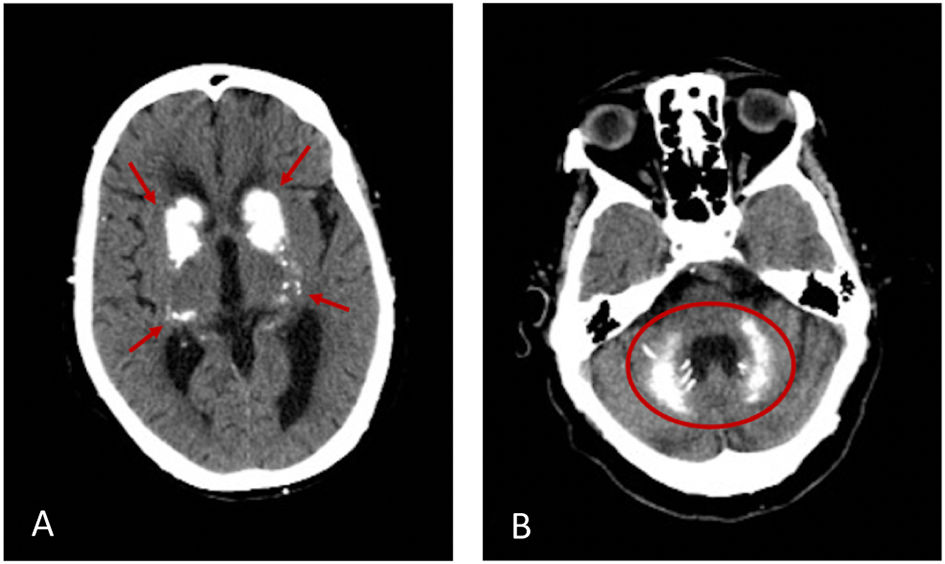
A 72-year-old woman with a past medical history of hypertension, dyslipidaemia, auricular fibrillation, heart failure and epilepsy for the last 3 years and partial thyroidectomy as of 20 years ago presented with a 9-month history of seizures and psychosis and was admitted for investigation. The physical examination showed neglect. Laboratory testing revealed hypocalcaemia 7.2 mg/dl (normal value, <8.8) with hyperphosphatemia 6.9 mg/dl (normal value, <4.5) and hypoparathyroidism with a PTH value of 3.7 pg/ml (normal value, <10). Vitamin D, magnesium, albumin, and thyroid functioning testing came back normal. The brain computer tomography (CT) revealed bilateral basal ganglia calcifications (Fig. 1A, arrows, and B circle). Considering her past medical history, clinical and physical findings, and subsequent investigation exams, Fahr's syndrome was diagnosed. The aetiology assumed was secondary to hypoparathyroidism related to her prior thyroidectomy. She started treatment with calcium and calcitriol with improvement. By using this particular case, authors aim at alerting that in the presence of neuropsychiatric symptoms and basal ganglia calcifications, Fahr's syndrome should be considered even if rare, especially after thyroidectomy. The treatment should be direct to the relief of symptoms and pointed to the underlying cause. Prompt treatment can prevent brain calcifications and neurophysiological disorders.
Citescore 2024
0,7
SJR
SJR es una prestigiosa métrica basada en la idea de que todas las citaciones no son iguales. SJR usa un algoritmo similar al page rank de Google; es una medida cuantitativa y cualitativa al impacto de una publicación.
Ver másSJR 2024
0,140
SNIP
SNIP permite comparar el impacto de revistas de diferentes campos temáticos, corrigiendo las diferencias en la probabilidad de ser citado que existe entre revistas de distintas materias.
Ver másSNIP 2024
0,282
Porcentaje de aceptación
La tasa de aceptación de las revistas se calcula dividiendo el número total de artículos aceptados (inicialmente y después de la revisión estándar) por el número total de envíos (aceptados y rechazados).
Ver másPorcentaje de aceptación
63 %
Ver más métricas