


The six-minute walk test (6MWT) is routinely used to assess functional capacity in clinical practice and research. However, in adults with hematologic malignancies enrolled in a hematopoietic stem cell transplantation (HSCT) program, its test–retest reliability, learning effect, and measurement error remain insufficiently characterized.
ObjectiveTo determine the test–retest reliability, learning effect, and measurement error of the 6MWT in adults enrolled in an HSCT program.
MethodsThis cross-sectional test–retest study included 45 adults receiving pre- or post-HSCT care who completed two standardized 6MWTs separated by 24hours. Six-minute walk distance (6MWD) was the primary outcome. Test–retest reliability was assessed using the intraclass correlation coefficient (ICC), while measurement error was examined using Bland–Altman analysis, the standard error of measurement (SEM), and the minimal detectable change at the 95% confidence level (MDC95).
ResultsMean 6MWD increased from 483.1±120.6 m on the first test to 496.6±124.5 m on the second, demonstrating a learning effect. The mean between-test difference was 13.4 m, with 95% limits of agreement ranging from−10.9 to 37.8 m. Test–retest reliability was excellent (ICC=0.995, 95% CI 0.991–0.997). The MDC95 for the total sample was 24.17 m.
ConclusionIn adults enrolled in an HSCT program, the 6MWT demonstrated excellent test–retest reliability but also a measurable learning effect. These findings support repeating the test when establishing baseline functional capacity to improve the accuracy of longitudinal interpretation during physiotherapy assessment and follow-up.
La prueba de marcha de seis minutos (PM6M) se utiliza habitualmente para evaluar la capacidad funcional en la práctica clínica y en investigación. Sin embargo, en adultos con neoplasias hematológicas incluidos en un programa de trasplante de células madre hematopoyéticas (TCMH), su confiabilidad test–retest, efecto de aprendizaje y error de medición permanecen insuficientemente caracterizados.
ObjetivoDeterminar la confiabilidad test–retest, el efecto de aprendizaje y el error de medición de la PM6M en adultos incluidos en un programa de TCMH.
MétodosEste estudio transversal test–retest incluyó a 45 adultos que recibían atención pre- o post-TCMH, quienes completaron dos PM6M estandarizadas separadas por 24 horas. La distancia recorrida en la PM6M fue el desenlace principal. La confiabilidad test–retest se evaluó mediante el coeficiente de correlación intraclase (CCI), mientras que el error de medición se examinó mediante análisis de Bland–Altman, el error estándar de medición (EEM) y el cambio mínimo detectable con un nivel de confianza del 95% (CMD95).
ResultadosLa distancia media recorrida aumentó de 483,1±120,6 m en la primera prueba a 496,6±124,5 m en la segunda, demostrando un efecto de aprendizaje. La diferencia media entre pruebas fue de 13,4 m, con límites de acuerdo del 95% entre−10,9 y 37,8 m. La confiabilidad test–retest fue excelente (CCI=0,995; IC95%: 0,991–0,997). El CMD95 para la muestra total fue de 24,17 m.
ConclusiónEn adultos incluidos en un programa de TCMH, la PM6M demostró una excelente confiabilidad test–retest, pero también un efecto de aprendizaje medible. Estos hallazgos apoyan la repetición de la prueba al establecer la capacidad funcional basal, con el fin de mejorar la precisión de la interpretación longitudinal durante la evaluación y el seguimiento kinesiológico.
Hematologic malignancies encompass a diverse group of cancers, including leukemias, lymphomas, and multiple myeloma, which accounted for 6.6% of all incident cancer cases and 7.2% of cancer-related deaths worldwide in 20221. These diseases often require intensive chemotherapy for effective disease management2. In selected patients, hematopoietic stem cell transplantation (HSCT) may be indicated and is classified according to the origin of hematopoietic cells: autologous HSCT uses the patient's own cells, whereas allogeneic HSCT uses cells from a human leukocyte antigen-compatible donor3. Allogeneic HSCT is considered a potentially curative option for some hematologic malignancies, while autologous HSCT is mainly used to support high-dose chemotherapy3. However, recipients of both auto and allo HSCT face the risk of long-term complications, including impaired physical functioning and fatigue4, reduced lower-limb muscle strength5,6, decreased quality of life4,5, psychological symptoms such as anxiety and depression7, poor sleep quality8, body-composition abnormalities or risk profiles such as weight loss, obesity, malnutrition, and sarcopenia9, and reduced bone mineral density or bone loss10–12.
An essential component of care both before and after HSCT is the thorough evaluation of physical capacity. Among available exercise-capacity assessments, CPET and the 6MWT provide complementary information. CPET assesses the integrated cardiovascular, ventilatory, and metabolic response to exercise under stress conditions and is considered the gold standard for evaluating peak and submaximal exercise capacity13. In patients undergoing allogeneic HSCT, CPET alone did not independently predict survival outcomes, but its combination with the HCT-specific comorbidity index improved the prediction of overall survival and non-relapse mortality13. In contrast, the 6MWT is a standardized, self-paced field test that is simple, affordable, and widely used to assess functional capacity in oncology and prehabilitation settings14. In patients referred for allogeneic HSCT, pre-transplant 6MWD and the desaturation–distance ratio have shown prognostic relevance for 24-month survival15. However, the 6MWT has not been extensively studied in hematological populations, and its test–retest reliability, learning effect, and measurement error remain insufficiently characterized in adults enrolled in HSCT programs in our setting.
The 6MWT is a practical and accessible tool that can be performed in low-resource settings, demonstrating high effectiveness in evaluating physical capacity across various respiratory, metabolic, cardiovascular, and neurological conditions16–18.
In oncology and rehabilitation settings, the 6MWT has been increasingly adopted as a pragmatic outcome measure. However, evidence regarding its test–retest reliability and measurement error in patients with hematologic malignancies remains limited. In several clinical populations, performance improves on the second administration, supporting the presence of a learning effect and the recommendation to repeat the test when feasible19–21. In preoperative cancer patients enrolled in a prehabilitation program, Sebio-Garcia et al. (2022) also reported excellent repeatability, together with a mean increase of 19.5 m (95% CI: 15.6 to 23.5; p<0.001) on the second 6MWT, with limits of agreement ranging from−31.3 to 70.4 m and a coefficient of variation of 4%22.
Accordingly, the primary objective of this study was to determine the learning effect of the 6MWT in adults enrolled in an HSCT program. As a secondary objective, we aimed to estimate the standard error of measurement and the minimal detectable change for this population.
MethodsStudy design and participantsThis was a cross-sectional test–retest study conducted among patients in a national HSCT program between March and May 2024. The study was approved by the relevant institutional ethics committee (Code: 05122023), and written informed consent was obtained from all participants. The study was conducted in accordance with the STrengthening the Reporting of OBservational studies in Epidemiology (STROBE) recommendations23.
SubjectsThe inclusion criteria consisted of patients aged 18 years or older with hematological malignancies who were enrolled in an HSCT program and were either awaiting or had undergone autologous or allogeneic transplantation. Patients were excluded if they had locomotor or cognitive impairments, refused to participate, had active infections, bleeding, or cytopenias, or had any pre-existing orthopedic or neurological conditions that could impair their ability to perform the 6MWT.
Materials and procedureAt recruitment, demographic, anthropometric, and clinical variables were recorded, including age, sex, employment status, region of residence, smoking history, alcohol consumption, cancer diagnosis, previous chemotherapy, HSCT status, and comorbidities. Functional performance was assessed using the Karnofsky Performance Status scale, a clinician-rated scale ranging from 0 to 100, with higher scores indicating better functional status24. Independence in activities of daily living was assessed using the Barthel Index, scored from 0 to 100, with higher scores indicating greater independence25.
The 6MWT was conducted indoors along a flat, straight 30-meter walking course, following international guidelines26. Participants were instructed to walk the course back and forth as far as possible within the allocated six-minute period26. The primary 6MWT variable was six-minute walk distance (6MWD). Secondary variables included baseline and post-test SpO2, baseline and post-test HR, one-minute HR recovery, and dyspnea and leg fatigue before and after each test using the modified Borg scale27. A finger pulse oximeter (MightySat® Rx, Masimo Health, Irvine, CA, USA) was used to measure oxygen saturation (SpO2) and heart rate (HR). The evaluator had prior experience administering this test.
Sample size calculationUsing the method proposed by Walter et al. which is based on an estimate utilizing the intraclass correlation coefficient (ICC), it was determined that a minimum of 40 participants was required28. This calculation assumed an acceptable reliability of p0=0.60 and an expected reliability of p1=0.80, with a power of 90% and a significance level of 5%. A 5% loss was anticipated.
Statistical analysesAll data are presented as means with standard deviations (SD) or medians with the 25th and 75th percentiles, depending on the distribution of the data. The distribution of continuous variables was assessed using the Shapiro–Wilk test. Paired comparisons between the first and second 6MWT were performed using paired-samples t-tests for normally distributed differences or Wilcoxon signed-rank tests for non-normally distributed differences. Between-group comparisons were performed using Student's t-test or the Mann–Whitney U test, according to data distribution. Categorical variables were compared using the chi-square test or Fisher's exact test, as appropriate. The measurement properties of the 6MWT were evaluated following the taxonomy and definitions established by the COSMIN initiative29. Test–retest reliability was quantified using a two-way mixed-effects, absolute-agreement, single-measures ICC(3,1) with 95% confidence intervals and interpreted as poor (<0.50), moderate (0.50–0.75), good (0.75–0.90), and excellent (>0.90)30. The learning effect was examined as the paired mean difference between the second and first test (second–first).
Agreement between tests was evaluated using Bland–Altman analysis. For each participant, the between-test difference and the mean of the two tests were calculated. The mean difference was interpreted as systematic bias, and the 95% limits of agreement were calculated as the mean difference±1.96 times the SD of the differences31. The distribution of the between-test differences was examined to support the interpretation of the limits of agreement. The Bland–Altman plot was visually inspected for potential heteroscedasticity, and proportional bias was assessed by regressing the between-test differences on the mean of the two tests.
The standard error of measurement (SEM) was computed as SEM=SDpooled×, and the minimal detectable change at 95% confidence (MDC95) as 1.96××SEM; MDC95 reflects the smallest change beyond measurement error and is not a minimal clinically important difference32. A significance level of p<0.05 was considered statistically significant. All statistical analyses were performed using SPSS version 25.0 (SPSS, Chicago, USA) and GraphPad Prism 8 (GraphPad Software, La Jolla, California, USA).
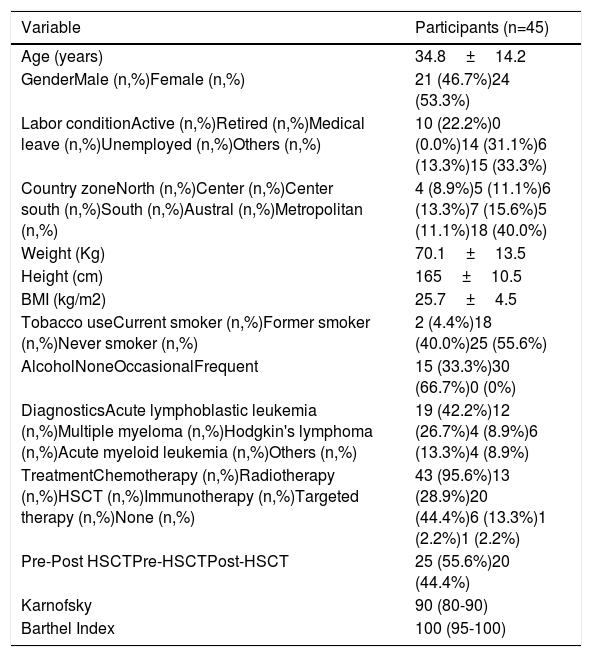
ResultsA total of 45 participants were included, with a mean age of 34.8±14.2 years. The sample had a balanced sex distribution, with 46.7% of the participants being men and 53.3% being women. Regarding employment status, 22.2% were actively working, 31.1% were on medical leave, and 33.3% reported other employment conditions. The majority of participants (40%) resided in the metropolitan region. The mean weight was 70.1±13.5kg, with a mean height of 165±10.5cm and a body mass index (BMI) of 25.7±4.5kg/m2.
Regarding smoking history, 4.4% of participants were current smokers, while 40% were former smokers. Alcohol consumption was reported as occasional in 66.7% of cases. The most frequent cancer diagnoses were acute lymphoblastic leukemia (42.2%), multiple myeloma (26.7%), and acute myeloid leukemia (13.3%). The majority of participants had received chemotherapy (95.6%), and 44.4% had undergone HSCT. At the time of assessment, 55.6% of patients were pre-HSCT, and 44.4% were post-HSCT. Functional status, assessed using the Karnofsky scale, had a median score of 90 (80–90), while the Barthel Index median was 100 (95–100), suggesting preserved functional independence in most participants.
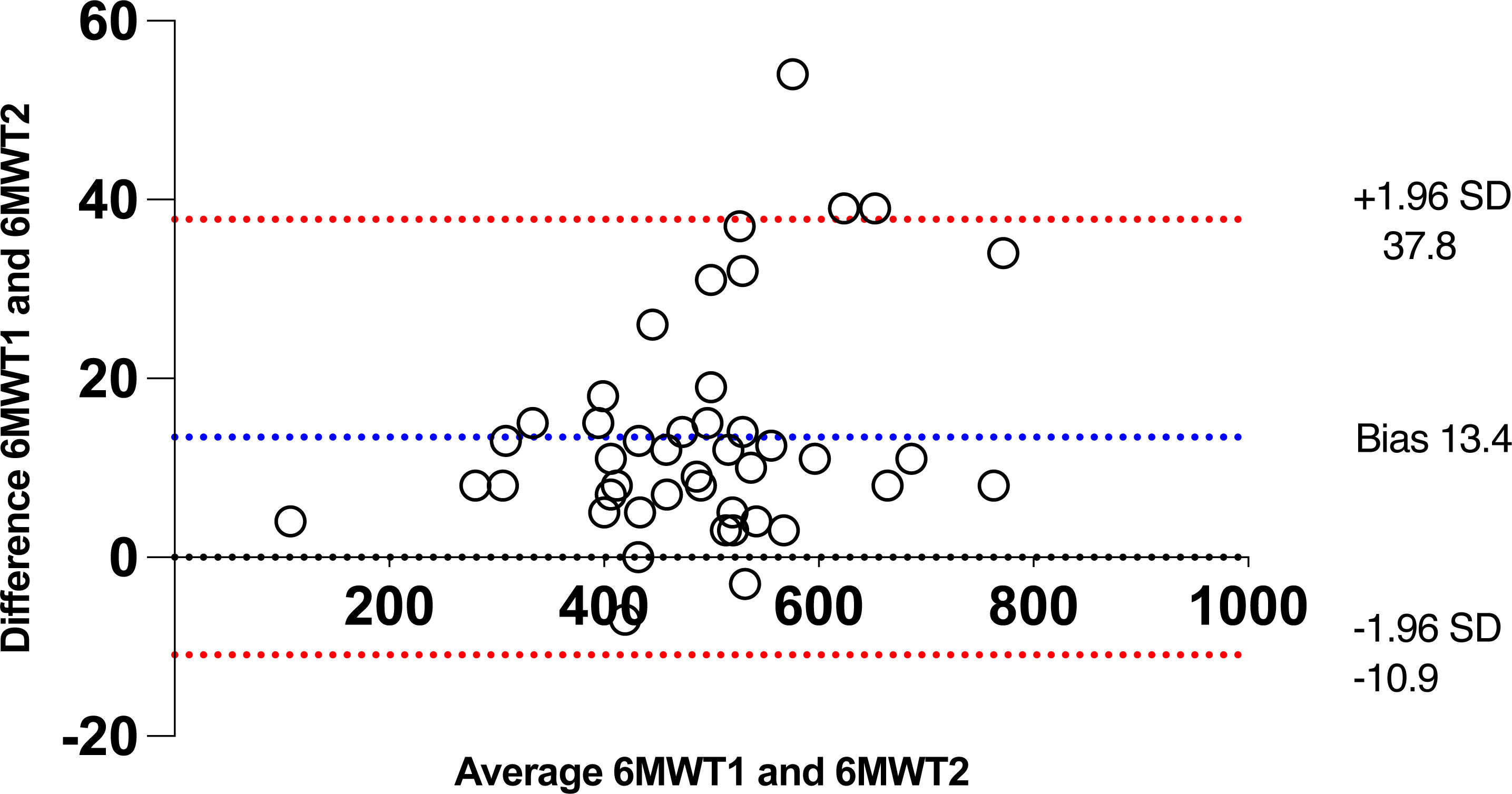
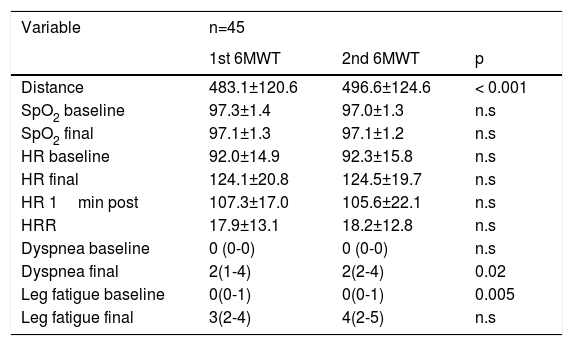
The distance covered in the second 6MWT (496.6±124.6 m) was greater than that in the first trial (483.1±120.6 m), supporting the presence of a learning effect (p<0.001). Bland–Altman analysis showed a mean bias of 13.4 m, with 95% limits of agreement from−10.9 m to 37.8 m (Figure 1). Regression analysis showed a small proportional bias, indicating that the between-test difference tended to increase slightly as mean 6MWD increased b=0.032; p=0.033).
Bland–Altman plot of agreement between the first and second six-minute walk tests
Note. The x-axis represents the average distance walked in both tests, and the y-axis shows the difference between the two tests. The solid line indicates the mean bias (13.4 m), while the dashed lines represent the 95% limits of agreement (–10.9 m to 37.8 m). The plot illustrates a slight systematic improvement, consistent with a learning effect.
Baseline and end-test SpO2, baseline and post-test HR, and 1-minute HR recovery did not differ significantly between trials. Dyspnea at baseline was similar between tests, whereas final dyspnea was higher during the second trial. Baseline leg fatigue was also higher before the second trial, while final leg fatigue did not differ significantly between tests.
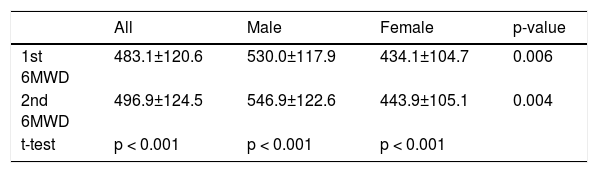
When stratifying by sex, men walked significantly longer distances than women in both trials (p=0.006 for the first and p=0.004 for the second test). Within each sex group, there was a significant improvement in distance walked between the first and second trials (p < 0.001), confirming the test's ability to detect performance changes.
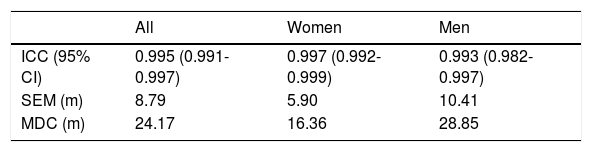
The test-retest reliability of the 6MWT was excellent, with an ICC of 0.995 (95% CI: 0.991–0.997) for the total sample. When analyzed by sex, ICC values remained high for both women (0.997, 95% CI: 0.992–0.999) and men (0.993, 95% CI: 0.982–0.997).
The SEM was 8.79 m for the total sample, with lower values in women (5.90 m) compared to men (10.41 m). The MDC95, representing the smallest change required beyond measurement error, was 24.17 m for the total sample, with 16.36 m for women and 28.85 m for men.
DiscussionThis study examined the learning effect and measurement error of the 6MWT in adults enrolled in an HSCT program. The main findings were that 6MWD improved on the second test, indicating a learning effect, while test–retest reliability was excellent. In addition, the estimated SEM and MDC95 provide clinically useful parameters for interpreting change over time in this population. This finding is consistent with previous studies in other patient groups, suggesting that repeating the 6MWT may provide a more accurate measurement of functional capacity in this population20,21,33.
The learning effect observed in this study raises important clinical implications. Given that the 6MWT is a commonly used tool to assess physical capacity in cancer patients34–36, it is crucial to consider the need for a second test when evaluating patients’ physical function22. When feasible, performing two 6MWTs to establish baseline functional capacity may reduce learning-effect-related underestimation and provide a more reliable reference for longitudinal follow-up. In addition, changes in 6MWD during follow-up should be interpreted considering the MDC95 reported in this study, as this threshold helps distinguish true change from measurement error. This approach may help clinicians guide rehabilitation programs and post-transplant follow-up while avoiding misinterpretation of test results22.
Descriptive statistics of the included patients.
| Variable | Participants (n=45) |
|---|---|
| Age (years) | 34.8±14.2 |
| GenderMale (n,%)Female (n,%) | 21 (46.7%)24 (53.3%) |
| Labor conditionActive (n,%)Retired (n,%)Medical leave (n,%)Unemployed (n,%)Others (n,%) | 10 (22.2%)0 (0.0%)14 (31.1%)6 (13.3%)15 (33.3%) |
| Country zoneNorth (n,%)Center (n,%)Center south (n,%)South (n,%)Austral (n,%)Metropolitan (n,%) | 4 (8.9%)5 (11.1%)6 (13.3%)7 (15.6%)5 (11.1%)18 (40.0%) |
| Weight (Kg) | 70.1±13.5 |
| Height (cm) | 165±10.5 |
| BMI (kg/m2) | 25.7±4.5 |
| Tobacco useCurrent smoker (n,%)Former smoker (n,%)Never smoker (n,%) | 2 (4.4%)18 (40.0%)25 (55.6%) |
| AlcoholNoneOccasionalFrequent | 15 (33.3%)30 (66.7%)0 (0%) |
| DiagnosticsAcute lymphoblastic leukemia (n,%)Multiple myeloma (n,%)Hodgkin's lymphoma (n,%)Acute myeloid leukemia (n,%)Others (n,%) | 19 (42.2%)12 (26.7%)4 (8.9%)6 (13.3%)4 (8.9%) |
| TreatmentChemotherapy (n,%)Radiotherapy (n,%)HSCT (n,%)Immunotherapy (n,%)Targeted therapy (n,%)None (n,%) | 43 (95.6%)13 (28.9%)20 (44.4%)6 (13.3%)1 (2.2%)1 (2.2%) |
| Pre-Post HSCTPre-HSCTPost-HSCT | 25 (55.6%)20 (44.4%) |
| Karnofsky | 90 (80-90) |
| Barthel Index | 100 (95-100) |
Note. Continuous variables are presented as mean±standard deviation (SD) or median (P25–P75), as appropriate. Categorical variables are presented as n (%). Abbreviations: BMI, body mass index; HSCT, hematopoietic stem cell transplantation.
Comparison between exercise physiological responses between the first and second six-minute walk tests (6MWT).
| Variable | n=45 | ||
|---|---|---|---|
| 1st 6MWT | 2nd 6MWT | p | |
| Distance | 483.1±120.6 | 496.6±124.6 | < 0.001 |
| SpO2 baseline | 97.3±1.4 | 97.0±1.3 | n.s |
| SpO2 final | 97.1±1.3 | 97.1±1.2 | n.s |
| HR baseline | 92.0±14.9 | 92.3±15.8 | n.s |
| HR final | 124.1±20.8 | 124.5±19.7 | n.s |
| HR 1min post | 107.3±17.0 | 105.6±22.1 | n.s |
| HRR | 17.9±13.1 | 18.2±12.8 | n.s |
| Dyspnea baseline | 0 (0-0) | 0 (0-0) | n.s |
| Dyspnea final | 2(1-4) | 2(2-4) | 0.02 |
| Leg fatigue baseline | 0(0-1) | 0(0-1) | 0.005 |
| Leg fatigue final | 3(2-4) | 4(2-5) | n.s |
Note. Values are presented as mean±standard deviation or median (interquartile range) as appropriate. Distance is expressed in meters (m); oxygen saturation (SpO2) in percentage (%); heart rate (HR) in beats per minute (bpm); and dyspnea and leg fatigue in points according to the modified Borg scale (0–10). HRR corresponds to heart rate recovery at one minute post-test. Abbreviations: 6MWT: Six-minute walk test; HR: Heart rate; SpO2: Oxygen saturation; HRR: Heart rate recovery.
Six-minute Walk Distance according to sex and test occasion.
| All | Male | Female | p-value | |
|---|---|---|---|---|
| 1st 6MWD | 483.1±120.6 | 530.0±117.9 | 434.1±104.7 | 0.006 |
| 2nd 6MWD | 496.9±124.5 | 546.9±122.6 | 443.9±105.1 | 0.004 |
| t-test | p < 0.001 | p < 0.001 | p < 0.001 |
Note. Values are expressed as mean±standard deviation. 6MWD: six-minute walk distance. Results are presented for the first and second tests in the total sample (All) and by sex (Male and Female). The p-value compares differences between sexes for each measurement. The t-test evaluates differences between the first and second tests within each group, showing a significant improvement (p < 0.001) in all comparisons.
Test–retest reliability and measurement error of the six-minute walk distance.
| All | Women | Men | |
|---|---|---|---|
| ICC (95% CI) | 0.995 (0.991-0.997) | 0.997 (0.992-0.999) | 0.993 (0.982-0.997) |
| SEM (m) | 8.79 | 5.90 | 10.41 |
| MDC (m) | 24.17 | 16.36 | 28.85 |
Note. Values are presented for all participants (All), stratified by sex (Women and Men). ICC values are reported with their 95% confidence intervals. SEM represents the measurement error, while MDC95 is the minimum change required to exceed measurement error at the 95% confidence level. ICC: Intraclass Correlation Coefficient; SEM: Standard Error of Measurement; MDC: Minimal Detectable Change.
Despite the improvement in walking distance, dyspnea and pre-test leg fatigue were higher during the second assessment. This pattern may reflect greater engagement with the task or a more demanding pacing strategy once participants became familiar with the test procedure. In contrast, physiological responses such as SpO2, HR, and HR recovery remained stable between trials. Given the relatively young age and baseline clinical profile of the sample, these stable physiological responses are not unexpected. The mean 6MWD of approximately 500 m is also consistent with previous reports in cancer populations37,38.
The analysis of SEM and MDC95 provides valuable insights into the precision and clinical applicability of the 6MWT in this oncological population. The SEM represents the inherent measurement variability, with lower values observed in women (5.90 m) compared to men (10.41 m), suggesting more consistent performance in female participants. The MDC95, which defines the minimum detectable change beyond measurement error, was 24.17 m for the total sample, with sex-specific values of 16.36 m in women and 28.85 m in men. These findings indicate that any improvement or decline in walking distance exceeding these thresholds should be interpreted as a physiological or functional change rather than random measurement variability. The higher MDC95 in men suggests more significant variability in their test-retest performance, which may be influenced by physical capacity, effort perception, or variability in pacing strategies. These results highlight the importance of considering sex-specific thresholds when using the 6MWT to monitor functional changes in oncological patients.
The literature on the 6MWT in patients with hematologic malignancies is limited, but some previous studies in similar populations have observed improvements in test performance due to the learning effect22. For example, in patients undergoing oncological surgery or prehabilitation, an improvement in the distance covered during the second 6MWT trial has been noted, supporting the findings obtained in this study22. Although the population in our study differed in terms of treatment type (HSCT), the results are consistent with observations from other studies regarding the influence of learning on the accuracy of physical capacity measurement19. Moreover, these findings underscore the need to investigate whether prior familiarization with the 6MWT could serve as a strategy to minimize the potential learning effect.
Some regional evidence, mainly from Brazilian cohorts, has evaluated functional capacity in patients undergoing or surviving HSCT. Silva et al. reported acute reductions in lung function, handgrip strength, and percent-predicted 6MWD during hospitalization for HSCT, and found that reductions in maximal inspiratory pressure were associated with non-relapse mortality39. In HSCT survivors, Penna et al. observed long-term impairments in functional capacity, pulmonary function, and QoL, with physically active individuals showing better 6MWT and pulmonary function outcomes40. More recently, Penna et al. found that lower-than-expected pre-HSCT functional capacity was associated with lower pulmonary function, greater lower-limb fatigue, and longer hospital stay41. However, these regional studies focused on functional status and clinical outcomes rather than on the measurement properties of the 6MWT. Therefore, evidence on test–retest reliability, learning effect, and measurement error of the 6MWT in adults enrolled in HSCT programs remains limited in regional settings.
This study has several limitations. First, because of its cross-sectional test–retest design, the study cannot determine the responsiveness of the 6MWT to clinical changes over time or its association with post-transplant outcomes. Second, the sample size was modest, although it met the a priori requirement for the reliability analysis. Third, the study population was relatively young, functionally preserved, and had few comorbidities, which may limit generalizability to more impaired HSCT populations. Fourth, evaluator blinding was not feasible; however, the 6MWT was administered by a trained professional using standardized procedures. A major strength of this study is the use of a measurement-property framework based on COSMIN recommendations, which improves the interpretability and clinical applicability of the findings.
ConclusionIn patients with hematologic malignancies enrolled in a hematopoietic stem cell transplantation program, the 6MWT demonstrates excellent test–retest reliability and a clear learning effect, with a greater distance achieved on the second trial (mean increase, 13.4 m; 95% limits of agreement,−10.9 to 37.8 m). The SEM and MDC95 values provide useful parameters for interpreting changes in 6MWD beyond measurement error in this population.
Declaration of InterestThe authors declare that they have no conflicts of interest.
Data Availability StatementThe datasets generated during and/or analyzed during the current study are available from the corresponding author on reasonable request.

