




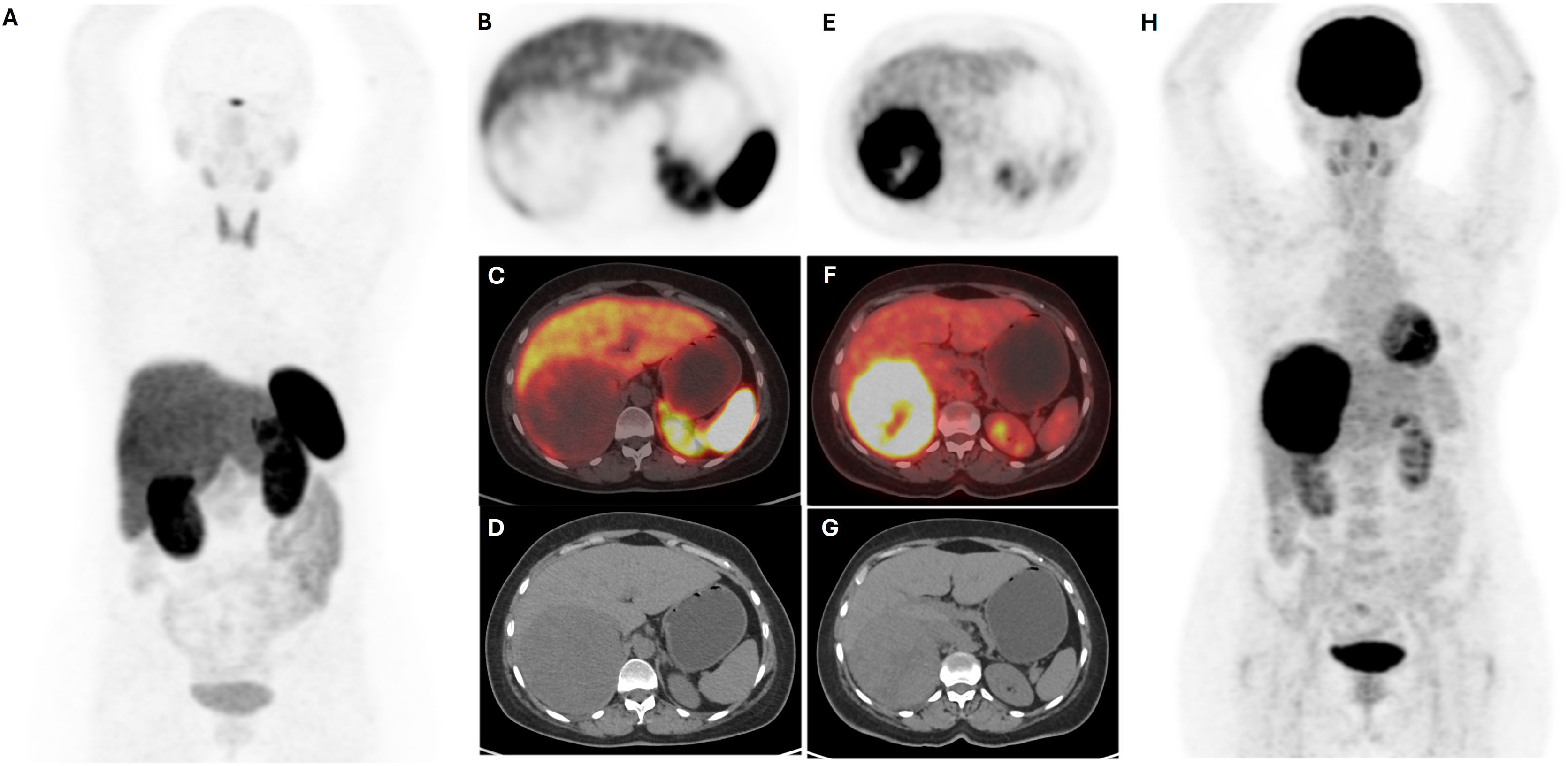

A 53-year-old female presented with unintentional weight loss, dyspnea and intermittent abdominal discomfort for 6 months. Contrast-enhanced thorax CT incidentally revealed a large heterogeneous mass in the right upper quadrant, approximately 11 cm in diameter, with indistinguishable borders from the right lobe of the liver (Fig. 1A and B). Then, contrast-enhanced abdominal magnetic resonance imaging (MRI) performed for differential diagnosis and an indeterminate mass was observed in the right adrenal gland (Fig. 1C and D). Due to the characteristics and contrast enhancement pattern of the lesion, malignancies such as metastasis, pheochromocytoma and adrenal cortical carcinoma (ACC) were considered in the initial diagnosis. Subsequently, [68Ga]Ga-DOTATATE PET/CT was accomplished for lesion characterization and to rule out any distant metastasis because of mildly elevated noradrenaline level. However, it did not demonstrate pathological radiotracer uptake which may be compatible with pheochromocytoma and metastatic lesion (Fig. 2A–D). Afterwards, [18F]fludeoxyglucose (FDG) PET/CT was performed for further evaluation and revealed intense heterogeneous increased uptake in the adrenal mass (Fig. 2E–H).The patient underwent surgical resection of the adrenal mass. Immunohistochemical analysis and histopathological findings of the mass were consistent with a huge ACC (Fig. 3).

Thorax CT detected a large heterogeneous mass in the right upper quadrant (arrow) (Fig. 1A and B). Abdominal MRI showed a heterogeneous signal mass lesion measuring approximately 11 × 11 × 12 cm in the largest dimensions, with cystic-necrotic areas in the central section, capsule contrast enhancement in the late phase (arrow) (Fig. 1C and D).
![[68Ga]Ga-DOTATATE PET/CT demonstrated relatively increased radiotracer uptake (SUVmax 4) in the adrenal mass (Fig. 2A–D). [18F]FDG PET/CT displayed intense heterogeneous increased radiotracer uptake in the adrenal mass (SUVmax,12.03) (Fig. 2E–H). No abnormal tracer uptake was observed in other body areas.](https://static.elsevier.es/multimedia/22538089/0000004300000006/v2_202501150428/S2253808924000867/v2_202501150428/en/main.assets/gr2.jpeg?xkr=ue/ImdikoIMrsJoerZ+w997EogCnBdOOD93cPFbanNdV4B9vwZQjgKcZv3MP4CdsNwQlWjMJVGmnQkWYSILi5A+SRkJSPOz9h16qM4vZDYAbNsQ/uaRxCUgctkWl9X3tbQgzlJBxwdKMNtNF3DIWiNLTCvQeRTEnkdFff70+QevT6sSv3YGaIbrFGbdIZXl9AfKL9pIqrThmFLGxSPJ0TJrEL62ToHeA9/IE4AlbUREpGPgveOn6mFBAUDPDslPq7XCLZKoqMfv7SFF5/9+3i11qxJyO3CZPey66JlTeHbs= "[68Ga]Ga-DOTATATE PET/CT demonstrated relatively increased radiotracer uptake (SUVmax 4) in the adrenal mass (Fig. 2A–D). [18F]FDG PET/CT displayed intense heterogeneous increased radiotracer uptake in the adrenal mass (SUVmax,12.03) (Fig. 2E–H). No abnormal tracer uptake was observed in other body areas.")
[68Ga]Ga-DOTATATE PET/CT demonstrated relatively increased radiotracer uptake (SUVmax 4) in the adrenal mass (Fig. 2A–D). [18F]FDG PET/CT displayed intense heterogeneous increased radiotracer uptake in the adrenal mass (SUVmax,12.03) (Fig. 2E–H). No abnormal tracer uptake was observed in other body areas.

Neoplastic cells with clear and eosinophilic cytoplasm, some of which have small nucleoli, have round to oval nuclei (Hematoxylin&Eosin ×40) (Fig. 3A). The neoplastic cells showed variation in nuclear size. Positive focal nuclear and cytoplasmic staining for calretinin (Fig. 3B) and positive focal nuclear staining for steroidogenic factor-1 (Fig. 3C) have been reported. The Ki-67 proliferation index was 5–10% (Fig. 3D).
Adrenocortical carcinoma (ACC) is an extremely rare endocrine malignancy that is not always identified during conventional radiological methods and hormonal examinations.1 The clinical manifestation depends on the location, size and hormonal status. Nonfunctional ACC may not be identified until the lesion compresses adjacent tissues and organs or may be detected incidentally during clinical examination. Therefore, mostly patients present with locally advanced or metastatic disease.2 [18F]FDG PET/CT provides additional information regarding metabolic activity and biologic aggressiveness of indeterminate adrenal masses. Moreover, a positive correlation between SUVmax and Ki-67 expression in FDG-avid ACCs was generally observed.3 In this study, the patient only has a local disease despite the huge ACC. Additionally, it was observed increased FDG uptake in the adrenal mass although the Ki-67 index was low. A limited number of similar cases have been described in the literature. The absence of metastatic lesions despite its size and increased FDG uptake notwithstanding low Ki-67 index make this case more interesting than other cases in the literature.
Ethical statementsThe ethics committee approval was not required because it was an interesting image.
FundingNone of the authors in this study received financial support.
Conflict of interestThe authors state that they have no proprietary interest in the products named in this article.
