



Improvisational theatre is an activity that combines many of the recommendations that promote healthy aging: physical exercise, cognitive stimulation, socialization, meditation and music therapy. The purpose of the study is to assess whether improvisational theatre can enhance physical and cognitive function, as well as quality of life and emotional status of older adults.
DesignA quasi-experimental study was conducted in five groups (two from residential facilities and three comprising community dwelling older adults), utilizing a convenience-based sample size.
Sample and settingFifty-six participants were recruited, with a mean age of 76.6 (9.3), of whom 73% were women, 34% lived in residential facilities, and 66% lived in the community.
ResultsWhile Barthel Index and Lawton Index remained stable along the intervention period, we found statistically significant changes in all the other physical-related assessed variables (SPPB, hand-grip strength, FRAIL index). There was also significant improvement in the MoC@ scale, verbal and semantic fluency, EuroQol, loneliness and depression. Sensitivity analyses indicated that some effects may be context-dependent and influenced by subgroup composition (Visual Analogue Scale, MoC@, FRAIL, and verbal fluency).
ConclusionImprovisational theatre enhanced physical, mental, social, and emotional well-being of participants. Incorporating improvisational theatre training is a valuable addition to interventions aimed at addressing the challenges posed by an aging population on a broader scale.
El teatro de improvisación combina muchas de las recomendaciones que promueven el envejecimiento saludable: ejercicio físico, estimulación cognitiva, socialización, meditación y musicoterapia. El objetivo del estudio es evaluar si el teatro de improvisación puede mejorar la función física y cognitiva, así como la calidad de vida y el estado emocional de las personas mayores.
Materiales y métodosSe realizó un estudio cuasi-experimental en cinco grupos (dos de residencias y tres compuestos por personas mayores que residen en la comunidad), utilizando un muestreo por conveniencia.
ResultadosSe reclutaron 56 participantes, con una edad media de 76.6 años (SD=9.3), de los cuales el 73% eran mujeres, el 34% residían en medio residencial y el 66% vivían en la comunidad. Mientras que el Índice de Barthel y el Índice de Lawton se mantuvieron estables durante el periodo de intervención, encontramos cambios estadísticamente significativos en todas las demás variables físicas evaluadas (SPPB, fuerza de prensión manual, índice FRAIL). También se observaron mejoras significativas en la escala MoC@, fluidez verbal y semántica, EuroQol, soledad y depresión. Los análisis de sensibilidad sugirieron que algunos de los efectos observados podrían ser dependientes del contexto (escala visual analógica, MoC@, escala FRAIL y fluidez verbal).
ConclusionesEl teatro de improvisación mejoró el bienestar físico, mental, social y emocional de los participantes. Incorporar el entrenamiento en teatro de improvisación constituye un aporte valioso a las intervenciones destinadas a afrontar los retos que plantea el envejecimiento de la población a gran escala.
The worldwide phenomenon of an aging population requires the creation of public policies informed by transdisciplinary research centred on older adults.1 As Lopreite discusses, the burdens of aging could be reduced with effective health interventions, such as health promotion and disease prevention programs, targeting the primary causes of morbidity and disability.2
The World Health Organization (WHO) has defined healthy ageing as “a process of maintaining functional ability to enable wellbeing in older age”.3 Lara et al. have delineated five essential domains of healthy aging: physiological and metabolic health, physical capability, cognitive function, social well-being and psychological well-being.4 The strategies to promote healthy aging should, therefore, focus on fostering these domains.
Some of the most studied measures that promote healthy aging are physical exercise,5,6 maintaining social interactions7 and cognitive stimulation.8 Others, such as music therapy and meditation, are also being researched.9,10 However, most of these interventions are delivered in isolation, targeting single domains of function. There remains a lack of integrative interventions capable of simultaneously engaging physical, cognitive, emotional, and social processes in older adults.
Keisari et al. have previously exposed the benefits of drama therapy in mental health during aging.11 Allowing participants to experience new roles leads to personal development using their creativity as well as promotes social bonding within individuals. Nevertheless, interventions specifically based on improvisational theatre, which emphasize spontaneity and real-time interaction, remain underexplored in older adult populations.
Improvisation theater is an artistic discipline that combines oral and gestural expression and the interaction between the creators of the scene, to develop a story, without a prefixed text or idea. In this way, the improviser brings together the figure of playwright, director, set designer and editor.12 More specifically, improvisational theatre can be defined as a structured yet flexible practice in which participants co-create spontaneous narratives based on principles such as active listening, acceptance of others’ contributions (“yes, and”), and collaborative meaning-making. This process requires continuous adaptation to verbal and non-verbal cues and engages attentional, emotional, and social regulation systems.13
It requires spontaneity, which is embedded in established fundamentals that are practiced repeatedly,14 and is characterized by playfulness and creativity Therefore, rather than being a simple combination of physical activity and organization, improvisational theatre constitutes a complex cognitive, emotional, and social practice involving real-time coordination, creativity, and embodied interaction.15
Several studies have identified physiological changes that may be associated with the positive effects of improvisation practice, such as increasing in salivary oxytocin levels following a session of “mirror gaming”16 and reductions in the activation of executive functioning regions in MRI17 during a training of improvisational program compared with learning Chinese classes, suggesting the enhancement of creativity with the former. These findings suggest that improvisation may promote more efficient neural processing and adaptive cognitive functioning. From a neurocognitive perspective, improvisational theatre involves complex cognitive-motor mechanisms, including dual-tasking, as participants must simultaneously process social information, generate narrative responses, and coordinate motor actions. This may stimulate executive functions such as working memory, inhibitory control, and cognitive flexibility, while also engaging motor planning and sensorimotor integration processes.
Therefore, improvisational theater is an activity that combines many of the recommendations that promote healthy aging:
- •
Physical exercise: it is performed during the warm-up at the beginning of classes and in relation to body expression in the various scenes.
- •
Cognitive stimulation: a story has to be created as in immediate response to what is presented by the scene partners.
- •
Socialization: it is a group activity that also often involves creating close bonds, since trust in others is essential for the scene to progress.
- •
Meditation: for the component of mindfulness to what is happening “Here and now” in the scene.
- •
Music therapy: both the warm-up and the development of the scenes can be accompanied by music, and there are also specific exercises where it is necessary to sing or dance.
Importantly, this combination of components positions improvisational theatre as a multi-component intervention that may provide added value over traditional single-domain approaches, as it more closely reflects real-life cognitive, motor, and social demands.
The purpose of this exploratory study is to assess whether improvisational theater can enhance physical and cognitive function, as well as quality of life and emotional status of older adults (ImproAging project). We hypothesize that its integrative and multi-domain nature may lead to broader and more transferable benefits compared to conventional interventions.
Material and methodsA quasi-experimental study was conducted in five groups (two from residential facilities and three comprising community dwelling older adults), utilizing a convenience-based sample size. No formal sample size calculation was performed due to the exploratory nature of the study; therefore, the sample should be considered pragmatic and hypothesis-generating.
ParticipantsFifty-six participants aged 65 and older were recruited for the study. Inclusion criteria included: being 65 years or older, the ability to travel to the improvisational theatre workshop's locations, signing informed consent. Participants were selected through primary care physicians, residential facilities staff, and self-selection via newspaper advertisements, until all spots were filled.
Exclusion criteria included:
- •
Refusal or inability to provide informed consent.
- •
Moderate to severe dementia (GDS stages 5–7).
- •
Moderate functional impairment (Barthel Index below 60).
- •
Life expectancy of less than 6 months.
- •
Acute medical condition requiring hospitalization or intensive medical follow-up.
- •
Inability to travel to the improvisational theater workshop locations.
Participants who attended less than 50% of sessions were considered drop-outs and excluded from the final analysis, with a per-protocol approach. Adherence to the intervention was recorded as the percentage of sessions attended.
Measures- -
Demographic and health-related data: age, sex, weight, height, comorbidity (Charlson Comorbidity Index18), history of cardiovascular risk factors, polypharmacy, and any visual or hearing impairments.
- -
Physical status: independence in basic activities of daily living (Barthel Index19); independence in instrumental activities of daily living (Lawton and Brody Index20); grip strength of the dominant upper limb (using “JAMAR 5030J1 Hand Dynamometer”); frailty (FRAIL scale21 and Short Physical Performance Battery22,23 (SPPB)); number of falls in the past year.
- -
Cognitive status: educational level, previous cognitive impairment diagnoses and its severity (GDS-FAST24), MoC@ scale,25 verbal fluency (number of words beginning with “P” in 1min) and semantic fluency (number of animals named in 1min).
- -
Social and emotional status: loneliness (UCLA scale26), quality of life (EuroQol-5D-VAS27), depression (abbreviated Yesavage scale28).
Workshop attendance was documented and, at the end of the workshop, participants were asked if they would consider doing this activity again in the future.
All instruments used have been previously validated in older adult populations and are widely employed in geriatric and clinical research settings.
InterventionThe intervention consisted of weekly improvisational theatre workshops, each lasting 2h, over a 6-month period, resulting in a total of 24 sessions (48 teaching of instruction). Five groups of 9–12 participants were formed, each led by an experienced tutor trained in this discipline and skilled in working with older adults. Tutors followed a standardized intervention manual (see Appendix I), ensuring consistency across groups, and maintained periodical meetings to throughout the intervention period. A structured curriculum was developed, documenting exercises and activities for each session.
The course comprised three phases, similar to those established in other improvisational theatre teaching programs:
- 1.
Group formation and bonding: activities focused on building trust, overcoming stage fright and introducing the principles of improvisational theatre.
- 2.
Theatre resources and tools for theatrical improvisation: exercises covered corporal expression, character creation, improvisational dialogue, spatial awareness, mime, emotional expression, and dramaturgy.
- 3.
Performance creation: the group collaboratively developed a performance under the guidance of the tutor, based on what they had learned. They continued to work on improving the quality of improvisations until the day of the end-of-course event.
Each phase was progressively structured to increase cognitive and motor demands, promoting skill acquisition and adaptation over time.
Each session followed a consistent structure:
- •
Welcome: time for the group members and the tutor to meet.
- •
Physical warm-up: through spatial movement, simple games, and dance. This component involved light-to-moderate intensity physical activity, adapted to participants’ abilities.
- •
Mental warm-up: dynamics for mental agility and mindfulness, and tasks challenging executive function and memory.
- •
Main class content: theoretical contents, but mainly activities to meet session's objectives.
- •
Performance and feedback: part of the group observed while the other part performed small theatrical scenes based on the day's learning, then roles were switched.
- •
Group relaxation and reflection: guided meditation and closing circle, where participants shared their experiences and insights.
Regarding intensity and physiological load, the intervention was designed to be safe and feasible for older adults, with perceived exertion monitored informally by tutors using observational criteria (e.g., fatigue, breathlessness, ability to speak during activity). No objective physiological measures (e.g., heart rate) were systematically recorded.
A detailed description of session contents, exercises, and progression is provided in Appendix I to ensure reproducibility of the intervention.
Statistical analysisDescriptive statistics, including mean, standard deviation, and median, were calculated for continuous variables, while frequencies and percentages were reported for categorical data. Normality of the variables was assessed using the Kolmogorov–Smirnov test. Baseline values were compared between groups using the Kruskal–Wallis test, and post-hoc pairwise comparisons for significant results were performed using Dunn's test with Hochberg correction. Data collected at the beginning and end of the intervention were compared within subjects using the Wilcoxon signed-rank test, as none of the variables met the criteria for normal distribution. In addition to the paired comparisons, changes (delta values) between baseline and follow-up were calculated to quantify individual-level differences. Exploratory subgroup analyses were performed to examine potential patterns within smaller samples as well as within both evaluated settings (ambulatory and residential care). A leave-one-out sensitivity analysis was conducted to evaluate the robustness of the findings. To account for multiple comparisons, all p-values were adjusted using the False Discovery Rate (FDR) method, which was implemented in R. Statistical significance was set at p<0.05, and all other analyses were conducted using STATA version 17.
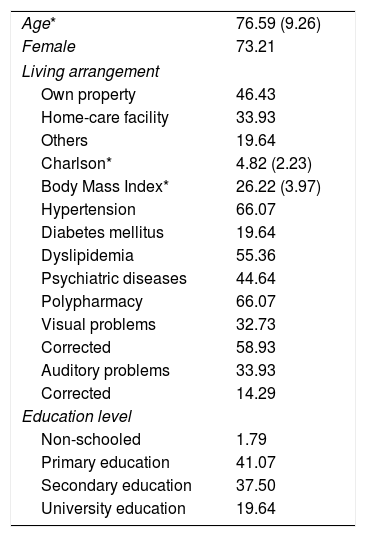
ResultsFifty-six participants were recruited, with a mean age of 76.6 (9.3), of whom 73% were women, 34% lived in residential facilities (two groups of 11 and 9 participants), and 66% lived in the community (three groups of 14, 11 and 11 participants). The average score on the Charlson Comorbidity Index was 4.8 (2.2), and 67% had polypharmacy (taking 5 or more medications). Baseline data is summarized in Table 1.
Baseline characteristics.
| Age* | 76.59 (9.26) |
| Female | 73.21 |
| Living arrangement | |
| Own property | 46.43 |
| Home-care facility | 33.93 |
| Others | 19.64 |
| Charlson* | 4.82 (2.23) |
| Body Mass Index* | 26.22 (3.97) |
| Hypertension | 66.07 |
| Diabetes mellitus | 19.64 |
| Dyslipidemia | 55.36 |
| Psychiatric diseases | 44.64 |
| Polypharmacy | 66.07 |
| Visual problems | 32.73 |
| Corrected | 58.93 |
| Auditory problems | 33.93 |
| Corrected | 14.29 |
| Education level | |
| Non-schooled | 1.79 |
| Primary education | 41.07 |
| Secondary education | 37.50 |
| University education | 19.64 |
Data is presented as percentages (%), except * which is presented as mean (SD).
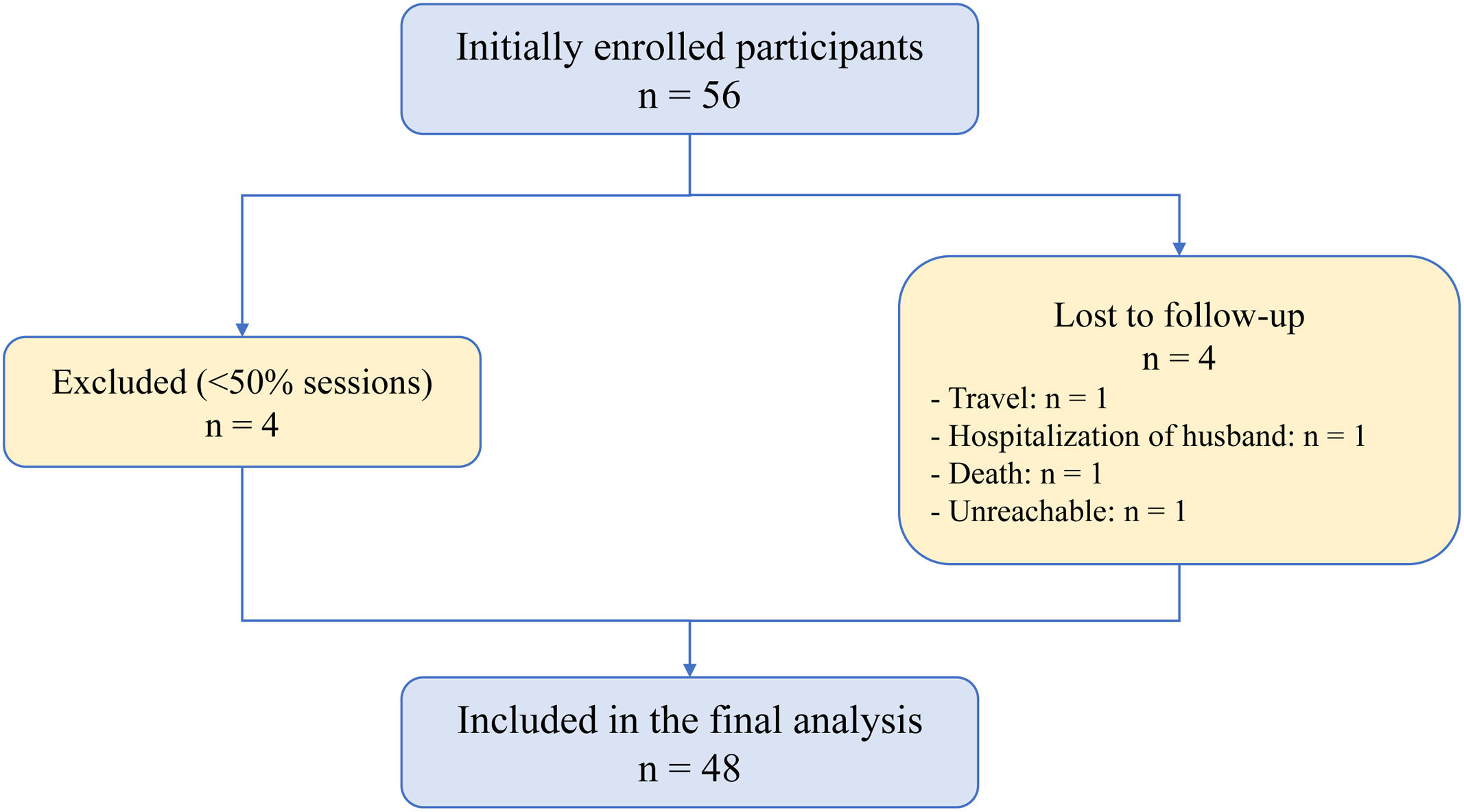
Of the 56 participants initially enrolled, complete data were obtained for 48 individuals (Fig. 1). Eight participants were excluded from the final analysis. Four participants were excluded due to attending fewer than 50% of the sessions; this threshold was predefined, as such a low level of adherence was considered insufficient for the intervention to have a meaningful impact on outcomes. The remaining four participants did not complete the post-workshop assessment for the following reasons: one participant was unable to attend due to travel, one due to a family circumstance (hospitalization of a spouse), one died as a result of a respiratory exacerbation, and one could not be contacted despite repeated attempts.

At baseline, the Kruskal–Wallis test indicated significant differences between groups for Lawton Index, SPPB, and FRAIL scores, and marginally significant differences for Barthel Index. Post-hoc pairwise comparisons using Dunn's test with Hochberg correction showed that these differences were primarily driven by group 1 (residential care centre) versus groups 2 and 4 (both community settings). Baseline characteristics of the participants who completed the study and those lost were compared, and no significant differences were found.
Physical condition and frailtyWhile Barthel Index and Lawton Index remained stable along the intervention period (median of 100 and 7–8, respectively), we found statistically significant changes in all the other physical-related assessed variables.
At the beginning of the study, 24 of the 48 assessed participants met the criteria for physical frailty measured by the SPPB (<10 points). By the end, 10 had improved beyond the frailty parameters and only 14 participants still met the criteria. SPPB median scores changed from 9.5 (IQR 7–11) to 11 (IQR 9–12) (p=0.001).
Similarly, adjusting for BMI and sex, 37 participants had low hand-grip, compared to 34 at the end of the intervention. In this case, mean grip strength increased from 20.52 (SD 0.9) to 22.58 (SD 0.86) (p<0.0001).
Finally, according to FRAIL index, prior to the program 16, 22, and 10 participants were not-frail, pre-frail and frail, respectively. After the intervention, 23, and 21 were not-frail, pre-frail, respectively, and only 4 of them remained meeting criteria for frailty. The median scores were 1 before (IQR 0–2) and after the intervention (IQR 0–1.5) (p=0.01).
Cognitive statusThe median score of MoCA scale was 20 (IQR 16–24) at the beginning of the study and 23 (IQR 20–27) at the end (p<0.001). Verbal and semantic fluency also increased from a mean of 12 (SD 0.77) to 14.1 (SD 0.82) (p<0.01) and from 15.4 (SD 0.88) to 17.2 (SD 0.85) (p<0.001), respectively.
At the beginning of the study, 43 individuals screened positive for cognitive impairment based on the MoCA scale (scoring less than 26 points) and by the end of the study, only 34 participants had scores suggesting the presence of cognitive impairment.
Well-being related variablesScores measuring quality of life significantly changed after the intervention, with EuroQol decreasing from 6 (IQR 5–8) to 5 (IQR 5–6.5) (p<0.001) and the Visual Analogue Scale increasing from 70 (IQR 60–80) to 80 (IQR 70–90) (p<0.001).
Loneliness level measured by the UCLA scale improved after the intervention from a median score of 35 (IQR 29–38) to 38 (IQR 35–39) (p<0.0001). Similarly, the median score on the Yesavage scale also improved from 2 (IQR 0.5–5) to 1 (IQR 0–2.5) (p<0.0001).
When asked if they would repeat the activity in the future, 89% responded affirmatively.
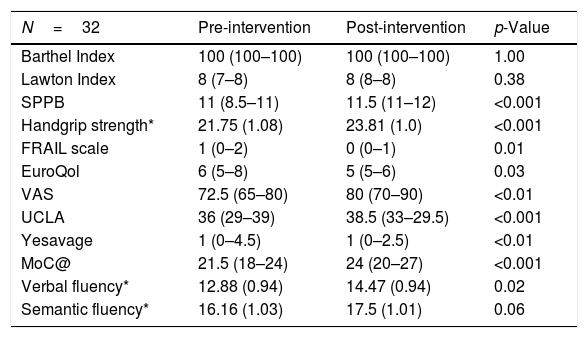
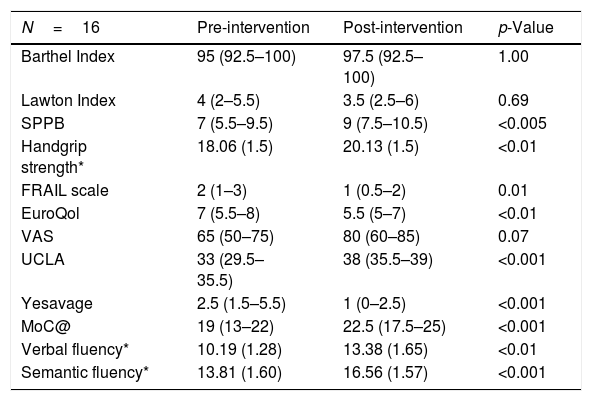
Post-hoc analysisExploratory subgroup analysis revealed significant pre-post differences only in the MoCA scale in group 2 (residential care). When examining the interventions across the two different settings (ambulatory and residential), the overall patters were similar; however, the Visual Analogue Scale showed significant improvements only in the ambulatory setting, whereas semantic fluency improvements were significant only in the residential setting (Tables 2 and 3). Nonetheless, the overall results previously reported remained robust in the sensitivity analysis, which assessed the effect of sequentially removing each group (leave-one-out) for all variables. The exception was the FRAIL scale, whose global significance was lost when either group 3 or 5 was removed, indicating that the overall effect is dependent on these two groups.
Changes in the studied variables in the ambulatory setting.
| N=32 | Pre-intervention | Post-intervention | p-Value |
|---|---|---|---|
| Barthel Index | 100 (100–100) | 100 (100–100) | 1.00 |
| Lawton Index | 8 (7–8) | 8 (8–8) | 0.38 |
| SPPB | 11 (8.5–11) | 11.5 (11–12) | <0.001 |
| Handgrip strength* | 21.75 (1.08) | 23.81 (1.0) | <0.001 |
| FRAIL scale | 1 (0–2) | 0 (0–1) | 0.01 |
| EuroQol | 6 (5–8) | 5 (5–6) | 0.03 |
| VAS | 72.5 (65–80) | 80 (70–90) | <0.01 |
| UCLA | 36 (29–39) | 38.5 (33–29.5) | <0.001 |
| Yesavage | 1 (0–4.5) | 1 (0–2.5) | <0.01 |
| MoC@ | 21.5 (18–24) | 24 (20–27) | <0.001 |
| Verbal fluency* | 12.88 (0.94) | 14.47 (0.94) | 0.02 |
| Semantic fluency* | 16.16 (1.03) | 17.5 (1.01) | 0.06 |
Data are presented as median (interquartile range), except for variables marked with * which are presented as mean (SD). Non-normally distributed variables were compared using the Wilcoxon signed-rank test, while normally distributed variables* were compared using paired t-tests. SPPB: Short Physical Performance Battery; VAS: Visual Analogue Scale.
Changes in the studied variables in the residential care setting.
| N=16 | Pre-intervention | Post-intervention | p-Value |
|---|---|---|---|
| Barthel Index | 95 (92.5–100) | 97.5 (92.5–100) | 1.00 |
| Lawton Index | 4 (2–5.5) | 3.5 (2.5–6) | 0.69 |
| SPPB | 7 (5.5–9.5) | 9 (7.5–10.5) | <0.005 |
| Handgrip strength* | 18.06 (1.5) | 20.13 (1.5) | <0.01 |
| FRAIL scale | 2 (1–3) | 1 (0.5–2) | 0.01 |
| EuroQol | 7 (5.5–8) | 5.5 (5–7) | <0.01 |
| VAS | 65 (50–75) | 80 (60–85) | 0.07 |
| UCLA | 33 (29.5–35.5) | 38 (35.5–39) | <0.001 |
| Yesavage | 2.5 (1.5–5.5) | 1 (0–2.5) | <0.001 |
| MoC@ | 19 (13–22) | 22.5 (17.5–25) | <0.001 |
| Verbal fluency* | 10.19 (1.28) | 13.38 (1.65) | <0.01 |
| Semantic fluency* | 13.81 (1.60) | 16.56 (1.57) | <0.001 |
Data are presented as median (interquartile range), except for variables marked with * which are presented as mean (SD). Non-normally distributed variables were compared using the Wilcoxon signed-rank test, while normally distributed variables * were compared using paired t-tests. SPPB: Short Physical Performance Battery; VAS: Visual Analogue Scale.
The practice of improvisational theater had multidimensional statistically significant benefits: physical, mental, social, and emotional. Following the sensitivity analysis, the results remained consistent. These benefits were observed both in participants living in the community and in those in residential care homes. Although subgroup analyses did not show statistically significant differences between settings, this is likely due to the small sample sizes within each subgroup, which may have limited the statistical power to detect such differences.
There is a joint effort to promote and implement numerous recommendations for promoting healthy aging,29,30 and having a single activity – improvisational theater – could yield benefits across multiple domains and may help reduce costs and improve compliance suggesting that it may have a meaningful impact at the public health level.
The dynamics of improvisational theater can be adapted to various cognitive and physical situations and due to its collaborative nature, it allows for a certain degree of heterogeneity among the members of the same group.
Considering the type of exercises performed in the classes, improvisational theatre aligns with what we understand as mobility training. The World Health Organization's International Classification of Functioning, Disability and Health (ICF) defines mobility as the ability to change and maintain body positions and locations (WHO, 2001).31 We found statistical and clinically significant changes in all the physical related measures – all of them remained consistent in the subgroup analysis.
This aligns with a recent review of 12 randomized controlled trial, which included 1317 participants, and found that interventions aimed at improving mobility, significantly improved SPPB scores by 1 point (95% confidence interval: 0.51–1.51).32 Similarly, multicomponent exercise has also proved to improve other physical parameters such as grip strength and frailty.33
Cognitive assessment results were generally positive and consistent across subgroup analyses, except for semantic fluency. These changes were not significant in the ambulatory care group, possibly due to the small sample size or greater baseline variability.
Noteworthy, similar interventions to improvisational theater have shown to improve cognitive abilities in comparison with physical activity classes, as seen in Keisari et al. study where mirror game exercises enhanced attention measures and improved the detection of spoken words in noisy environments.34 Improvisation can serve as a valuable strategy in dementia care, as it encourages participants to engage in activities that prioritize collaboration in the present moment rather than relying on memory. A study utilizing a single-group design demonstrated that improvisation enhanced positive emotions and diminished depressive symptoms among 178 individuals with dementia.35 While depression and its connection to cognitive and mental health have been examined for nearly two decades36 there has only recently been an increased emphasis on its relation with factors such as a sense of purpose in life,37 social engagement and loneliness.38 In this study, an improvement in participants’ mood and perceived loneliness was observed. We attribute this not only to the fact that the activity was conducted in a group setting, but also to the fostering of trust within the group, as well as the encouragement of emotional expression and collaboration. However, the low baseline scores limit the ability to draw robust conclusions regarding these aspects.
Possibly, the above-mentioned factors collectively contributed to an enhanced perception of quality of life among the participants, as evidenced by the EuroQol scale and the Visual Analog Scale (VAS) scores. However, regarding subgroup analysis VAS improvements were not consistent across settings suggesting that perceived health-related quality of life may be more sensitive to environmental and psychosocial context than other outcome measures.
Fifty-two of the fifty-six participants met the minimum adherence criteria for the program, attending at least 50% of the sessions. This implies a drop-out rate of less than 10%, which is significantly lower than the expected rates for exercise-based interventions, typically around 20–30%.39 Our study shows that motivation is an important element in achieving healthy aging. Almost 90% of ImproAging participants would repeat the activity and we believe that by enjoying Improv, it becomes an end in itself, and promotes compliance. Notably, the Finnish Geriatric Study40 and related studies within the Worldwide Fingers Trials41 have demonstrated that outcomes for older adults improve significantly when they deliberately engage in lifestyle factors that have long been associated with reduced cognitive decline.
After the study was completed, many of the members of the different groups remained in contact. They were interested in continuing the activity after the end of the 6-month period, and even went to the city hall to request funding. This suggests that Improv can provide a rich platform for effective social interaction in older adults.
Limitations and strengths of the studyAlthough our findings provide encouraging insights into the role of improvisational theatre, we must acknowledge several limitations that should be considered when interpreting the results. First, the design of the study limits internal validity and prevents us from establishing definitive causal relationships. Furthermore, since our sample was obtained through convenience and self-selection, we faced a potential selection bias; participants may have been more motivated and predisposed to engage in non-pharmacological interventions than the general population. Additionally, the absence of a formal sample size calculation means that the statistical power of the study may be limited, potentially overlooking more subtle effects. Moreover, the delivery of the intervention may also have introduced challenges regarding variability. Although we followed a standardized program and maintained regular coordination between instructors, the dynamics of five different groups are difficult to fully homogenize. We conducted specific analyses to contextualize this group-related variability, but residual effects cannot be entirely ruled out. Moreover, the study design made blinding of outcome assessment unfeasible, which may have introduced measurement bias. We also recognize that the repeated use of assessment tools could have led to a learning effect among participants, potentially influencing their scores. We also faced limitations in monitoring external variables. We did not systematically record other concurrent physical or cognitive interventions, nor did we include physiological measures such as heart rate or perceived exertion. This limits our capacity to precisely characterize the intervention's physical intensity. Furthermore, although we have described the reasons for dropout, the lack of an intention-to-treat analysis means missing data might still have influenced the final results. Lastly, taking into account our exclusion criteria and the fact that the sample consisted predominantly of physically active women, the generalizability of the findings to more diverse or sedentary populations may be limited.
Despite these limitations, we believe this study offers significant strengths. It explores a novel and relatively uncharted area, positioning improvisational theatre as a multicomponent approach that integrates physical, cognitive, emotional, and social stimulation. To ensure transparency and reproducibility, we have fully described our structured program in the supplementary material. Perhaps, most notably, the high adherence rate and low dropout suggest strong acceptability and feasibility. The core philosophy of improvisational theatre – “there is no mistake” – created a collaborative, non-judgmental environment that allowed for participation across a wide range of functional levels. This highlights its potential applicability in both community and institutional settings.
In conclusion, we view these findings as preliminary yet promising. They provide a necessary foundation for future research to employ more robust methodological designs, including controlled trials, larger samples, and long-term follow-up to further validate these benefits.
ConclusionsImprovisational theatre is an activity that combines many of the recommendations that promote healthy aging: physical exercise, cognitive stimulation, socialization, meditation and music therapy. Incorporating improvisational theater training is a valuable addition to interventions aimed at addressing the challenges posed by an aging population on a broader scale. While our findings are preliminary and exploratory, further studies with specifically designed and controlled protocols are necessary to validate these results, fully understand the long-term effects, and clarify the relationship between social connections and improvisational activities.
Ethical considerationsThis study has been approved by the local Ethics Committee (Clinical Research Ethics Committee of Navarra), project code PI_2022/147. All participants provided written informed consent to participate in the study, and the procedures were conducted in accordance with the ethical standards of the Clinical Research Ethics Committee of Navarra. Participants were informed of their right to withdraw at any time without consequence, and their data were handled in compliance with applicable data protection regulations.
FundingThis study was supported by funding from the “La Caixa” Foundation through the 2022 Art for Change Call.
Conflicts of interestThe authors declare no conflict of interest in relationship to the present study.
Data availabilityThe data for this study are not publicly available because participant consent for online data sharing was not obtained during the ethical approval process. The data are stored securely in compliance with ethical guidelines and institutional regulations, and access is restricted to protect participant confidentiality. Requests for data access may be considered on a case-by-case basis, subject to approval by the Clinical Research Ethics Committee of Navarra and in accordance with applicable data protection regulations.
Conceptualization: CMI, CC; Methodology: CMI, CC; Validation: CMI, CC; Formal analysis: CMI, CC; Investigation: CMI, CC, SLM, GAKJ, EAB; Resources: CMI; Data curation: CC; Writing – original draft: CMI, CC; Writing – review & editing: CMI, CC, SLM, GAKJ, EAB; Visualization: CMI; Supervision: CMI; Project administration: CMI; Funding acquisition: CMI.
The following are the supplementary data to this article:



