

metricas
Revista Española de Anestesiología y Reanimación Factores clínicos y relación no lineal entre edad y desenlace neurológico en ...
Información de la revista
Vol. 73. Núm. 9.
(Noviembre 2026)
Cita
Cita
Compartir
Descargar PDF
Más opciones de artículo
Visitas
90
Vol. 73. Núm. 9.
(Noviembre 2026)
Original

Factores clínicos y relación no lineal entre edad y desenlace neurológico en pacientes en coma tras un paro cardíaco

Clinical factors and the non-linear relationship between age and neurological outcome in comatose patients following cardiac arrest
Visitas
90
A. Guevara Tirado
Autor para correspondencia
albertoguevara1986@gmail.com

Autor para correspondencia.
Universidad Científica del Sur, Lima, Perú
Este artículo ha recibido
Información del artículo
Resumen
Texto completo
Bibliografía
Descargar PDF
Estadísticas
Resumen
Introducción

La edad suele incorporarse como predictor lineal o categórico después del paro cardíaco, lo que puede ocultar variaciones en su asociación con el desenlace neurológico.

Objetivo

Evaluar factores clínicos asociados con un buen desenlace neurológico y explorar su relación no lineal con la edad en pacientes comatosos tras recuperar la circulación.

Materiales y método

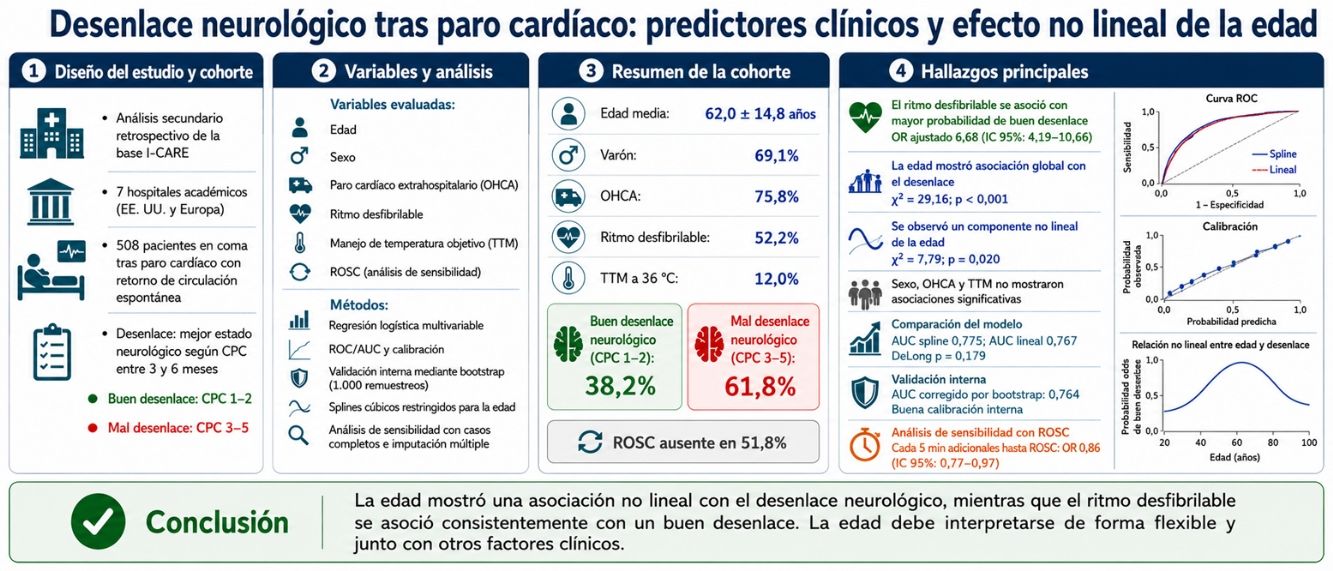
Análisis retrospectivo de 508 pacientes de la cohorte I-CARE. El desenlace fue Cerebral Performance Category (CPC) 1-2 frente a CPC 3-5, según el mejor CPC entre 3 y 6 meses. La edad se modeló mediante splines cúbicos restringidos con 4 nodos. Se evaluaron discriminación, calibración y optimismo mediante 1.000 remuestreos bootstrap. El tiempo hasta el retorno de la circulación espontánea (ROSC), ausente en el 51,8%, se examinó en análisis de sensibilidad.

Resultados

El 38,2% presentó CPC 1-2. La edad mostró asociación con el desenlace (χ2=29,16; p<0,001) y no linealidad (χ2=7,79; p=0,020). El ritmo desfibrilable se asoció con mayor probabilidad de buen desenlace (OR ajustado=6,68; IC95%: 4,19-10,66). El AUC fue 0,775 para el modelo spline y 0,767 para el lineal, sin diferencia significativa (p=0,179); el AUC corregido por optimismo fue 0,764. En la imputación múltiple, cada 5min adicionales hasta ROSC se asociaron con menor probabilidad de buen desenlace (OR=0,86; IC95%: 0,77-0,97).

Conclusiones

La edad mostró una asociación no lineal con el desenlace neurológico, y el modelado flexible mejoró el ajuste, aunque no la discriminación. El ritmo desfibrilable fue el factor más asociado con un buen desenlace.

Palabras clave:
Paro cardíaco
Coma
Pronóstico
Fibrilación ventricular
Edad
Abstract
Introduction

Age is often incorporated as a linear or categorical predictor after cardiac arrest, which may obscure variations in its association with neurological outcome.

Objective

To evaluate clinical factors associated with good neurological outcome and explore its nonlinear relationship with age in comatose patients after return of spontaneous circulation.

Materials and method

Retrospective analysis of 508 patients from the I-CARE cohort. The outcome was Cerebral Performance Category (CPC) 1–2 versus CPC 3–5, based on the best CPC recorded between 3 and 6 months. Age was modeled using restricted cubic splines with four knots. Discrimination, calibration, and optimism were assessed using 1,000 bootstrap resamples. Time to return of spontaneous circulation (ROSC), missing in 51.8%, was examined in sensitivity analyses.

Results

CPC 1–2 occurred in 38.2%. Age was associated with outcome (χ2=29.16; p<0.001) and showed nonlinearity (χ2=7.79; p=0.020). A shockable rhythm was associated with a higher probability of good outcome (adjusted OR=6.68; 95% CI: 4.19–10.66). The AUC was 0.775 for the spline model and 0.767 for the linear model, with no significant difference (p=0.179); the optimism-corrected AUC was 0.764. In multiple imputation, each additional five minutes to ROSC was associated with a lower probability of good outcome (OR=0.86; 95% CI: 0.77–0.97).

Conclusions

Age showed a nonlinear association with neurological outcome, and flexible modeling improved model fit, although not discrimination. Shockable rhythm was the factor most strongly associated with good outcome.

Keywords:
Heart Arrest
Coma
Prognosis
Ventricular Fibrillation
Age
Resumen gráfico

Artículo

Opciones para acceder a los textos completos de la publicación Revista Española de Anestesiología y Reanimación
Suscriptor
Suscriptor de la revista

Si ya tiene sus datos de acceso, clique aquí.

Si olvidó su clave de acceso puede recuperarla clicando aquí y seleccionando la opción "He olvidado mi contraseña".
Comprar
Comprar acceso al artículo

Comprando el artículo el PDF del mismo podrá ser descargado

Comprar ahora
Contactar
Teléfono para suscripciones e incidencias
De lunes a viernes de 9h a 18h (GMT+1) excepto los meses de julio y agosto que será de 9 a 15h
Llamadas desde España
932 415 960
Llamadas desde fuera de España
+34 932 415 960
E-mail
Bibliografía
[1]
L. Wang, J. Liu, P. Yin, et al.
Mortality risk and burden of sudden cardiac arrest associated with hot nights, heatwaves, cold spells, and non-optimum temperatures in 0.88 million patients: an individual-level case-crossover study.
Sci Total Environ., 949 (2024),
[2]
M.S.B. Faheem, T. Asghar, F. Feroze, et al.
Trends in mortalities due to sudden cardiac arrest in the United States population.
J Arrhythm., 41 (2025),
[3]
S. Kortli, P. Nasa.
The neurological phoenix: multimodal strategies for brain recovery and prognostication in post-cardiac arrest syndrome—a 2025 clinical framework.
Front Med (Lausanne)., 13 (2026),
[4]
S. Khayat Kakhki, M. Daneshfar, M. Yousefnezhad, A. NamaeiQasemnia.
Incidence and prognostic impact of delirium after cardiac arrest: a systematic review and meta-analysis.
Resusc Plus., 27 (2026),
[5]
A. Fasolino, S. Compagnoni, E. Baldi, et al.
Updates on post-resuscitation care: after the return of spontaneous circulation beyond the 2021 guidelines.
Rev Cardiovasc Med., 23 (2022), pp. 373
[6]
J.P. Nolan, C. Sandroni, B.W. Böttiger, et al.
European Resuscitation Council and European Society of Intensive Care Medicine guidelines 2021: post-resuscitation care.
Intensive Care Med., 47 (2021), pp. 369-421
[7]
W.J. Choi, J.H. Lee, Korean Hypothermia Network Investigators.
The prediction of early neurological outcomes in out-of-hospital cardiac arrest patients: a multicenter prospective cohort study by the KORHN registry.
J Clin Med., 14 (2025),
[8]
S. Katzenschlager, N. Kaltschmidt, S. Orlob, et al.
Factors for good neurological outcome in adult OHCA with initial shockable rhythm: a retrospective multicenter cohort study from the German Resuscitation Registry.
Resusc Plus., 25 (2025), pp. 101022
[9]
A.F.W. Ho, K.Y. Lee, S. Nur, et al.
Association between conversion to shockable rhythms and survival with favorable neurological outcomes for out-of-hospital cardiac arrests.
Prehosp Emerg Care., 28 (2024), pp. 126-134
[10]
Y. Kato, S.-I. Miura, A. Hirayama, et al.
Comparison of clinical outcomes between patients with pulseless ventricular tachycardia and ventricular fibrillation in out-of-hospital cardiac arrest.
Resusc Plus., 6 (2021), pp. 100107
[11]
H. Miyoshi, M. Nishikimi, K. Kikutani, S. Ohshimo, N. Shime.
Changes in neurological status from 30 to 90 days post-cardiac arrest by age: a nationwide retrospective observational study.
Resusc Plus., 22 (2025),
[12]
K.G. Hirsch, E. Amorim, P.J. Coppler, et al.
Part 11: Post-cardiac arrest care: 2025 American Heart Association guidelines for cardiopulmonary resuscitation and emergency cardiovascular care.
Circulation., 152 (2025), pp. S673-S718
[13]
Y.-J. Kim, Y. Jung, B.K. Lee, C.S. Youn, W.Y. Kim.
Early prognostication after out-of-hospital cardiac arrest: modified rCAST score incorporating age and brainstem reflexes.
J Clin Med., 14 (2025), pp. 6830
[14]
S.W. Terman, T.A. Shields, B. Hume, R. Silbergleit.
The influence of age and chronic medical conditions on neurological outcomes in out-of-hospital cardiac arrest.
Resuscitation., 89 (2015), pp. 169-176
[15]
B. Kiss, Á. Pál-Jakab, B. Nagy, et al.
Age-treatment interactions in out-of-hospital cardiac arrest: a nationwide registry analysis.
J Clin Med., 15 (2026), pp. 705
[16]
K. Jang, H.-M. Hwang, Y.H. Seo.
Factors affecting neurological outcomes of patients with sudden cardiac arrest in the emergency department.
BMC Emerg Med., 24 (2024), pp. 167
[17]
P. Andersson, J. Johnsson, O. Björnsson, et al.
Predicting neurological outcome after out-of-hospital cardiac arrest with cumulative information: development and internal validation of an artificial neural network algorithm.
[18]
C. Sandroni, S. D’Arrigo, S. Cacciola, et al.
Prediction of good neurological outcome in comatose survivors of cardiac arrest: a systematic review.
Intensive Care Med., 48 (2022), pp. 389-413
[19]
S.A. Amacher, R. Blatter, M. Briel, et al.
Predicting neurological outcome in adult patients with cardiac arrest: systematic review and meta-analysis of prediction model performance.
[20]
E. Amorim, W.-L. Zheng, J.W. Lee, et al.
I-CARE: International Cardiac Arrest REsearch consortium Database. Version 2.1.
PhysioNet., (2023),
[21]
E. Amorim, W.-L. Zheng, J.W. Lee, et al.
The International Cardiac Arrest Research Consortium Electroencephalography Database.
Crit Care Med., 51 (2023), pp. 1802-1811
[22]
C.-H. Wang, T.-C. Lu, J. Tay, et al.
Prognostic impact of heart rhythm shockability trajectory in out-of-hospital cardiac arrest: a multicenter retrospective study.
Circ Cardiovasc Qual Outcomes., 17 (2024),
[23]
C. Sandroni, T. Cronberg, M. Sekhon.
Brain injury after cardiac arrest: pathophysiology, treatment, and prognosis.
Intensive Care Med., 47 (2021), pp. 1393-1414
[24]
A.K. Ayyappan Unnithan.
Update on hypoxic-ischemic brain injury: prognosis and management.
World J Methodol., 16 (2026),
[25]
F.J.P. Teixeira, B. Ahmad, V. Gibatova, et al.
Do neuroprognostic studies account for self-fulfilling prophecy bias in their methodology? The SPIN protocol for a systematic review.
Crit Care Explor., 5 (2023),
asdasdasd
Opciones de artículo
Herramientas

