

metricas
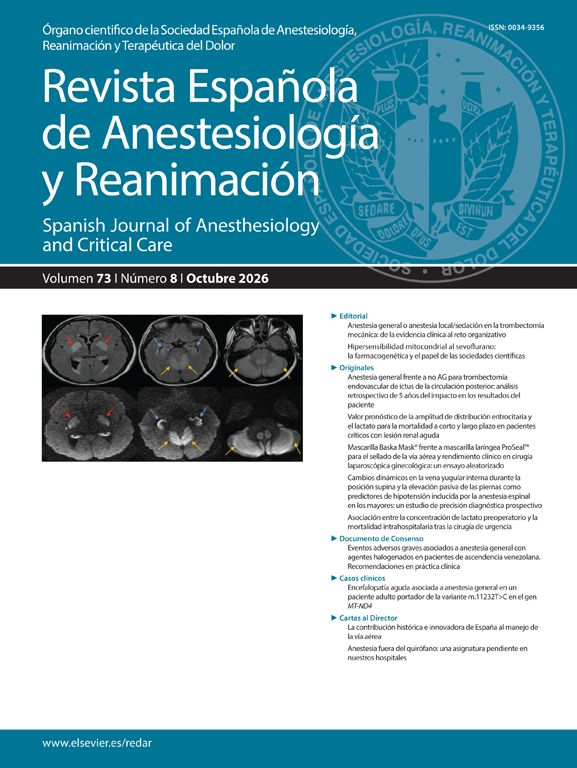
Revista Española de Anestesiología y Reanimación Encefalopatía aguda asociada a anestesia general en un paciente adulto portador...
Información de la revista
Vol. 73. Núm. 8.
(Octubre 2026)
Cita
Cita
Compartir
Descargar PDF
Más opciones de artículo
Visitas
1079
Vol. 73. Núm. 8.
(Octubre 2026)
Caso clínico

Encefalopatía aguda asociada a anestesia general en un paciente adulto portador de la variante m.11232T>C en el gen MT-ND4

An adult case of acute encephalopathy associated with general anesthesia and the m.11232T>C MT-ND4 variant
Visitas
1079
I. Arranz Chamorroa,
Autor para correspondencia
irene.arranzchamorro@gmail.com

Autor para correspondencia.
, P. Blanco-Schweizerb, E. Ruiz Pesinic, M. Busto Bustoa, T. Ticona Espinozab, J. Rodríguez Jiménezd
a Servicio de Anestesiología y Reanimación, Hospital Río Hortega de Valladolid, Valladolid, España
b Servicio de Medicina Intensiva, Hospital Río Hortega de Valladolid, Valladolid, España
c Departamento de Bioquímica y Biología Molecular y Celular, Universidad de Zaragoza, Zaragoza, España
d Servicio de Radiodiagnóstico, Hospital Río Hortega de Valladolid, Valladolid, España
Este artículo ha recibido
Información del artículo
Resumen
Texto completo
Bibliografía
Descargar PDF
Estadísticas
Resumen

Se presenta el caso de una mujer de 20 años que desarrolló encefalopatía aguda tras anestesia general con sevoflurano, propofol y opioides, sin incidencias intraoperatorias. La paciente presentó deterioro neurológico severo seguido de acidosis metabólica e hiperlactacidemia y hallazgos radiológicos compatibles con afectación de ganglios basales, tronco del encéfalo y cerebelo. El estudio genético confirmó la presencia de la variante mitocondrial m.11232T>C en el gen MT-ND4, previamente descrita únicamente en población pediátrica. Este caso podría ser uno de los primeros casos descritos en la literatura de encefalopatía aguda asociada a esta mutación en un paciente adulto, posiblemente precipitada por exposición a anestésicos volátiles. La evolución clínica y radiológica favorable tras neuroprotección intensiva y craniectomía descompresiva suboccipital respalda la importancia del diagnóstico precoz y del manejo individualizado. Es importante considerar la disfunción mitocondrial ante cuadros neurológicos atípicos tras anestesia general, especialmente en pacientes con hiperlactacidemia y antecedentes familiares compatibles.

Palabras clave:
Mutación MT-ND4
Variante m.11232T>C
Enfermedad mitocondrial
Mutación del ADN mitocondrial
Encefalopatía tóxico-metabólica
Síndrome de CHANTER
Sevoflurano
Trastornos metabólicos perioperatorios y acidosis láctica
Abstract

We report the case of a 20-year-old woman who developed acute encephalopathy after uneventful general anesthesia with sevoflurane, propofol, and opioids. The patient presented neurological impairment followed by metabolic acidosis and hyperlactatemia and neuroimaging findings involving the basal ganglia, brainstem, and cerebellum. Genetic testing confirmed the mitochondrial variant m.11232T>C in the MT-ND4 gene, previously described only in pediatric patients. This case could be one of the first cases described in the literature of acute encephalopathy associated with this mutation in an adult patient, possibly precipitated by exposure to volatile anesthetics. The patient's favorable clinical and radiological evolution after intensive neuroprotective management and suboccipital decompressive craniectomy highlights the importance of early diagnosis and individualized treatment. Mitochondrial dysfunction should be considered in atypical neurological presentations following general anesthesia, especially when accompanied by lactic acidosis and unusual neuroimaging findings.


Keywords:
MT-ND4 mutation
m.11232T>C variant
Mitochondrial disease
Mitochondrial DNA mutation
Toxic–metabolic encephalopathy
CHANTER syndrome
Sevoflurane
Perioperative metabolic disorders and lactic acidosis

Artículo

Opciones para acceder a los textos completos de la publicación Revista Española de Anestesiología y Reanimación
Suscriptor
Suscriptor de la revista

Si ya tiene sus datos de acceso, clique aquí.

Si olvidó su clave de acceso puede recuperarla clicando aquí y seleccionando la opción "He olvidado mi contraseña".
Comprar
Comprar acceso al artículo

Comprando el artículo el PDF del mismo podrá ser descargado

Comprar ahora
Contactar
Teléfono para suscripciones e incidencias
De lunes a viernes de 9h a 18h (GMT+1) excepto los meses de julio y agosto que será de 9 a 15h
Llamadas desde España
932 415 960
Llamadas desde fuera de España
+34 932 415 960
E-mail
Bibliografía
[1]
Sociedad Española de Anestesiología, Reanimación y Terapéutica del Dolor (SEDAR). Comité Ejecutivo SEDAR; Comité Científico Permanente SEDAR; Grupo de Trabajo mtND4-Anestesia Pediátrica. Alerta médica: mutación genética en niños de procedencia venezolana y complicaciones anestésicas.
SEDAR, (2025),
[2]
E. Ruiz-Pesini, E. López-Gallardo, Y. Dahmani, et al.
Diseases of the human mitochondrial oxidative phosphorylation system.
Rev Neurol., 43 (2006), pp. 416-424
[3]
N.G. Larsson, A. Olfors.
Mitochondrial myopathies.
Acta Physiol Scand., 171 (2001), pp. 385-393
[4]
G. Lenaz, R. Fato, M.L. Genova, C. Bergamini, C. Bianchi, A. Biondi.
Mitochondrial complex I: structural and funcional aspects.
Biochim Biophys Acta., 1757 (2006), pp. 1406-1420
[5]
P.J. Hanley, J. Ray, U. Brandt, J. Daut.
Halothane, isoflurane and sevo-furane inhibit NADH: ubiquinone oxidoreductase (complex I) of cardiac mitochondria.
Physiol., 544 (2002), pp. 687-693
[6]
A. Fedorov, A. Lehto, J. Klein.
Inhibition of mitochondrial respiration by general anesthetic drugs.
Naunyn Schmiedebergs Arch Pharmacol., 396 (2023), pp. 375-381
[7]
J.-I. Kishikawa, Y. Inoue, M. Fujikawa, et al.
General anesthetics cause mitochondrial dysfunction and reduction of intracellular ATP levels.
PLoS One., 13 (2018), pp. e0190213
[8]
A.W. El-Hattab, A.M. Adesina, J. Jones, F. Scaglia.
MELAS syndrome: Clinical manifestations, pathogenesis, and treatment options.
Mol Genet Metab., 116 (2015), pp. 4-12
[9]
P. Sharma, R.K. Saran, R. Sharma, R.K. Gupta.
Toxic and acquired metabolic encephalopathies: MRI features.
AJR Am J Roentgenol., 193 (2009), pp. 879-886
[10]
T.J.E. Muttikkal, M. Wintermark.
MRI patterns of global hypoxic-ischemic injury in adults.
Neuroradiology., 55 (2013), pp. 663-670
[11]
K.S. Mallikarjun, M.S. Parsons, Z. Nigogosyan, M.S. Goyal, R. Eldaya.
Neuroimaging findings in CHANTER syndrome: a case series.
Am J Neuroradiol., 43 (2022), pp. 1136-1141
[12]
M. Meadow, M. Tsai, S. Carter.
Chanter syndrome in a cocaine positive patient.
Radiol Case Rep., 20 (2025), pp. 4123-4127
[13]
A.S. Jasne, S.A. Kennedy, S.L. Zuckerman, et al.
CHANTER syndrome: a distinct pattern of opioid-related toxic leukoencephalopathy.
AJNR Am J Neuroradiol., 40 (2019), pp. 1016-1022
[14]
L.J. Morgenstern, et al.
Suboccipital Decompressive Craniectomy for Cerebellar Infarction: A Systematic Review and Meta-Analysis.
[15]
D. Lindeskog, A. Lilja-Cyron, J. Kelsen, M. Juhler.
Long-term functional outcome after decompressive suboccipital craniectomy for space-occupying cerebellar infarction.
Clin Neurol Neurosurg., 176 (2019), pp. 47-52
[16]
W.J. Powers, A.A. Rabinstein, T. Ackerson, on behalf of the American Heart Association Stroke Council, et al.
Guidelines for the early management of patients with acute ischemic stroke: 2019 update to the 2018 guidelines for the early management of acute ischemic stroke: a guideline for healthcare professionals from the American Heart Association/American Stroke Association.
Stroke., 50 (2019), pp. e344-e418
asdasdasd
Opciones de artículo
Herramientas
