




The first objective was to investigate the association between cognitive performance and disease-related factors in fibromyalgia (FM). The second objective was to compare non-cognitive impairment group with mild cognitive impairment group in FM.
Material and methodsForty-nine FM female participants were included. Individuals with FM were divided into two groups. Scores of 23 or higher were defined as non-cognitive impairment group, and scores below 23 were defined as mild cognitive impairment group. The non-cognitive impairment group had 20 FM, and the mild cognitive impairment group had 29 FM. Body mass index, Montreal Cognitive Assessment (MoCA) Test, Fibromyalgia Impact Questionnaire (FIQ), Widespread Pain Index (WPI), Symptom Severity Scale (SSS), Multidimensional Assessment of Fatigue (MAF), Beck Anxiety Inventory (BAI), Pittsburgh Sleep Quality Index (PSQI), Biopsychosocial Questionnaire (BETY-BQ), Short Form-36 (SF-36), Timed Up and Go Test (TUG), and dual-task performance were assessed.
ResultsMoCA had low-level correlation with WPI (r: −0.424; p: 0.003), SSS (r: −0.319; p: 0.031), BAI (r: −0.316; p: 0.028), BETY-BQ (r: −0.345; p: 0.016), TUG (r: −0.379; p: 0.012), and dual-task performance (r: −0.294; p: 0.045). The intergroup comparison revealed a difference in favor of non-cognitive impairment group in BETY-BQ (p: 0.033). In multiple regression analysis, the greatest contribution to the model of MoCA came from WPI (Beta: −0.395; p: 0.005). The model explains approximately 15.6% of the variance in the dependent variable (MoCA).
ConclusionCognitive performance of FM might be associated with pain, symptom severity, anxiety, biopsychosocial condition, mobility, and dual-task performance. Cognitive status could make a difference in biopsychosocial condition. Widespread pain made the greatest contribution for cognitive performance.
El primer objetivo de este estudio fue investigar la asociación entre el estado cognitivo y los factores relacionados con la enfermedad en personas con fibromialgia (FM). El segundo objetivo fue comparar el grupo sin deterioro cognitivo con el grupo con deterioro cognitivo leve en pacientes con FM.
Material y métodosSe incluyeron cuarenta y nueve participantes femeninas con fibromialgia (FM). Las personas con FM se dividieron en dos grupos. Las puntuaciones de 23 o superiores se definieron como el grupo sin deterioro cognitivo, y las puntuaciones inferiores a 23 como el grupo con deterioro cognitivo leve. El grupo sin deterioro cognitivo tenía 20 FM, y el grupo con deterioro cognitivo leve tenía 29 FM. Se evaluaron el índice de masa corporal, la prueba de evaluación cognitiva de Montreal (MoCA), el cuestionario de impacto de la fibromialgia (FIQ), el índice de dolor generalizado (WPI), la escala de gravedad de los síntomas (SSS), la escala de evaluación multidimensional de la fatiga (MAF), el inventario de ansiedad de Beck (BAI), el índice de calidad del sueño de Pittsburgh (PSQI), el cuestionario biopsicosocial (BETY-BQ), el formulario corto SF-36 (SF-36), la prueba de levantarse y caminar cronometrada (TUG) y el rendimiento en tareas duales.
ResultadosEl MoCA mostró una correlación baja con el WPI (r: −0,424; p: 0,003), el SSS (r: −0,319; p: 0,031), el BAI (r: −0,316; p: 0,028), el BETY-BQ (r: −0,345; p: 0,016), el TUG (r: −0,379; p: 0,012) y el rendimiento en tareas duales (r: −0,294; p: 0,045). La comparación intergrupal reveló una diferencia a favor del grupo sin mejoría cognitiva en el BETY-BQ (p: 0,033). En el análisis de regresión múltiple, la mayor contribución al modelo de MoCA provino de WPI (Beta: −0,395; p: 0,005). El modelo explica aproximadamente el 15,6% de la varianza en la variable dependiente (MoCA).
ConclusiónEl rendimiento cognitivo de las personas con fibromialgia podría estar asociado con el dolor, la gravedad de los síntomas, la ansiedad, el estado biopsicosocial, la movilidad y el desempeño en tareas duales. El estado cognitivo podría influir en el estado biopsicosocial. El dolor generalizado fue el factor que más influyó en el rendimiento cognitivo.
Fibromyalgia (FM) is a disease characterized by chronic musculoskeletal pain, accompanied by symptoms such as fatigue, sleep problems, cognitive dysfunction, and mood disorders like anxiety and depression [1].
FM is considered as a central sensitization syndrome, involving central nervous system dysfunction and peripheral sensitization. This dysfunction stems from factors like plasticity, neuroinflammation, and neurostructural changes due to chronic pain or stress. These alterations affect memory, pain perception, and cognitive function by impacting cortical and subcortical regions [2,3].
Cognitive problems are observed in the majority of FM patients. At least 76% of FM patients report difficulties with concentration, forgetfulness, mental confusion, or a combination of these complaints [4,5]. Additionally, patients report processing information less efficiently, having difficulty in remembering things, and being unable to perform challenging cognitive tasks at previous levels. Many patients emphasize that cognitive dysfunction is a symptom more distressing and inhibitory than pain [6]. Especially clinicians have begun to address cognitive dysfunction observed in FM as a distinct clinical condition. The cognitive performance of FM patients is evaluated as significantly worse when compared not only with healthy controls, but also with individuals with other rheumatic diseases or chronic pain problems [7]. Self-reported cognitive difficulties were also associated with greater pain, stiffness, poor sleep and anxious-depressive symptoms [5]. Body mass index (BMI) may also influence cognitive performance, particularly at overweight and obesity levels (BMI >25kg/m2) [8]. Although overweight and obesity is common in FM [9], its association with cognitive impairment remains inconsistent [10]; therefore, BMI can be considered a secondary factor that may influence the clinical presentation in FM.
Studies have shown that individuals with FM experience decreased mobility and difficulties in performing daily life activities. Furthermore, most daily activities that involve both motor and cognitive processing simultaneously, referred to as dual tasks, are frequently affected in FM [11]. Gaining a better understanding of cognitive function performance and the associated factors underlying it can provide additional insights into the etiology of symptoms and the management of FM. The first aim of this study was to investigate the association between cognitive status and body mass index, functional status, pain, symptom severity, fatigue, anxiety, sleep quality, biopsychosocial condition, quality of life, mobility, and dual-task performance in individuals with FM. The second objective was to compare non-cognitive impairment group with mild cognitive impairment group in FM.
MethodsStudy designThe study design was a cross-sectional, observational study, and the sampling method was specified as convenience sampling.
ParticipantsThe study was included individuals with FM. Participants were recruited using a convenience sampling method from patients attending the rheumatology outpatient clinic. Individuals with FM were divided into two groups. Scores of 23 or higher were defined as the non-cognitive impairment group, and scores below 23 were defined as the mild cognitive impairment group. Inclusion criteria were (a) diagnosed with FM by a rheumatologist according to the 2016 American College of Rheumatology (ACR) classification criteria (b) being women, (c) between 18 and 65 years of age and (d) participating voluntarily in the study. Exclusion criteria were (a) the presence of concurrent autoimmune or inflammatory diseases, cardiovascular, pulmonary, orthopedic, or neurological disorders that significantly affect their physical condition (b) having cognitive impairment that affects cooperation (c) being pregnant (d) undergoing any surgical history within the last six months.
According to the Helsinki Declaration of 1975, as revised in 1983, the local ethical committee determined at the meeting that there was no ethical problem for the study to be carried out (decision no:14, dated: 09.05.2023). All patients were informed verbally and informed consent forms were signed.
AssessmentsAll evaluations were performed by the same physiotherapists via structured interview. After the demographic data of the participants was recorded, cognitive status was assessed using the Montreal Cognitive Assessment (MoCA) test, functional status with the Fibromyalgia Impact Questionnaire (FIQ), and the Widespread Pain Index (WPI), symptom severity with Symptom Severity Scale (SSS), their fatigue levels with the Multidimensional Assessment of Fatigue (MAF), anxiety levels with the Beck Anxiety Inventory (BAI), sleep quality with the Pittsburgh Sleep Quality Index (PSQI), biopsychosocial status with the Biopsychosocial Questionnaire (BETY-BQ), quality of life with the Short Form-36 (SF-36), mobility with the Timed Up and Go Test (TUG), and their dual-task performance by being asked to count backward from 100 by twos during the TUG assessment.
Montreal Cognitive Assessment (MoCA)The MoCA has been developed as a rapid screening test for mild cognitive impairment. This test assesses attention and concentration across eight different cognitive domains: executive functions, memory, language, visual spatial skills, abstract thinking, calculation, and orientation. The application takes about 10min. The maximum possible score on the test is 30. In a study where a systematic review and meta-analysis of the literature was conducted, a MoCA cutoff score of 23 was determined instead of the initially recommended score of 26 [12]. Scores of 23 or higher were defined as the non-cognitive impairment group, and scores below 23 were defined as the mild cognitive impairment group. The Turkish validity and reliability study of the MoCA was conducted by Selekler et al. [13].
Fibromyalgia Impact Questionnaire (FIQ)FIQ includes 10 items evaluating the health status and physical function ranging from 0 to 100. Higher scores indicate a lower functionality on the disease [14]. The FIQ is a reliable and valid instrument for measuring functional disability in Turkish FM patients [15].
Widespread Pain Index (WPI)This index evaluates the patient's pain across 19 regions during the previous week. Each region corresponds to a score of 1. The scores are added together to produce a total score ranging from 0 to 19, where higher scores indicate more extensive pain throughout the body. The Widespread Pain Index is utilized in conjunction with the Symptom Severity Scale as a diagnostic tool to assess FM [16].
Symptom Severity Scale (SSS)This scale consists of three questions related to fatigue, waking up tired, and cognitive symptoms, each represented on a scale of 0=no problem at all, 1=mild problem, 2=moderately important problem, and 3=severe problem. Additionally, the scale inquires about the presence of headaches, lower abdominal pain and cramps, and depression over the past six months, which are scored as “present (1 point)” or “absent (0 points).” The total score is calculated on a scale of 0–12 with higher scores indicating greater symptom severity [17].
Multidimensional Assessment of Fatigue (MAF)This scale has 16 items and measures four dimensions of fatigue: severity, distress, degree of interference in activities of daily living, and timing. Items 1–14 in the assessment consist of 10-point numerical rating scales, while items 15–16 require multiple-choice responses. The 10-point numerical rating scale range from 1 (not at all) to 10 (a great deal). Higher score indicates extreme fatigue. The MAF is a valid and reliable scale for assessing fatigue in chronic musculoskeletal physical therapy patients [18].
Beck Anxiety Inventory (BAI)BAI includes 21 questions evaluating the level of anxiety. Each question is rated between 0 (not at all) and 3 (severely). Higher scores indicate a severe anxiety level. The BAI is reliable and valid measure of anxiety in the Turkish population [19].
Pittsburgh Sleep Quality Index (PSQI)This scale evaluates sleep quality over a one-month period. It consists of global and seven component scores, including subjective sleep quality, sleep latency, sleep duration, sleep efficiency, sleep disturbances, use of sleeping medications, and daytime dysfunction. Each component is scored on a scale from 0 to 3, with a higher score indicating poorer sleep quality. The Turkish version of the PSQI is valid and reliable in the Turkish population [20].
Biopsychosocial Questionnaire (BETY-BQ)This scale, developed in Turkish, consists of 30 items and is used to evaluate the disease-related biopsychosocial process. Higher scores indicate a poorer biopsychosocial status of patients. The validity and reliability of this scale in FM were assessed by Unal in 2017 [21].
Short Form-36 (SF-36)This scale assesses the quality of life, where “100 points” indicate a good health status, and “0 points” indicate a poor health status. The SF-36 physical component comprises Physical Functioning, Role Physical, Bodily Pain, and General Health scales, while the mental component includes Mental Health, Role Emotional, and Social Functioning scales. In the study physical and mental component scores were used as subgroup measures [22].
Timed Up and Go Test (TUG)This test is a performance-based measure of functional mobility. Participants stand up from a chair without using arm rests. Then, they walk 3 meters as quickly as possible (no running), turn around, walk back to the chair, and sit down again [23]. In the dual-task condition, they count backward by two from 100 while performing the TUG test. The score for both tests is recorded as the time (s) it took for the subjects to complete them.
Sample sizePower analysis was performed using the G-Power 3.1 program to determine the sample size of the study. As a result of the power analysis based on TUG dual-task cognitive performance, it was calculated that minimum of 49 subjects must have been enrolled to have 80% power with 5% type 1 error level [8].
Statistical analysisThe SPSS statistical package version 22.0 (IBM Corp., Armonk, NY, USA) was used to analyze the data. The Kolmogorov–Smirnov test was used to determine whether the continuous variables were normal distributions. Continuous variables were expressed as mean±SD for normal distributions and median (minimum–maximum) for non-normal distributions. The categorical variables were expressed in numbers and percentage. The correlation between continuous variables were examined with Spearman or Pearson correlation analysis. Correlation was categorized as low (r: 0.10–0.49), moderate (r: 0.50–0.69), or high (r: 0.70–1.00) [24]. Multiple linear regression was used to identify the strongest association with the dependent variable (MoCA) and rank them in order of importance. Variables that were significantly correlated with the dependent variable (MoCA) in the correlation analysis (p<0.05) were selected for inclusion in the multiple regression model. The independent variables in the model were WPI, SSS, BAI, BETY-BQ, TUG, and dual-task TUG. Prior to regression analysis, the assumptions of linear regression were evaluated. The independence of residuals was assessed using the Durbin–Watson statistic, and multicollinearity was examined using tolerance and variance inflation factor (VIF) values. Regression results were reported as unstandardized coefficients (B), standardized coefficients (β), 95% confidence intervals (95% CIs), t-values, F-statistic, correlation coefficient (R), coefficient of determination (R2), and p-values.
When parametric test assumptions were met, the Independent Samples t Test was used to compare differences between independent groups; when parametric test assumptions were not met, the Mann–Whitney U test was used to compare differences between independent groups. Statistical significance was set at p<0.05.
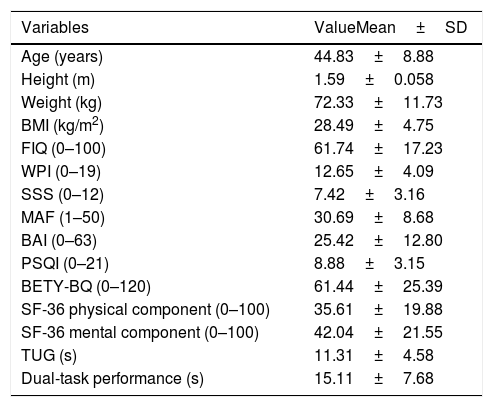
ResultsThe study included 49 participants (mean age: 44.83±8.88 years) diagnosed with FM. Demographic and descriptive data of outcome measures are shown in Table 1. The non-cognitive impairment group had 20 individuals with FM, and the mild cognitive impairment group had 29 individuals with FM.
Demographic and outcome measures data for individuals with fibromyalgia (n=49).
| Variables | ValueMean±SD |
|---|---|
| Age (years) | 44.83±8.88 |
| Height (m) | 1.59±0.058 |
| Weight (kg) | 72.33±11.73 |
| BMI (kg/m2) | 28.49±4.75 |
| FIQ (0–100) | 61.74±17.23 |
| WPI (0–19) | 12.65±4.09 |
| SSS (0–12) | 7.42±3.16 |
| MAF (1–50) | 30.69±8.68 |
| BAI (0–63) | 25.42±12.80 |
| PSQI (0–21) | 8.88±3.15 |
| BETY-BQ (0–120) | 61.44±25.39 |
| SF-36 physical component (0–100) | 35.61±19.88 |
| SF-36 mental component (0–100) | 42.04±21.55 |
| TUG (s) | 11.31±4.58 |
| Dual-task performance (s) | 15.11±7.68 |
SD: standard deviation; BMI: body mass index; FIQ: Fibromyalgia Impact Questionnaire; WPI: Widespread Pain Index; SSS: Symptom Severity Scale; MAF: Multidimensional Assessment of Fatigue; BAI: Beck Anxiety Index; PSQI: Pittsburgh Sleep Quality Index; BETY-BQ: Biopsychosocial Questionnaire; TUG: Timed Up and Go Test.
The mean values and standard deviations of FM individuals were as follows: body mass index 28.49±4.75, MoCA 20.19±6.08, FIQ 61.74±17.23, WPI 12.65±4.09, SSS 7.42±3.16, MAF 30.69±8.68, BAI 25.42±12.80, PSQI 8.88±3.15, BETY-BQ 61.44±25.39, SF-36 physical component 35.61±19.88, SF-36 mental component 42.04±21.55, TUG 11.31±4.58, dual-task TUG 15.11±7.68 (Table 1).
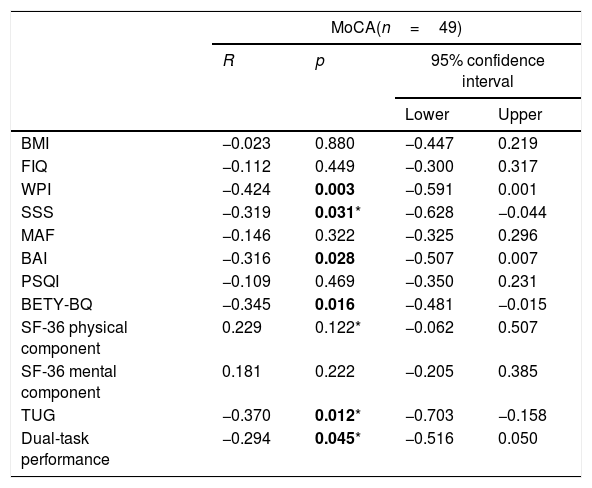
In correlation analysis, MoCA had low correlation with WPI (r: −0.424; p: 0.003), SSS (r: −0.319; p: 0.031), BAI (r: −0.316; p: 0.028), BETY-BQ (r: −0.345; p: 0.016), TUG (r: −0.379; p: 0.012) and dual-task performance (r: −0.294; p: 0.045). However, MoCA did not have correlation with BMI, FIQ, MAF, PSQI, SF-36 physical component, SF-36 mental component (p>0.05) (Table 2).
The correlation between MoCA and outcome measures.
| MoCA(n=49) | ||||
|---|---|---|---|---|
| R | p | 95% confidence interval | ||
| Lower | Upper | |||
| BMI | −0.023 | 0.880 | −0.447 | 0.219 |
| FIQ | −0.112 | 0.449 | −0.300 | 0.317 |
| WPI | −0.424 | 0.003 | −0.591 | 0.001 |
| SSS | −0.319 | 0.031* | −0.628 | −0.044 |
| MAF | −0.146 | 0.322 | −0.325 | 0.296 |
| BAI | −0.316 | 0.028 | −0.507 | 0.007 |
| PSQI | −0.109 | 0.469 | −0.350 | 0.231 |
| BETY-BQ | −0.345 | 0.016 | −0.481 | −0.015 |
| SF-36 physical component | 0.229 | 0.122* | −0.062 | 0.507 |
| SF-36 mental component | 0.181 | 0.222 | −0.205 | 0.385 |
| TUG | −0.370 | 0.012* | −0.703 | −0.158 |
| Dual-task performance | −0.294 | 0.045* | −0.516 | 0.050 |
BMI: body mass index; FIQ: Fibromyalgia Impact Questionnaire; WPI: Widespread Pain Index; SSS: Symptom Severity Scale; MAF: Multidimensional Assessment of Fatigue; BAI: Beck Anxiety Index; PSQI: Pittsburgh Sleep Quality Index; BETY-BQ: Biopsychosocial Questionnaire; TUG: Timed Up and Go Test; MoCA: Montreal Cognitive Assessment Test.
Pearson correlataion analysis.
The stepwise multiple linear regression analysis for the strongest association with MoCA in patients with FM was completed in one stage. The WPI variable was entered into the analysis as the greatest contribution to the model of MoCA in patients with FM. Indicates that a 1-unit increase in the WPI is associated with approximately a 0.596-unit decrease in the MoCA variable (B=−0.596, 95% CI: −1.00 to −0.18). Based on the standardized effect size, the relationship can be described as moderately negative (Beta=−0.395). Both the regression coefficient and the model appear statistically significant (t=−2.919 and F=8.521 (p<0.05). There is a moderate relationship between the variables (R=0.395). The model explains approximately 15.6% of the variance in the dependent variable (MoCA). This rate can be considered low-to-moderate explanatory power in social and clinical sciences (R2=0.156). Durbin–Watson was 0.765 (Table 3).
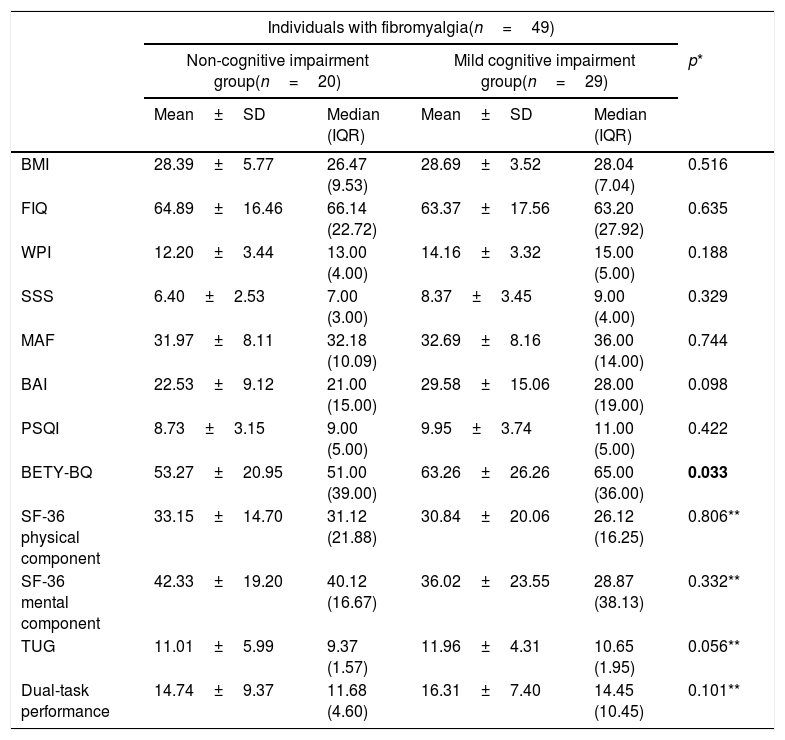
The non-cognitive impairment group was compared with the mild cognitive impairment group. The intergroup comparison revealed a difference in favor of the non-cognitive impairment group in only BETY-BQ (p: 0.033). There were no differences between the groups in the BMI (p: 0.516), FIQ (p: 0.635), WPI (p: 0.188), SSS (p: 0.329), MAF (p: 0.744), BAI (p: 0.098), PSQI (p: 0.422), SF-36 physical component (p: 0.806), SF-36 mental component (p: 0.332), TUG (p: 0.056), and dual-task performance (p: 0.101) parameters (Table 4).
Intergroup comparison results in FM (non-cognitive impairment group vs mild cognitive impairment group).
| Individuals with fibromyalgia(n=49) | |||||
|---|---|---|---|---|---|
| Non-cognitive impairment group(n=20) | Mild cognitive impairment group(n=29) | p* | |||
| Mean±SD | Median (IQR) | Mean±SD | Median (IQR) | ||
| BMI | 28.39±5.77 | 26.47 (9.53) | 28.69±3.52 | 28.04 (7.04) | 0.516 |
| FIQ | 64.89±16.46 | 66.14 (22.72) | 63.37±17.56 | 63.20 (27.92) | 0.635 |
| WPI | 12.20±3.44 | 13.00 (4.00) | 14.16±3.32 | 15.00 (5.00) | 0.188 |
| SSS | 6.40±2.53 | 7.00 (3.00) | 8.37±3.45 | 9.00 (4.00) | 0.329 |
| MAF | 31.97±8.11 | 32.18 (10.09) | 32.69±8.16 | 36.00 (14.00) | 0.744 |
| BAI | 22.53±9.12 | 21.00 (15.00) | 29.58±15.06 | 28.00 (19.00) | 0.098 |
| PSQI | 8.73±3.15 | 9.00 (5.00) | 9.95±3.74 | 11.00 (5.00) | 0.422 |
| BETY-BQ | 53.27±20.95 | 51.00 (39.00) | 63.26±26.26 | 65.00 (36.00) | 0.033 |
| SF-36 physical component | 33.15±14.70 | 31.12 (21.88) | 30.84±20.06 | 26.12 (16.25) | 0.806** |
| SF-36 mental component | 42.33±19.20 | 40.12 (16.67) | 36.02±23.55 | 28.87 (38.13) | 0.332** |
| TUG | 11.01±5.99 | 9.37 (1.57) | 11.96±4.31 | 10.65 (1.95) | 0.056** |
| Dual-task performance | 14.74±9.37 | 11.68 (4.60) | 16.31±7.40 | 14.45 (10.45) | 0.101** |
FIQ: Fibromyalgia Impact Questionnaire; WPI: Widespread Pain Index; SSS: Symptom Severity Scale; MAF: Multidimensional Assessment of Fatigue; BAI: Beck Anxiety Index; PSQI: Pittsburgh Sleep Quality Index; BETY-BQ: Biopsychosocial Questionnaire; TUG: Timed Up and Go Test; MoCA: Montreal Cognitive Assessment Test.
As a result of this study, the cognitive performance of individuals with FM is correlated with pain, symptom severities, anxiety, biopsychosocial conditions, mobility, and dual-task performance. The greatest contribution to the model of MoCA came from WPI variable. And cognitive status made a difference in biopsychosocial conditions.
The sensation of pain is associated with various levels of the cognitive system, including attention networks that are not under conscious control, and it is identified as a significant determinant of cognitive dysfunction. The brain regions involved in performing cognitive functions partly overlap with those responsible for perceiving and controlling pain. It is argued that these brain regions, which carry out processes related to pain and are also involved in cognitive functions, may be unable to perform cognitive tasks due to their engagement with pain. Furthermore, chronic pain could lead to changes in neuroplasticity or disrupted neurochemistry, subsequently impacting cognitive functioning [25]. Studies in the literature indicate a relationship between pain levels and cognitive functions in individuals with FM [25–27]. In similarly, the present study also found a relationship between individuals’ pain levels and cognitive function. Also, the greatest contribution to the model of MoCA came from WPI variable in the regression analysis. FM patients might experience more cognitive challenges than any other patient group in a rheumatology clinic. Also, higher pain level might be indicative of a more severe form of [28].
Research presenting the influence of psychological factors like anxiety and depression on cognitive functions presents conflicting results in the literature. In their exploratory correlation analysis of an FMS sample, Galvez-Sánchez et al. (2018) reported that lower cognitive performance was associated with higher anxiety. Neuropsychological performance in individuals with FM was associated with pain and with this connection remained independent of anxiety levels [29]. Additionally, a notable correlation was observed between cognitive performance and anxiety levels [30,31]. Contrary, some studies suggested that cognitive deficits are independent of comorbid depression and/or anxiety disorders [27]. The results of the present study supported the evidence indicating an association between cognitive impairment and anxiety. Anxiety symptoms were associated with various cognitive variables, including delayed recall, memory, and processing speed [27]. This correlation might be better understood as a deficit in the categorization process, which is influenced by executive functioning, in addition to a response to a decrease in memory capacity [32].
The pain and symptoms observed in FM are not solely physical; they constitute a biopsychosocial condition involving emotional and cognitive components alongside biological factors. Therefore, in diagnosis and treatment, the biopsychosocial approach, which emphasizes the intricate interplay of biological, psychological, and social factors, becomes the most essential tool for comprehending FM [32,33]. For these reasons, BETY-BQ, a valid and reliable questionnaire that includes many biopsychosocial components was used in individuals with FM [34]. It also effective in evaluating the cognitive awareness of FM. In similarly, the current results showed that cognitive impairment associated with biopsychosocial status of patients. When the non-cognitive impairment group was compared with the mild cognitive impairment group, cognitive status made a difference in biopsychosocial conditions. When assessing cognitive function and implementing a treatment program in this regard, it will be highly effective in managing FM to not overlook psychosocial factors, which encompass individuals’ activity and participation. Showing the necessary care for these parameters will have a significant impact on FM management.
Panton et al. showed that the women with FM had reduced functionality compared with age- and weight-matched controls. Furthermore, the capacity to engage in daily activities is influenced by physical fitness [35]. Moreira and Novak noted that both pain and cognitive impairment in chronic painful conditions affect mobility status, and mobility is affected to a greater extent when both are present [36]. Cognitive activity plays a role in inherent motor activities like walking, which constitutes a daily living activity. While walking, people often think about their destination and their plans upon arrival simultaneously. This concurrent performance of a physical activity (like walking) and a mental task (like thinking) is termed a dual task [8,37,38]. In present study TUG test was used for mobility and dual-task performance of patient. Similar to the study conducted by Murillo-Garcia et al., there was an association between patients’ cognitive functions and their mobility and dual-task performance. Additionally, earlier research demonstrated that physical performance in the TUG test, under both single-task and dual-task conditions, could serve as a predictor for mild cognitive impairment. Radunovic et al. showed that gait is impaired in patients with FM during dual-task walking. Similarly, in another study, individuals with FM exhibited lower performance compared to controls under both single and dual-task conditions. Furthermore, disease duration, pain and fatigue severity, functional capacity, leisure and physical activity total scores, alexithymia scores, health status, and cognitive variables were found to be correlated with dual-task performance [39].
Finally, non-significant results in this study for fatigue and insomnia are in line with previous studies suggesting a minor role of these factors in the cognitive impairment seen in FM patients [6,27]. In previous studies related to FM, Beyrek et al. reported an association between dual-task performance and functional status assessed using R-FIQ, while Radunovic et al. reported an association with the mental component of SF-36 [39,40]. It is observed that when cognitive function is included, functional status and quality of life can also be affected. There was no relationship in this study due to the use of MOCA, which evaluates the distinction between normal and mild cognitive impairment, unlike other studies, and may not have been effective in distinguishing these parameters. Additionally, in present study, BMI was not associated with cognitive status. There were conflicting results in the literature regarding this situation. While some studies reported that BMI was not associated with cognitive function, others stated that it had a negative effect [10].
Previous literature has reported some side effects on cognition associated to the medication use. The limitation of this study is that we did not examine the impact of medication usage and educational background on cognitive function. The American college of rheumatology (ACR) has recognized the importance of cognitive impairments for FM by incorporating them into the currently suggested diagnostic criteria for FM [16]. The strength of this study lies in the utilization of a recognized tool to assess cognitive function and the comprehensively exploration of its associations with various factors.
Teaching patients with FM to incorporate daily-planners, ‘to-do’ lists, elaboration strategies and attention techniques can help them feel proactive in addressing their cognitive concerns. In future studies, the results regarding the effect of drug use or drug addiction on cognitive functions may be interesting.
ConclusionThe findings indicate that cognitive performance in individuals with FM might be associated with multiple clinical and functional factors, including pain, symptom severity, anxiety, biopsychosocial condition, mobility and dual-task performance. Cognitive status could make a difference in biopsychosocial condition. Among the variables included in the regression model, widespread pain showed the strongest association with the cognitive performance and made the greatest contribution to the explained variance. The low correlation between the variables, the Durbin–Watson value in the regression analysis, and the explanation of 15.6% of the total variance suggest that cognitive performance in individuals with FM may be influenced by other factors. This could be investigated in future studies.
Authors’ contributionsBerna Cagla Balkisli: Conceptualization, methodology, interpretation, investigation, writing – original draft.
Elif Gur Kabul: Conceptualization, methodology, formal analysis, interpretation, investigation, writing – original draft.
Zulal Tatar: Conceptualization, methodology, data curation.
Bilge Basakci Calik: Conceptualization, methodology, supervision, interpretation, review & editing.
Veli Cobankara: Conceptualization, methodology, data curation, review & editing.
Ethics statementThis study was approved by The Ethics Committee of Pamukkale University (decision no: 14, dated: 09.05.2023).
Declaration of generative AI and AI-assisted technologies in the writing processAny of the material has not been partially or totally produced with the help of any artificial intelligence software or tool.
FundingThis study did not receive any specific grant from funding agencies.
Conflicts of interestThe authors declare that they have no conflict of interest.
Data availabilityThe data that support the findings of this study are avail-able from the corresponding author upon reasonable request.


