

metricas

Radiología

Sugerencias
Radiología Uso del diversor de flujo Derivo Embolisation Device para aneurismas de las arte...
Información de la revista
Cita
Cita
Compartir
Descargar PDF
Más opciones de artículo
Visitas
512
ORIGINAL
Disponible online el 30 de marzo de 2026

Uso del diversor de flujo Derivo Embolisation Device para aneurismas de las arterias renal y esplénica: estudio retrospectivo

Flow Diversion for Renal and Splenic Artery Aneurysms Using the Derivo Embolisation Device: A Retrospective Study
Visitas
512
C. Piñanaa,
Autor para correspondencia
capiplaza@gmail.com

Autor para correspondencia.
, R. González-Costerob, J. Villalbac, A. Illaded, J. González-Plazad, M. Rengela, M. Pérez-Lafuentee
a Unidad de Radiología Intervencionista, Hospital Clínico Universitario de Valencia, Valencia, España
b Unidad de Radiología Intervencionista, Hospital Universitario Puerta de Hierro, Madrid, España
c Unidad de Radiología Intervencionista, Hospital de la Santa Creu i Sant Pau, Barcelona, España
d Unidad de Radiología Intervencionista, Hospital Clínico Universitario de Santiago de Compostela, Santiago de Compostela, España
e Unidad de Radiología Intervencionista, Hospital Universitari Vall d’Hebron, Barcelona, España
Este artículo ha recibido
Información del artículo
Resumen
Texto completo
Bibliografía
Descargar PDF
Estadísticas
Resumen
Introducción

Los aneurismas de las arterias viscerales se diagnostican con mayor frecuencia y presentan riesgo considerable de rotura. El tratamiento endovascular suele preferirse frente a la cirugía, aunque la anatomía compleja y la implicación de ramas adyacentes puede limitar la embolización. Dado que los stents diversores de flujo (DF) han superado retos similares en aneurismas intracraneales, evaluamos su eficacia en aneurismas renales y esplénicos en una experiencia multicéntrica con Derivo Embolisation Device (DED).

Métodos

Se analizaron retrospectivamente todos los pacientes tratados con Derivo en tres centros entre 2021 y 2024. Se recopilaron datos clínicos, características de los aneurismas, tasas de oclusión, complicaciones y morbilidad.

Resultados

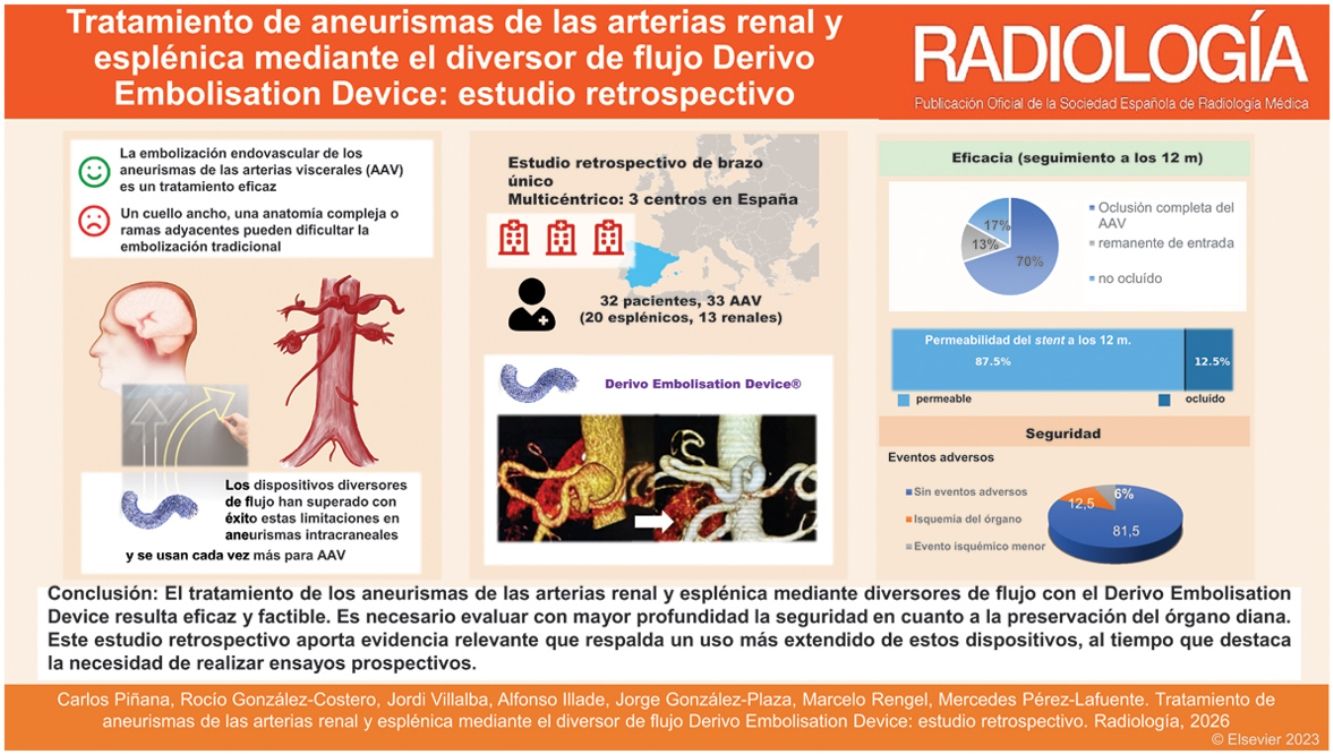
Se trataron 33 aneurismas viscerales: 60,6% esplénicos y 39,4% renales. Diámetro máximo medio: 19 mm. A los 12 meses, se logró oclusión completa en 21/30 casos (70%) y un 13% adicional presentó relleno mínimo. La permeabilidad final del stent fue 87,5%, y todas las ramas cubiertas permanecieron permeables. Se documentaron dos problemas técnicos (6%). Los eventos adversos mayores (oclusión del stent e isquemia del órgano) afectaron a cuatro pacientes (12,5%), con mayor incidencia en el subgrupo de coiling adicional. No hubo mortalidad.

Conclusión

El tratamiento con DF usando DED parece eficaz y factible, con altas tasas de oclusión. La seguridad respecto a eventos trombóticos requiere mayor evaluación, destacando la importancia de un manejo estricto de la antiagregación y el posible beneficio del diversor de flujo sin coiling adicional. Se necesitan ensayos prospectivos para definir claramente su papel terapéutico en arterias viscerales.

Palabras clave:
Aneurismas viscerales
Procedimiento endovascular
Embolización
Exclusión aneurisma
Diversor de flujo
Derivo Embolisation Device
Abstract
Purpose

Visceral artery aneurysms are increasingly diagnosed and carry a substantial rupture risk. Endovascular treatment is often preferred over surgery, yet complex anatomy and side-branch involvement may limit embolisation. As flow-diverter stents have addressed similar challenges in intracranial aneurysms, we aimed to evaluate their performance for renal and splenic artery aneurysms and report a multicentric experience using the Derivo Embolisation Device.

Methods

We retrospectively analysed all patients treated with Derivo devices in three high-volume centres between 2021 and 2024. We collected data on symptoms, aneurysm characteristics, occlusion rates, complications and morbidity.

Results

Thirty-three visceral artery aneurysms were treated: 60.6% splenic and 39.4% renal. Mean maximum diameter of the lesions was 19mm. At 12-month follow-up, complete occlusion was achieved in 21/30 cases (70%), with an additional 13% showing minimal filling; 87.5% of stents and side branches remained patent. Two technical issues occurred (6%). Major adverse events affected four patients (12.5%) due to stent occlusion and subsequent end-organ ischaemia. Higher overall incidence of adverse events was found in the adjunctive-coiling subgroup. No deaths were reported.

Conclusion

Flow-diverter treatment of visceral artery aneurysms using the Derivo Embolisation Device appears effective and feasible, achieving high occlusion rates. However, safety regarding organ preservation warrants further evaluation, emphasising strict antiplatelet management and the potential benefits of stand-alone flow diversion. Prospective trials are needed to clearly define their therapeutic role.

Keywords:
Visceral aneurysm
Endovascular procedures
Embolisation
Aneurysm occlusion
Flow diverter
Derivo Embolisation Device
Resumen gráfico

Artículo

Opciones para acceder a los textos completos de la publicación Radiología
Suscriptor
Suscriptor de la revista

Si ya tiene sus datos de acceso, clique aquí.

Si olvidó su clave de acceso puede recuperarla clicando aquí y seleccionando la opción "He olvidado mi contraseña".
Comprar
Comprar acceso al artículo

Comprando el artículo el PDF del mismo podrá ser descargado

Comprar ahora
Contactar
Teléfono para suscripciones e incidencias
De lunes a viernes de 9h a 18h (GMT+1) excepto los meses de julio y agosto que será de 9 a 15h
Llamadas desde España
932 415 960
Llamadas desde fuera de España
+34 932 415 960
E-mail
Bibliografía
[1]
R. Loffroy, S. Favelier, P. Pottecher, P.-Y. Genson, L. Estivalet, S. Gehin, et al.
Endovascular management of visceral artery aneurysms: When to watch, when to intervene?.
World J Radiol., 7 (2015), pp. 143-148
[2]
M. Rossi, M. Krokidis, E. Kashef, B. Peynircioglu, M.A. Tipaldi.
CIRSE standards of practice for the endovascular treatment of visceral and renal artery aneurysms and pseudoaneurysms.
Cardiovasc Intervent Radiol., 47 (2024), pp. 26-35
[3]
H.K. Kok, H. Asadi, M. Sheehan, M.F. Given, M.J. Lee.
Systematic review and single-center experience for endovascular management of visceral and renal artery aneurysms.
J Vasc Interv Radiol., 27 (2016), pp. 1630-1641
[4]
Y. Zhang, D. Xiang, Q. Lu, M. Wu, J. Cui.
A systematic review and meta-analysis of the performance of flow-diverting stents in the treatment of peripheral and visceral artery aneurysms.
Catheter Cardiovasc Interv., (2020), pp. 1-9
[5]
P. Rabuffi, A. Bruni, E.G.M. Antonuccio, C. Ambrogi, S. Vagnarelli.
Treatment of visceral artery aneurysms and pseudoaneurysms with the use of cerebral flow diverting stents: initial experience.
CVIR Endovasc., 3 (2020), pp. 48
[6]
T. Becske, D.F. Kallmes, I. Saatci, C.G. McDougall, I. Szikora, G. Lanzino, et al.
Pipeline for uncoilable or failed aneurysms: results from a multicenter clinical trial.
Radiology., 267 (2013), pp. 858-868
[7]
P.K. Nelson, P. Lylyk, I. Szikora, S.G. Wetzel, I. Wanke, D. Fiorella.
The Pipeline Embolization Device for the intracranial treatment of aneurysms trial.
Am J Neuroradiol., 32 (2011), pp. 34-40
[8]
G. Zhou, M. Su, Y.Q. Zhu, M.-H. Li.
Efficacy of flow-diverting devices for cerebral aneurysms: a systematic review and meta-analysis.
World Neurosurg., 85 (2016), pp. 252-262
[9]
D. Adrahtas, P. Jasinski, G. Koullias, D. Fiorella, A.K. Tassiopoulos.
Endovascular treatment of a complex renal artery aneurysm using coils and the pipeline embolization device in a patient with a solitary kidney.
[10]
D. Colombi, F.C. Bodini, M. Bossalini, B. Rossi, E. Michieletti.
Extracranial visceral artery aneurysms/pseudoaneurysms repaired with flow diverter device developed for cerebral aneurysms: preliminary results.
Ann Vasc Surg., 53 (2018), pp. 272.e1-272.e9
[11]
V. Semeraro, R. Arpesani, G. Della Malva, F. Gasparrini, S. Vidali, M.P. Ganimede, et al.
Flow diverter treatment for renal artery aneurysms: one-year follow-up of a multicentric preliminary experience.
Diagn Interv Radiol., 28 (2022), pp. 609-615
[12]
D. Ley, R. Mühl-Benninghaus, U. Yilmaz, H. Körner, G.F.M. Cattaneo, W. Mailänder, et al.
The Derivo Embolization Device, a second generation flow diverter for the treatment of intracranial aneurysms, evaluated in an elastase-induced aneurysm model.
Clin Neuroradiol., 27 (2017), pp. 335-343
[13]
C.J. O’Kelly, T. Krings, D. Fiorella, T.R. Marotta.
A novel grading scale for the angiographic assessment of intracranial aneurysms treated using flow diverting stents.
Interv Neuroradiol., 16 (2010), pp. 133-137
[14]
O. Khalilzadeh, M.O. Baerlocher, P.B. Shyn, B.L. Connolly, A.M. Devane, C.S. Morris, et al.
Proposal of a new Adverse Event classification by the Society of Interventional Radiology Standards of Practice Committee.
J Vasc Interv Radiol., 28 (2017), pp. 1432-1437
[15]
C. Piñana, S. Remollo, J. Zamarro, M. Werner, M. Espinosa de Rueda, P. Vega, et al.
Derivo embolization device for intracranial aneurysms: a Spanish multicenter retrospective study.
J Neurointerv Surg., (2022), pp. 1-6
[16]
A. Monteiro, S.M. Burke, A.A. Baig, S. Khan, J.M. Cappuzzo, M. Waqas, et al.
A systematic review and meta-analysis of the Derivo Embolization Device: a novel surface-modified flow diverter for intracranial aneurysm treatment.
J Neurointerv Surg., 14 (2022), pp. 1125-1129
[17]
J. Maingard, A. Lamanna, H.K. Kok, D. Ranatunga, R. Ravi, R.V. Chandra, et al.
Endovascular treatment of visceral artery and renal aneurysms (VRRA) using a constant mesh density flow diverting stent.
CVIR Endovasc., 2 (2019), pp. 15
[18]
G.S. Sfyroeras, I. Dalainas, T.G. Giannakopoulos, K. Antonopoulos, J.D. Kakisis, C.D. Liapis.
Flow-diverting stents for the treatment of arterial aneurysms.
J Vasc Surg., 56 (2012), pp. 839-846
[19]
R.A. Chaer, C.J. Abularrage, D.M. Coleman, M.H. Eslami, V.S. Kashyap, C. Rockman, et al.
The Society for Vascular Surgery clinical practice guidelines on the management of visceral aneurysms.
J Vasc Surg., 72 (2020), pp. 3S-39S
[20]
G. Zhou, M. Su, Y.L. Yin, M.-H. Li.
Complications associated with the use of flow-diverting devices for cerebral aneurysms: a systematic review and meta-analysis.
Neurosurg Focus., 42 (2017), pp. E17
[21]
A.M. Belli, G. Markose, R. Morgan.
The role of interventional radiology in the management of abdominal visceral artery aneurysms.
Cardiovasc Intervent Radiol., 35 (2012), pp. 234-243
asdasdasd
Opciones de artículo
Herramientas

