
Neuropsychological tests must be adapted to local sociocultural realities. The Barcelona-2 test (TB-2) is a tool used in Spain and Hispanic America to perform a general neuropsychological assessment. The objective of this study was to develop versions of the TB-2 for six major dialects of Spanish-speaking Latin American countries, taking into account cross-cultural and cross-linguistic factors.
MethodWorking documents consisting of sheets with three columns were established: original version, proposals for changes and justification of the proposals. The phonetic-prosodic aspect of the evaluation, which was controlled by local evaluators, was excluded. The documents were completed by at least two researchers for each dialect and subsequently agreed upon. The proposals were compared with the meanings of the Royal Spanish Academy and the Dictionary of Americanisms of the Association of Academies of the Spanish Language. The final versions were the subject of six acceptability studies.
ResultsVersions have been established for 19 countries with 47 working documents for the Mexican, Caribbean, Central American, Andean, Austral, and Chilean TB-2 dialect varieties.
ConclusionsFor the first time a neuropsychological test, initially developed in Catalan and Spanish, is simultaneously adapted to the six major Hispanic American dialects. These versions will avoid local interpretations and improvisations when administering the test in any Spanish-speaking territory. Administration to broad populations without and with cognitive impairment should allow for completing or modifying some of the changes and, perhaps, adjusting the score ranges.
Los test neuropsicológicos deben adaptarse a las realidades socioculturales locales. El test Barcelona-2 (TB-2) es un instrumento usado en España e Hispanoamérica para realizar una exploración neuropsicológica general. El objetivo de este estudio fue desarrollar versiones del TB-2 para seis grandes dialectos de países latinoamericanos hispanohablantes, teniendo en cuenta factores transculturales y translingüísticos.
MétodoSe establecieron documentos de trabajo consistentes en hojas con tres columnas: versión original, propuestas de cambios y justificación de las propuestas. Se excluyó el aspecto fonético-prosódico de la exploración que controlaron los evaluadores locales. Los documentos fueron cumplimentados por, al menos, dos investigadores para cada dialecto y posteriormente consensuados. Las propuestas fueron cotejadas con las acepciones del Diccionario de la Real Academia Española y el Diccionario de Americanismos de la Asociación de Academias de la Lengua Española. Las versiones finales fueron objeto de seis estudios de aceptabilidad.
ResultadosSe han establecido versiones para 19 países con 47 documentos de trabajo para las variedades dialectales del TB-2 mexicana, caribeña, centroamericana, andina, austral y chilena.
ConclusionesPor primera vez un test neuropsicológico, inicialmente desarrollado en catalán y castellano, se adapta simultáneamente a los seis grandes dialectos hispanoamericanos. Estas versiones evitarán interpretaciones e improvisaciones locales al administrar el test en cualquier territorio hispanohablante. La administración a poblaciones amplias sin y con deterioro cognitivo deberá permitir el completar o modificar algunos de los cambios y, quizás, adecuar los rangos de puntuación.
The Barcelona Test1,2 is a neuropsychological assessment instrument that is widely used in Spain and Latin America. A new version, the Barcelona-2 Test (BT-2), was published in 2019.3
The BT-2 is divided into 6 cognitive domains3: spoken language, orientation and attention, written language, motor/praxis, perception/gnosis, memory, and abstraction/executive function. This study aimed to address certain language-related and cultural challenges4–6 with the administration of the BT-2 in Spanish-speaking Latin American countries. This short introduction explains the context of this issue in neurology.
It is fundamental in clinical practice that cognitive assessment instruments are well fitted to patients’ sociocultural and linguistic reality.4 Therefore,5,6 instruments must be culturally and linguistically appropriate,7 socially acceptable, and their content and psychometric properties must be valid, with construct validity being particularly important.8 Therefore, if one wishes to use a locally developed test in a culturally and/or linguistically distinct population, its adaptation is obligatory.6,7,9 Though various guidelines have been published for the adaptation of neuropsychological tests between languages,10–13 none exist for adaptation between dialects. Evidently, any adaptation between Spanish dialects must take into account cultural and especially lexical idiosyncrasies, in order to constitute a true adaptation. A paradigmatic example is the term “aguacate” (avocado), which is widely known in Spain, and its Latin American cognate “palta,” which is unknown in Spain.
Describing the characteristics of Latin American variants of Spanish is beyond the scope of this introduction. A series of works on Spanish dialectology are included in the “References” section.14–22
Isoglosses, or the geographic boundaries of areas in which a distinctive linguistic trait occurs,4,23 are complex. Dialectal traits may encompass any level of language: phonetics/prosody, phonology, morphology, lexis, syntax, and discourse/pragmatics.20 The colonisation of the Americas led to massive migration from Spain, and particularly Andalusia and the Canary Islands, contributing to the essential characteristics of Latin American Spanish. Contact with autochthonous languages is another factor contributing to the formation of American dialects of Spanish. Several studies have analysed the influences of autochthonous languages at different linguistic levels in Latin American variants of Spanish24,25; these influences promoted the creation of a large number of bilingual societies.
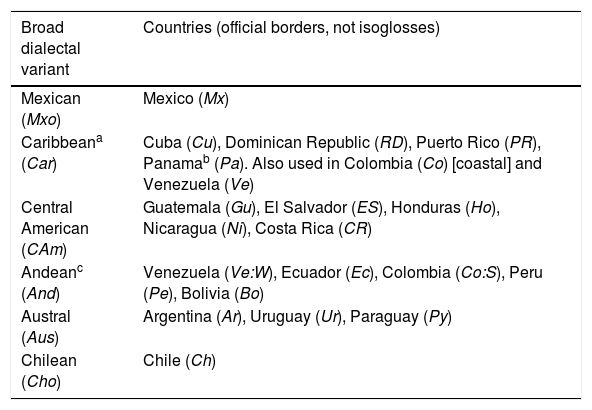
Table 1 presents a simplified summary of the main dialectal variants of Latin American Spanish and the countries where they are spoken. The table includes the codes for each country according to the Diccionario de Americanismos (DA) of the Association of Academies of the Spanish Language (https://www.asale.org).
Simplified summary of the dialectal variants of Latin American Spanish and the countries where they are spoken. It should be noted that interactions between dialects are complex and numerous. The codes (abbreviations) used for countries are shown in parentheses; other abbreviations are listed at the bottom of the table.
| Broad dialectal variant | Countries (official borders, not isoglosses) |
|---|---|
| Mexican (Mxo) | Mexico (Mx) |
| Caribbeana (Car) | Cuba (Cu), Dominican Republic (RD), Puerto Rico (PR), Panamab (Pa). Also used in Colombia (Co) [coastal] and Venezuela (Ve) |
| Central American (CAm) | Guatemala (Gu), El Salvador (ES), Honduras (Ho), Nicaragua (Ni), Costa Rica (CR) |
| Andeanc (And) | Venezuela (Ve:W), Ecuador (Ec), Colombia (Co:S), Peru (Pe), Bolivia (Bo) |
| Austral (Aus) | Argentina (Ar), Uruguay (Ur), Paraguay (Py) |
| Chilean (Cho) | Chile (Ch) |
This study aimed to develop linguistic and cultural adaptations of the BT-2 for use in Latin America.
MethodsThe research team was composed of psychologists, neuropsychologists, speech therapists, and physicians with clinical experience in neuropsychological evaluation, as well as a linguist (FDV). Spanish was the first language of all Latin American researchers; each researcher spoke one of the standard dialects used in the education systems of their respective countries.
To avoid atomisation, we decided to create 6 different versions of the BT-2, one for each of the 6 main dialectal groups in Latin American Spanish (Table 1). In addition to isoglosses, we considered countries’ political borders. This consideration is based on the fact that “national” borders represent the limits of education systems and language standardisation.26
The study focused on general and lexical concepts (with some grammatical considerations). Phonetics and prosody were not studied, as we assumed that test users would use the standard local pronunciations.
The project was approved by the ethics committee of the medical research institute of Hospital del Mar, in Barcelona (Spain).27
Each adaptation of the test was developed according to the following procedure4,11:
- 1.
The steering committee created a series of working documents, with 3 parallel parts: original version of the text; a space to note proposed changes; and a space to note the reasoning for the change.
- 2.
The working documents were distributed to local researchers, along with guidelines for performing their work. The development of each version involved at least 2 researchers, who were required to fill out their own document without knowledge of the other researchers’ work.
- 3.
The completed documents were returned to the coordinators, initially in Barcelona (LVC) and subsequently in Panama City (MCJ). The proposed changes were systematically tabulated by country/dialect to enable comparisons within and between dialects. The Mexican adaptation was based on the Revised Barcelona Test.28
- 4.
Proposed changes were reviewed in the reference dictionaries cited (see below). Revisions were based on the definitions of the terms used in the original version. When the proposed use was found to be atypical or inconsistent with the reference dictionaries, the relevant local researchers were consulted once more.
- 5.
Finally, the coordinators produced a unified document for each dialect. In the event of significant differences or disagreements within a given version, the researchers were contacted again. After final approval, the definitive examination protocol was drafted.
Three reference dictionaries were used: Diccionario de la Lengua Española de la Real Academia Española (DRAE) (2022 online update [https://dle.rae.es DLE 23.6]), which was used for words in the original test; Diccionario de Americanismos (DA) (see above); and Diccionario panhispánico de dudas (DPD) (electronic version of the first print version ([2005]).
Entries in the DRAE and the DA were used to confirm the appropriateness of the proposed changes and the territorial scope of their use. Finally, the DPD was consulted if any further information was needed. Sayings and proverbs were consulted in the Cervantes Institute's Refranero Multilingüe (https://cvc.cervantes.es). We also used such non-academic dictionaries as Wiktionary (https://es.wiktionary.org/wiki/Wikcionario).
ResultsA total of 47 working documents were created. By dialect, the documents developed were the following: 5 for Mexican Spanish, 8 for Caribbean Spanish, 20 for Central American Spanish, 7 for Andean Spanish, 7 for Austral Spanish, and 3 for Chilean Spanish. We adapted 23 tests of the total 40 making up the test; the number of changes by country was as follows: Mx (18), Cu (10), RD (13), PR (15), Pa (17), Co (16), Ve (14), Gu (12), ES (13), Ho (17), Ni (15), CR (16), Ec (15), Pe (13), Bo (22), Ar (19), Ur (20), Py (21), Ch (20).
Below, the proposed adaptations are grouped according to section: sociodemographic information and neuropsychological tests. The present study only describes the most relevant results. The examples and proposed modifications for each dialect are included in the Supplementary Material.
Sociodemographic informationThis information (Supplementary Material, section 1) includes 2 components: general registry and neuropsychological data (place of birth, level of schooling, and profession) and confidential personal data (address, personal identification number, marital status, and dominant hand).
Neuropsychological testsThe following sections show the proposed adaptations, omitting those for which adaptation was not needed. The changes are presented schematically, with the numbers from the administration protocol; the adaptations are described in the Supplementary Material (section 2).
Module 2. Spoken language, orientation, and attention. Tests 1–13Test 1. Spontaneous speech. This test, with 3 sections, aims to score aphasia using 3 methods: basic conversation, thematic narration, and thematic description.
Test 1.1. Basic conversation. Semi-structured conversation with a list of questions. Conversation should take place in the local dialect, following the original outline.
Test 1.2. Thematic narration. Subject narrates a story about “un bosque” (a forest). Depending on local and sociocultural characteristics, a different theme may be selected. Researchers were reminded that the aim of the test is to obtain information on narrative capacity and that the theme was not a critical point of the assessment.
Test 1.3. Thematic description. Description of BT Image 1 (living room). Though this test is open-ended, the administration protocol includes guidelines on the expected lexicon. Three items were adapted: “taburete” (stool), “subida” (sitting on), and “tirar” (throw away).
Test 4. Orientation to person, space, and time. Assessment of subjects’ orientation to person, space, and time. Researchers were reminded that the examiners administering the test would have to modify their register according to the context and the characteristics of the patient; this is also the case for other tests.
Test 7. Orophonatory praxis. Assessment of orophonatory imitation. To address dialectal problems, a video was created for the original version of the test with a demonstration of each item (https://www.youtube.com/@testbarcelona-neuropsychol413). For the manual, some issues were raised regarding the items “calling a cat” and “disapproval.”
Test 8. Section: repetition of sentences. Issues were raised regarding the items “grifo” (faucet), “volví” (I returned), “radio” (radio), and “gorrión” (sparrow).
Test 9. Repetition of semantic mistakes. Repetition, without comment, of semantically incorrect phrases. Adaptations were proposed for the terms “coche” (car) and “azúcar” (sugar).
Test 10. Visual-verbal naming. Naming based on visual stimuli: objects (10.1), actions (10.2), and body parts (not adapted).
Subtest 10.1. Naming images of objects. Visual confrontation naming in which verbal cues may be given. All items were considered acceptable, with the exceptions “grúa” (crane) and “tienda de campaña” (tent).
Subtest 10.2. Naming images of actions. Three items were changed: “esquiar” (skiing), “beber” (drinking), and “pelar” (peeling).
Test 11. Verb naming. Two alternatives: naming as a response to a question or to complete a sentence.
Subtest 11.1. Naming as a response to a question. Subjects respond to a question by naming an object. Issues were raised with the contextualised assessment of the items “peine” (comb), “farmacia” (pharmacy), “lápiz” (pencil), “habitación” (room), and “nevera/estropear” (refrigerator/spoil).
Subtest 11.2. Naming to complete a sentence. Subjects complete a sentence. Researchers suggested changing the words “cuchara” (spoon), “cerilla” (match), “botones/abrochar” (buttons/fasten), and “cordones/atar” (shoelaces/tie).
Test 12. Semantic fluency. Three semantic fluency tasks. Subjects would be expected to use dialectal words with which examiners would be familiar. See the Supplementary Material for examples.
Test 13. Verbal comprehension. Verbal comprehension is studied using tests of understanding of words (13.1), body parts (13.2), commands (13.3), and complex verbal material (13.4). Only the latter 2 tasks required adaptation.
Subtest 13.3. Commands. Ability to understand and follow verbal instructions. Changes were proposed for the commands “Enséñeme el puño” (make a fist), “Señale el techo… la mesa… y luego el suelo” (point to the ceiling… the table… and then the floor), and “Ponga el lápiz… al otro lado del papel… y luego doble el papel por la mitad” (Place the pencil… to the other side of the paper… then fold the paper in half).
Subtest 13.4. Complex verbal material. Subjects respond yes or no to a question that requires semantic knowledge. The word “hierro” (iron) was adapted (item 2B), and an item (3A and 3B) related to climatic conditions was reformulated.
Module 2. Written language. Tests 14–18Test 14. Reading: verbalisation. Reading a text. Nuances of the terms “huerto” (vegetable garden), “coger” (pick up), and “hincar” (drive/sink into) were considered. A priori, no changes were permitted that would change the total number of words, as this would affect the final score.
Test 15. Reading comprehension (no verbalisation). This study involves the use of different words. The words requiring changes are listed below.
Subtest 15.1. Word-image matching. Subjects match written words to pictures. Researchers noted the need to change the term “tienda de campaña” (tent) for “carpa.”
Subtest 15.3. Morphosyntactic comprehension: understanding of serial instructions. Performance of orders written in formal language (“usted” form). We decided not to adapt the test using informal or colloquial language (eg, the “vos” form in Austral variants).
Subtest: reading comprehension (sentences). Subjects complete a sentence by selecting one of 4 words. Two changes were proposed related to the terms “obras públicas” (public works) and “coche” (car).
Module 3. Motor/praxis. Tests 19–24Test 19. Gestures symbolising communication (instructions and imitation). Subjects are instructed verbally, in formal language, to perform gestures; where appropriate, informal (use of the “tú” rather than the “usted” form) or colloquial language may be used. Numerous adaptations were proposed for the gesture “hacer autoestop” (hitch-hiking).
Test 20. Miming the use of objects (instructions and imitation). Subjects mime the use of objects indicated by the examiner. The items “brocha” (paintbrush), “peine” (comb), “sierra” (saw), and “sacacorchos” (corkscrew) were adapted.
Test 21. Sequential use of objects (ideational praxis). Use of objects to achieve an objective. Though the instruction is “use these objects” (“vela” [candle], “palmatoria” [candlestick], and “caja de cerillas” [box of matches]; “hoja papel” [sheet of paper] and “sobre” [envelope]), some items were adapted.
Test 24. Simple, semicomplex, and complex drawing praxis.
Subtest 24.1. Instructions: simple and semicomplex figures. The instructions required adaptation of the words “maceta” (plant pot) and “cubo” (cube).
Module 4. Perception/gnosis. Tests 25–32Test 26. Recognition and naming of objects from non-prototypical perspectives. Different dialects had different names for various items: “pinza (de tender la ropa)” (clothes peg), “clavija” (electrical plug), “cafetera” (coffee pot), “plátano” (banana), “bombilla” (light bulb), “gafas” (spectacles), and “sacacorchos” (corkscrew).
Test 27. Overlapping images. Discrimination of overlapping images and pairing in multiple choice, recognition, and naming. The items “gorra” (baseball cap), “gafas” (spectacles), “cazo” (saucepan), “maleta” (suitcase), and 3 elements from item 5 (“paraguas” [umbrella], “bastón” [walking stick], and “cubo” [bucket]) required adaptation.
Test 28. Colour processing.
Subtest 28.1. Selection of a specific colour. Subjects select the appropriate colour from 4 alternatives. The only problem was related to the word “plátano” (banana), which may have different names and different colours.
Subtest 28.2. Colour matching; Subtest 28.3. Colour naming; Subtest 28.4. Pointing to colours. Matching/naming/pointing to a given colour. In all these subtests, 2 changes were proposed: the addition of “colorado” as a synonym of “rojo” (red), and the addition of “lila” as a synonym of “violeta” (violet). Furthermore, the DA includes the word “lila” as a type of plants with lilac or purple-coloured flowers (Mx, Ni, Py).
Subtest 28.5. Colour naming. Subjects respond to a question about a given colour. Three items were adapted: “tomates maduros” (ripe tomatoes), “hierba” (grass), and “plátanos” (bananas).
Test 29. Tactile processing. Tactile recognition and naming. Verbal naming of an object recognised by touch. Six items had to be adapted: “Lápiz” (pencil), “vela” (candle), “goma de borrar” (eraser), “peine” (comb), “clip” (paper clip), and “caja de cerillas” (box of matches [see notes on “fósforo” in the Supplementary Material]).
Test 32. Auditory gnosis (screening). Recognition of sounds made by the examiner (bell, tearing paper, applause, shaking a bunch of keys, shaking coins, whistling). The examiner instructs the subject to recognise the sound. For Py, it was proposed that the word “tintineo” (jingling; for keys and coins) be changed for “campanillas de.”
Module 5. Memory. Tests 33–36Researchers proposed minimal changes to memory tests. However, they recommended the use of terms appropriate for subjects with low levels of schooling, without changing the lexical structure or difficulty of the task. Thus, for instance, we did not accept such changes as “Ernesto” for “José”, “Roca” for “González”, or the names of cities instead of the phrase “una ciudad de la costa” (a city on the coast). Examples of the types of changes accepted were “una ciudad del interior” (an inland city) for “una ciudad del oriente” (a city in the east) (ES), or “hospital universitario” (university hospital) for “hospital nacional” (national hospital) (ES).
Test 33. Verbal memory of texts. Immediate and delayed recall of a text read out loud. The terms “diputado” (member of parliament) and “ingresar” (to admit [eg, to hospital]) were adapted.
Test 34. Learning of a series of words. Subjects must recall a list of 12 words. Adaptation was considered for 3 terms: “pastel” (cake; this term ultimately was not modified), “ático” (attic), and “plátano” (banana).
Module 6. Abstraction/executive function. Tests 37–41Test 37. Information. Evaluation of general knowledge related to level of schooling. Some items are related to school curricula and geographical/historical context. Some changes were proposed but the test was not ultimately modified.
Test 38. Abstraction and abstract verbal comprehension.
Subtest 38.1. Similarities. Subjects must abstract similarities between objects (eg, “hacha” [axe] and “sierra” [saw]). Changes were suggested for the items “plátano” (banana) and “león” (lion).
Subtest 38.2. Comprehension/abstraction of proverbs and situations. Subjects must explain the figurative meaning of sayings, proverbs, and expressions, as well as complex situations from daily life (eg, “why should we use public transport more often?”). Changes were made to the items “No es oro todo lo que reluce” (“Not all that glitters is gold”), “Quien se ahoga se agarra a un clavo ardiendo” (“A drowning person will grasp a red-hot nail”; loosely equivalent to the English saying “Desperate times call for desperate measures”), “¿Qué se debe hacer si se incendia una sartén?” (“What should we do if a frying pan catches fire?”), and “¿Por qué se deben separar los desperdicios?” (“Why should waste be separated?”).
Test 40. Arithmetic problems. Assessment of reasoning and calculation ability by solving arithmetic problems. We considered that changing the name of the currency would not cause significant problems, though changing the amounts would, as it may change the difficulty of the arithmetical operations. Therefore, we considered it more appropriate to change the concepts in order to maintain the same figures and calculations. The proposed changes including ad hoc modification of the names of currency fractions (eg, cents), or changing concepts in order that the quantities be appropriate to each currency. Furthermore, we changed the terms “estantería” (bookshelf) and “obrero” (builder).
Discussion and conclusionsExhaustiveness, isoglosses, and political borders. A priori, we ruled out all exhaustive or very localist approaches, as these would not be feasible. Rather than considering the divisions established by isoglosses, we took into account geographical borders between countries, as each country has its official Koiné, which is basically disseminated through education systems and mass media.
Given the great variety of dialects within political borders, it is extremely difficult to establish a single protocol for each country, let alone for the 6 broad groups of dialects. Thus, the Caribbean regions of such countries as Mx and Ve, for instance, present clear dialectal differentiation. This study revealed numerous examples of lexis that is restricted to certain geographical areas of a given country. This demonstrates the reality and the complexity of isoglosses.
Specific historico-cultural and dialectal circumstances. Below, we present a list of the main observations and modifications made to the BT-2 for use in Latin American populations, all of which are based on historico-cultural and chrono-dialectal factors.
- •
The dissemination of certain words across practically the entire region, such as the case of “fósforos” rather than “cerillos” or “cerillas” (matches).
- •
Individual differences between Peninsular and Latin American Spanish, including the following examples: “coger” (agarrar; pick up), “tirar” (botar; throw away), “grifo” (canilla, caño, llave; faucet), “coche” (carro; car), “tienda de campaña” (carpa; tent), “farmacia” (droguería, drugstore; pharmacy), “nevera” (frigidaire, frigider, refri, refrigerador; refrigerator); “hierro” (fierro; iron); “hincar” (clavar; drive/sink into); “globo” (bomba; balloon).
- •
The enormous variety in Latin American Spanish of certain voices and expressions, for instance: “hacer autoestop” (Esp; hitch-hiking): aventón, a dedo, jalada, raite, bola, botella, cola, halar, linche, pon, ton; “cordones” (shoelaces): agujetas, cintas, guatos, huatos, pasadores, trenzas; “maceta/tiesto” (plant pot): macetero, plantero, matero, plantera; “pinza” (clothes peg): broche, gancho, horquilla, palillo, prensa; “plátano” (banana): banana, guineo, plátano guineo, cambur, gualele; “grifo” (faucet): canilla, caño, llave, paja, tubo.
- •
Local differentiation in the gender of certain words, for instance: “el/la sartén” (frying pan), “el/la radio” (radio), “el/la azúcar” (sugar). This is also the case in Peninsular Spanish.
- •
The differentiation in Austral dialects in the use of the “vos” form and verb conjugations, which is also observed in situations of informal or colloquial language use.
- •
The need for thematic adaptation in the test of narrative language: changes in the subject “un bosque” (a forest) for “un mercado” (a market; “tianguis”, “tiangue”), or the differentiation in Bo in the description of natural settings (“selva” [jungle], “valle” [valley], “pampa” [flatlands], or “altiplano” [plateau]).
- •
The creation of socially specific situations (dual meaning) in the use of such words as “coger” (to pick up; “popular vulgarism, to perform coitus” [DA]) or “gorra” (baseball cap; “head of the penis”).
- •
The specific use of certain words that should be known when evaluating a subject outside of their cultural/dialectal context. For instance, a Mexican subject examined in Barcelona may use such words as “guajolote” (turkey; locally unfamiliar) or “aguacate” (avocado; locally familiar); however, a Peruvian subject examined in the same city may use the word “palta” (avocado; locally unfamiliar). In all these cases, examiners who are unfamiliar with certain words must make the appropriate checks.
- •
The possible and inherent variability in examiners’ judgement is another relevant consideration in adapting the tests. For instance, different names for a given object or action may exist within a single dialect. In general terms, we may establish an “agreed name,” but variability is always possible: for instance, “estropear” (spoil) can be expressed in numerous ways, such as “arruinar,” “descomponer,” “echar a perder,” or “malograr.”
Contributions. For the first time, a neuropsychological test has been adapted systematically for use in the Spanish-speaking Latin American community. This contribution prevents, or reduces, problems with administration of the test in a different dialect/culture than the one for which it was initially developed. Besides the researchers’ proposals, this study took into account the content of dictionaries, mainly the DRAE and DA. Regarding sayings and proverbs, the Cervantes Institute's Refranero Multilingüe was of great help. The use of these dictionaries substantially strengthens the results of the study in both linguistic and territorial aspects.
Interpretation. This study illustrates the lack of universal truths in neuropsychology, as well as the vast diversity and richness of languages. It underscores the need to develop assessment methods adapted to each language and culture, and specifically taking into account the local dialectal reality.29,30 Evidently, test manuals cannot account for all situations. The common sense and flexibility of examiners familiar with the test are essential. Instructions must be modified to ensure that the patient understands the task to be performed. However, such changes must not interfere with the objectives, structure, or difficulty of a test.
Integration with previous studies. This research is related to previous studies into the BT performed in Mexico. It also links into the series of working guidelines on transcultural and dialectal neuropsychology.
Implications. This study contributes new information from the cultural, linguistic, and clinical perspectives. Due to its dialectal approach, it enables us to fill a transcendental gap in neuropsychological evaluation and to facilitate the administration and interpretation of the BT-2 in different dialectal/cultural settings in Latin America, accounting for the characteristics of the speakers of different dialects.31 As some authors have argued, there are no “better or worse” dialects: each one has its own characteristics and intrinsic value, including the standard dialect.21,32 Furthermore, this study will be valuable for understanding the responses of a user of a specific dialect who is examined in another dialectal/territorial setting. This study underscores the fact that for some items, more than one question, or more than one response, is possible; this is known as “name agreement.”33–35
Transferability. These studies and their methodology may be transferred to other neuropsychological tests. Though this study focuses on the adaptation, rather than the standardisation, of the BT-2 for Latin American populations, as explained in the manual, a large number of the tests are dichotomous; therefore, these scores will coincide with the original data, and will be transferable to Latin America.4 This statement is supported by studies performed in Mexico, Ecuador, and Colombia, as well as pilot studies conducted as part of the present project.
Without a doubt, the modification of certain elements of the test (specifically, lexis and certain grammatical constructions) implies a need to test its reliability, particularly in patients with cognitive alterations. In other words, we must ensure that all adapted versions are both reliable and clinically practical. However, these questions are a matter for future studies.
Limitations. Establishing a protocol for every dialect and subdialect of Latin American Spanish is a great challenge, due to the high level of atomisation that this would imply. Furthermore, the adaptations proposed do not address local phonetic or prosodic considerations, assuming that all examiners will use their own form of speech. One clear limitation of the study is the exclusion of some dialects, such as United States Spanish. Finally, it would be beneficial to create transcultural and dialectal psycholinguistic databases for Latin America.36
FundingThis study has received no specific funding from any public, commercial, or non-profit organisation.
Conflicts of interestNone declared.
Steering committee. Jordi Peña Casanova; Faustino Diéguez Vide. Coordinators. Milagro Jaen; Laia Vinaixa.
Lead researchers. Jordi Peña Casanova; Milagro Jaen; Laia Vinaixa; Faustino Diéguez Vide; Teresita Villaseñor; Yanet Castro; Lorena García; Carina Castillo; Claudia Dechent; Ana Verónica Ferreira; Eduardo Torrealba; Ninoska Ocampo; Aldana Rocchini; Lisette Arévalo; Javier Cortaberría; Yelba Godoy; Adiel Silva.
Clinical researchers, psychologists, and neuropsychologists. Argentina: Josefina Ruozi, Mariela Colombo. Bolivia: Roberto Flores, Patricia Wiener Bercowik. Chile: Álvaro Aliaga Moore, Miguel Ángel Ramos. Colombia: Angie Espitia, Liliana Duarte. Costa Rica: José Luis Ortiz, María Gabriela León, Paola Echeverría. Ecuador: Carina Castillo Valdivieso, Rafael Franco, Raquel Mendoza. Guatemala: Aura Pamela Hernández, Dora Rodríguez, Raymond Martínez. Mexico: Anna Ruth Diaz, Jorge Sigg, Miguel Ángel Villa. Nicaragua: Davinia Zamora. Panama: Analinnette Lebrija, Viana Falconett. Paraguay: Diana Báez, Dulce Benítez. Perú: Gabriel Coletti, Lilia Campos. Uruguay: Jorge Lorenzo. Venezuela: Pilar García.
The following are the supplementary data to this article: