



Irritable bowel syndrome (IBS) is the most common functional gastrointestinal disorder. Its pathophysiology remains incompletely understood, and no objective diagnostic markers are currently available. Diagnosis is based on the Rome IV criteria, which rely exclusively on gastrointestinal symptoms and may be limited in routine clinical practice.
AimTo develop a clinical score for IBS incorporating extra-intestinal factors, including mental health disorders, medication use, pain-related conditions, demographic characteristics, and medical history.
MethodsA case–control study including 109 participants was conducted. Clinical information, medication use, demographic data, and validated mental health questionnaires were collected through structured personal interviews. Variables associated with IBS in univariate analysis were included in a multivariate logistic regression model to develop the final probability score.
ResultsA clinical score including six variables was developed: history of drug allergy, migraine, anxiety, Hospital Anxiety and Depression Scale score>7, low perceived work responsibility, and proton pump inhibitor use. The score estimates the probability of being classified as IBS in this model, with a sensitivity of 80.4% and a specificity of 73.6%.
ConclusionsThis clinical score integrates extra-intestinal factors and provides a more comprehensive approach to IBS assessment in clinical practice. Its use may facilitate earlier identification of patients with suspected IBS, although further studies are needed to validate its usefulness in primary care settings.
El síndrome del intestino irritable (SII) es el trastorno gastrointestinal funcional más frecuente. Su fisiopatología no está completamente esclarecida y, en la actualidad, no se dispone de marcadores diagnósticos objetivos. El diagnóstico se basa en los criterios de Roma IV, centrados exclusivamente en los síntomas gastrointestinales, lo que puede limitar su aplicabilidad en la práctica clínica habitual.
ObjetivoDesarrollar una puntuación clínica para el SII que incorpore factores extraintestinales, incluyendo trastornos de salud mental, uso de medicación, condiciones relacionadas con el dolor, características demográficas y antecedentes médicos.
MétodosSe realizó un estudio de casos y controles que incluyó a 109 participantes. Se recogieron datos clínicos, uso de medicación, variables demográficas y cuestionarios validados de salud mental mediante entrevistas personales estructuradas. Las variables asociadas al SII en el análisis univariante se incluyeron en un modelo de regresión logística multivariante para desarrollar la puntuación de probabilidad final.
ResultadosSe desarrolló una puntuación clínica compuesta por seis variables: antecedentes de alergia a fármacos, migraña, ansiedad, puntuación>7 en la Escala Hospitalaria de Ansiedad y Depresión, baja percepción de la responsabilidad laboral y uso de inhibidores de la bomba de protones. Esta puntuación permite estimar la probabilidad de clasificación como SII en el modelo, con una sensibilidad del 80,4% y una especificidad del 73,6%.
ConclusionesEsta puntuación clínica integra factores extraintestinales y proporciona un enfoque más integral para la evaluación del SII en la práctica clínica. Su uso podría facilitar la identificación precoz de pacientes con sospecha de SII, aunque se requieren estudios adicionales para validar su utilidad en el ámbito de la atención primaria.
Irritable bowel syndrome (IBS) is the most prevalent gastrointestinal disorder in the world, especially in Western countries; its prevalence in the United States is between 7 and 16%.1 It is a functional gastrointestinal disorder whose main symptoms are abdominal pain, changes in stool frequency, changes in stool consistency and visceral hypersensitivity.2 As a functional disorder, IBS cannot be explained by morphologic, metabolic, or neurologic alterations that are demonstrated through common diagnostic techniques.3 Therefore, its diagnosis is based on the Rome IV clinical criteria and the exclusion of other digestive diseases such as inflammatory bowel disease, celiac disease, parasitosis, or colorectal cancer, as well as systemic pathologies such as endocrine disorders (e.g., hypothyroidism), diabetes, or systemic autoimmune diseases. Despite its high prevalence, the etiology and pathophysiology of IBS remains unknown. Several hypotheses about IBS etiology include microbiota dysbiosis and psychosocial disorders, pointing out that IBS can be a microbiota–gut–brain disorder.4
Various investigations show that patients diagnosed with IBS suffer more anxiety, depression, phobias, neuroticism or emotional instability and somatization comparing to control groups, as well as higher levels of anxiety and depression.5 Depression and IBS share some hormonal and biochemical alterations, such as changes in microbiota and intestinal permeability, alterations in hypothalamic–pituitary–adrenal axis, or neurotransmitters dysfunctions in the central nervous system and the enteric nervous system.6 Cytokines levels in blood and colonic mucosa of IBS patients and comorbid anxiety are higher comparing to those who only suffer from IBS; at the same time, anxiety correlates with a deterioration of gastrointestinal symptomatology, responding positively to psychiatric treatment.7
In primary care, IBS diagnosis remains challenging due to symptom overlap and lack of biomarkers, often leading to delayed diagnosis and unnecessary tests. Since IBS is a functional pathology with a multifactorial origin, we propose to develop a probability model from a comparative statistical analysis, measuring different variables of the clinical information and mental health status.
Material and methodsStudy design and settingThis work is an exploratory case–control study approved by the Ethical Committee CEICA, with report number PI19/184. 109 participants have been included from three different medical specialties consultations: primary care consultations of Univérsitas health center (Zaragoza, Spain), hospital emergencies and gastroenterology consultations of Hospital Clínico Lozano Blesa (Zaragoza, Spain).
ParticipantsThe minimum required sample size was calculated using the GRANMO online calculator. Accepting an alpha risk of 0.05 and a beta risk of 0.2 in a one-sided test, 50 subjects per group were needed to detect a statistically significant difference between two proportions (expected proportions: 0.05 in group 1 and 0.2 in group 2), using the arcsine approximation and assuming no loss to follow-up. The result of this calculation was that sample size should be formed by minimum 50 cases and 50 controls to obtain statistically significant results. A total of 109 participants (53 IBS patients and 56 controls) were included in the study. Participants were recruited consecutively in different healthcare settings during routine clinical practice. Potential participants were screened for eligibility, and those meeting all inclusion criteria and none of the exclusion criteria were invited to participate in the study and provide informed consent. Regarding the clinical classification within the IBS group, 77% of patients were diagnosed with the constipation subtype (IBS-C), 17% presented with the mixed subtype (IBS-M), and the diarrhea subtype (IBS-D) represented the smallest group, comprising just 6% of the clinical sample. Inclusion criteria for cases were age between 18 and 75 years, a diagnosis of IBS according to Rome IV criteria, and provision of informed consent. Individuals with a diagnosis of another gastrointestinal disease were not considered eligible for inclusion. Control subjects were consecutively recruited from the same healthcare settings as cases. Eligible controls were adults aged 18–75 years without a diagnosis of IBS according to Rome IV criteria and without known gastrointestinal diseases. The presence of non-gastrointestinal comorbidities or pharmacological treatments was not considered an exclusion criterion. Personal interviews asking for clinical information as medical history, pharmacotherapy, and demographic information were performed.
Hospital anxiety and depression scaleA validated questionnaire to measure the mental health status of the participants was applied. The Hospital Anxiety and Depression Scale (HADS) was used to assess the probability of suffering anxiety or depression. The HADS scale consists of 14 questions, 7 of them measure the depression risk and 7 measure the risk of anxiety. Score above 9 has a sensitivity for anxiety diagnostic of 66% and 93% of specificity. Score above 7 has a sensitivity to diagnosis of depression of 66% and 97% of specificity.8
Statistical analysisAll collected data were statistically analyzed with the program IBM-SPSS 22.0 comparing both groups: cases and controls. We made a comparative analysis of the distribution of the variables between cases and controls. Afterwards, a multivariate binary logistic regression analysis was carried out. For this, variables with statistically significant differences were selected and used to develop the score. The selection of variables for this latter was performed with the program UAB AllSetsReg – Linear & Logistic. Collinearity between variables was assessed before model inclusion.
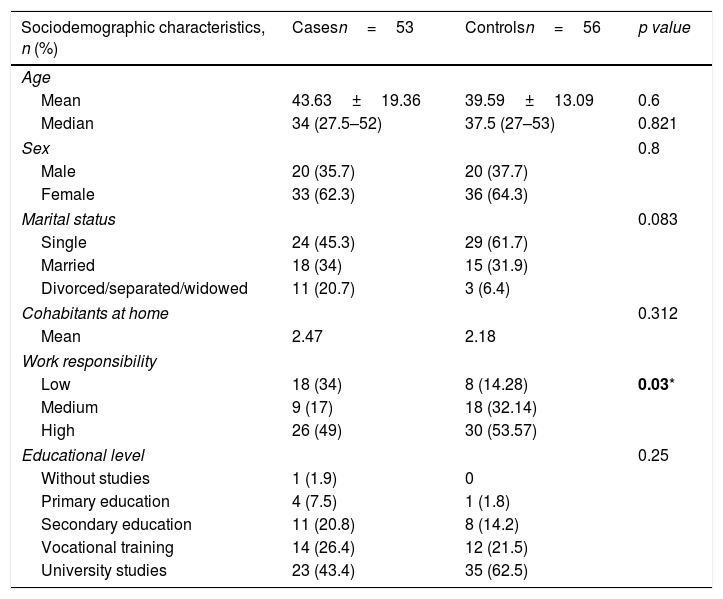
ResultsThe participants comprised 109 individuals, with 53 cases and 56 controls (Table 1). The average age was 42.09±2.01 years and its median was 36 years old. Control group was made up with 20 men (35.7%) and 36 women (64.3%) and the case group, with 20 men (37.7%) and 33 women (62.3%). There were almost statistically significant differences in the distribution of marital status between cases and controls (p=0.083), finding more cases divorced/separated/widowed than controls.
Characteristics of the study participants.
| Sociodemographic characteristics, n (%) | Casesn=53 | Controlsn=56 | p value |
|---|---|---|---|
| Age | |||
| Mean | 43.63±19.36 | 39.59±13.09 | 0.6 |
| Median | 34 (27.5–52) | 37.5 (27–53) | 0.821 |
| Sex | 0.8 | ||
| Male | 20 (35.7) | 20 (37.7) | |
| Female | 33 (62.3) | 36 (64.3) | |
| Marital status | 0.083 | ||
| Single | 24 (45.3) | 29 (61.7) | |
| Married | 18 (34) | 15 (31.9) | |
| Divorced/separated/widowed | 11 (20.7) | 3 (6.4) | |
| Cohabitants at home | 0.312 | ||
| Mean | 2.47 | 2.18 | |
| Work responsibility | |||
| Low | 18 (34) | 8 (14.28) | 0.03* |
| Medium | 9 (17) | 18 (32.14) | |
| High | 26 (49) | 30 (53.57) | |
| Educational level | 0.25 | ||
| Without studies | 1 (1.9) | 0 | |
| Primary education | 4 (7.5) | 1 (1.8) | |
| Secondary education | 11 (20.8) | 8 (14.2) | |
| Vocational training | 14 (26.4) | 12 (21.5) | |
| University studies | 23 (43.4) | 35 (62.5) | |
Regarding work responsibility, 14.28% considered their work responsibility to be low, compared to 34% of the case group, finding a statistically significant difference (p=0.03). No significant differences were found between groups regarding educational level (p=0.25) (Table 1).
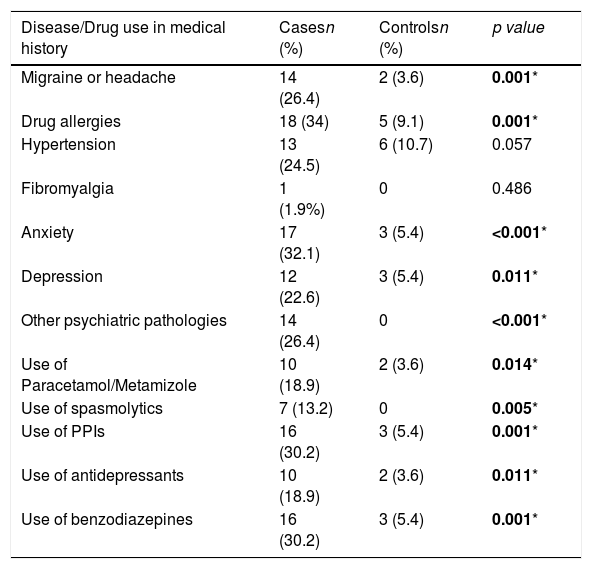
IBS correlation with mental health disordersOur analysis showed that pain disorders were more prevalent among IBS cases (Table 2). The case group had a significantly higher prevalence of migraine and headache compared to controls, with 14 cases (26.4%) reporting these conditions, versus only 2 controls (3.6%) with cephalalgia. Statistically significant differences were also found in drug allergies, with 18 cases (34%) compared to 5 controls (9.1%). Depression, anxiety, and other mental disorders were also more frequent in cases (range 32.1%-26.4%) than in controls (5.4%), all of them with significant differences (Table 2).
Comparison of the prevalence of different diseases and drug use between cases and controls.
| Disease/Drug use in medical history | Casesn (%) | Controlsn (%) | p value |
|---|---|---|---|
| Migraine or headache | 14 (26.4) | 2 (3.6) | 0.001* |
| Drug allergies | 18 (34) | 5 (9.1) | 0.001* |
| Hypertension | 13 (24.5) | 6 (10.7) | 0.057 |
| Fibromyalgia | 1 (1.9%) | 0 | 0.486 |
| Anxiety | 17 (32.1) | 3 (5.4) | <0.001* |
| Depression | 12 (22.6) | 3 (5.4) | 0.011* |
| Other psychiatric pathologies | 14 (26.4) | 0 | <0.001* |
| Use of Paracetamol/Metamizole | 10 (18.9) | 2 (3.6) | 0.014* |
| Use of spasmolytics | 7 (13.2) | 0 | 0.005* |
| Use of PPIs | 16 (30.2) | 3 (5.4) | 0.001* |
| Use of antidepressants | 10 (18.9) | 2 (3.6) | 0.011* |
| Use of benzodiazepines | 16 (30.2) | 3 (5.4) | 0.001* |
Other psychiatric pathologies: sleep disorders, eating disorders and attention deficit hyperactivity disorder. Data are expressed in number of cases/controls meeting each condition. Student's t-test was used to compare means.
Analysis of drug use revealed significant differences, with the case group being higher medication use than the control one (Table 2). IBS cases took more medication for digestive symptoms, particularly spasmolytics (13.2% versus 0%) and proton pump inhibitors (PPIs) (30.2% versus 5.4%).
Additionally, cases had a higher utilization of analgesics. Paracetamol and metamizole use were notably higher in cases (18.9% versus 3.6%). Similarly, cases had a higher consumption of antidepressants (18.9% versus 3.6%) and benzodiazepines (30.2% versus 5.4%).
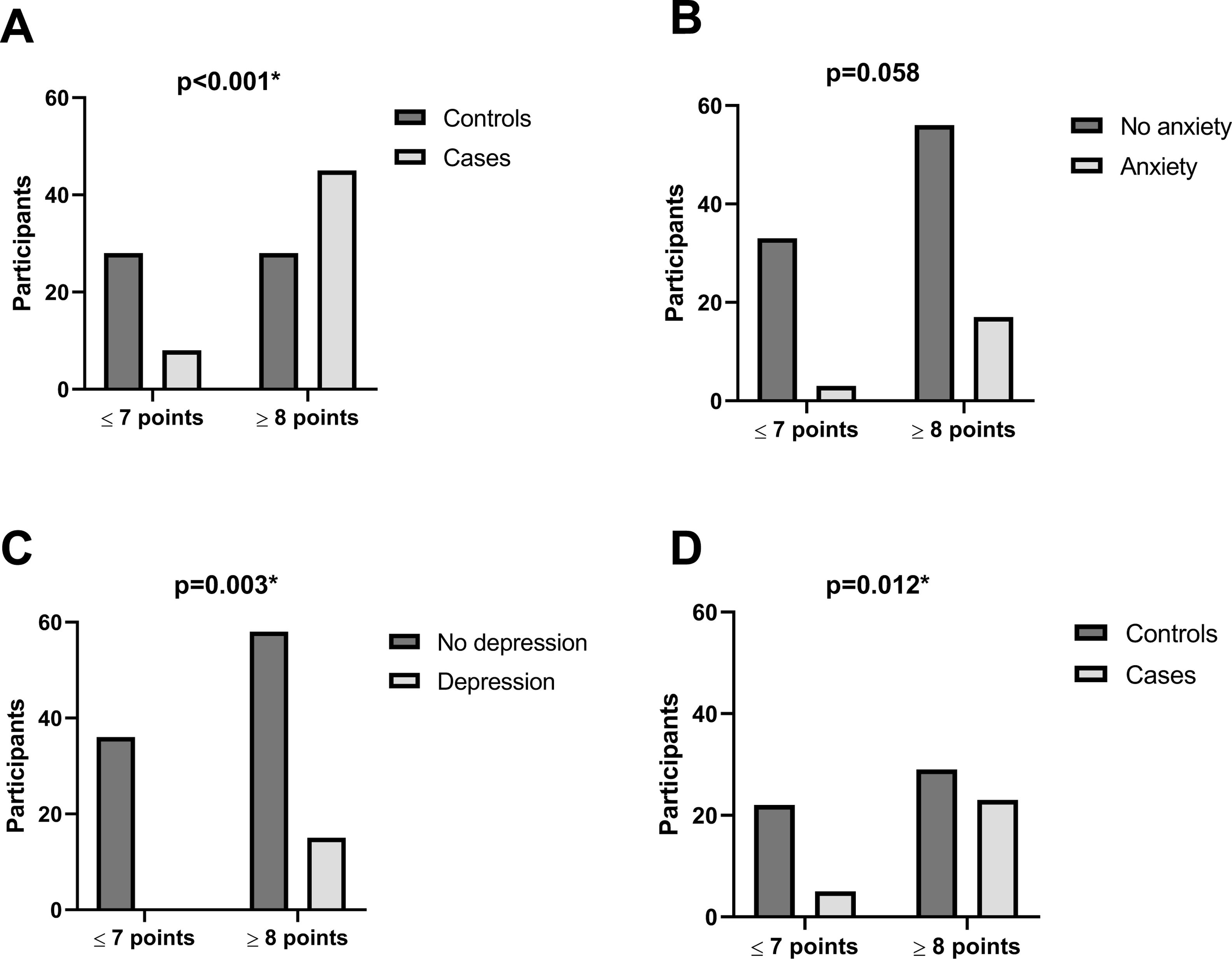
Hospital Anxiety and Depression Scale (HADS)The results of HADS are interpreted as follows: <7 points indicate a normal psychological state, 7–9 points suggest a probable depressive disorder, and >9 points indicate a probable anxiety disorder. The case group scored with an average of 14.6 points versus 8.14 points for controls. Notably, 84.9% of IBS cases scored above 7 points, highlighting a high prevalence of anxiety and depression in this group. In contrast, 50% of controls scored above this threshold, showing significant differences (Fig. 1A).

HADS score. We grouped the scores into two groups, scores below 7 points (healthy mental status) or above 8 points (potentially anxiety or depression). A. HADS scores considering cases and controls groups, p value<0.001. B. HADS score regarding individuals diagnosed with anxiety or not (regardless of whether they belong to the cases or control group), p value=0.05. C. HADS score regarding individuals diagnosed with depression or not (regardless of whether they belong to the cases or control group), p value=0.003. D. HADS score regarding individuals not diagnosed with depression, anxiety, or other psychiatric conditions, p value=0.012.
We also examined the prevalence of individuals with anxiety previously diagnosed and a HADS score>7, obtaining differences, but they were not statistically significant (p=0.058) (Fig. 1B). A similar analysis was conducted for individuals diagnosed with depression and a HADS score≥8, revealing significant differences (p=0.003) (Fig. 1C). To further validate these findings, we reanalyzed the HADS scores after excluding participants with diagnosed depression, anxiety, or other psychiatric conditions. The differences between cases and controls remained statistically significant (p=0.012). In this subset, we compared 51 controls (47% of whom had HADS scores≥8) and 23 cases, with 78% scoring above this threshold (Fig. 1D).
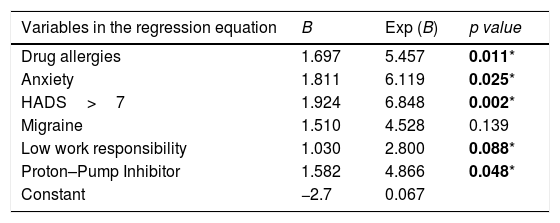
Developing a probability modelA univariate analysis was performed, including all study variables with a p-value less than 0.20. Afterwards, the existence of interactions between variables was evaluated, dismissing it, as these interactions were not statistically different. Subsequently, a logistic regression study was done. Based on our results, the following variables were finally selected for the logistic regression equation: low work responsibility, migraine, drug allergies, anxiety, PPIs use, HADS>7.
B and Exp (B) values were obtained from the logistic regression analysis. B represents the coefficient by which each variable is multiplied. Exp (B) represents the odds ratio for each variable included in the model, indicating the relative increase in the odds of belonging to the IBS group when the variable is present, assuming the remaining variables are constant. Due to the case–control design, these values should not be interpreted as measures of absolute risk. Table 3 presents the results of the analysis, showing the proportion of IBS patients with each variable compared to those without it.
Variables in the regression equation.
| Variables in the regression equation | B | Exp (B) | p value |
|---|---|---|---|
| Drug allergies | 1.697 | 5.457 | 0.011* |
| Anxiety | 1.811 | 6.119 | 0.025* |
| HADS>7 | 1.924 | 6.848 | 0.002* |
| Migraine | 1.510 | 4.528 | 0.139 |
| Low work responsibility | 1.030 | 2.800 | 0.088* |
| Proton–Pump Inhibitor | 1.582 | 4.866 | 0.048* |
| Constant | −2.7 | 0.067 |
B is the coefficient by which each of the variables is multiplied in the equation that will later give rise to the diagnostic score. Exp (B): odds ratio associated with each variable.
Considering these data, the multivariate logistic regression analysis was done, obtaining the subsequent logistic regression equation:

In order to ease the score calculation, we rounded the coefficients of this equation obtaining the following score:

This score gives the probability of being classified as IBS in this model. To use the score, the presence of each variable is multiplied by its coefficient. As an example, when we suspect that a patient can be suffering from IBS, and we know that this patient has drug allergy, has a HADS score over 7, has migraine, and takes PPI, the score will result this way: Z=1.5·1+2·0+2·1+1.5·1+1·0+1.5·1=6.5.
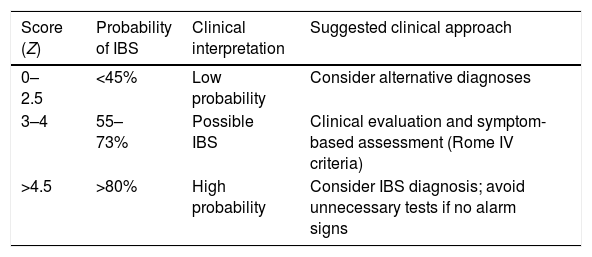
Once the score (Z) is obtained, the probability of being classified as IBS in this model is shown in Supplementary data. To facilitate the clinical applicability of the proposed score, a risk stratification table was developed based on the obtained values. Patients were classified into three categories according to their total score (Z): low, intermediate, and high probability of being classified as IBS in this model. As shown in Table 4, scores below 3 were associated with a low probability, scores between 3 and 5 with an intermediate probability, and scores above 5 with a high probability of IBS. This categorization may help clinicians in primary care settings to quickly estimate the likelihood of IBS and support decision-making in patients presenting with compatible symptoms. Our score has an 80.4% of sensitivity and 73.6% of specificity in our sample.
Interpretation of the proposed IBS probability score according to total score (Z).
| Score (Z) | Probability of IBS | Clinical interpretation | Suggested clinical approach |
|---|---|---|---|
| 0–2.5 | <45% | Low probability | Consider alternative diagnoses |
| 3–4 | 55–73% | Possible IBS | Clinical evaluation and symptom-based assessment (Rome IV criteria) |
| >4.5 | >80% | High probability | Consider IBS diagnosis; avoid unnecessary tests if no alarm signs |
The probability ranges are based on the distribution observed in this sample and should be interpreted as the likelihood of being classified as IBS within this model.
The aim of this study was to facilitate and improve the initial diagnostic capacity of patients who come to the consultation with symptoms compatible with IBS, developing a score that could facilitate IBS diagnosis. Given the multifactorial nature of IBS, we analyzed extra-digestive parameters, including demographic information, medical history, pharmacotherapy, and mental health status.
Our results have allowed us to develop a score by a multivariate logistic regression analysis including variables as suffering from drug allergies, anxiety, a HADS score>7, suffering from migraine, considering work responsibility as low and the use of PPIs (Z=1.5*DrugAllergies+2*Anxiety+2*HADS7+1.5*Migraine+1*LowWorkResponsibility+1.5*PPI). Interestingly, these mental health-related variables are the most relevant and influential in our score.
Each variable of the score is discussed below. The prevalence of drug allergies is multiplied by a factor of 1.5. Previous studies have also revealed that patients diagnosed with functional gastrointestinal disorders declare drug allergies more frequently than those suffering from organic pathologies.9 An association between allergies and IBS has been demonstrated as well, by relating childhood allergies with the development of functional gastrointestinal disorders.10
Similarly, there are numerous overlaps between migraine and IBS, as both pathologies are more prevalent in women, present pain and affect the emotional status.11 Moreover, a prevalence study affirms that people with IBS have a 60% more probability of suffering migraine than the general population.12 In agreement with our results, IBS patients are more likely to be prescribed long-term PPIs than controls.13 Actually, antisecretory drugs are the fourth most prescribed drug for IBS patients.
Considering one's own work responsibility as low is multiplied by one in our score. Our results are similar to those obtained by Nilsson et al., who describe an association between unemployment and IBS but shows no correlation between IBS and factors as educational level or marital status.14 This fact can be interpreted as IBS patients could consider themselves less valued and motivated. Concerning work and IBS, there are high rates of work impairment and overall work loss in IBS patients.15 In addition, IBS patients display a feeling of being less influential and a loss of codetermination in working groups.16 Interestingly, low work responsibility, often characterized by little control over tasks or decision-making, can ironically lead to high, chronic stress and anxiety.
The most relevant factors of our score are anxiety and a HADS score>7, because suffering these two conditions is correlated to a probability higher than 70% of being classified as IBS in this model (Supplementary data 1). The inclusion of both clinically diagnosed anxiety and HADS score>7 may appear redundant at first glance; however, these variables capture different dimensions of mental health. While a previous diagnosis of anxiety reflects a chronic or clinically recognized condition, the HADS score provides a measure of current psychological status, including subclinical symptoms. Therefore, both variables may contribute complementary information in the context of IBS, a disorder strongly influenced by dynamic gut–brain interactions.17 The role of mental health issues in IBS pathophysiology has been widely investigated, as it can be shown in different metanalysis.18 In fact, it has been described not only a positive correlation between anxiety and IBS, but also the worsening of IBS symptoms in periods of stress. In addition, stress can alter microbiota and their metabolites resulting in an increase in bowel movement.19 The measurement of anxiety specifically associated to visceral hypersensitivity can be the main diagnostic predictor of IBS.20 Additionally, depression is also positively associated to IBS.21
Our results show that cases got higher HADS score than controls. Other studies have endorsed these results using other scales to measure anxiety and depression. Actually, IBS patients present higher score in Beck Anxiety Inventory scale,22 Hammilton Anxiety and Depression Scales,23 Patient Health Questionnaire (PHQ-9) or Composite International Diagnostic Interview Short Form (CIDI-SF).24 HADS has also been analyzed showing that IBS patients obtain higher scores,25 corroborating the deterioration of mental health in IBS patients.
Nowadays, Rome IV criteria are the diagnostic tool for IBS. These criteria are based on patients’ gastrointestinal symptomatology. These criteria have evolved over time, but scales based on gastrointestinal symptoms have been predominantly used. This causes the final diagnosis of the pathology to be delayed, and a long time passes before it becomes definitive due to the no specificity of the symptoms and the patient's personal assessment of them. Therefore, we propose adding extra-digestive parameters to the multivariate analysis’ formula, increasing the probability of a correct diagnosis of IBS. In agreement, Sood et al.’s metanalysis affirms that the isolated study of gastrointestinal symptoms, biomarkers, or psychological parameters does not improve the IBS diagnosis, but it determines that the combination of these three variables leads to a higher probability index of IBS diagnosis comparing to criteria based only in gastrointestinal symptoms.26 Similarly, the presence of psychosocial factors can significantly predict if an individual belongs to the IBS group or to the control one.27
Given that IBS is a heterogeneous and multifactorial disease, the implementation of scales combining digestive, psychological, dietary factors and other medical illnesses should be assessed. A global analysis of patients’ situation could be done, considering more variables than their gastrointestinal symptomatology, achieving IBS diagnosis with more sensitivity and specificity. IBS scores could also help healthcare administrations reduce costs associated with multiple diagnostic tests performed on patients suspected of having IBS, while simultaneously improving patients’ quality of life. Our score could serve as a triage tool to identify individuals at high risk for IBS, thereby reducing diagnostic time and promoting a more rational and cost-effective use of medical tests.28 From a clinical perspective, this score should not be interpreted as a definitive diagnostic tool, but rather as a screening instrument to support decision-making in routine practice. Given the absence of objective biomarkers for IBS and the reliance on symptom-based criteria, this score may help identify individuals with a higher probability of being classified as IBS in this model based on extra-intestinal factors. In this context, a higher score could alert clinicians to consider IBS earlier in the diagnostic process, potentially reducing unnecessary investigations and facilitating a more targeted clinical approach. Importantly, the score is intended to complement, not replace, established diagnostic criteria such as Rome IV, and should be interpreted within the overall clinical context of each patient.
Regarding the interpretation of our score, if our study had been conducted in the general population without distinguishing between cases and controls, the score could be translated directly into the risk of suffering IBS. However, since this is a case–control study, such interpretation is not applicable. Given that we included 50% cases and 50% controls, interpreting the score in this way would incorrectly assume an IBS prevalence of 50% in the general population. Therefore, our analysis can be interpreted as the probability of being classified as IBS in this model, which is indirectly similar. Despite this, we consider that this score would facilitate the IBS diagnosis. Further research is needed to validate this index as a risk score, applying it to patients with undiagnosed gastrointestinal disorders.
This study has several limitations that should be considered when interpreting the results. First, its case–control design does not allow estimation of the absolute risk of IBS, but only the probability of being classified as IBS in this model, which may limit the direct applicability of the score in the general population. Second, the relatively small sample size and the number of variables included in the multivariate model may increase the risk of overfitting, potentially affecting the stability and generalizability of the score. In addition, there is the lack of stratification of IBS patients according to clinical subtype and recruitment setting, which may contribute to population heterogeneity and could influence the generalizability of the findings. Third, the score was developed and evaluated within the same population, and no internal or external validation was performed, which limits its robustness and requires further validation in independent cohorts. Moreover, the association observed with certain variables, such as proton pump inhibitor use, may be influenced by indication bias, as these drugs are frequently prescribed in patients with gastrointestinal symptoms. Finally, data collection relied on self-reported information obtained through interviews, which may be subject to recall bias. Future studies with larger sample sizes, prospective designs, and external validation are needed to confirm the clinical utility of this probability model. The inclusion of patients presenting with symptoms compatible with irritable bowel syndrome but ultimately diagnosed with organic gastrointestinal diseases such as inflammatory bowel disease or colorectal cancer would also be valuable to further assess the discriminative performance of the model in clinically challenging differential diagnosis scenarios.
Our results highlight the importance of mental health status in IBS. These modifiable factors could be considered approach therapy strategies. In fact, some studies have already exposed that psychotherapy and mindfulness strategies improve symptomatology in IBS and the patient management, as well as improving quality of life.29,30 In summary, our results allow for the development of a score based on mental health mainly and other extra digestive parameters that may facilitate the IBS management. Nevertheless, this score must be validated in the future by applying it to more patients and examining its consistency and changes over time.
Conclusions- 1.
The diagnostic approach to IBS should be based on both gastrointestinal and extra digestive symptoms.
- 2.
Mental health represents an important variable that should be taken into consideration in the diagnostic process of IBS.
- 3.
Medical history, particularly regarding drug allergies and proton pump inhibitor (PPI) use, may provide valuable information for the diagnosis of IBS.
This work is a case–control study approved by the Ethical Committee CEICA, with report number PI19/184.
FundingThis work was funded by grants from the Foundation for the Study of Inflammatory Bowel Diseases in Aragón (ARAINF 2012/0567) and from European Social Fund (ESF) and the Aragón Regional Government (A20_23R).
Conflict of interestThe authors declare no potential conflicts of interest with respect to the research, authorship, and/or publication of this article.
We thank all the participants of this study and the practitioners involved in the participant selection.
The followings are the supplementary data to this article:



