metricas

Gastroenterología y Hepatología

Sugerencias
Gastroenterología y Hepatología Novel biomarkers and multi-omics approaches for diagnosis and management of ulce...
Información de la revista
Vol. 49. Núm. 7.
(Agosto - Septiembre 2026)
Cita
Cita
Compartir
Descargar PDF
Más opciones de artículo
Visitas
786
Vol. 49. Núm. 7.
(Agosto - Septiembre 2026)
Special article

Novel biomarkers and multi-omics approaches for diagnosis and management of ulcerative colitis

Nuevos biomarcadores y enfoques multiómica para el diagnóstico y manejo de la colitis ulcerosa
Visitas
786
Arup Deya, Manish Kumar Gautama,
Autor para correspondencia
manish.g@adtu.in

Corresponding author.
, Sandip Mondalb, Saikat Sena
a Faculty of Pharmaceutical Science, Assam down town University, Sankar Madhab Path, Gandhi Nagar, Panikhaiti, Guwahati 781026, Assam, India
b Amity Institute of Pharmacy, Amity University, Kolkata 700135, West Bengal, India
Este artículo ha recibido
Información del artículo
Resumen
Texto completo
Bibliografía
Descargar PDF
Estadísticas
Abstract
Background

Ulcerative colitis (UC) remains challenging to diagnose, monitor, and treat due to heterogeneous disease presentation and lack of reliable non-invasive markers. Current diagnostic tools, including endoscopy and routine laboratory tests, are limited by invasiveness, cost, and low sensitivity.

Aim

This review evaluates emerging biomarkers and multi-omics strategies in UC, highlighting their potential role in disease diagnosis, prognosis, and therapeutic response prediction.

Methods

A comprehensive literature analysis was conducted, focusing on faecal, serological, genetic, epigenetic, microbial, and metabolite-based biomarkers, as well as recent advances in transcriptomics, proteomics, and metabolomics. Integration with machine learning approaches was also assessed for their clinical applicability.

Results

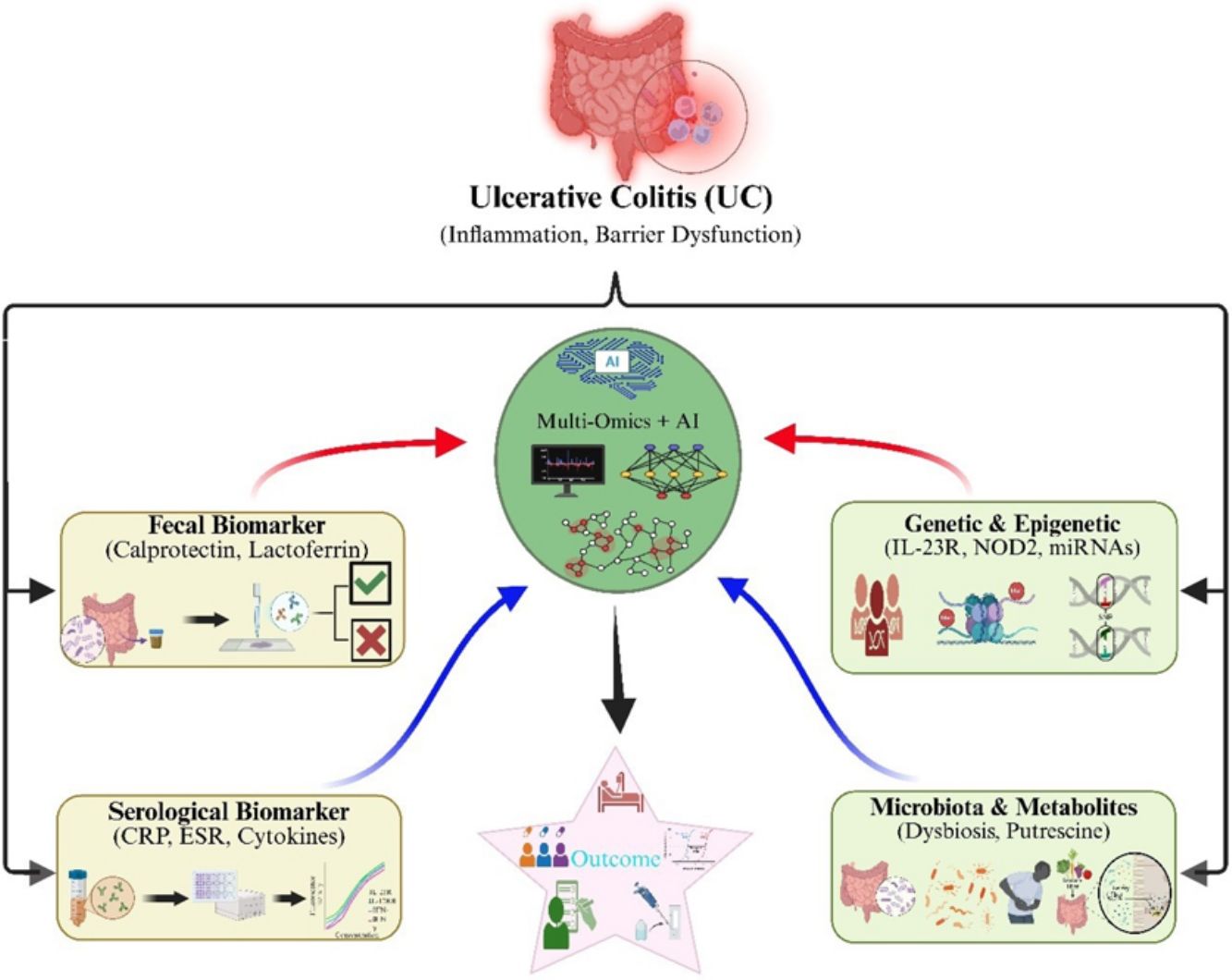
Faecal calprotectin and lactoferrin remain reliable non-invasive markers for mucosal inflammation, while serological markers such as CRP and ESR show limited specificity. Genetic variants (IL23R, NOD2) and epigenetic regulators, particularly microRNAs, demonstrate potential for disease stratification. Dysbiosis and altered microbial metabolites further correlate with disease severity and treatment response. Multi-omics integration offers a systems-level view of UC, enabling biomarker panels that improve diagnostic precision and predict therapeutic outcomes. Machine learning tools enhance biomarker-based models, but clinical translation is constrained by variability, validation gaps, and regulatory hurdles.

Conclusion

Emerging biomarkers, especially when integrated across omics platforms and supported by artificial intelligence, provide promising avenues for precision medicine in UC. However, standardisation, external validation, and regulatory qualification remain essential for their successful clinical implementation.

Keywords:
Ulcerative colitis
Biomarkers
Multi-omics
MicroRNA
Machine learning
Resumen
Antecedentes

La colitis ulcerosa (CU) sigue siendo difícil de diagnosticar, monitorizar y tratar debido a la heterogeneidad clínica y a la falta de marcadores no invasivos fiables. Las herramientas diagnósticas actuales, como la endoscopia y las pruebas de laboratorio rutinarias, se ven limitadas por su carácter invasivo, elevado coste y baja sensibilidad.

Objetivo

Esta revisión evalúa biomarcadores emergentes y estrategias multi-ómicas en CU, destacando su papel potencial en el diagnóstico, el pronóstico y la predicción de la respuesta terapéutica.

Métodos

Se realizó un análisis exhaustivo de la literatura, centrado en biomarcadores fecales, serológicos, genéticos, epigenéticos, microbianos y metabolómicos, así como en los avances recientes en transcriptómica, proteómica y metabolómica. También se valoró la integración con enfoques de aprendizaje automático para su aplicabilidad clínica.

Resultados

La calprotectina y la lactoferrina fecales siguen siendo marcadores no invasivos fiables de inflamación mucosa, mientras que los marcadores serológicos como la PCR y la VSG presentan una especificidad limitada. Variantes genéticas (IL23R, NOD2) y reguladores epigenéticos, especialmente microARN, muestran potencial en la estratificación de pacientes. La disbiosis y las alteraciones en metabolitos microbianos también se correlacionan con la gravedad de la enfermedad y la respuesta al tratamiento. La integración multi-ómica ofrece una visión sistémica de la CU, permitiendo paneles de biomarcadores que mejoran la precisión diagnóstica y predicen los resultados terapéuticos. Las herramientas de aprendizaje automático potencian los modelos basados en biomarcadores, aunque su traslación clínica está limitada por la variabilidad, la falta de validación externa y los retos regulatorios.

Conclusiones

Los biomarcadores emergentes, especialmente cuando se integran en plataformas ómicas y se apoyan en inteligencia artificial, representan vías prometedoras para la medicina de precisión en CU. Sin embargo, la estandarización, la validación externa y la cualificación regulatoria son esenciales para su implementación clínica exitosa.

Palabras clave:
Colitis ulcerosa
Biomarcadores
Multiómica
MicroARN
Aprendizaje automático
Resumen gráfico

Artículo

Opciones para acceder a los textos completos de la publicación Gastroenterología y Hepatología
Suscriptor
Suscriptor de la revista

Si ya tiene sus datos de acceso, clique aquí.

Si olvidó su clave de acceso puede recuperarla clicando aquí y seleccionando la opción "He olvidado mi contraseña".
Comprar
Comprar acceso al artículo

Comprando el artículo el PDF del mismo podrá ser descargado

Comprar ahora
Contactar
Teléfono para suscripciones e incidencias
De lunes a viernes de 9h a 18h (GMT+1) excepto los meses de julio y agosto que será de 9 a 15h
Llamadas desde España
932 415 960
Llamadas desde fuera de España
+34 932 415 960
E-mail
References
[1]
P. Alavinejad, S.J. Hashemi, N. Behl, A. Hormati, A. Elbasuny, N.E. Daryani, et al.
Inflammatory bowel disease evolution in the past two decades: a chronological multinational study.
EClinicalMedicine, 70 (2024),
[2]
M. Gajendran, P. Loganathan, G. Jimenez, A.P. Catinella, N. Ng, C. Umapathy, et al.
A comprehensive review and update on ulcerative colitis.
Dis Mon, 65 (2019),
[3]
S. Plevy, M.S. Silverberg, S. Lockton, T. Stockfisch, L. Croner, J. Stachelski, et al.
Combined serological, genetic, and inflammatory markers differentiate non-IBD, Crohn's disease, and ulcerative colitis patients.
Inflamm Bowel Dis, 19 (2013), pp. 1139-1148
[4]
A. Kilcoyne, J.L. Kaplan, M.S. Gee.
Inflammatory bowel disease imaging: current practice and future directions.
World J Gastroenterol, 22 (2016), pp. 917-932
[5]
P. Freire, R. Cardoso, P. Figueiredo, M.M. Donato, M. Ferreira, S. Mendes, et al.
NOD2 gene mutations in ulcerative colitis: useless or misunderstood?.
Int J Colorectal Dis, 29 (2014), pp. 653-661
[6]
M. Maksic, I. Corovic, T. Maksic, J. Zivic, M. Zivic, N. Zdravkovic, et al.
Molecular insight into the role of HLA genotypes in immunogenicity and secondary refractoriness to anti-TNF therapy in IBD patients.
Int J Mol Sci, 26 (2025),
[7]
D.F. McCole.
IBD candidate genes and intestinal barrier regulation.
Inflamm Bowel Dis, 20 (2014), pp. 1829-1849
[8]
L. Yan, C. Gu, S. Gao, B. Wei.
Epigenetic regulation and therapeutic strategies in ulcerative colitis.
Front Genet, 14 (2023),
[9]
I. Aggeletopoulou, A. Mouzaki, K. Thomopoulos, C. Triantos.
miRNA molecules-late breaking treatment for inflammatory bowel diseases?.
Int J Mol Sci, 24 (2023),
[10]
V. Kiudelis, J. Kupcinskas, A. Link.
Circulating and fecal microRNAs as non-invasive biomarkers for IBD: current evidence and next steps.
Best Pract Res Clin Gastroenterol, 78 (2025),
[11]
L. Sun, Y. Han, H. Wang, H. Liu, S. Liu, H. Yang, et al.
MicroRNAs as potential biomarkers for the diagnosis of inflammatory bowel disease: a systematic review and meta-analysis.
J Int Med Res, 50 (2022),
[12]
L. Caba, A. Florea, P. Cianga, V. Drug, R. Popescu, C. Mihai, et al.
Genetic and epigenetic factors in ulcerative colitis: a narrative literature review.
[13]
K.K. Nasser, T. Shinawi.
Genotype-protein phenotype characterization of NOD2 and IL23R missense variants associated with inflammatory bowel disease: a paradigm from molecular modelling, dynamics, and docking simulations.
Front Med (Lausanne), 9 (2022),
[14]
V.V. Galatenko, A.V. Galatenko, T.R. Samatov, A.A. Turchinovich, M.Y. Shkurnikov, J.A. Makarova, et al.
Comprehensive network of miRNA-induced intergenic interactions and a biological role of its core in cancer.
[15]
J.J. Chen, S.J. Bai, W.W. Li, C.J. Zhou, P. Zheng, L. Fang, et al.
Urinary biomarker panel for diagnosing patients with depression and anxiety disorders.
Transl Psychiatry, 8 (2018), pp. 192
[16]
C. Moore, G. Corbett, A.C. Moss.
Systematic review and meta-analysis: serum infliximab levels during maintenance therapy and outcomes in inflammatory bowel disease.
J Crohns Colitis, 10 (2016), pp. 619-625
[17]
M.A. Dar, A. Arafah, K.A. Bhat, A. Khan, M.S. Khan, A. Ali, et al.
Multiomics technologies: role in disease biomarker discoveries and therapeutics.
Brief Funct Genomics, 22 (2023), pp. 76-96
[18]
X. Dai, L. Shen.
Advances and trends in omics technology development.
Front Med (Lausanne), 9 (2022),
[19]
S. Zeng, Z. Zheng, X. Wei, L. Chen, J. Lin, M. Liu, et al.
Multiomics analysis unravels alteration in molecule and pathways involved in nondiabetic chronic wounds.
ACS Omega, 9 (2024), pp. 20425-20436
[20]
J. Liu, L. Yang, D. Liu, Q. Wu, Y. Yu, X. Huang, et al.
The role of multi-omics in biomarker discovery, diagnosis, prognosis, and therapeutic monitoring of tissue repair and regeneration processes.
J Orthop Transl, 54 (2025), pp. 131-151
[21]
A.J. Preto, S. Chanana, D. Ence, M.D. Healy, D. Domingo-Fernández, K.A. West.
Multi-omics data integration identifies novel biomarkers and patient subgroups in inflammatory bowel disease.
J Crohns Colitis, 19 (2025),
[22]
A.R. Bourgonje, H. van Goor, K.N. Faber, G. Dijkstra.
Clinical value of multiomics-based biomarker signatures in inflammatory bowel diseases: challenges and opportunities.
Clin Transl Gastroenterol, 14 (2023), pp. e00579
[23]
A. Kazemi, M. Fathy, A. Jahanian, J. Khanali, Y. Ostadi, A. Babajani, et al.
The role of MMPs and TIMPs in regenerative medicine: from pathological ECM remodeling to therapeutic applications.
Biomed Pharmacother, 191 (2025),
[24]
Z. Deng, T. Fan, C. Xiao, H. Tian, Y. Zheng, C. Li, et al.
TGF-β signaling in health, disease, and therapeutics.
Signal Transduct Target Ther, 9 (2024), pp. 61
[25]
M. Manchanda, M. Torres, F. Inuossa, R. Bansal, R. Kumar, M. Hunt, et al.
Metabolic reprogramming and reliance in human skin wound healing.
J Invest Dermatol, 143 (2023),
[26]
J. Huang, X. Zhu, Y. Ma, Z. Zhang, J. Zhang, Z. Hao, et al.
Machine learning in the differential diagnosis of ulcerative colitis and Crohn's disease: a systematic review.
Transl Gastroenterol Hepatol, 10 (2025), pp. 56
[27]
G. Alfonso Perez, R. Castillo.
Gene identification in inflammatory bowel disease via a machine learning approach.
Medicina (Kaunas), 59 (2023), pp. 1218
[28]
M. Ghassemi, L. Oakden-Rayner, A.L. Beam.
The false hope of current approaches to explainable artificial intelligence in health care.
Lancet Digit Health, 3 (2021), pp. e745-e750
[29]
G. Ruan, J. Qi, Y. Cheng, R. Liu, B. Zhang, M. Zhi, et al.
Development and validation of a deep neural network for accurate identification of endoscopic images from patients with ulcerative colitis and Crohn's disease.
Front Med (Lausanne), 9 (2022),
[30]
J.H. Kim, A.R. Choe, Y. Park, E.M. Song, J.R. Byun, M.S. Cho, et al.
Using a deep learning model to address interobserver variability in the evaluation of ulcerative colitis (UC) severity.
J Pers Med, 13 (2023), pp. 1584
[31]
A. Sakuraba, N. Nemoto, N. Hibi, R. Ozaki, S. Tokunaga, O. Kikuchi, et al.
Extent of disease affects the usefulness of fecal biomarkers in ulcerative colitis.
BMC Gastroenterol, 21 (2021), pp. 197
[32]
A.T. Aborode, R.O. Adesola, G.Y. Scott, E. Arthur-Hayford, O.J. Otorkpa, S.D. Kwaku, et al.
Bringing lab to the field: exploring innovations in point-of-care diagnostics for the rapid detection and management of tropical diseases in resource-limited settings.
Adv Biomark Sci Technol, 7 (2025), pp. 28-43
[33]
T. Shaik, X. Tao, L. Li, H. Xie, J.D. Velásquez.
A survey of multimodal information fusion for smart healthcare: mapping the journey from data to wisdom.
Inform Fusion, 102 (2024),
[34]
F. Krones, U. Marikkar, G. Parsons, A. Szmul, A. Mahdi.
Review of multimodal machine learning approaches in healthcare.
Inform Fusion, 114 (2025),
asdasdasd
Opciones de artículo
Herramientas