

metricas
covid
Gastroenterología y Hepatología Follicular pancreatitis mimicking pancreatic cancer: A diagnostic challenge
Información de la revista
Visitas
289
Vol. 48. Núm. 10.
(Diciembre 2025)
Image of the month
Acceso a texto completo
Follicular pancreatitis mimicking pancreatic cancer: A diagnostic challenge
Pancreatitis follicular que imita cáncer de páncreas: un desafío diagnóstico
Visitas
289
Yu Lu1, Qiu Wu1, Tao Yin
Autor para correspondencia
ytwhun@hust.edu.cn

Corresponding author.
Department of Pancreatic Surgery, Union Hospital, Tongji Medical College, Huazhong University of Science and Technology, Wuhan, China
Este artículo ha recibido
Información del artículo
Texto completo
Bibliografía
Descargar PDF
Estadísticas
Figuras (2)
Texto completo

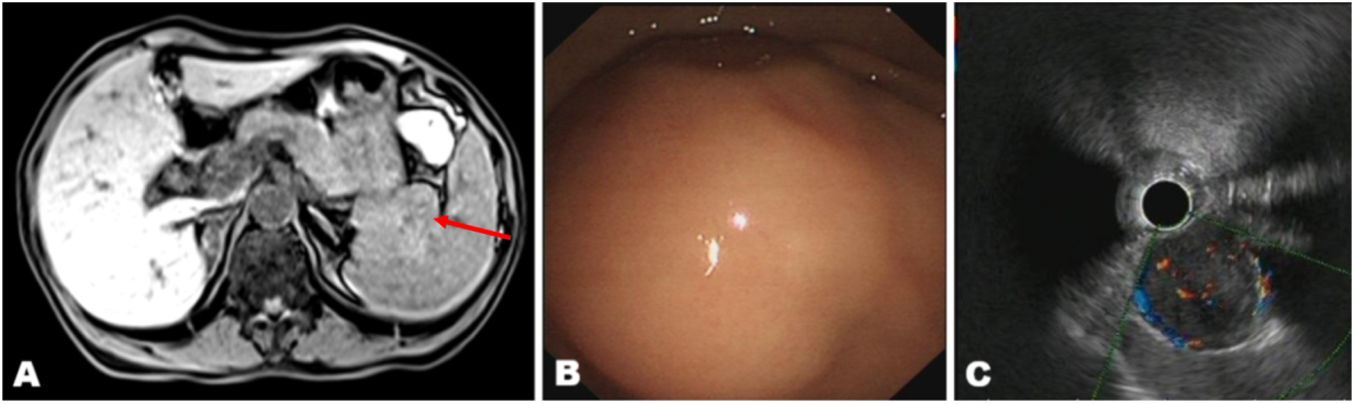
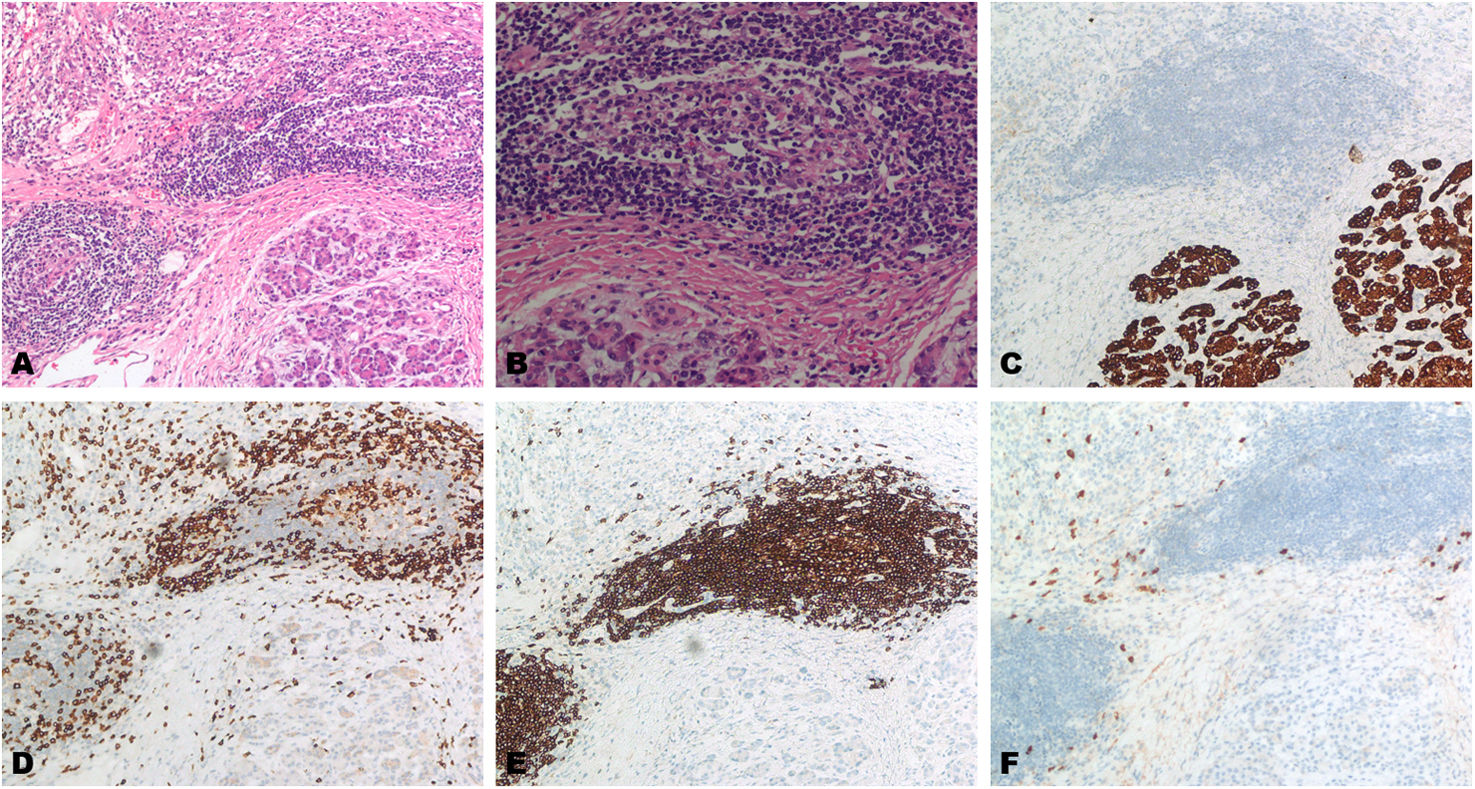
A 68-year-old woman presented with a one-month history of vomiting and diarrhea. Magnetic resonance imaging (MRI) revealed lesions in the pancreatic tail and splenic hilum, with heterogeneous enhancement after contrast administration (Fig. 1A). Endoscopic ultrasound (EUS) identified a large hypoechoic mass in the tail of the pancreas, with scattered internal calcifications (Fig. 1B and C). The laboratory examination shows that the tumor markers have not significantly increased, but the lesion still cannot be ruled out as malignant. Consequently, the patient underwent a laparoscopic distal pancreatectomy and splenectomy. Postoperative pathology confirmed chronic pancreatitis with significant fibrosis and lymphoid follicles (Fig. 2A and B). Immunohistochemical analysis revealed pancreatic tissue atrophy (PCK+) (Fig. 2C). The infiltrating lymphocytes were predominantly CD20+ B cells, alongside CD3+ T cells (Fig. 2D and E). IgG expression was less than 1% (Fig. 2F). Based on these findings, the patient was ultimately diagnosed with follicular pancreatitis. Follicular pancreatitis, a rare Th17-associated disorder, is often indistinguishable from pancreatic cancer preoperatively. Current expert criteria emphasize concurrent periductal lymphocytic infiltration and germinal center formation. Ultrasound-guided fine-needle biopsy may aid accurate diagnosis.1,2

Figure 1.

(A) MRI revealed pancreatic tail/splenic hilum lesions with heterogeneous post-contrast enhancement. (B and C) EUS reveals hypoechoic pancreatic tail mass with scattered calcifications.

Figure 2.

(A and B) H&E staining indicated fibrosis and lymphoid follicles. (C) IHC revealed pancreatic atrophy (PCK+). (D and E) IHC revealed infiltrating lymphocytes: CD20+ B cells (predominant) and CD3+ T cells. (F) IHC revealed IgG expression was less than 1%.

CRediT authorship contribution statement

Yu Lu and Qiu Wu collected the data and drafted the manuscript; Tao Yin revised the manuscript and conducted the study. All authors reviewed and approved the final manuscript.

Informed consent

Informed consent was obtained from the patient for the publication of their information and image.

Funding

None declared.

Conflict of interest

There are none to declare.

References
[1]
Y. Zen, A. Ishikawa, S. Ogiso, N. Heaton, B. Portmann.
Follicular cholangitis and pancreatitis – clinicopathological features and differential diagnosis of an under-recognized entity.
Histopathology, 60 (2012), pp. 261-269
[2]
R.K. Gupta, B.H. Xie, K.T. Patton, M. Lisovsky, E. Burks, S.W. Behrman, et al.
Follicular pancreatitis: a distinct form of chronic pancreatitis – an additional mimic of pancreatic neoplasms.
Hum Pathol, 48 (2016), pp. 154-162

Co-first authors.

Copyright © 2025. Elsevier España, S.L.U.. All rights reserved
Descargar PDF