Loss to follow up (LTFU) among people living with HIV is a major clinical and public health challenge, as it is associated with increased risk of onward transmission and higher mortality. Understanding the characteristics of people who are lost to follow-up is essential to improve continuity of care and inform targeted retention strategies.
MethodsWe conducted a retrospective observational study in the Infectious Diseases Unit of Hospital Clínico Universitario de San Juan (Alicante, Spain). We included 209 adults diagnosed with HIV since 2016 and recorded sociodemographic, clinical and virological variables. LTFU was defined, according to GeSIDA criteria, as the absence of clinical visits for ≥12 months. We used bivariate analyses, multivariable logistic regression, and Kaplan–Meier curves to explore factors associated with LTFU and estimate time to LTFU.
ResultsOverall, 23.9% of patients (n=50) were LTFU. Compared with retained patients, those LTFU were younger (30.5 vs 34.0 years; p=0.016), more frequently of non-Spanish nationality (29.8% vs 14.1%; p=0.010) and less likely to have a stable partner (12.3% vs 29.2%; p=0.008). Detectable viral load at the last visit was the variable most strongly associated with LTFU (52.4% vs 16.5%; p<0.001). In the multivariable model, non-Spanish nationality (OR 2.84; 95% CI 1.21–6.62; p=0.016) and detectable viral load (OR 5.90; 95% CI 2.40–12.50; p<0.001) remained independently associated with a higher odds of LTFU. The probability of remaining in care at 1, 3 and 5 years was 86.0%, 74.5% and 70.2%, respectively.
ConclusionsThe LTFU rate in our cohort is comparable to that reported in similar high-income settings. Younger age, non-Spanish origin and detectable viral load at last visit were associated with a higher likelihood of LTFU, with a substantial proportion of events occurring early after entry into care. These findings identify young people of non-Spanish nationality with detectable viraemia as a priority group for targeted HIV retention interventions.
La pérdida de seguimiento (PS) en personas con infección por el VIH constituye un importante reto clínico y de salud pública, al asociarse a un mayor riesgo de transmisión y de mortalidad. Conocer las características de las personas que presentan pérdida de seguimiento es esencial para mejorar la continuidad asistencial y orientar intervenciones de retención.
MétodosSe realizó un estudio observacional retrospectivo en la Unidad de Enfermedades Infecciosas del Hospital Clínico Universitario de San Juan (Alicante, España). Se incluyeron 209 personas adultas diagnosticadas de infección por el VIH desde 2016 y se recogieron variables sociodemográficas, clínicas y virológicas. La PS se definió, según los criterios de GeSIDA, como la ausencia de visitas clínicas durante ≥12 meses. Se llevaron a cabo análisis bivariantes, un modelo de regresión logística multivariable y curvas de Kaplan Meier para identificar factores asociados a PS y estimar el tiempo hasta la PS.
ResultadosEn conjunto, el 23.9% de los pacientes (n=50) presentaron PS. En comparación con los pacientes retenidos en seguimiento, las personas con PS eran más jóvenes (30,5 frente a 34,0 años; p=0,016), presentaban con mayor frecuencia nacionalidad no española (29,8% frente a 14,1%; p=0,010) y tenían con menor frecuencia pareja estable (12,3% frente a 29,2%; p=0,008). La carga viral detectable en la última visita fue la variable más fuertemente asociada a PS (52,4% frente a 16,5%; p<0,001). En el modelo multivariable, la nacionalidad no española (OR 2,84; IC95%: 1,21–6,62; p=0,016) y la carga viral detectable (OR 5,90; IC95%: 2,40–12,50; p<0,001) se mantuvieron independientemente asociadas a un mayor probabilidad de PS. La probabilidad de permanecer en seguimiento a 1, 3 y 5 años fue del 86,0%, 74,5% y 70,2%, respectivamente.
ConclusionesLa tasa de PS en nuestra cohorte es comparable a la descrita en otros entornos de renta alta. La edad joven, el origen no español y la carga viral detectable en la última visita se asociaron a una mayor probabilidad de PS, observándose una proporción relevante de eventos de PS en fases tempranas tras el inicio de la atención especializada. Estos hallazgos señalan a la población migrante joven con viremia detectable como un grupo prioritario para intervenciones de retención en la atención al VIH.
Retention in human immunodeficiency virus (HIV) care has become a central challenge in the modern antiretroviral therapy (ART) era.1,2 Although ART has transformed HIV into a chronic manageable condition, progress towards the Joint United Nations Programme on HIV/AIDS (UNAIDS) 95–95–95 targets for 2030 is hindered by gaps in the care continuum, particularly loss to follow-up (LTFU).2 In 2024, an estimated 87% of all people living with HIV worldwide knew their status, 77% were receiving ART and 73% had suppressed viral load, indicating that important gaps remain to be closed.1
In the World Health Organization (WHO) European Region, 2023 estimates indicated that 83% of people living with HIV were diagnosed, 84% of those diagnosed were on ART and 93% of those treated had achieved viral suppression, resulting in overall viral suppression in 65% of all people living with HIV.3 In Spain, among an estimated 148,371 people living with HIV, 93% are diagnosed, 97% of those diagnosed receive ART and 91% of those treated have suppressed viral load.3 LTFU is a key barrier to further improving these indicators, as disengagement from care contributes to ongoing viraemia and undermines progress towards the 95–95–95 targets.2–4
In most clinical cohorts, LTFU is defined as the absence of recorded clinic visits over a 12-month period, which corresponds to at least two missed scheduled visits and leaves a full year without updated clinical information.4 In European clinical cohorts, the proportion of patients LTFU typically ranges between 13% and 19%,5 with higher figures (around 22%) reported in large multicentre cohorts such as EuroSIDA.6 In Spain, LTFU estimates in clinical cohorts have ranged from approximately 14–18.9%.7–9 However, these series differ substantially in clinical protocols, visit schedules and operational definitions of LTFU, limiting direct comparability of their results.5–9
Previous studies from diverse settings have linked LTFU to a range of sociodemographic, behavioural and clinical factors, including younger age, injecting drug use, lower educational level, migrant status, not being a man who has sex with men, shorter time since HIV diagnosis, delayed ART initiation, low CD4 cell counts, high viral load, advanced HIV disease and greater distance between patients’ homes and clinics.5–8,10–18 In Spain, LTFU has also been associated with younger age, absence of a stable partner, unemployment, migration, substance use, shorter time on treatment and in follow-up, care at hospitals with a lower volume of HIV patients and higher CD4 counts at enrolment.8–10 LTFU is consistently associated with poorer immunological and virological outcomes, more frequent hospitalization and significantly higher mortality compared with patients who remain in regular care.5,6,10,13,15,16,19,20
The coronavirus disease 2019 (COVID-19) pandemic further challenged continuity of HIV care. Up to 73 countries reported disruptions and difficulties in providing ART services in 2020, potentially affecting around 17 million people living with HIV.1 Several cohort studies have shown that LTFU increased during the pandemic, although the underlying sociodemographic and clinical determinants were broadly similar to those observed before COVID-19.21–23
Against this background, updated data on the magnitude of LTFU and its associated factors in contemporary HIV cohorts in Spain are needed, particularly regarding migrant status and virological control at the last visit. Our study aims to address this gap.
MethodsA retrospective observational cohort study was conducted among adults living with HIV followed at the Infectious Diseases Unit (IDU) of Hospital Clínico Universitario de San Juan (HCUSJ) in Alicante, Spain. The hospital serves a catchment area of approximately 247,000 inhabitants. As of 18 June 2024, a total of 1143 adults with HIV infection were in active follow-up at IDU. Patients were excluded if they had been followed at HCUSJ for less than twelve months, including those transferred to another centre before completing this minimum follow-up period. Patients were also excluded if key data required to determine the outcome or perform the multivariable analysis were missing (age, sex, country of origin, date of first visit, CD4 cell count and HIV-RNA at baseline or at the last visit).
Eligible participants were adults (≥18 years) with confirmed HIV infection who initiated ART at HCUSJ and had follow-up data in the electronic medical record.
We extracted pseudonymized sociodemographic, clinical and virological data from electronic medical records and pharmacy databases, including age, sex, nationality, HIV transmission route, CD4 cell count, HIV viral load, comorbidities and ART regimen.
The main outcomes were binary LTFU (yes/no) and time from ART initiation to LTFU. LTFU was defined, in accordance with the GeSIDA quality-of-care indicator, as the absence of recorded outpatient visits during the 12 months preceding the evaluation date.24 This 12-month interval typically corresponds to at least two consecutive missed scheduled visits and therefore to one full year without updated clinical information. The recommended quality benchmark for this indicator is that LTFU should remain below 5% of all patients in active follow-up.24
Categorical variables were summarized as counts and percentages, and continuous variables as means (standard deviation) or medians (interquartile range, IQR), as appropriate. Bivariate associations with LTFU were assessed using Chi-square or Fisher's exact tests for categorical variables and Student's t test or the Mann–Whitney U test for continuous variables. Variables deemed clinically relevant or significant in bivariate analyses were included in a multivariable logistic regression model, with results expressed as odds ratios (OR) and 95% confidence intervals (CI). Time from ART initiation to LTFU was analyzed with Kaplan–Meier curves and compared using the log-rank test. All analyses were conducted with SPSS version 29 (IBM Corp., Armonk, NY, USA).
The study complied with the Declaration of Helsinki, Good Clinical Practice guidelines, Regulation (EU) 2016/679 and Spanish Biomedical Research Law 14/2007. Data were pseudonymized and handled confidentially, and the ethics committee granted a waiver of written informed consent owing to the retrospective use of routinely collected data.
ResultsData collection took place between 10 February and 9 April 2026. Of 210 eligible patients, one was excluded because death was unrelated to HIV/AIDS and occurred in the context of untreated advanced cancer, leaving 209 individuals in the final cohort. Among these, 50 (23.9%) were classified as lost to follow-up (LTFU), 31 (14.8%) were transferred to other centres and 128 (61.2%) remained in active follow-up at the end of the study period.
Most participants were cisgender men (85.6%), with a median age at HIV diagnosis of 33 years (IQR 28–43). Just over one third were Spanish nationals (37.3%), and a similar proportion were from South America, with smaller groups from other regions. Sex between men was the most frequent transmission route (65.6%), followed by heterosexual intercourse (31.1%). The majority did not report a stable partner (68.9%), and 17.2% reported current drug use. At diagnosis, 12.5% of patients already met acquired immunodeficiency syndrome (AIDS)-defining criteria (stage C).
Baseline CD4 cell count, available in most patients, increased from a mean of 446cells/mm3 at diagnosis to 732cells/mm3 at the last visit. At last measurement, 78.5% had undetectable viral load, while 9.6% had ≥500copies/mL. Overall, one quarter of patients had at least one comorbidity, most often psychiatric disorders. Integrase inhibitor-based regimens were the predominant ART, and only a small minority required hospitalization or died from non-HIV-related causes during follow-up.
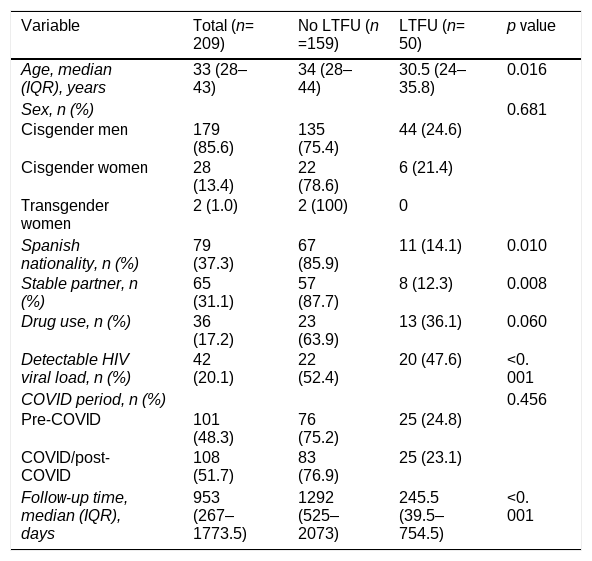
Table 1 summarizes baseline characteristics by LTFU status. Patients who were LTFU were younger, more often of non-Spanish nationality and less likely to have a stable partner. They more frequently had detectable viral load at the last visit and markedly shorter follow-up. LTFU proportions did not differ significantly between pre-COVID and COVID/post-COVID periods.
Baseline characteristics of HIV cohort according to loss to follow-up (LTFU).
| Variable | Total (n=209) | No LTFU (n=159) | LTFU (n=50) | p value |
|---|---|---|---|---|
| Age, median (IQR), years | 33 (28–43) | 34 (28–44) | 30.5 (24–35.8) | 0.016 |
| Sex, n (%) | 0.681 | |||
| Cisgender men | 179 (85.6) | 135 (75.4) | 44 (24.6) | |
| Cisgender women | 28 (13.4) | 22 (78.6) | 6 (21.4) | |
| Transgender women | 2 (1.0) | 2 (100) | 0 | |
| Spanish nationality, n (%) | 79 (37.3) | 67 (85.9) | 11 (14.1) | 0.010 |
| Stable partner, n (%) | 65 (31.1) | 57 (87.7) | 8 (12.3) | 0.008 |
| Drug use, n (%) | 36 (17.2) | 23 (63.9) | 13 (36.1) | 0.060 |
| Detectable HIV viral load, n (%) | 42 (20.1) | 22 (52.4) | 20 (47.6) | <0.001 |
| COVID period, n (%) | 0.456 | |||
| Pre-COVID | 101 (48.3) | 76 (75.2) | 25 (24.8) | |
| COVID/post-COVID | 108 (51.7) | 83 (76.9) | 25 (23.1) | |
| Follow-up time, median (IQR), days | 953 (267–1773.5) | 1292 (525–2073) | 245.5 (39.5–754.5) | <0.001 |
Continuous variables are presented as median and interquartile range (IQR), and categorical variables as absolute numbers and percentages. Comparisons between groups were performed using Pearson's Chi-square or Fisher's exact test for categorical variables and the Mann–Whitney U test for continuous variables. A p-value<0.05 was considered statistically significant.
In the sociodemographic domain, patients who were LTFU were younger (median 30.5 years; IQR 24–35.8) than those retained (34 years; IQR 28–44; p=0.016). Nationality was associated with LTFU: 29.8% of non-Spanish individuals were LTFU versus 14.1% of Spanish nationals (p=0.010). LTFU occurred in 12.3% with a stable partner versus 29.2% without (p=0.008). LTFU was higher in the hospital catchment area (27.6% vs 5.7%; p=0.006), where non-Spanish patients were more frequent (65.5% vs 48.6%; p=0.060).
Drug use showed a non-significant trend towards higher LTFU (36.1% vs 21.4%; p=0.060). No significant differences were observed for sex, AIDS history, comorbidities or ACRG3. LTFU was clearly higher with detectable viral load (52.4% vs 16.5%; p<0.001).
The timing of the last visit showed no significant differences, with similar proportions of LTFU in the pre-COVID period (24.8%) and the COVID/post-COVID period (23.1%; p=0.786). Follow-up duration was significantly shorter among patients LTFU (median 245 days; IQR 39–754) compared with those retained in care (1292 days; IQR 525–2073; p<0.001).
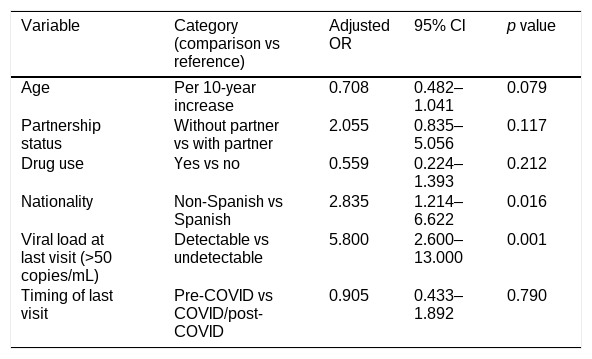
Multivariable logistic regressionIn the multivariable logistic regression model (Table 2)—including age, partnership status, drug use, nationality, viral load at the last determination and timing of the last visit—the overall model was statistically significant (χ2=39.8; df=6; p<0.001), with a Nagelkerke R2 of 0.26 and 80.3% of cases correctly classified. The model showed high specificity (94.9%) but limited sensitivity (34%), a pattern expected when the proportion of events is relatively low. After adjustment, non-Spanish nationality remained independently associated with a higher likelihood of LTFU (OR=2.84; 95% CI 1.21–6.62; p=0.016). Detectable viral load at the last measurement was strongly associated with LTFU (OR=5.9; 95% CI 2.4–12.5; p<0.001). Increasing age showed a non-significant trend towards lower odds of LTFU (adjusted OR per 10-year increase = 0.71; 95% CI 0.48–1.04; p = 0.079). No statistically significant associations were observed for partnership status (p=0.117), drug use (p=0.212) or the COVID-related period of the last visit (p=0.790).
Multivariable logistic regression analysis of factors associated with loss to follow-up.
| Variable | Category (comparison vs reference) | Adjusted OR | 95% CI | p value |
|---|---|---|---|---|
| Age | Per 10-year increase | 0.708 | 0.482–1.041 | 0.079 |
| Partnership status | Without partner vs with partner | 2.055 | 0.835–5.056 | 0.117 |
| Drug use | Yes vs no | 0.559 | 0.224–1.393 | 0.212 |
| Nationality | Non-Spanish vs Spanish | 2.835 | 1.214–6.622 | 0.016 |
| Viral load at last visit (>50copies/mL) | Detectable vs undetectable | 5.800 | 2.600–13.000 | 0.001 |
| Timing of last visit | Pre-COVID vs COVID/post-COVID | 0.905 | 0.433–1.892 | 0.790 |
Adjusted odds ratios (ORs) with 95% confidence intervals (CIs) are presented for all variables included in the final model. A p-value<0.05 was considered statistically significant.
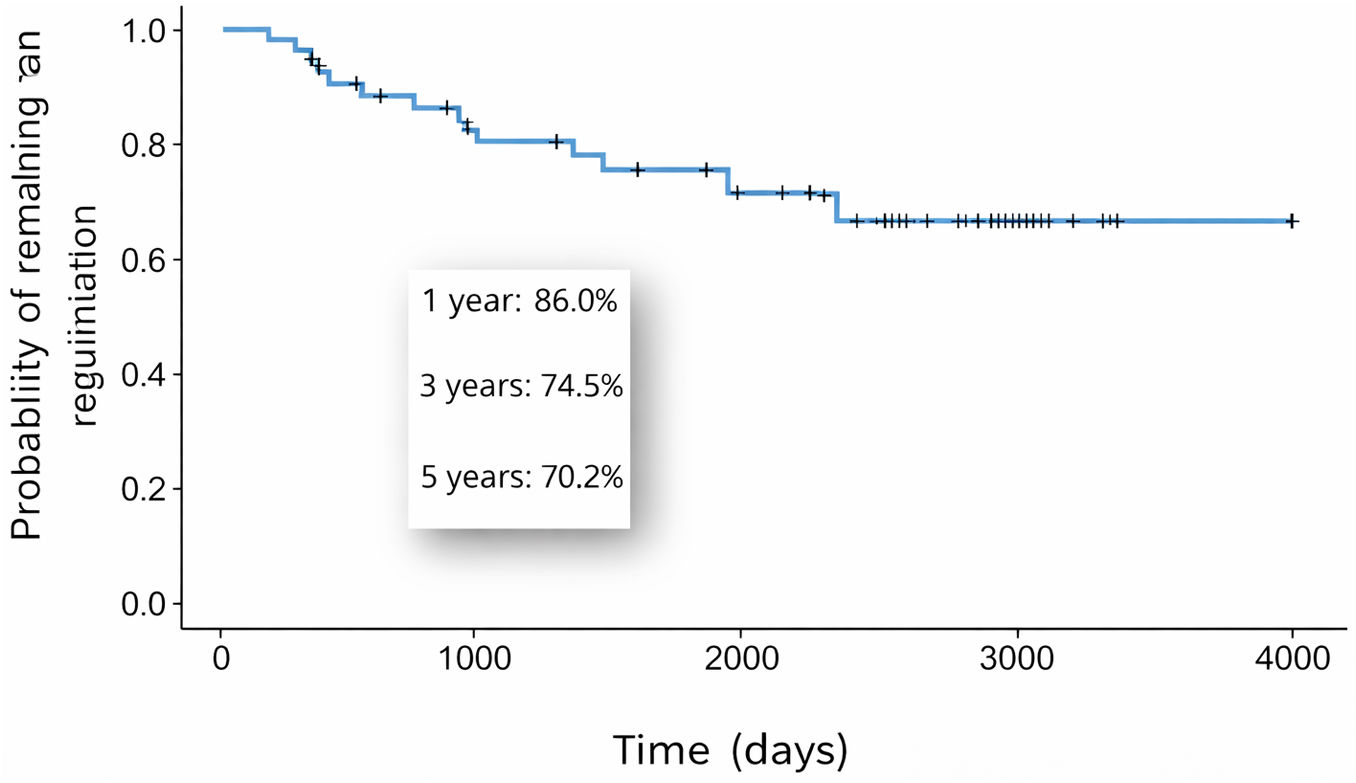
Kaplan–Meier survival analysis was performed to estimate the probability of remaining in follow-up over time. The estimated probabilities of retention at 1, 3 and 5 years were 86.0%, 74.5% and 70.2%, respectively (Fig. 1). By year 5, the cumulative proportion of patients LTFU reached 29.8%. The survival curve showed a gradual decline in retention, with a steeper decrease during the first year and a slower reduction thereafter. The number of patients at risk decreased progressively over time: 209 at baseline, 137 at 1 year, 100 at 3 years and 64 at 5 years.
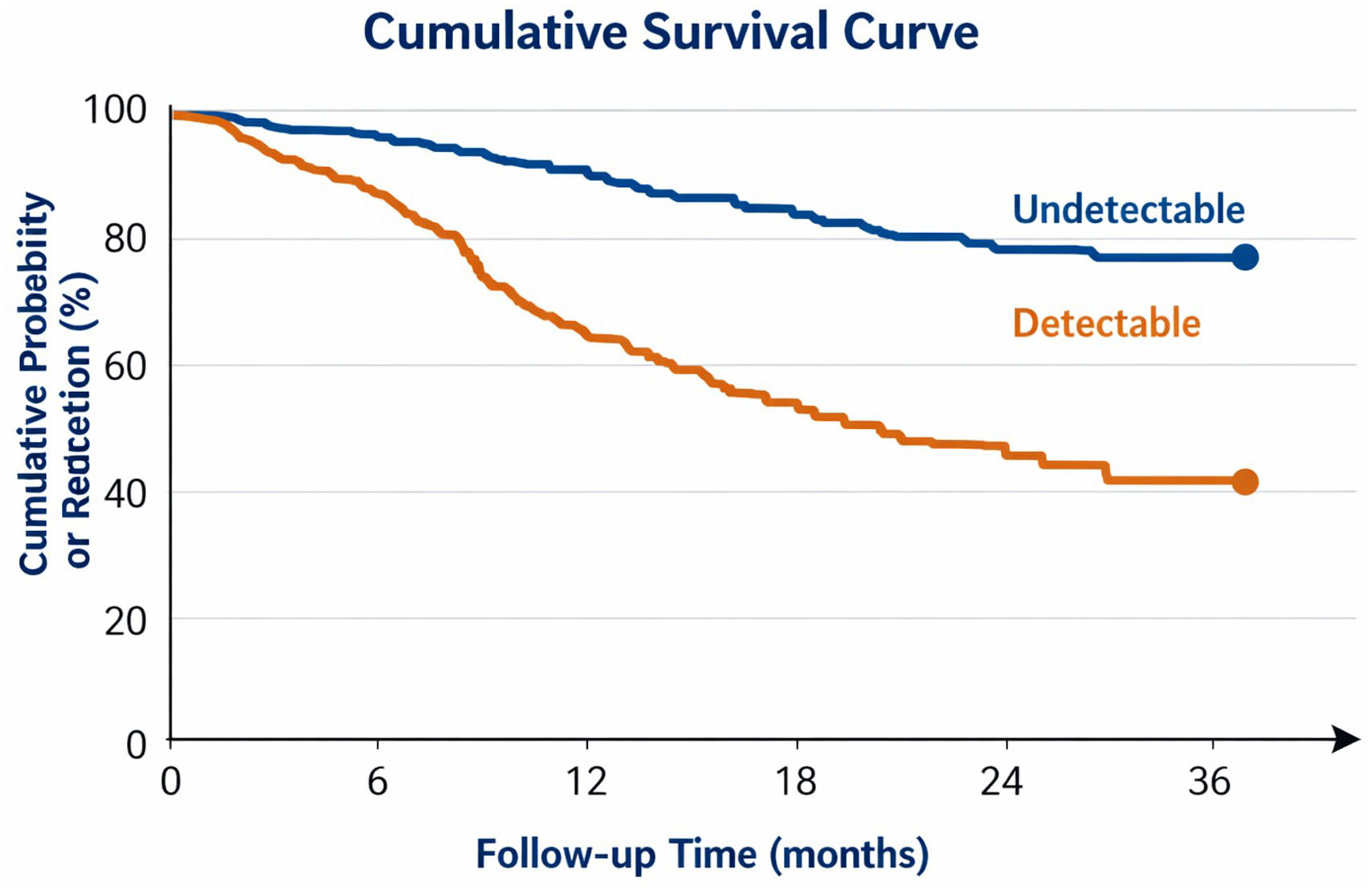
Kaplan–Meier survival analysis stratified by the last recorded viral load (Fig. 2) revealed significant differences in the probability of remaining in follow-up between patients with undetectable and detectable viral load (p<0.001, log-rank test). Throughout the observation period, patients with undetectable viral load maintained a consistently higher probability of retention, whereas those with detectable viral load showed a steeper decline from the early years. The estimated probabilities of remaining in follow-up at 1, 3 and 5 years were approximately 91.7%, 83.0% and 78.5% for patients with undetectable viral load, and 58.3%, 32.7% and nearly 0% for those with detectable viral load. The mean annual risk of LTFU during the first five years, based on a cumulative LTFU of 30% (50/209), was around 6–7% per year.
Kaplan–Meier curves stratified by viral load. Kaplan–Meier survival curves showing the probability of remaining in follow-up according to viral load status at the last measurement. Patients with undetectable viral load had significantly higher retention probabilities than those with detectable viral load (p<0.001, log-rank test).
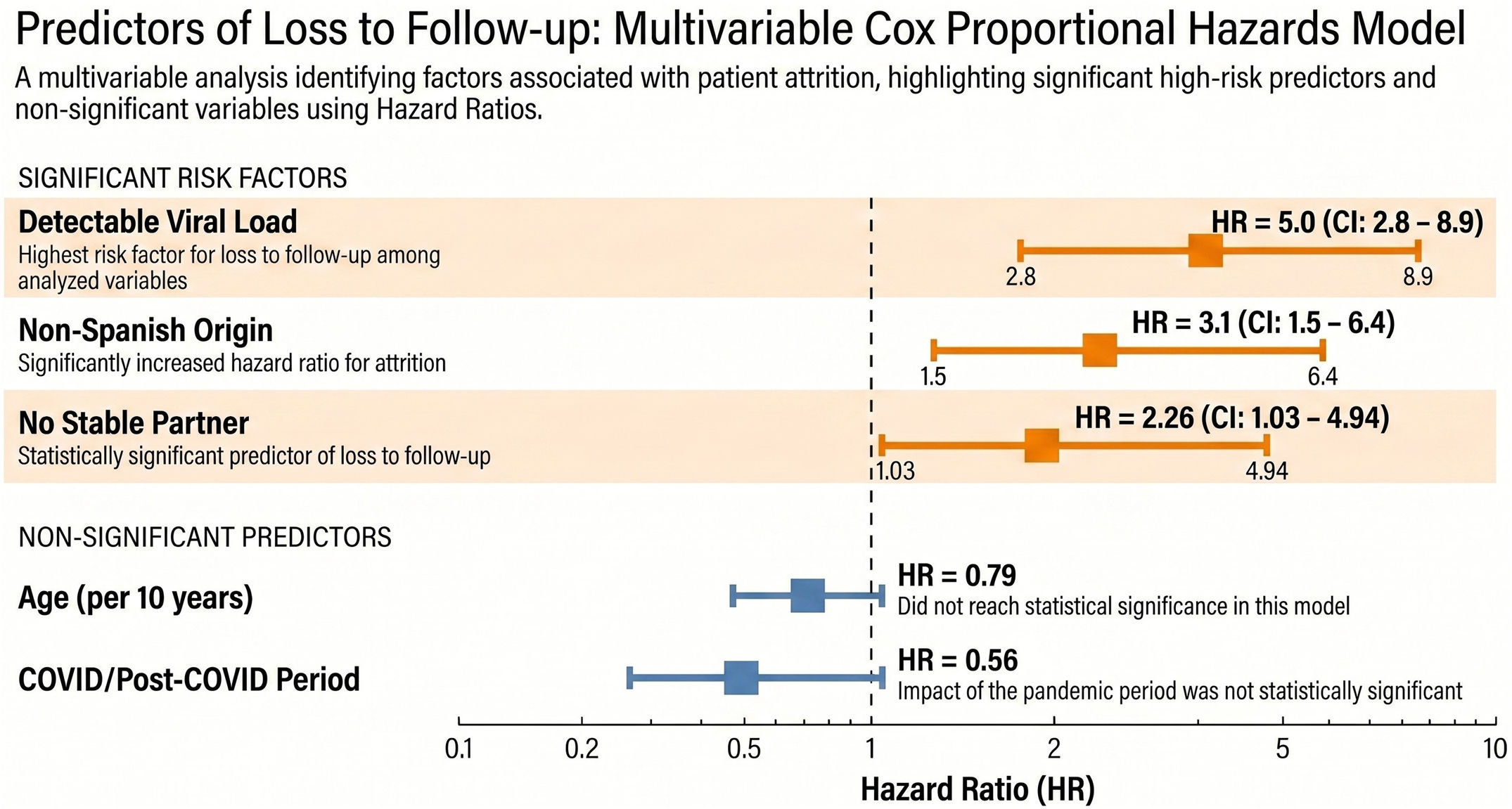
In the multivariable Cox proportional hazards model (Fig. 3), which included age (per 10-year increase), non-Spanish nationality, detectable viral load at the last visit, follow-up period and stable partnership status, detectable viral load was independently associated with a higher hazard of LTFU (adjusted hazard ratio [HR] 5.0; 95% CI 2.8–8.9; p<0.001). Non-Spanish nationality (adjusted HR 3.1; 95% CI 1.5–6.4; p=0.003) and absence of a stable partner (adjusted HR 2.26; 95% CI 1.03–4.94; p=0.042) were also independently associated with LTFU. Older age (adjusted HR per 10-year increase 0.79; 95% CI 0.57–1.10; p=0.17) and the COVID/post-COVID period, compared with the pre-COVID period (adjusted HR 0.56; 95% CI 0.30–1.02; p=0.056), were not significantly associated with LTFU.
Forest plot of the Cox proportional hazards model. Forest plot illustrating adjusted hazard ratios (HRs) and 95% confidence intervals for factors associated with loss to follow-up. Detectable viral load, non-Spanish origin, and absence of a stable partner were independently associated with higher risk of loss to follow-up. Age and the COVID/post-COVID period showed non-significant associations.
The primary objective of this study was to characterize LTFU among people living with HIV in our cohort. In the present analysis, 50 of 209 patients (23.9%) were classified as LTFU. Although definitions and observation periods vary across studies, this finding remains broadly consistent with previous European and Spanish reports on disengagement from HIV care where LTFU typically ranges from 13% to 19.5 In the Spanish VIH y AdvanCedHIV (VACH) cohort, 15.5% of patients were LTFU over two years,7 a proportion higher than that reported in an Italian cohort (8% over six years, annual rate<2%).5
Patients who disengaged from care did so early, with a median follow-up of less than one year, whereas those retained accumulated approximately 3.5 years of effective follow-up. This pattern suggests room for improvement in retention, even in the context of high ART coverage and good virological suppression. Similar findings have been described in the UK Collaborative HIV Cohort (UK CHIC), where most losses occurred within the first two years of follow-up,19 highlighting the early post-diagnosis period as particularly vulnerable.
LTFU has major epidemiological implications, especially among individuals with detectable viraemia or those who interrupt ART. These groups concentrate on the highest potential for onward transmission and contribute disproportionately to sustaining the HIV epidemic. Treatment interruption leads to viral rebound, increased clinical risk, and heightened infectiousness, amplifying the population-level impact of disengagement. Ensuring continuous engagement is therefore essential to achieving the UNAIDS 95–95–95 targets for 2030.25
Risk factors for LTFU and comparison with previous studiesIn our cohort, the strongest predictor of LTFU was detectable viral load at the last visit, confirmed in both logistic and Cox models. This finding aligns with multiple international cohorts where lack of virological suppression consistently predicts poor engagement, suboptimal adherence, and subsequent disengagement.5,6,10,12,13,15,16,18,20
Non-Spanish origin was also independently associated with LTFU, consistent with Spanish, European and international studies identifying migrant status as a determinant of healthcare disengagement.5–18,26 Structural barriers—administrative instability, language limitations, precarious employment, and reduced social support—likely contribute to this vulnerability.
Similarly, absence of a stable partner increased the risk of LTFU. This finding mirrors results from Spanish cohorts7,8 and international studies,11,18,20 underscoring the role of personal support networks in adherence and continuity of care.
Although younger age is frequently reported as a risk factor in the literature, in our cohort this association was only observed in univariate analysis. Sample size limitations may explain this discrepancy. Other studies have linked younger age to lower perceived risk, greater mobility, and reduced social stability.5–20
In contrast to previous reports, gender, drug use, advanced HIV stage, and comorbidities were not associated with LTFU. This may reflect limited statistical power in small subgroups and potential under-recording of behavioural variables in retrospective data. Overall, these findings highlight the need for early, targeted interventions in individuals with detectable viral load or social vulnerability to prevent progression towards disengagement.
Temporal dynamics of LTFU (Kaplan–Meier) in the context of the literatureFew European or Latin American studies have used time-to-event methods such as Kaplan–Meier curves to analyze retention. Most rely on cumulative proportions, person-year rates, or multivariable models. Our use of survival analysis therefore provides a more detailed understanding of the temporal pattern of disengagement.
In our cohort, the probability of remaining in care at 1, 3 and 5 years was 86%, 74.5% and 70.2%, respectively. The Kaplan–Meier curve suggests an annual loss rate slightly above the 5% threshold recommended by GeSIDA,24 with losses concentrated in the early years. This pattern likely reflects social vulnerability, a high proportion of migrant patients, and unstable socio-familial circumstances.
Comparisons with other settings show both similarities and differences. An Ethiopian cohort reported cumulative losses of 15%, 25% and 35% at 1, 3 and 5 years, respectively, with a trajectory like ours during the first three years but slightly worse retention at five years.14 The TREAT Asia HIV Observational Database (TAHOD) cohort showed markedly higher retention, with losses below 15% at five years, likely due to inclusion of clinically stable patients with long-term ART exposure.15
Other cohorts report substantial cumulative losses—EuroSIDA (22% overall),6 a Colombian cohort (12% over 19 months),11 and Belgian and British cohorts (25.8% and 28.1% at 10 years)12,19—although methodological differences limit direct comparability.
Conversely, studies from Korea and Australia describe much higher cumulative losses (44.3% and 47.8%),13,16 placing our cohort in an intermediate position internationally.
Role of the COVID-19 pandemic: Cox model findingsThe COVID/post-COVID period showed a trend towards lower LTFU (HR=0.56), although not statistically significant (p=0.056). The literature shows heterogeneous results. Some studies reported substantial increases in LTFU during the pandemic (30–40% relative increases) due to disruptions in essential HIV services.21–23 Others found more limited effects after adjusting for clinical and social factors.
The Italian Cohort of Antiretroviral-Naïve Patients (ICONA) illustrates this variability: crude analyses suggested a significant increase in losses, but socioeconomic variables and administrative issues explained much of the effect. Different analysis reduced the apparent increase from 7% (p<0.0001) to 1% (p=0.538) when restricted to centres with automated electronic data capture.26
Several factors may explain the pattern observed in our cohort. A longer pandemic period may have allowed health systems to reorganize after the emergency phase, incorporating flexible care pathways, telemedicine, and proactive follow-up of vulnerable patients. At the same time, the introduction of simpler and better-tolerated ART regimens likely supported adherence. In addition, organizational strategies such as pharmacy-based ART dispensing and prioritization of complex patients could have mitigated the negative impacts on retention in care.
LimitationsSome variables that showed a trend towards association with LTFU in bivariate analyses did not reach statistical significance in the multivariable model. This may reflect the relatively small size of our cohort and the limited number of events, which may have reduced the statistical power to detect modest associations. Larger multicentre cohorts or longer follow-up might help to confirm or refute these potential associations.
Although medical records were reviewed to identify documented transfers of care to other centres, we could not exclude undocumented transfers among patients without evidence of re-engagement at our centre. In many cases, telephone contact attempts from the clinic were unsuccessful; therefore, some events classified as LTFU may have represented unrecorded transfers rather than complete disengagement from HIV care.
ConclusionsLTFU affected 23.9% of people living with HIV in this cohort, with most losses occurring early after linkage to care. Detectable viral load at the last visit and non-Spanish origin were the strongest and most consistent predictors of disengagement, and absence of a stable partner also increased the risk over time. In contrast, classical factors such as sex, advanced HIV stage or comorbidities were not independently associated with LTFU. Early targeted interventions focusing on virological suppression and social vulnerability, particularly migrant patients and those without stable partners, are essential to improve retention.
Author contributionsAndrés Fernández-Montealegre, Francisco Jover Díaz, Andrea Riaño Pérez, Mariángeles Bernabeu-Martínez, Elisabet Delgado Sánchez and Jorge Peris García contributed to the conception and design of the study, data acquisition and interpretation. Francisco Jover Díaz supervised the study. Andrés Fernández-Montealegre and Francisco Jover Díaz drafted the manuscript. All authors critically revised the manuscript, approved the final version, and agreed to be accountable for all aspects of the work.
Ethical considerationsThe study was conducted in accordance with the principles of the Declaration of Helsinki, Good Clinical Practice guidelines, Regulation (EU) 2016/679, and Spanish Biomedical Research Law 14/2007. The protocol was approved by the Research Ethics Committee of Hospital Universitario San Juan de Alicante (code 25/064) on 25 November 2025.
Informed consentGiven the retrospective design of the study and the use of pseudonymised routinely collected clinical data, the requirement for written informed consent was waived by the ethics committee.
Generative AI statementDuring the preparation of this work, the authors used Perplexity Pro to improve readability and language. After using this tool, the authors reviewed and edited the content as needed and took full responsibility for the content of the publication.
FundingThis research did not receive any specific grant from funding agencies in the public, commercial, or non-profit sectors. No external financial support, equipment, or study drugs were provided for the conduct of this study.
Conflicts of interestThe authors have no conflicts of interest to declare.