



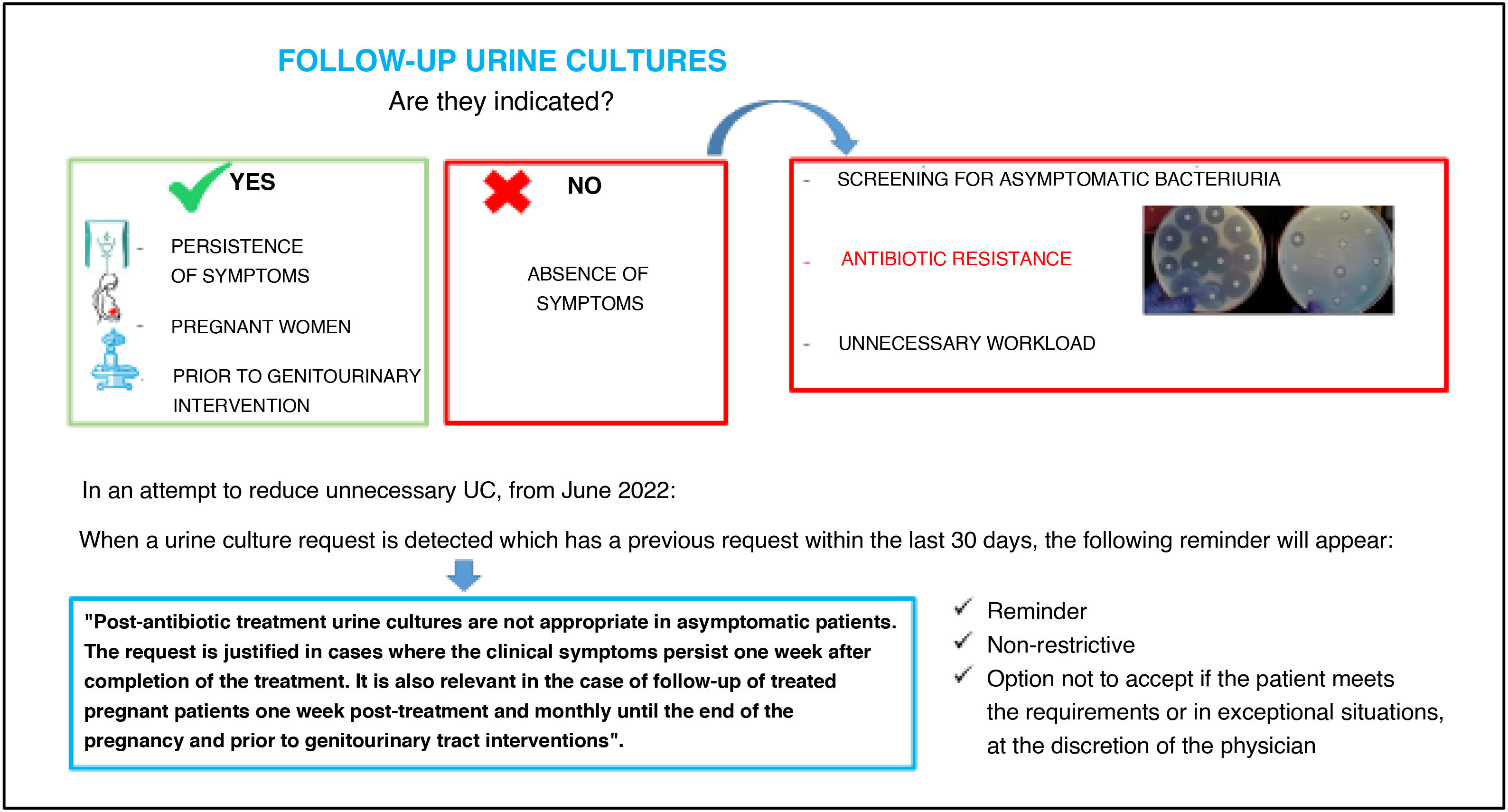




With the aim of reducing the number of Post-Treatment Control Urine Cultures (UC) from Health Centers in our healthcare area, we conducted an Antimicrobial Stewardship Program (ASP) intervention throughout 2022. To do this, we set out to introduce effective methods to quantify, analyze, and subsequently try to reduce the number of inappropiate UC.
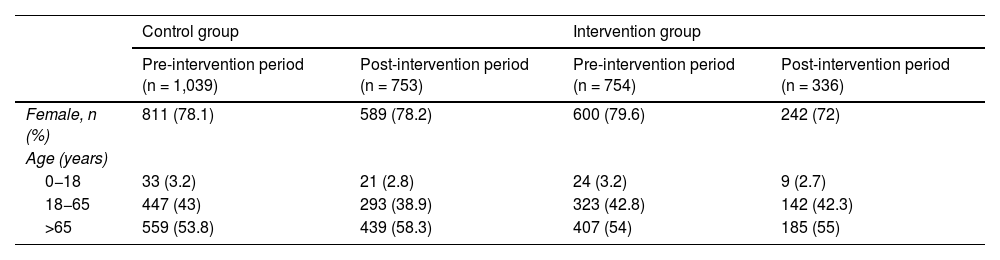
MethodsWe conducted a prospective and non-restrictive quasi-experimental intervention study with historical and parallel control group to evaluate the impact of the intervention. The UC evaluation was performed by analyzing all the medical records of repeated UC in a period of less than 31 days. UC were classified as: appropriate, inappropriate and doubtful. The study was conducted in 3 phases: phase 1) measurement of the baseline situation; phase 2) intervention in intervention group: simple educational presentations and implementation of a non-restrictive computerized rule, and phase 3) analysis of results in both groups and periods.
ResultsLooking at the %AUC, we observed that in the control group there was hardly any variation while in the intervention group (IG) these increased by 152.4 (p < 0.001). In addition, in the IG there was a decrease in total UCs of 55.4% (n = 418), representing an estimated savings of €7524. The acceptance of the CR in the IG was 9.6%.
ConclusionsThis ASP intervention is useful in decreasing the number of IUCs, especially the educational presentations. Achieving this can reduce direct and indirect patient harm and healthcare overload, in addition to improving the management of healthcare resources.
Con el objetivo de reducir el número de urocultivos de control postratamiento (UC) de nuestros centros de salud asociados, realizamos una intervención PROA durante el 2022. Para ello, nos propusimos introducir métodos eficientes para cuantificar, analizar y, posteriormente, intentar reducir el número de UC inapropiados.
MétodosLlevamos a cabo un estudio de intervención cuasiexperimental, prospectivo y no restrictivo, con un grupo de control histórico y paralelo, para evaluar el impacto de la intervención. La evaluación de los UC se realizó analizando las historias clínicas de los UC repetidos en menos de 31 días. Los UC se clasificaron como: apropiados, inapropiados y dudosos. El estudio se llevó a cabo en 3 fases: fase 1) medición de la situación basal; fase 2) intervención en el grupo de intervención: presentaciones educativas sencillas e implementación de una regla informática no restrictiva, y fase 3) análisis de los resultados en ambos grupos y períodos.
ResultadosEn cuanto al porcentaje de UC apropiados, observamos que en el grupo control apenas hubo variación, mientras que en el grupo intervención estos aumentaron un 152,4% (p < 0,001). Además, en el grupo intervención hubo una disminución en los UC totales del 55,4% (n = 418), suponiendo un ahorro estimado de 7.524€. La aceptación de la regla informática en el grupo intervención fue del 9,6%.
ConclusionesEsta intervención PROA es útil para disminuir el número de UCI, principalmente las presentaciones educativas. Lograr esto puede disminuir el daño directo e indirecto al paciente y la sobrecarga sanitaria, además de mejorar la gestión de los recursos sanitarios.
Article
Socio de la Sociedad Española de Enfermedades Infecciosas y Microbiología Clínica

Para acceder a la revista
Es necesario que lo haga desde la zona privada de la web de la SEIMC, clique aquí
Para realizar los cursos formativos
La actividad estará abierta para socios de la SEIMC. IMPORTANTE, recuerde que requiere registro previo gratuito. Empezar aquí

