
The use of haptic simulation in dental education is rapidly growing as a means of providing safe and repeatable practice in the psychomotor and clinical skills necessary for dentists. This paper aims to map the global research trends of haptic simulation in dental education (2020–2025), as well as analyze its productivity, impact, collaboration, and thematic evolution.
Material and methodsA scientometric study was conducted using Scopus on December 15, 2025. The search was done using a combination of haptic and educational words TITLE-ABS, restricting PUBYEAR to 2020–2025. Records were screened, excluding duplicates, and eligible documents were exported as CSV, fully loaded with metadata. Analyses were performed in SciVal (impact and collaboration), Bibliometrix (R), and VOSviewer (descriptive metrics, co-authorship, co-words and conceptual mapping. Indicators included productivity, citations, CiteScore, SNIP, international collaboration, multiple correspondence analysis, and no language restrictions.
ResultsBetween 2020 and 2025, the corpus consisted of 112 documents across 56 sources, marking a sudden burst of interest in haptic simulation (growth of 54.4% annually). Papers were of recent vintage (mean of 1.6 years old) and had a mean of 14.7 citations per paper, with a total of 773 cited references. It is a highly collaborative discipline, with 547 authors contributing, a mean of 6.79 co-authors per article, and 31.2% of papers being international collaborations. Institutional impact varied, with highlights suggesting disparate strength e.g. University of Hong Kong (143 citations; 23.8 citations/article); Mahidol University (73 citations; 12.2 citations/article).
ConclusionsGlobal research in haptic simulation science in dental education reflected accelerating growth, collaboration, and an increase in high-impact outlet publications, progressing toward scientific maturity, and consolidating haptics as a pedagogical innovation that enhances clinical training methods. The findings support placing immersive technologies into existing curricula, alongside continued collaborative efforts internationally to sustain development and expand results.
La simulación háptica se ha expandido rápidamente en la educación odontológica, ofreciendo una práctica segura y repetible para el desarrollo de habilidades psicomotoras y clínicas. El objetivo fue evaluar los patrones globales de investigación sobre simulación háptica en la educación odontológica (2020–2025), evaluado la productividad, el impacto, la colaboración, y la evolución temática.
Material y métodosSe llevó a cabo un estudio cienciométrico utilizando Scopus el 15 de diciembre de 2025. La búsqueda se realizó combinando términos relacionados con hápticos y términos vinculados a la educación en el campo TITLE-ABS y limitando el PUBYEAR al intervalo 2020–2025. Se llevó a cabo una evaluación de la coincidencia de los registros, se eliminaron los duplicados, y los documentos que eran elegibles se exportaron en formato CSV con metadatos completos. Los análisis fueron realizados en SciVal (impacto y colaboración), Bibliometrix (R) y VOSviewer (métricas descriptivas, coautoría, keywords compartidas y mapeo conceptual). Los indicadores tomaron en consideración cuestiones de productividad, citas, CiteScore, SNIP, colaboración internacional, y análisis de correspondencia múltiple; no se aplicaron restricciones de idioma.
ResultadosEl estudio determinó la existencia de 112 documentos de procedencia 56 fuentes. En lo referente a la tasa de crecimiento anual ésta se alzó hasta un 54,49% con documentos relativamente viejos, presentando una media de 1,69 años y 14,75 citas por documento, las cuales estaban respaldadas por 773 referencias. La colaboración fue muy sólida (547 autores; 6,79 coautores/artículo), con una coautoría internacional de un 31,25%. La tipología de las publicaciones las de tipo artículo original fueron las que dieron cuenta de la mayor cifra (81) y las revisiones se encuadraron en 15. Las aportaciones con más impacto llegaron de la Universidad de Hong Kong (143; 23,8/artículo) y de la Universidad Mahidol (73; 12,2/artículo). Las revistas más relevantes contaron con la presencia de Journal of Dental Education y European Journal of Dental Education. Los grupos conceptuales enlazaron la idea de la simulación háptica con la realidad virtual/aumentada, las habilidades psicomotoras, la percepción de los alumnos y temáticas emergentes como la IA y la impresión del 3D.
ConclusionesLa investigación internacional sobre la simulación háptica en el área de la formación odontológica experimentó un acelerado crecimiento, una sólida cooperación, así como un aumento en el número de publicaciones científicas realizadas en revistas de alto impacto. El ámbito académico alcanzó la madurez científica, siendo la háptica una innovación educativa que favorece la educación clínica. Los resultados respaldan la incorporación de tecnologías inmersivas en los programas de enseñanza y el fomento de colaboraciones internacionales para fomentar la investigación y el incremento del impacto.
Dentistry stands out in the healthcare sector for its strong focus on practical applications and the development of rigorous manual dexterity, which is essential for the manual management of restorative treatments. During the preclinical phase, the main objective and core competency of operative dentistry are the development of students' psychomotor skills, an aspect to which most of the curriculum is dedicated.1 In recent years, haptic technology has been introduced as an additional approach to conventional simulations in dental training. This novel digital technology is gaining popularity for learning dental movements and enriching technical skills in dentistry.2,3 It also allows users to experience tactile sensations when operating instruments.4
Haptic and force feedback technology is an important complementary feature in pure-vision virtual environments, as it allows dental students to simulate a more realistic operating experience by adding the sense of touch.4 Tactile detection is responsible for acquiring characteristics through contact between the hand and the object. The tactile sensor fulfills two essential functions: detection and recognition.5,6
Today, dental education has accepted this unique, new educational technique.
This technology will augment or even replace conventional teaching methods in skill acquisition.7 Its adoption into the curriculum fits well with a modern or contemporary approach that is based on evidence and technology pedagogy. These haptic devices are touted as an adjunct resource that can build upon existing traditional preclinical skills training modalities based on mannequins and extracted teeth.8
Kinesthetic communication is another name for this technology, which uses vibration and force tracked and mapped to physiological movements to create a proprioceptive response so that dental students can practice procedures on virtual patients. Force feedback technology is especially important here as it emulates the realistic resistance and pressure felt when interacting with a virtual tooth.9 The haptic sensation is the most complex of the senses, defined as the acquisition of information through the skin tactile system while touching or operating, and it depends on the many tactile receptors present throughout the body.10
Bibliometrics is the mathematical and statistical approach to the systematic analysis of scientific literature, especially as it pertains to varying types of publication by means of citation studies, citation density, classification, and impact factor. The same applies to information on authors regarding productivity, country of co-authorship, and association of the topics to the author's institutional affiliation. Such analysis is important in plotting academic trajectories, determining the current trend in research topics, and suggesting what worthwhile work is to be done on the subject in a wider field of inquiry.11
The objective of this study was to evaluate global research patterns on haptic simulation in dental education from a scientometric perspective.
Materials and methodsStudy designThis was an observational retrospective scientometric study developed to investigate worldwide research in haptic simulation in dental education. The study design allowed the analysis of scientific productivity, collaboration networks, and conceptual development of the area over a specific period. The RAMIBS guidelines were used to report the findings.12
Search strategyThe search was conducted on December 15, 2025, in the Scopus database, recognized for its international coverage and its ability to provide robust bibliometric indicators. A total of 112 potentially relevant documents were identified. The search formula used was TITLE-ABS (“haptic simulator*” OR “haptic device*” OR “haptic technology*” OR “haptic interface*” OR “haptic feedback” OR “force feedback” OR “tactile interface*” OR “tactile feedback” OR “virtual reality simulator*” OR “VR simulator*” OR “augmented reality simulator*” OR “AR simulator*” OR “computer-assisted simulation” OR “digital simulator*” OR “simulation-based training”) AND TITLE-ABS (“dental education” OR “dentistry education” OR “dental training” OR “dentistry training” OR “dental student*” OR “dentistry student*” OR “dental curriculum” OR “dental teaching” OR “preclinical dental education” OR “clinical dental education” OR “dental skills training” OR “simulation in dental education”) AND PUBYEAR >2019 AND PUBYEAR <2026.
Inclusion and exclusion criteriaDocuments published between 2020 and 2025 that explicitly mentioned haptic simulation applied to dental education were selected. Original articles, systematic or narrative reviews, book chapters, conference papers, and editorials were considered, provided with information pertinent to the scientometric study. No language restriction was enforced; therefore, a wider range of sources was selected. Duplicate documents, those published outside a suitable timeframe, those which were not related to the study topic, and records without access to relevant metadata were dismissed as works based on the technological simulation applied to other health areas.
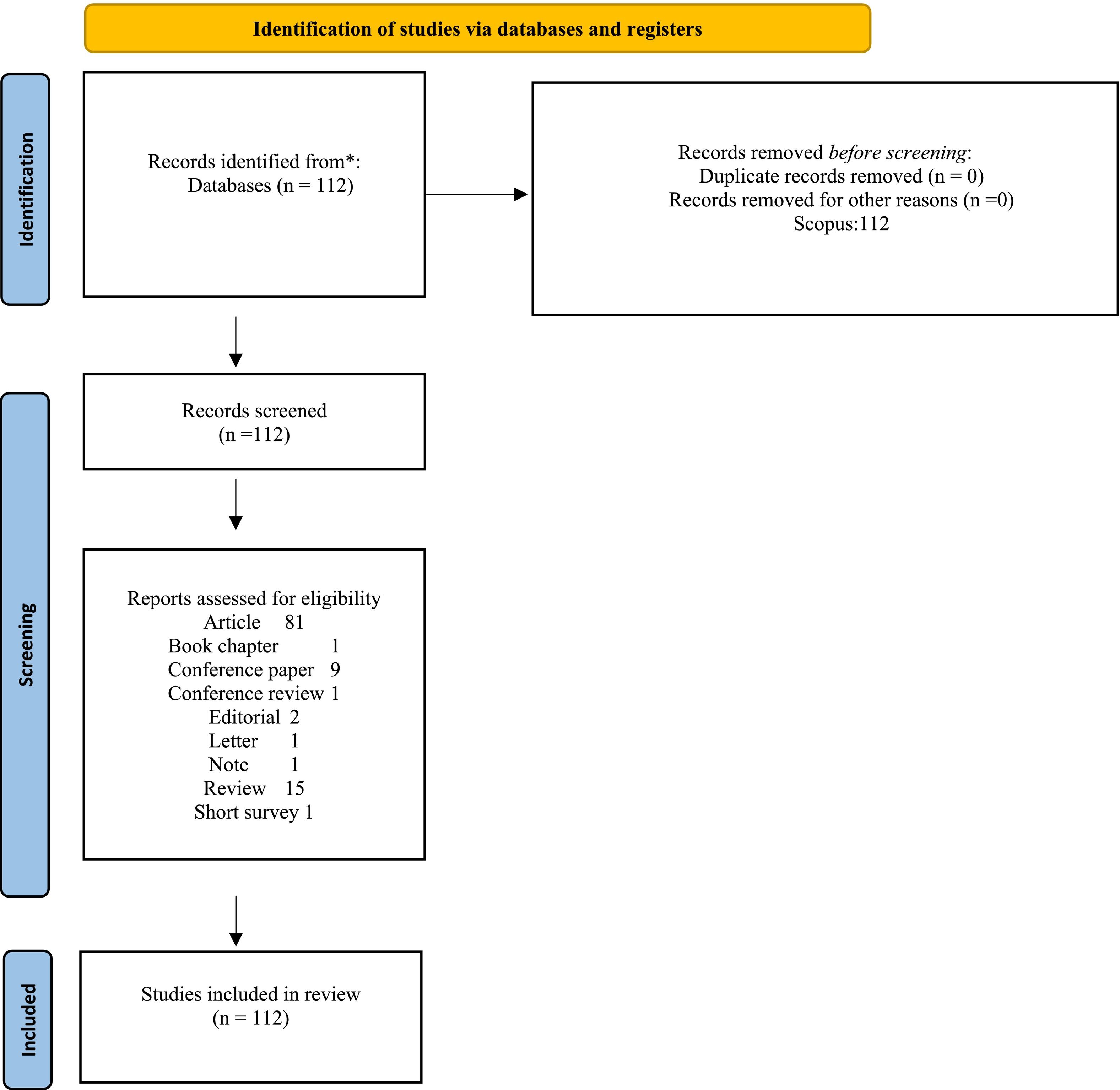
ProceduresTwo independent reviewers, FEC and FMT, conducted title-and-abstract screening and full-text eligibility assessment for all retrieved records; each reviewer screened independently and documented inclusion decisions and reasons for exclusion. Discrepancies were resolved first by bilateral discussion to achieve consensus and, when consensus could not be reached, a third senior reviewer (IC) adjudicated the decision. After identifying records on Scopus, these were cleaned (duplicates removed and relevance confirmed by reading titles and abstracts) to ensure that these documents adhered to defined inclusion criteria. Once selected, complete metadata (authors, affiliations, sources, citations, and references) were exported in CSV format to allow for their feeding into powerful analysis platforms. The file was loaded into SciVal, from which indicators of impact, institutional collaboration, and performance by country were extracted, while Bibliometrix® was used to run descriptive analysis, co-authorship networks, co-words, and various correspondences. This process allows for a thorough view of the field from both productivity and impact perspectives and in terms of thematic structures and patterns of scientific collaboration (Fig. 1) (Supplementary Material S1).
Scientometric indicators and data analysis
Various indicators were studied to characterize the field and measure its degree of academic consolidation: productivity indicators (number of publications per year, by source and author); impact indicators (average citations per document, CiteScore, and SNIP of journals); collaboration indicators (number of coauthors per article, percentage of international collaborations and institutions networks); and thematic evolution indicators (study of co-word and factorial correspondence). The data were processed using Bibliometrix (R) and VOSviewer, which provide the possibility of generating collaboration maps, visualizing the thematic networks, and revealing growth patterns. Furthermore, by using fitting models, it was possible to describe the life cycle of a particular scientific production, and the coefficients of determination were used to measure the explanatory power of a particular delineated pattern.
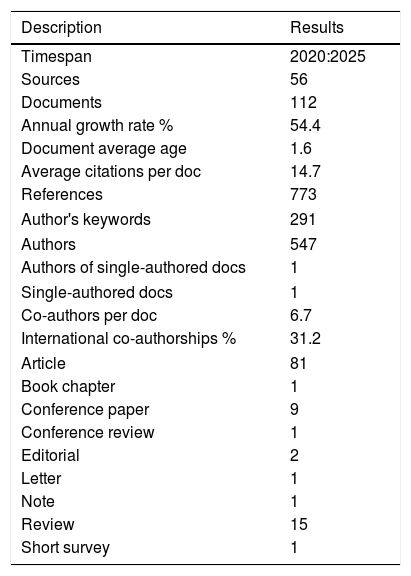
ResultsBetween 2020 and 2025, 112 sources from 56 were identified, evidence of a steady annual growth rate of 54.4%. The average age for work was 1.6 years and work averaged 14.7 citation documents. Supporting references 773. Output was highly collaborative, with 547 authors and 6.7 co-authors after isolating repeats (31.2% international collaborations); original articles predominated with 15 reviews, less commonplace sources such as book chapters, conference papers and editorials were less common (Table 1).
Main information.
| Description | Results |
|---|---|
| Timespan | 2020:2025 |
| Sources | 56 |
| Documents | 112 |
| Annual growth rate % | 54.4 |
| Document average age | 1.6 |
| Average citations per doc | 14.7 |
| References | 773 |
| Author's keywords | 291 |
| Authors | 547 |
| Authors of single-authored docs | 1 |
| Single-authored docs | 1 |
| Co-authors per doc | 6.7 |
| International co-authorships % | 31.2 |
| Article | 81 |
| Book chapter | 1 |
| Conference paper | 9 |
| Conference review | 1 |
| Editorial | 2 |
| Letter | 1 |
| Note | 1 |
| Review | 15 |
| Short survey | 1 |
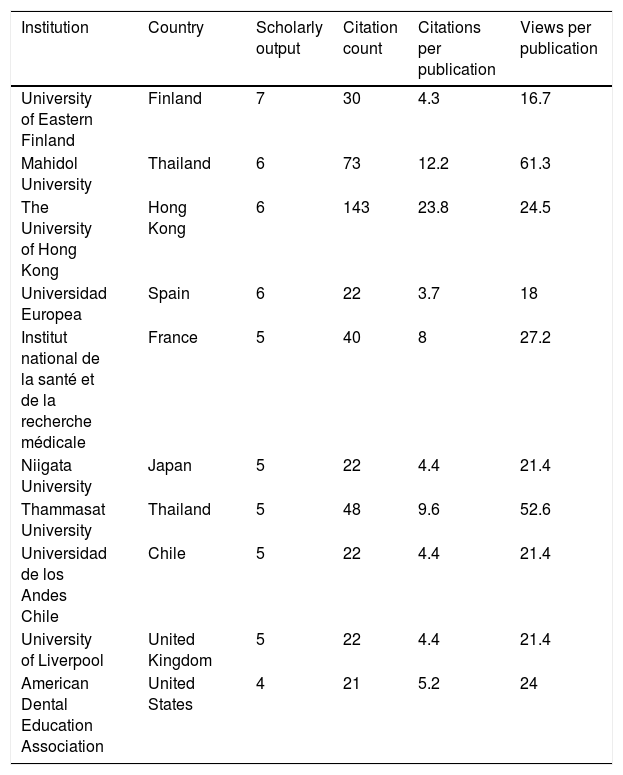
In the institutional analysis, the University of Eastern Finland had 7 publications with 30 citations: an average of 4.3 citations per document and 16.7 views. Mahidol University, 6 publications (73 citations; average 12.2 citations and 61.3 per article). The University of Hong Kong (6 documents, but the greatest impact of 143 citations, mean 23.8 per article). European University (6 publications and 22 citations). French National Institutes of Health and medical research, 5 documents, 40 citations, average 8 per publication. Niigata University, USA (University of the Andes, Chile), 5 publications, 22 citations, average 4.4 cit/document. The University of Liverpool, 5 publications, 22 citations, and an average of 4.4 per document. Thammasat University (5 publications, 48 citations, mean 9.6 plus 52.6 views per article) and finally, the American Dental Education Association (US), 4 documents with 21 citations and a mean of 5.2/published document. (Table 2).
Top 10 institutions.
| Institution | Country | Scholarly output | Citation count | Citations per publication | Views per publication |
|---|---|---|---|---|---|
| University of Eastern Finland | Finland | 7 | 30 | 4.3 | 16.7 |
| Mahidol University | Thailand | 6 | 73 | 12.2 | 61.3 |
| The University of Hong Kong | Hong Kong | 6 | 143 | 23.8 | 24.5 |
| Universidad Europea | Spain | 6 | 22 | 3.7 | 18 |
| Institut national de la santé et de la recherche médicale | France | 5 | 40 | 8 | 27.2 |
| Niigata University | Japan | 5 | 22 | 4.4 | 21.4 |
| Thammasat University | Thailand | 5 | 48 | 9.6 | 52.6 |
| Universidad de los Andes Chile | Chile | 5 | 22 | 4.4 | 21.4 |
| University of Liverpool | United Kingdom | 5 | 22 | 4.4 | 21.4 |
| American Dental Education Association | United States | 4 | 21 | 5.2 | 24 |
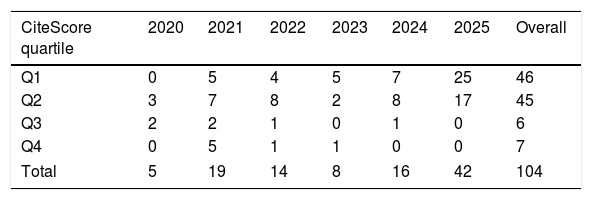
Overall, 104 publications were included for CiteScore quartile analysis (Table 3). Q1 started with 46 documents, with a clear growth trend noted at 25 articles in 2025; Q2 consisted of 45 works in total, spread more evenly through the period analyzed but did peak in 2025 at 17 articles; Q3 contained 6 publications with lower activity overall and no documents from the 2024 and 2025 period; finally, 7 documents were counted in Q4, with higher publication activity in 2021 and less often in subsequent years. Overall, there was noted to be a trend to publish in higher impact journals in all years, and especially in the last year analyzed.
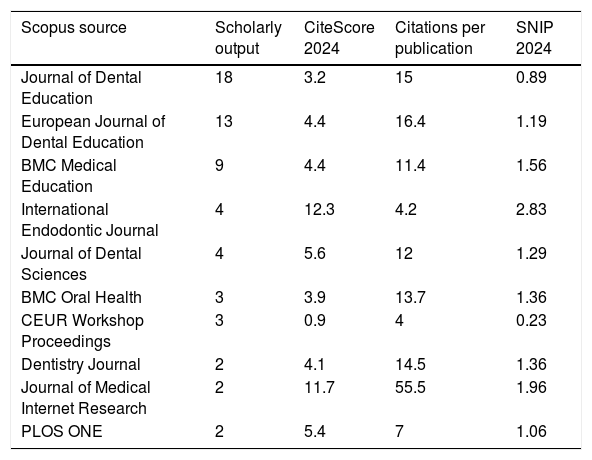
Regarding the analysis of Scopus sources, the Journal of Dental Education occupies rank 1 with 18 publications, with a CiteScore of 3.2 and 15 citations per article. The European Journal of Dental Education contributed 13 documents and an average of 16.4 citations, as well as CiteScore (4.4). BMC Medical Education has 9 articles with 11.4 citations per publication and an SNIP of 1.56. International Endodontic Journal 4 articles, although with a low 4.2 CiteScore; Journal of Dental Sciences 4 publications, with an average of 12 citations and 1.29 SNIP. BMC Oral Health, with fewer documents, has 13.7 citations per article. CEUR Workshop Proceedings 3 articles (4 citations average and SNIP of 0.23); Dentistry Journal 2 publications and 14.5 citations per document. Journal of Medical Internet Research has 2 articles, which obtained an average of 55.5 and a CiteScore of 11.7. PLOS ONE 2 works, average of 7 citations, and CiteScore of 5.4. (Table 4).
Top 10 Scopus sources.
| Scopus source | Scholarly output | CiteScore 2024 | Citations per publication | SNIP 2024 |
|---|---|---|---|---|
| Journal of Dental Education | 18 | 3.2 | 15 | 0.89 |
| European Journal of Dental Education | 13 | 4.4 | 16.4 | 1.19 |
| BMC Medical Education | 9 | 4.4 | 11.4 | 1.56 |
| International Endodontic Journal | 4 | 12.3 | 4.2 | 2.83 |
| Journal of Dental Sciences | 4 | 5.6 | 12 | 1.29 |
| BMC Oral Health | 3 | 3.9 | 13.7 | 1.36 |
| CEUR Workshop Proceedings | 3 | 0.9 | 4 | 0.23 |
| Dentistry Journal | 2 | 4.1 | 14.5 | 1.36 |
| Journal of Medical Internet Research | 2 | 11.7 | 55.5 | 1.96 |
| PLOS ONE | 2 | 5.4 | 7 | 1.06 |
Source: Normalized Impact per Paper (SNIP).
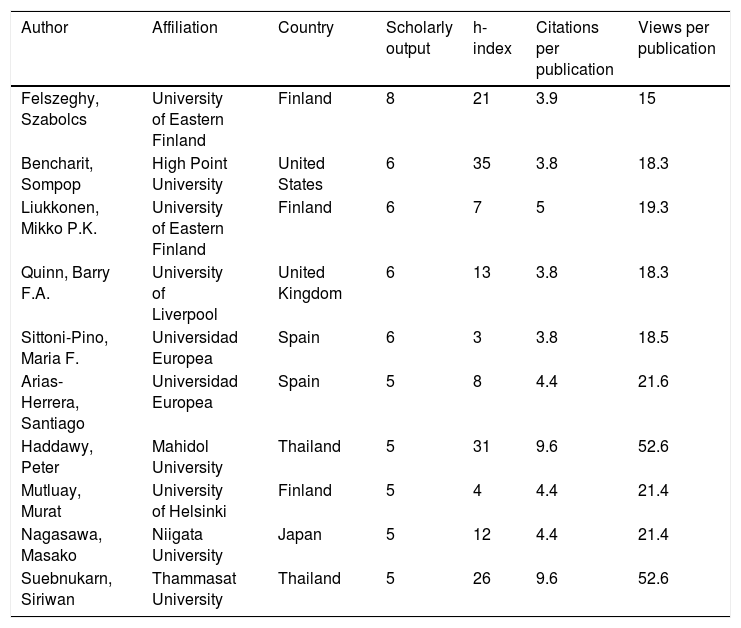
In the authorship analysis, Felszeghy and Szabolcs of the University of Eastern Finland led with 8 publications, an h-index of 21, and average citations per document of 3.9. Bencharit, Sompop, from High Point University in the United States, contributed 6 works with an h-index of 35 and average citations per document of 3.8. At the same Finnish institution, Liukkonen, Mikko P.K. produced 6 articles and an h-index of 7 and average citations per document of 5. Quinn, Barry F.A. of the University of Liverpool also registered 6 documents, an h-index of 13, and average citations per document of 3.8. From Spain, Sittoni-Pino, Maria F. contributed with 6 publications and an h-index of 3, while Arias-Herrera, Santiago contributed 5 works and an h-index of 8 and average citations per document of 4.4. In Asia, Haddawy, Peter from Mahidol University in Thailand, stood out with 5 articles, an h-index of 31, and 9.6 citations per document, followed by Suebnukarn, Siriwan from Thammasat University, with the same number of publications and an h-index of 26. Finland, Mutluay, Murat from the University of Helsinki contributed 5 works and an h-index of 4 and average citations per document of 4.4. In Japan, Nagasawa, Masako from Niigata University produced 5 articles, h-index of 12, and 4.4 citations per document. (Table 5).
Top 10 most prominent authors.
| Author | Affiliation | Country | Scholarly output | h-index | Citations per publication | Views per publication |
|---|---|---|---|---|---|---|
| Felszeghy, Szabolcs | University of Eastern Finland | Finland | 8 | 21 | 3.9 | 15 |
| Bencharit, Sompop | High Point University | United States | 6 | 35 | 3.8 | 18.3 |
| Liukkonen, Mikko P.K. | University of Eastern Finland | Finland | 6 | 7 | 5 | 19.3 |
| Quinn, Barry F.A. | University of Liverpool | United Kingdom | 6 | 13 | 3.8 | 18.3 |
| Sittoni-Pino, Maria F. | Universidad Europea | Spain | 6 | 3 | 3.8 | 18.5 |
| Arias-Herrera, Santiago | Universidad Europea | Spain | 5 | 8 | 4.4 | 21.6 |
| Haddawy, Peter | Mahidol University | Thailand | 5 | 31 | 9.6 | 52.6 |
| Mutluay, Murat | University of Helsinki | Finland | 5 | 4 | 4.4 | 21.4 |
| Nagasawa, Masako | Niigata University | Japan | 5 | 12 | 4.4 | 21.4 |
| Suebnukarn, Siriwan | Thammasat University | Thailand | 5 | 26 | 9.6 | 52.6 |
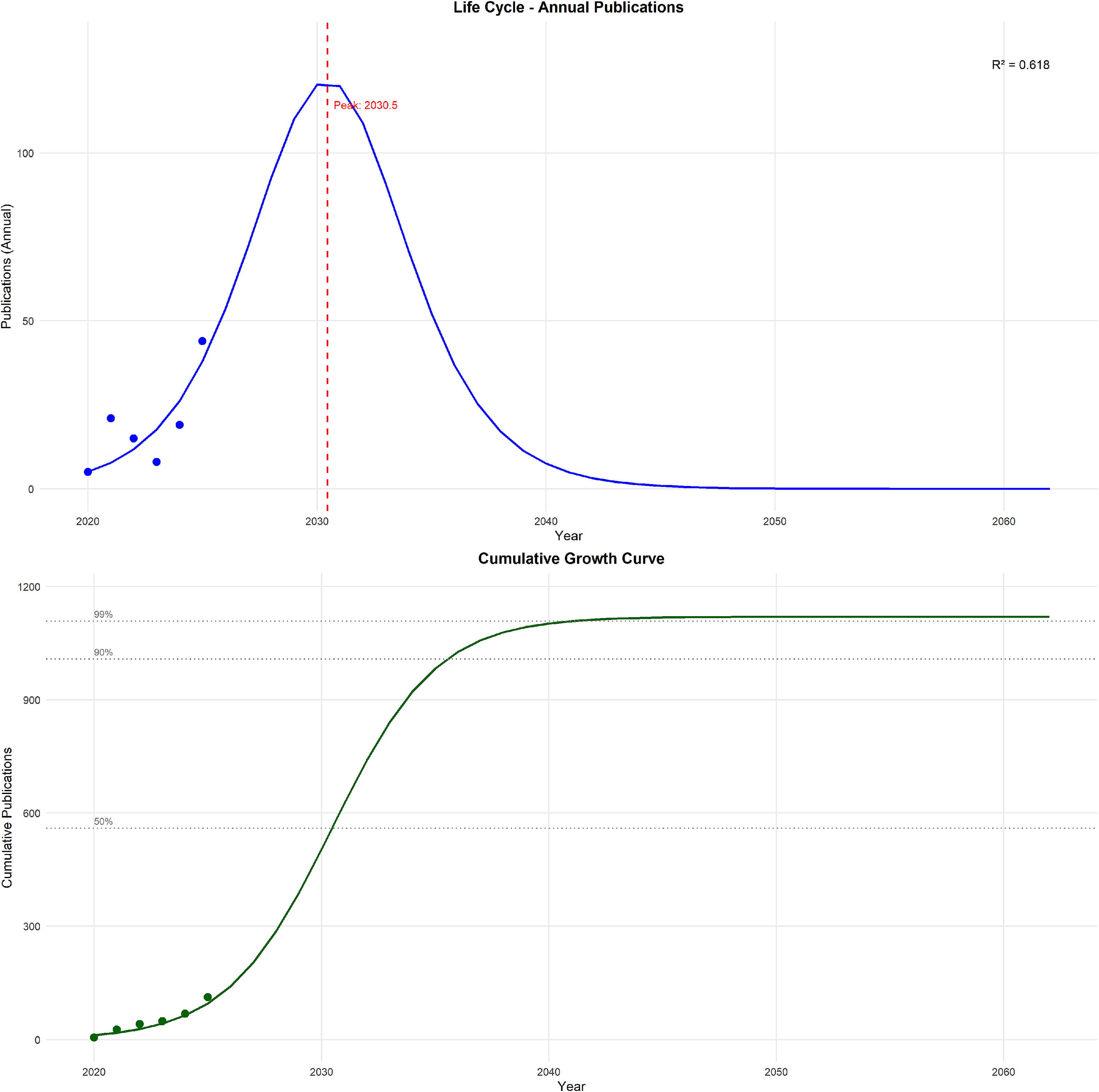
The life-cycle insights should be treated as tentative, given the relatively short data window (2020–2025) and the moderate R2 of the model fit (R2 = 0.618). Extremes of projection out to 2030 and beyond, particularly those toward 2065, rest on assumptions of continuity and stationarity of growth that are uncertain in a fast-moving landscape of technology and education. This more cautious framing will match reality more closely, avoiding overconfident claims not empirically supported. The cumulative growth curve shows that the number of publications continued to increase between 2020 and 2035, although the curve was steep in the early years. After that, output began to stabilize, approaching the cap of around 1200 publications, and the academic theme registered milestones at around 50, 90, and 99% of the cumulative total at around 2065. This proposed behavior is symptomatic of thematic consolidation within academia; in this context, the field appears to have emerged from the “emergent phase” to scientific maturity (Fig. 2).
Discussion
One major boost in haptic technology use in the life of virtual reality came with dental simulators. Theory and an intensive period of practice are essential, therefore, for the proper formation of students. During preclinic, students should practice and strengthen their clinical skills using simulators.13 The simulation can create a digital environment in which students can perform cavity preparation, removal of carious tissue, light curing, etc.14
The several advantages of incorporating this tool into dental education are related to its huge database of information on dental procedures that help to track and assess students' learning, assess their skills, and to give a more objective assessment of thesis according to their performances.15 Currently, the use of this haptic technology is mostly focused in a limited amount of areas like operative dentistry, where needing skills for performing dental preparation, although recent trends show the use of new techniques and devices which have improved the use of this technology in the preclinical aspect, due to their use of personalized treatment models, giving them a lot of possibilities of application.15,16
Hsu et al. commented on author productivity, naming authors such as Dang-Xiao Wang (n = 5), Siriwan Suebnukarn (n = 5), Yu-Chao Chang (n = 3), etc., who are affiliated with universities such as Beihang, Thammasat, Peking, etc. In our study, on the other hand, the most productive authors were Felszeghy S., Liukkonen M., Bencharit S., Quinn B.F., and Suebnukarn S., primarily affiliated with institutions such as the University of Eastern Finland, Mahidol University, and the University of Hong Kong. One thing to note is that Siriwan Suebnukarn appears in both studies, showing his continued active impact on the field. Another thing to note is that, while combing through a different database for information, the number of articles found is like that of our study, albeit a much larger year range, since our study covered the research topic for a shorter period. Therefore, the study of haptic technology has probably increased in recent years.16
On the other hand, another research done by Matoug et al. investigates the journals that published the “most” and those that made the “most” contributions: Journal of Dental Education (impact factor 1.4), European Journal of Dental Education (impact factor 1.7), and BMC Medical Education (impact factor 2.7), and these are also in our results. This journal means that research has advanced, and they were the most important contributors compared to the others. They also stated that the countries that contributed the most were the USA (n = 38), the UK (n = 34), France (n = 18), the Netherlands (n = 16), and China (n = 13). This shows how much more research is done in the USA from the beginning of this topic, which has grown with the participation of all these other countries. In our study, we found several more countries that cooperated with the research on this topic, such as Finland, Japan, Turkey, and Germany. Regarding the institutional analysis, they studied the universities and found as a result that La Vrije Universiteit Amsterdam had 13 publications, Université de Lorraine, Academic Center for Dentistry Amsterdam, and University of Leeds had 9 articles each. Which is different than in our study, the most significant contributor was the University of Eastern Finland with 7 publications and 30 citations; also, Mahidol University had 6 publications and 73 citations, and the University of Hong Kong also published 6 documents and had 143 citations.17
Several systematic reviews were found, in which Patil et al.18 stated that tools like Simodont have great potential for students learning in reinforcing their motor skills and improving manual dexterity, but require more thorough studies to fully realize the potential of these tools. Similarly, Shetty et al.19 mentioned that the continuous information provided by virtual reality and haptics has proven feasible and is well accepted by dental students, raising their confidence and improving their pre-clinical skills. After reviewing various publications, it has been observed that haptic technology in dentistry has been employed mainly in dental drilling and preparation tasks.20 Its implementation has facilitated the bridging of the learning gap between the preclinical and clinical practice phases, thus reducing anxiety in students who undergo clinical training and providing them with a greater sense of security and confidence in treating patients.16 Hence, future dental students can face and conquer the challenges and difficulties of the profession from their undergraduate to postgraduate training, aided by virtual reality and technology haptics. Since these types of simulations do not lead to clinical implications, they are allowed to err in them and have repeated opportunities until mastering techniques.21
While Scopus is a well-used and strong source, our reliance on it alone may leave us with an indexation bias that restricts the representativeness of this global overview of haptic simulation in dental education. Suitable works published in regional journals, conference proceedings, institutional or other repositories, other bibliographic databases (e.g., Web of Science, PubMed, Embase, or subject-specific or open-access alternatives) may be underrepresented or missing from the corpus we have inspected, with implications for geographic, linguistic, and document-type coverage. We have recorded this limitation and wish to argue that the choice of Scopus be justified explicitly in coverage for this specific field. Where practicable, future work should supplement Scopus searches with others and search for gray literature more vigorously. Where that is not possible, the manuscript conclusions should be stated more cautiously and may refer to the patterns of Scopus-indexed literature rather than the entirety of global production; that transparency will help them be interpretable and serve as a basis for further, more comprehensive investigation.
The results show that haptic simulation in dental education publishes an increasing scholarly output between 2020 and 2025 – 112 documents yearly, increasing 54.4% reflecting the increasing attention accorded to this technology. International collaboration accounts for approximately 31.2% of the corpus, suggesting a healthy multicenter collaborative research environment. Many institutions are represented, including the University of Hong Kong and Mahidol University, which have higher citation averages (23.8 and 12.2 citations per article, respectively). Citations from high-impact journals, including the Journal of Dental Education and the European Journal of Dental Education, are other indications of academic recognition of haptic simulation. Although our bibliometric evidence does not directly demonstrate a causal impact on learning outcomes, the clustering of authority in clinical skills, psychomotor training, and curricular studies supports the pedagogical potential and utility of haptic simulation. Results from this study support the growth of the use of haptics as complementary digital technologies with learning advantages in dental training.
Ethical considerationsNone to declare.
FundingNone.
Author contributionAll authors contributed significantly to the development of this study. Gabriel Barriga-Yauri led the conceptualization and design of the scientometric analysis, curated the data, and drafted the initial version of the manuscript. Fran Espinoza-Carhuancho was responsible for methodological development, statistical analysis, and critical revision of the text. Cesar Mauricio-Vílchez designed and executed the literature search strategy, extracted data, and prepared figures and tables. Ivan Calderon managed the software processes, handled database operations, and validated scientometric indicators. Felipe Lozano contributed to the interpretation of results, provided theoretical framing in dental education, and assisted with manuscript editing. Lucia Quispe-Tasayco supported the writing, coordinated references, and contributed to the visualization of global research trends. Frank Mayta-Tovalino supervised the project, ensured methodological rigor, critically reviewed the final draft, and served as corresponding author.
None to declare.

Supplementary material.