
Laparoscopic surgery has transformed surgical practice by reducing complications and recovery times. However, training remains limited due to restricted access to high-fidelity simulators, especially in resource-limited settings. Low-cost simulators have emerged as a feasible alternative to develop essential technical skills. The aim of this study was to design, develop, and validate a low-cost laparoscopic simulator for surgical training.
MethodsA quasi-experimental study was conducted with 24 general surgery residents. The simulator, built from medium-density fiberboard (MDF) and equipped with ports and a digital camera, was validated by a panel of 10 experts and assessed through the GOALS scale during a peg transfer task. Descriptive statistics and the Kruskal–Wallis test were applied to compare performance according to year of residency.
ResultsExperts reported high content and face validity (Aiken's V ≥ 0.75), highlighting its pedagogical relevance and functionality. Among residents, significant differences were found in performance across training levels (H = 8.70; p = 0.034), particularly between first- and fourth-year residents. The simulator showed discriminative capacity and educational usefulness.
DiscussionThe validated simulator represents an accessible and reproducible tool that facilitates training in minimally invasive surgery. Its low cost and effectiveness make it a strategic resource for institutions with budget limitations, supporting progressive and safe skill acquisition while enhancing surgical competence and patient safety.
La cirugía laparoscópica ha transformado la práctica quirúrgica al reducir complicaciones y tiempos de recuperación Sin embargo, la capacitación enfrenta limitaciones por la falta de acceso a simuladores de alta fidelidad en contextos con recursos restringidos En este escenario, los simuladores de bajo costo surgen como alternativa viable para desarrollar competencias técnicas esenciales El objetivo del estudio fue diseñar, desarrollar y validar un simulador laparoscópico de bajo costo para la formación de cirujanos.
MétodosSe llevó a cabo un estudio cuasiexperimental con 24 residentes de cirugía general El simulador, fabricado en tablero de fibra de densidad media (MDF) y adaptado con puertos y cámara digital, fue validado por un panel de 10 expertos y evaluado mediante la escala GOALS durante la práctica de transferencia de objetos Se aplicaron análisis descriptivos y prueba de Kruskal-Wallis para comparar niveles de habilidad según año de residencia.
ResultadosLos expertos otorgaron alta validez de contenido y apariencia (V de Aiken ≥0.75), destacando su pertinencia pedagógica y funcionalidad En residentes, se identificaron diferencias significativas en desempeño según nivel de formación (H = 8.70; p = 0.034), principalmente entre primer y cuarto año El simulador demostró capacidad discriminativa y utilidad educativa.
DiscusiónEl simulador validado constituye una herramienta accesible y reproducible que facilita el entrenamiento en cirugía mínimamente invasiva.
Su bajo costo y efectividad lo convierten en recurso estratégico para instituciones con limitaciones presupuestarias, favoreciendo una formación progresiva y segura orientada a la mejora de competencias y la seguridad del paciente.
Laparoscopic surgery has revolutionized medicine by offering minimally invasive techniques that reduce complications, postoperative pain, and recovery time compared to open surgery.1 This approach has transformed multiple surgical specialties, becoming the standard for procedures such as cholecystectomy and appendectomy.2,3
Despite its advantages, training in laparoscopy remains a challenge, particularly in regions with limited resources and in educational institutions, lacking access to tools that foster the development of surgical competencies. Unlike open surgery, laparoscopy requires the acquisition of specific skills, such as visuospatial coordination, precise manipulation within a restricted three-dimensional space, and adaptation to an indirect view of the surgical field.4
Faced with these demands, surgical training encounters a major hurdle: securing sufficient and safe practical training before contact with real patients. Although high-fidelity simulators—such as da Vinci robotic systems or virtual reality platforms—are effective, their high cost restricts their use in many institutions and developing countries. This perpetuates inequalities in skill development and impacts the quality of training in minimally invasive surgery.5
In this context, low-cost simulators emerge as an effective alternative for training both basic and advanced skills without reliance on expensive technology, thereby reducing the educational gap between institutions with different resource levels.6 Current studies have demonstrated that low-cost simulators can be as effective as conventional systems in developing basic surgical skills.7
Low-cost simulators have the strength of being more accessible and facilitating training for a larger number of learners, although their weakness is reduced fidelity. On the other hand, high-end simulators have the strength of offering superior quality and realism, but their weakness is the high cost that limits accessibility. As an opportunity, the different price ranges allow teaching to be adapted to diverse contexts; however, the threat is that investment in high-cost equipment may not be sustainable, while low-cost devices may be perceived as insufficient in academic programs.
The aim of this study was to design, develop, and validate a low-cost laparoscopic simulator for surgical training. The implementation of this simulator may broaden access to minimally invasive surgery training, particularly in resource-limited settings. Its affordable and reproducible approach provides an accessible alternative for developing technical skills, which translates into better surgical preparedness and greater patient safety. This proposal seeks to narrow educational disparities in laparoscopic surgery and lay the groundwork for future innovations in medical simulation.
Materials and methodsStudy designA quasi-experimental, descriptive, and quantitative study was conducted to functionally validate a low-cost laparoscopic simulator for surgical training. The performance of general surgery residents was evaluated in a controlled environment without manipulation of independent variables.
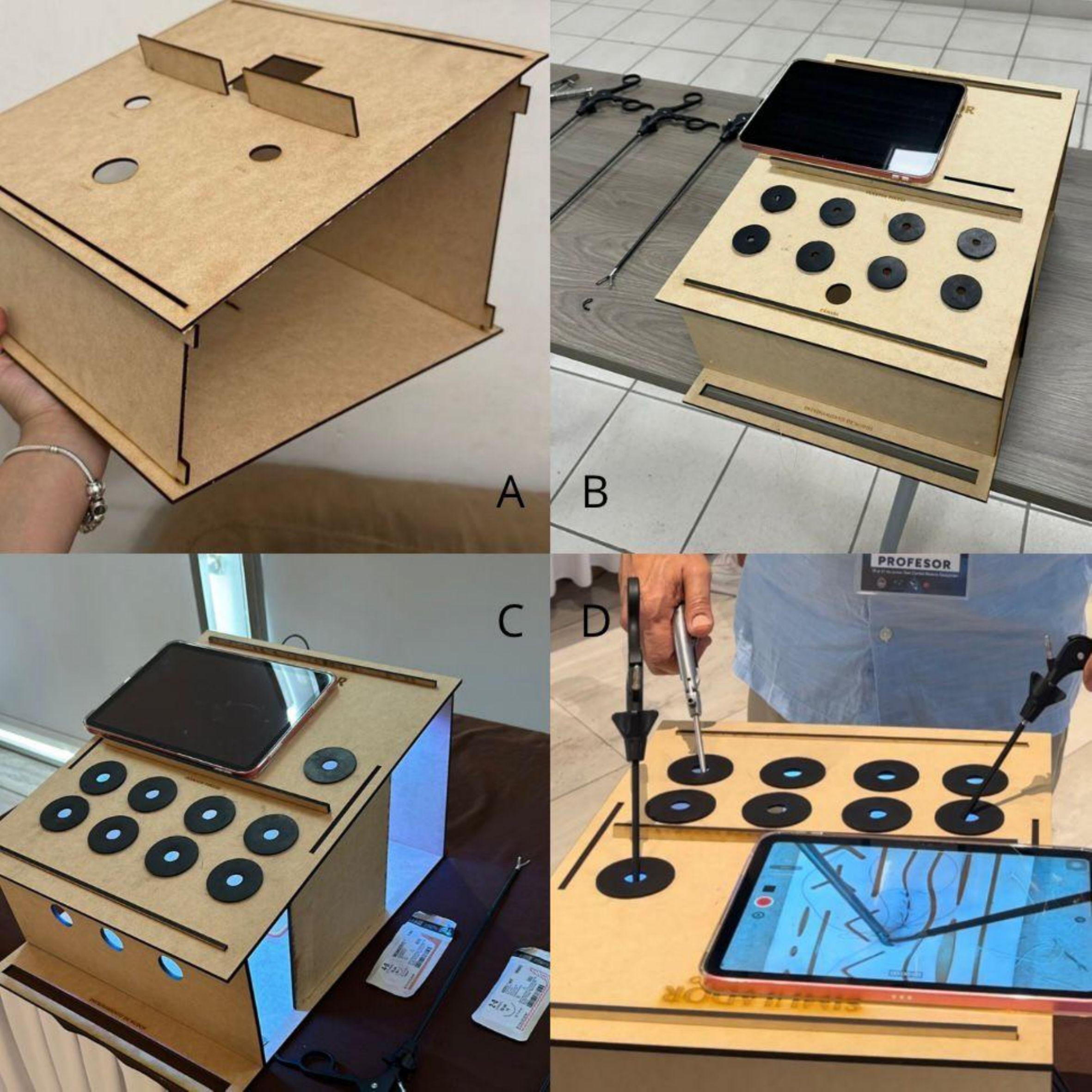
MaterialsThe simulator (Fig. 1) was manufactured using 4.5 mm medium-density fiberboard (MDF) board, laser-cut with CO2 technology from a digital design. The choice of materials was based on evidence supporting the use of affordable and accessible inputs for the creation of functional simulators.8 The dimensions (44 × 35 × 15 cm) replicate the functional space of the human abdominal cavity, allowing adequate angulation and instrument mobility during training.

Eight ports, each 3 cm in diameter, were incorporated and reinforced with flexible materials to ensure stability and resistance to repeated passage of laparoscopic instruments. Additionally, a 7 × 7 cm opening was designed for the insertion of a smartphone or tablet camera. Specific areas were integrated for extracorporeal knot tying, cutting on synthetic skin, and object transfer, in accordance with the exercises proposed by the Fundamentals of Laparoscopic Surgery (FLS) system.9
Expert judgment validationPrior to implementation, content validation was carried out through expert judgment. A panel of surgeons with laparoscopic experience reviewed the design, port distribution and diameter, anatomical dimensions, and training modules, providing recommendations to optimize realism and usability of the device. Key modifications included increasing the box height (rear wall from 15 to 20 cm and front wall from 10 to 15 cm), adding plastic elements to the orifices to simulate laparoscopic trocars, repositioning extracorporeal knot practice to a vertical setting, and enlarging the ports from 2 to 3 cm to improve maneuverability and compatibility with instruments.
Evaluation methodsTwo main instruments were employed: an expert judgment validation survey and the GOALS scale (Global Operative Assessment of Laparoscopic Skills).
Expert surveyThe first instrument was a structured survey administered to general surgeons with laparoscopic experience, who acted as expert judges. Inclusion criteria were at least one year of active practice and participation in resident training. The survey evaluated the content and face validity of the simulator, covering anatomical realism, technical functionality, educational applicability, and ergonomic design.
The survey consisted of three sections: evaluator demographic information; content validity assessment (anatomical realism and educational applicability); and face validity assessment (ergonomic and visual design). Each item was rated on a Likert scale from 1 (very poor) to 5 (excellent), with space for qualitative comments. This methodology aligns with accepted standards in educational research, which recommend expert judgment10,11 and participation of 6–10 experts to ensure content and face validity.12
The Aiken's V coefficient was calculated to quantify the level of agreement among experts for each item, with values ≥0.75 considered acceptable for content and face validity. Qualitative feedback was also collected to identify potential design improvements.
GOALS scaleThe GOALS scale has been internationally validated for assessing laparoscopic technical skills. It was applied to general surgery residents from first to fourth year through the peg transfer task,13 which consisted of transferring rubber bands from one peg to another using both hands, promoting bimanual coordination, depth perception, and visual control.
The scale was adapted to focus on five psychomotor dimensions: depth perception, instrument control and precision, movement efficiency and fluency, coordinated use of both hands, and effective use of the visual field. Each dimension was rated on a Likert scale from 1 (poor) to 5 (excellent), yielding a global score ranging from 5 to 25 points. This scale has demonstrated sensitivity in differentiating between various levels of surgical experience and is widely recognized as a standard tool for evaluating intraoperative laparoscopic competencies.14,15
Although GOALS is designed to evaluate laparoscopic skills across multiple sessions,16 in this study, it was applied once per resident to obtain a cross-sectional measurement of technical performance during the initial evaluation. This approach allows for an objective assessment of the simulator, following common practices in preliminary validation studies of laparoscopic simulators, where one-time evaluations provide valuable information about discrimination between different levels of experience and the educational utility of the simulator.17 Participants were surgical trainees who had initiated laparoscopic training but had not yet achieved full autonomy in minimally invasive procedures, placing them at an intermediate stage of technical-surgical skill acquisition. Both the sample size (15–22 residents) and the single-application design are supported by empirical evidence, as well as feasibility and relevance criteria for the initial validation of educational devices.18
The combined use of the GOALS scale and the expert judgment survey allowed for both quantitative and qualitative validation of the simulator, integrating objective performance metrics with expert feedback on its realism and educational value. This methodological complementarity ensured a more comprehensive evaluation of the device during its initial validation phase. Future studies may incorporate a digital version of the GOALS instrument to facilitate remote assessment and ensure uniformity in scoring across multiple evaluators.
Data distribution was assessed using the Shapiro–Wilk test, which indicated a non-normal distribution (p < 0.05). Therefore, the non-parametric Kruskal–Wallis test was applied to compare the groups.
ResultsSimulator designThe final prototype measured 44 × 35 cm and incorporated eight ports on the upper surface. Each port was reinforced with neoprene to simulate the resistance of the abdominal wall, and 15-mm openings were included to allow practice with laparoscopic staplers. The structure was manufactured from 4.5-mm MDF, selected for its adequate rigidity and low cost compared with acrylic, which is approximately five times more expensive. Metallic angles were added to the base to increase stability. The anterior wall measured 15 cm in height and the posterior wall 24 cm, providing an inclination that ensured ergonomic positioning for the user. Specific areas were integrated for extracorporeal knot tying and for manual knot training.
Before proceeding with formal validation, the prototype was presented to five expert surgeons in a preliminary review. This step allowed an informal but critical evaluation of the device, during which modifications were suggested and incorporated into the final design. These adjustments were subsequently reflected in the version that underwent structured expert and resident assessment.
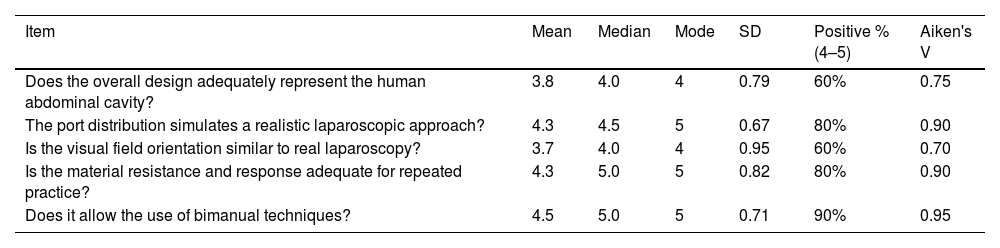
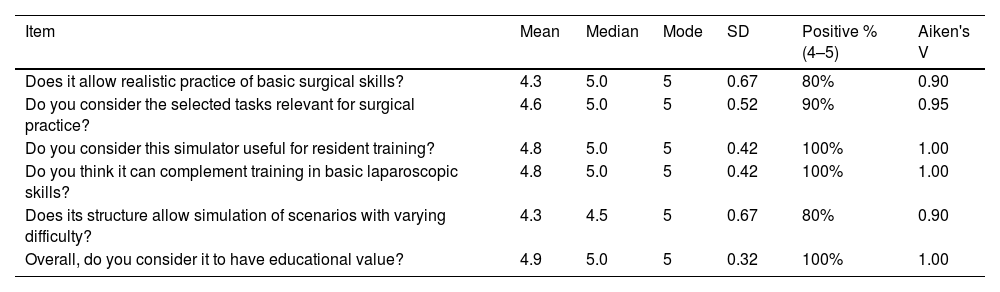
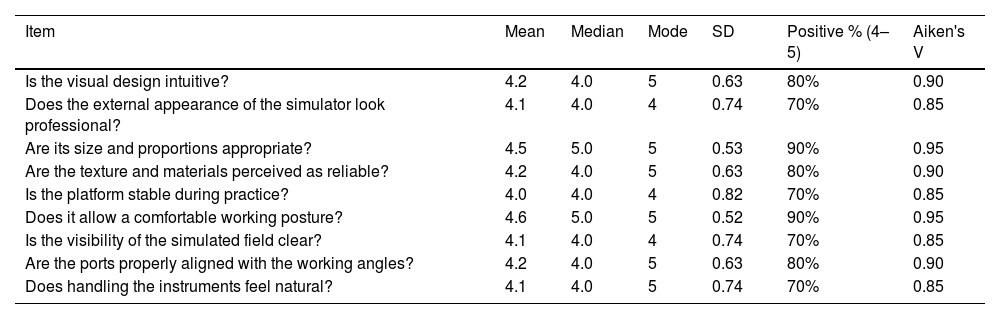
Expert evaluationA Likert-scale survey (1–5) was applied to 10 experts in general surgery and surgical subspecialties to assess the content validity, educational value, and ergonomic appearance of the low-cost laparoscopic simulator (Tables 1–3). Quantitative analysis was complemented with open-ended qualitative feedback.
Domain 1: Content validity.
| Item | Mean | Median | Mode | SD | Positive % (4–5) | Aiken's V |
|---|---|---|---|---|---|---|
| Does the overall design adequately represent the human abdominal cavity? | 3.8 | 4.0 | 4 | 0.79 | 60% | 0.75 |
| The port distribution simulates a realistic laparoscopic approach? | 4.3 | 4.5 | 5 | 0.67 | 80% | 0.90 |
| Is the visual field orientation similar to real laparoscopy? | 3.7 | 4.0 | 4 | 0.95 | 60% | 0.70 |
| Is the material resistance and response adequate for repeated practice? | 4.3 | 5.0 | 5 | 0.82 | 80% | 0.90 |
| Does it allow the use of bimanual techniques? | 4.5 | 5.0 | 5 | 0.71 | 90% | 0.95 |
Domain 2: Educational applicability.
| Item | Mean | Median | Mode | SD | Positive % (4–5) | Aiken's V |
|---|---|---|---|---|---|---|
| Does it allow realistic practice of basic surgical skills? | 4.3 | 5.0 | 5 | 0.67 | 80% | 0.90 |
| Do you consider the selected tasks relevant for surgical practice? | 4.6 | 5.0 | 5 | 0.52 | 90% | 0.95 |
| Do you consider this simulator useful for resident training? | 4.8 | 5.0 | 5 | 0.42 | 100% | 1.00 |
| Do you think it can complement training in basic laparoscopic skills? | 4.8 | 5.0 | 5 | 0.42 | 100% | 1.00 |
| Does its structure allow simulation of scenarios with varying difficulty? | 4.3 | 4.5 | 5 | 0.67 | 80% | 0.90 |
| Overall, do you consider it to have educational value? | 4.9 | 5.0 | 5 | 0.32 | 100% | 1.00 |
Domain 3: Face validity.
| Item | Mean | Median | Mode | SD | Positive % (4–5) | Aiken's V |
|---|---|---|---|---|---|---|
| Is the visual design intuitive? | 4.2 | 4.0 | 5 | 0.63 | 80% | 0.90 |
| Does the external appearance of the simulator look professional? | 4.1 | 4.0 | 4 | 0.74 | 70% | 0.85 |
| Are its size and proportions appropriate? | 4.5 | 5.0 | 5 | 0.53 | 90% | 0.95 |
| Are the texture and materials perceived as reliable? | 4.2 | 4.0 | 5 | 0.63 | 80% | 0.90 |
| Is the platform stable during practice? | 4.0 | 4.0 | 4 | 0.82 | 70% | 0.85 |
| Does it allow a comfortable working posture? | 4.6 | 5.0 | 5 | 0.52 | 90% | 0.95 |
| Is the visibility of the simulated field clear? | 4.1 | 4.0 | 4 | 0.74 | 70% | 0.85 |
| Are the ports properly aligned with the working angles? | 4.2 | 4.0 | 5 | 0.63 | 80% | 0.90 |
| Does handling the instruments feel natural? | 4.1 | 4.0 | 5 | 0.74 | 70% | 0.85 |
Results showed that all domains evaluated by experts achieved Aiken's V values ≥0.75, with the exception of one item, indicating high content and face validity. Notably, in the domain of educational applicability, several items reached Aiken's V values of 1.000, reflecting unanimous consensus regarding the simulator's usefulness in training contexts.
These findings suggest that the current design meets key pedagogical standards in laparoscopic surgery, particularly during the early stages of training. The simulator is regarded as both functional and scalable as a teaching resource.
Qualitative analysisPositive feedback:
- •
Useful tool: a good instrument to begin laparoscopic practice.
- •
Appropriate design for basic training: relevant for developing fundamental skills.
- •
Effective simplicity: basic, simple, and functional for its intended purpose.
- •
Valuable educational tool: useful despite the inherent difficulty of fully replicating real practice.
- •
Perceived value: favorably compared with models from large training centers.
- •
Expert acceptance: rated as an “excellent tool.”
Suggestions for improvement:
- •
Lack of 5 mm trocars: limits mobility and realism during practice.
- •
Restricted vision: recommendations included enhancing visibility with a laparoscopic lens or adding lateral visualization.
- •
Limited realism in some aspects: difficulty replicating actual surgical practice.
- •
Tablet placement: could be better positioned to more closely resemble the clinical setting.
Overall, experts perceived the simulator as a valid, functional, and economically accessible educational tool, with specific areas identified for improvement.
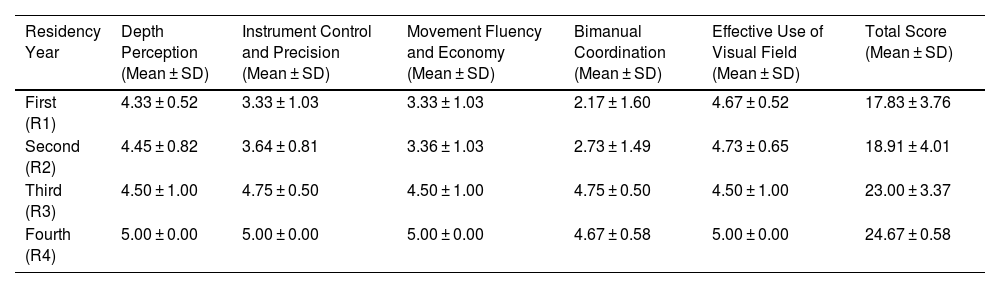
Resident evaluation – GOALS scaleThe performance of 24 general surgery residents from the General Hospital of the State of Sonora was assessed, representing 68.6% of the total 35 residents. Differences in participation were due to external rotations and workload. The adapted GOALS scale was applied, and the results were grouped by year of residency (Table 4).
Technical performance by residency year using the adapted GOALS scale.
| Residency Year | Depth Perception (Mean ± SD) | Instrument Control and Precision (Mean ± SD) | Movement Fluency and Economy (Mean ± SD) | Bimanual Coordination (Mean ± SD) | Effective Use of Visual Field (Mean ± SD) | Total Score (Mean ± SD) |
|---|---|---|---|---|---|---|
| First (R1) | 4.33 ± 0.52 | 3.33 ± 1.03 | 3.33 ± 1.03 | 2.17 ± 1.60 | 4.67 ± 0.52 | 17.83 ± 3.76 |
| Second (R2) | 4.45 ± 0.82 | 3.64 ± 0.81 | 3.36 ± 1.03 | 2.73 ± 1.49 | 4.73 ± 0.65 | 18.91 ± 4.01 |
| Third (R3) | 4.50 ± 1.00 | 4.75 ± 0.50 | 4.50 ± 1.00 | 4.75 ± 0.50 | 4.50 ± 1.00 | 23.00 ± 3.37 |
| Fourth (R4) | 5.00 ± 0.00 | 5.00 ± 0.00 | 5.00 ± 0.00 | 4.67 ± 0.58 | 5.00 ± 0.00 | 24.67 ± 0.58 |
The Kruskal-Wallis test was used to compare scores across groups, yielding the following results:
- •
H = 8.70
- •
p = 0.034
This confirms statistically significant differences in performance according to the residency year (p < 0.05).
In post hoc comparisons (Table 5), the only statistically significant difference was between first- and fourth-year residents (p = 0.0364), validating the simulator as a discriminative tool. Additionally, relevant trends were observed between third-year residents and lower levels, suggesting that the greatest skill progression occurs at advanced stages.
Skill-level discrimination (residents)Analysis using the GOALS scale revealed significant differences between residency years, particularly between first and fourth years, with superior performance in senior residents. Two key points emerge:
- 1.
The simulator is sensitive to detecting progressive skill levels, supporting its role as an evaluative tool.
- 2.
A visible learning curve was identified in technical dimensions, particularly bimanual coordination and movement fluency, consistent with the literature on laparoscopic training.
The comprehensive evaluation of the low-cost laparoscopic simulator, carried out by both experts and surgery residents, provides evidence of its validity, pedagogical utility, and potential for integration into surgical training programs.
According to experts, high scores across the three domains support that the design meets essential criteria for surgical education. Unanimous agreement on certain items (Aiken's V = 1.000) demonstrates strong acceptance and consensus regarding its functionality. These results, together with positive qualitative feedback, reinforce its accessible and adaptable character, highlighting its usefulness in institutions with limited budgets.
Among residents, analysis with the adapted GOALS scale demonstrated progressive performance improvements by residency year, identifying technical dimensions with the greatest development, such as bimanual coordination and movement fluency. This indicates that the simulator is sensitive to detecting technical skill progression, positioning it as both a practice tool and an objective means of evaluating competency development.
These findings indicate that the simulator is sensitive to different stages of surgical training and could be effectively integrated into a stepwise curriculum, providing early exposure and reinforcement of laparoscopic skills as residents progress clinically.
Expert feedback also highlighted areas for future improvement of the prototype: haptic fidelity, integration of real laparoscopic imaging, stability of the working field, and ergonomic design. These should not be interpreted as critical flaws but rather as opportunities to enhance pedagogical value and approach the standards of high-fidelity simulators, while maintaining affordability.
The findings of this study support the use of the low-cost laparoscopic simulator as a valid and useful tool for surgical training. Beyond quantitative results, expert consensus emphasizes its pedagogical relevance in the early stages of surgical learning and its ability to differentiate levels of technical skill among residents, highlighting its potential usefulness as an evaluative instrument. Although only one of the post hoc comparisons reached statistical significance, consistent trends were observed in line with the progression of surgical competencies, particularly among senior residents. These findings are consistent with the literature, which underscores the importance of accessible tools that allow progressive and safe psychomotor skill training, as reported by Li et al.,19 Banegas-Ruiz et al.,20 and Bogar et al.21 in demonstrating improvements in visuomotor coordination and movement efficiency.
From a practical perspective, its low cost, portability, and ease of fabrication make it a strategic resource for hospitals or schools with limited budgets. Incorporating it into residency programs could facilitate the standardization of basic skills before clinical exposure, thereby contributing to improved patient safety as described by Baris et al.22 and Aydin et al.23
The qualitative analysis complemented the quantitative results by reflecting the genuine interest of experts and their positive perception of the simulator's pedagogical potential. They highlighted its value as a realistic and functional solution in contexts where access to sophisticated technology is limited, its suitability for autonomous practice, and its potential to motivate self-assessment. They also identified areas for improvement, such as enhancing base stability and adjusting the visual angle to better simulate real surgical conditions.
These perspectives reflect not only technical acceptance but also an appreciation of its educational impact and alignment with contemporary competency-based surgical education principles. The enthusiasm expressed underscores the need for accessible and reproducible tools that ensure safe, progressive, and high-quality training, as observed by Reznick et al.24
The development and validation of a low-cost laparoscopic simulator allowed for the assessment of its technical performance and its impact on the training process of surgical residents. Through both quantitative and qualitative analysis, this study demonstrated that it is possible to design accessible tools that meet pedagogical, ergonomic, and clinical standards without relying on sophisticated technology.
Experts emphasized its relevance for teaching essential skills such as bimanual coordination, visuospatial management, and the precise execution of basic surgical maneuvers. They also highlighted its discriminative capacity and potential as an evaluative instrument in the early stages of training. At the same time, its affordability and reproducibility make it a realistic option for residency programs lacking access to commercial simulators, positioning it not merely as a temporary solution but as a sustainable educational resource.
The main limitations of this study include the small number of residents in advanced training years and the absence of longitudinal follow-up to assess clinical transfer. Future research could incorporate controlled experimental designs, evaluation of impact in real clinical scenarios, and objective intraoperative performance metrics.
The value of this simulator lies not only in its physical design but also in what it represents: a tool that responds to a concrete educational need, capable of bringing safe surgical practice closer to more learners. Although areas for improvement remain, these do not compromise its functionality; rather, they pave the way for continuous evolution of the design.
In conclusion, this study demonstrates that innovation in surgical education can emerge from simple and accessible solutions.
FundingThe authors received no financial support for the research, authorship, and/or publication of this article.
Ethical considerationsThis research has been designed with a strong ethical commitment, ensuring the protection and respect of participants' rights at all times. Informed consents were obtained from all participants prior to data collection, using clear and comprehensible language. Participants were informed of their right to withdraw from the study at any time without facing negative consequences.
None.
We thank the Universidad de Sonora and the Hospital General del Estado de Sonora for the support provided for this project, which was essential for carrying out this work.