
Innovative teaching approaches are increasingly adopted in health sciences education to support the development of students' decision-making skills. However, evidence regarding the effectiveness of case-based CDIO learning and the role of learner-related factors associated with performance remains limited. This study examined changes in students' decision-making performance following the implementation of case-based CDIO learning and explored the associations of safety awareness and self-confidence with post-intervention performance.
Materials and methodsA quasi-experimental pre–post study was conducted with 89 undergraduate students enrolled in a health-related course. Decision-making performance was assessed before and after the intervention using a rubric-based evaluation. Safety awareness and self-confidence were measured using self-report questionnaires. A paired t-test was used to examine changes in performance, and multiple linear regression analysis was conducted to assess the associations of safety awareness and self-confidence with post-intervention decision-making performance while controlling for baseline performance.
ResultsDecision-making scores increased significantly following the intervention (t(88) = 8.31, p < 0.001). The regression model was statistically significant (F(3, 85) = 15.04, p < 0.001), explaining 34.7% of the variance in post-intervention decision-making performance (R2 = 0.347). Baseline performance (β = 0.41, p < 0.001) and self-confidence (β = 0.29, p = 0.004) were significant positive predictors, whereas safety awareness was not significantly associated with performance (p = 0.840).
ConclusionCase-based CDIO learning appears to be a promising instructional approach for supporting the development of students' decision-making performance. Self-confidence was identified as a significant factor associated with performance after controlling for baseline performance, suggesting that learner perceptions may influence how effectively students apply knowledge in practice-oriented contexts.
Los enfoques pedagógicos innovadores se adoptan cada vez con mayor frecuencia en la educación en ciencias de la salud para apoyar el desarrollo de las habilidades de toma de decisiones de los estudiantes. Sin embargo, la evidencia sobre la efectividad del aprendizaje CDIO basado en casos y el papel de los factores relacionados con el estudiante asociados con el rendimiento sigue siendo limitada. Este estudio examina los cambios en el rendimiento en la toma de decisiones tras la implementación del aprendizaje CDIO basado en casos y explora las asociaciones entre la conciencia de seguridad, la autoconfianza y el rendimiento posterior a la intervención.
Materiales y métodosSe llevó a cabo un estudio cuasiexperimental con diseño pre–post con 89 estudiantes de grado matriculados en una asignatura del ámbito de las ciencias de la salud. El rendimiento en la toma de decisiones se evaluó antes y después de la intervención mediante una rúbrica. La conciencia de seguridad y la autoconfianza se midieron mediante cuestionarios de autoinforme. Se utilizó una prueba t para muestras relacionadas para examinar los cambios en el rendimiento, y se realizó un análisis de regresión lineal múltiple para evaluar las asociaciones entre la conciencia de seguridad, la autoconfianza y el rendimiento en la toma de decisiones posterior a la intervención, controlando el rendimiento basal.
ResultadosLas puntuaciones de toma de decisiones aumentaron significativamente tras la intervención (t(88) = 8.31, p < 0.001). El modelo de regresión fue estadísticamente significativo (F(3, 85) = 15.04, p < 0.001) y explicó el 34,7% de la varianza del rendimiento en la toma de decisiones posterior a la intervención (R2 = 0.347). El rendimiento basal (β = 0.41, p < 0.001) y la autoconfianza (β = 0.29, p = 0.004) fueron predictores positivos significativos, mientras que la conciencia de seguridad no se asoció significativamente con el rendimiento (p = 0.840).
ConclusiónEl aprendizaje CDIO basado en casos parece ser un enfoque pedagógico prometedor para apoyar el desarrollo del rendimiento en la toma de decisiones de los estudiantes. La autoconfianza se identificó como un factor significativamente asociado con el rendimiento tras controlar el nivel basal, lo que sugiere que las percepciones del estudiante pueden influir en la eficacia con la que aplican el conocimiento en contextos orientados a la práctica.
Clinical decision-making is a fundamental competency in health sciences education, as it directly affects the quality and safety of patient care.1 Clinical decision-making has been conceptualised as a complex cognitive process involving both analytical and non-analytical reasoning in uncertain and context-dependent situations.2 While clinical decision-making requires specific, domain-dependent cognitive skills, the development of these skills is supported by broader decision-making abilities, including systematic problem analysis, solution formulation, and reflective evaluation. In undergraduate health sciences education, students typically develop these foundational decision-making abilities before mastering more specialised clinical judgements. Therefore, examining decision-making performance provides a practical educational outcome for understanding how these foundational competencies develop. However, traditional lecture-based approaches in health professions education often emphasise knowledge transmission rather than application, leading to passive learning and limited development of practical decision-making skills, while decision-making itself is influenced by multiple individual and contextual factors.3,4 This gap between theoretical knowledge and its application in real-world contexts remains a critical challenge, particularly in settings undergoing educational reform and modernisation.5,6
To address these limitations, active learning approaches have been increasingly adopted in health sciences education. These approaches are grounded in constructivist learning principles, which emphasise active knowledge construction through experience and interaction rather than passive reception. Methods such as problem-based learning and team-based learning have been shown to enhance student engagement, critical thinking, and professional competencies compared with traditional teaching methods.7–10 These approaches encourage learners to actively construct knowledge and apply it in collaborative and problem-solving contexts.
Among these strategies, case-based learning (CBL) is particularly effective in promoting the application of knowledge in realistic scenarios. By engaging students in analysing and responding to authentic cases, CBL supports the development of higher-order thinking and decision-making skills that are essential in professional practice.11–13 Systematic evidence has also demonstrated the effectiveness of case-based learning in health professional education, highlighting its role in enhancing clinical reasoning and applied competencies.14 This contextualised learning approach aligns well with the demands of health sciences education, where decision-making often involves complex and uncertain situations. Recent evidence also suggests that integrating case-based learning within the CDIO framework may further enhance learning outcomes in nursing education.15
In parallel, the Conceive–Design–Implement–Operate (CDIO) framework provides a structured approach to experiential learning. Originally developed in engineering education, CDIO emphasises active participation, problem-solving, and the integration of theory and practice, reflecting principles of experiential learning in which knowledge is developed through iterative cycles of action and reflection.16,17 This perspective is consistent with experiential learning theory, which posits that knowledge is constructed through cyclical processes of experience, reflection, conceptualisation, and experimentation.18 Recent studies have demonstrated the applicability of CDIO-based approaches in medical and nursing education, showing improvements in students' competencies, engagement, and practical skills.19–23 In this context, case-based learning may provide the contextual foundation for learning, while the CDIO framework offers a structured process through which learners analyse problems, design solutions, implement decisions, and reflect on outcomes, thereby supporting the development of decision-making competence in a systematic manner. Although the CDIO framework originated in engineering education, its educational value lies in providing a structured and iterative approach to problem-solving. This process guides learners through identifying problems (Conceive), planning solutions (Design), implementing actions (Implement), and evaluating outcomes (Operate). In health sciences education, such a framework can serve as a pedagogical scaffold for strengthening general decision-making performance in practice-oriented learning environments. Rather than replacing the specialised reasoning required for complex clinical decision-making, CDIO provides a structured learning process through which foundational decision-making abilities can be systematically developed.
Despite these advances, most existing studies have primarily focused on learning outcomes such as knowledge acquisition and skill development, with less attention paid to the factors associated with performance differences among learners. In particular, the role of learners' perceptions, such as safety awareness and self-confidence, remains insufficiently explored. Self-confidence, often conceptually related to self-efficacy, reflects individuals' beliefs in their capability to organise and execute actions required to achieve desired outcomes.24 Prior research suggests that self-efficacy is associated with how effectively learners apply knowledge in complex tasks and make decisions in uncertain situations. From a broader motivational perspective, learners' perceptions may also be understood through the lens of control-value theory, which highlights the role of perceived control and value in shaping engagement, emotions, and performance in academic contexts.25,26 Such internal perceptions may be related to how students translate knowledge into action, highlighting the need to examine these relationships in the context of innovative teaching approaches.27
Therefore, this study aims to examine changes in students' decision-making performance following the implementation of case-based CDIO learning and to investigate whether safety awareness and self-confidence are associated with post-intervention decision-making performance while accounting for baseline performance levels. Accordingly, this study focuses on decision-making performance as an educational outcome reflecting students' ability to analyse problems, formulate solutions, and justify decisions in structured case-based learning activities.
The study is guided by the following hypotheses:
(H1) Decision-making performance increases from pre- to post-intervention following the implementation of case-based CDIO learning.
(H2) Safety awareness is associated with post-intervention decision-making performance.
(H3) Self-confidence is positively associated with post-intervention decision-making performance.
This study employed a quasi-experimental pre–post design to evaluate the effects of a case-based CDIO learning approach on students' decision-making performance. Decision-making performance was assessed before and after the intervention using a rubric-based evaluation. In addition, safety awareness and self-confidence were measured after the intervention to examine their associations with post-intervention decision-making performance.
Participants and data collectionA total of 112 third-year undergraduate students enrolled in a clinical decision-making course at a public university in Vietnam offering health-related programmes were invited to participate in the study. After data screening, 89 students with complete data were included in the final analysis. Participants were excluded if they did not complete all required components, including both pre- and post-intervention decision-making assessments and the post-intervention questionnaire. Only complete cases were included in the analysis, and no imputation was performed.
An a priori power analysis using G*Power indicated a minimum required sample size of 34 participants for a paired t-test, assuming a medium effect size (dz = 0.5), a significance level of 0.05, and a statistical power of 0.80. The final sample size of 89 substantially exceeded this requirement.
For the multiple linear regression analysis with three predictors, a separate power analysis indicated a minimum required sample size of 77 participants, assuming a medium effect size (f2 = 0.15), a significance level of 0.05, and a statistical power of 0.80. The final sample size of 89 was therefore considered sufficient for both analyses.
Data were collected using anonymised procedures. Each participant generated a unique self-identification code, which was used to match responses across the pre- and post-intervention assessments and the questionnaire. No personal identifying information was collected. Participation was voluntary, and all data were used solely for research purposes. The assessments were conducted as part of regular classroom activities and did not affect students' final grades.
InterventionThe intervention was designed based on the Conceive–Design–Implement–Operate (CDIO) framework and incorporated case-based learning activities. The learning process followed four stages.
In the Conceive stage, students analysed case scenarios to identify key problems and potential risks.
In the Design stage, they proposed solutions and developed decision-making strategies.
In the Implement stage, students engaged in group discussions and presented their proposed solutions.
In the Operate stage, they received feedback and reflected on their decisions, with an emphasis on applying the acquired knowledge to similar real-world situations.
The intervention was delivered over 15 weeks, with one session per week. Each weekly instructional session comprised three consecutive 50-min class periods (150 min in total). Each session began with a brief instructor-led introduction, followed by collaborative case analysis following the CDIO sequence, group presentations, and guided reflection. Students worked in groups of approximately 10 members during learning activities to facilitate collaborative problem-solving and discussion. However, all assessment tasks were completed individually to ensure that the evaluation of decision-making performance reflected each student's independent ability rather than group influence.
Students were presented with case scenarios involving workflow inefficiencies and potential risks in a simulated healthcare environment, requiring them to identify problems, propose solutions, and justify their decisions.
Different but structurally equivalent case scenarios were used for the pre- and post-intervention assessments to minimise potential recall bias while ensuring comparability in task complexity and decision-making demands. The same rubric and scoring criteria were applied consistently across both assessments. Additional case scenarios with similar structures were used during the learning activities to support practice and skill development. A representative example of the case scenarios used in the study is provided in Appendix A.
MeasuresDecision-making (DM)Decision-making performance was assessed using a rubric-based evaluation developed for the case analysis tasks in this study. The rubric consisted of three domains:
- (1)
risk identification (0–3 points), referring to the extent to which students correctly identified key problems or risks;
- (2)
proposed solution (0–4 points), reflecting the appropriateness and feasibility of the proposed solution; and
- (3)
justification (0–3 points), assessing the clarity and logic of the reasoning supporting the decision.
The total score ranged from 0 to 10 and was calculated as the sum of the three domain scores. The same rubric and scoring criteria were applied consistently in both the pre- and post-intervention assessments. Student responses were scored by two instructors experienced in health sciences education using the predefined rubric. One evaluator conducted the initial scoring, and the second reviewed all assigned scores. Final scores were determined through discussion and consensus when necessary. Detailed scoring criteria are provided in Appendix A.
Safety awareness (SA)Safety awareness was measured using a four-item self-report questionnaire assessing students' awareness of safety-related considerations in case analysis and decision-making. The items were adapted from prior studies on student perceptions and safety awareness in educational contexts3,7,28 and modified to fit the context of case-based learning.
Participants rated each item on a 5-point Likert scale (1 = strongly disagree, 5 = strongly agree). The items included:
(SA1) I am aware of potential risks in decision-making situations.
(SA2) I consider safety implications when analysing case scenarios.
(SA3) I recognise the importance of checking procedures before implementation.
(SA4) I understand the potential consequences of errors in practical contexts.
The safety awareness score was computed as the mean of the four items, with higher scores indicating greater perceived safety awareness.
Self-confidence (CF)Self-confidence was measured using a three-item self-report questionnaire assessing students' perceived confidence in analysing cases and making decisions. This construct is conceptually related to self-efficacy,24 which reflects individuals' beliefs in their ability to perform specific tasks. The items were adapted from prior research on student confidence and learning processes3,27 and modified to fit the context of case-based learning.
Each item was rated on a 5-point Likert scale (1 = strongly disagree, 5 = strongly agree). The items included:
(CF1) I feel confident analysing case scenarios.
(CF2) I can justify my decisions clearly.
(CF3) I am confident identifying potential errors in complex situations.
The self-confidence score was calculated as the mean of the three items, with higher scores indicating greater perceived confidence.
ReliabilityThe internal consistency of the questionnaire items was assessed using Cronbach's alpha. A value of α ≥ 0.70 was considered indicative of acceptable reliability for exploratory research purposes.
Data analysisData were analysed using IBM SPSS Statistics. Descriptive statistics were calculated for all variables. A paired t-test was conducted to examine differences in decision-making performance before and after the intervention.
Multiple linear regression analysis was performed to examine whether safety awareness and self-confidence were associated with post-intervention decision-making performance, while controlling for baseline decision-making performance. The regression model was specified as follows:

Assumptions for parametric tests, including normality, linearity, homoscedasticity, and absence of multicollinearity, were assessed prior to analysis. A significance level of p < 0.05 was used for all statistical tests.
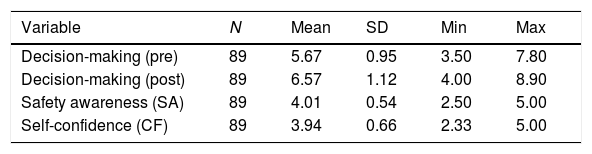
ResultsDescriptive statisticsA total of 89 participants were included in the final analysis. Descriptive statistics for all study variables are presented in Table 1.
Descriptive statistics for study variables (N = 89).
| Variable | N | Mean | SD | Min | Max |
|---|---|---|---|---|---|
| Decision-making (pre) | 89 | 5.67 | 0.95 | 3.50 | 7.80 |
| Decision-making (post) | 89 | 6.57 | 1.12 | 4.00 | 8.90 |
| Safety awareness (SA) | 89 | 4.01 | 0.54 | 2.50 | 5.00 |
| Self-confidence (CF) | 89 | 3.94 | 0.66 | 2.33 | 5.00 |
Decision-making scores increased from pre-intervention (M = 5.67, SD = 0.95) to post-intervention (M = 6.57, SD = 1.12). Safety awareness showed a relatively high mean score (M = 4.01, SD = 0.54), while self-confidence was at a moderate level (M = 3.94, SD = 0.66).
The internal consistency of the scales was acceptable, with Cronbach's alpha values of 0.728 for safety awareness and 0.795 for self-confidence.
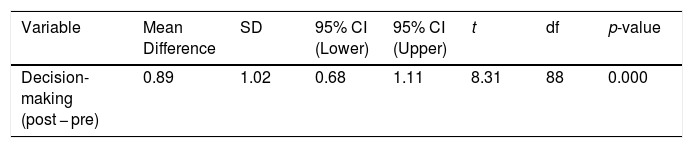
Paired t-testA paired-samples t-test was conducted to examine changes in decision-making performance following the intervention. As shown in Table 2, decision-making scores increased significantly from pre- to post-intervention, t(88) = 8.31, p < 0.001.
The mean difference between post- and pre-intervention scores was 0.89 (95% CI [0.68, 1.11]), indicating a significant improvement in performance following the implementation of the case-based CDIO learning approach.
The effect size was large (Cohen's d = 0.88; Hedges' g = 0.87), suggesting a substantial magnitude of improvement.
RegressionMultiple linear regression analysis was conducted to examine whether safety awareness and self-confidence were associated with post-intervention decision-making performance, while controlling for baseline decision-making performance.
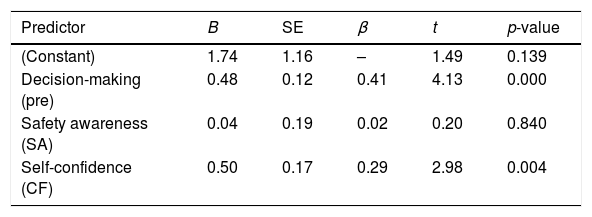
The overall model was statistically significant, F(3, 85) = 15.04, p < 0.001, explaining 34.7% of the variance in post-intervention decision-making performance (R2 = 0.347; adjusted R2 = 0.324).
As shown in Table 3, baseline decision-making performance was a significant positive predictor of post-intervention performance (β = 0.41, p < 0.001). Self-confidence was also a significant positive predictor (β = 0.29, p = 0.004). In contrast, safety awareness was not significantly associated with post-intervention decision-making performance (β = 0.02, p = 0.840).
Multiple linear regression predicting post-intervention decision-making performance (N = 89).
| Predictor | B | SE | β | t | p-value |
|---|---|---|---|---|---|
| (Constant) | 1.74 | 1.16 | – | 1.49 | 0.139 |
| Decision-making (pre) | 0.48 | 0.12 | 0.41 | 4.13 | 0.000 |
| Safety awareness (SA) | 0.04 | 0.19 | 0.02 | 0.20 | 0.840 |
| Self-confidence (CF) | 0.50 | 0.17 | 0.29 | 2.98 | 0.004 |
This study examined changes in students' decision-making performance following the implementation of a case-based CDIO learning approach and explored the role of safety awareness and self-confidence in relation to performance outcomes. The findings indicate that decision-making performance increased from pre- to post-intervention, supporting H1. This result suggests that structured, case-based CDIO learning may be associated with improvements in students' ability to apply knowledge in complex and practice-oriented contexts. This improvement may reflect the development of both analytical and contextual reasoning processes, which are central to clinical decision-making in complex environments.2
In addition, students reported relatively high levels of safety awareness and self-confidence after the learning experience. The regression analysis further showed that, after controlling for baseline decision-making performance, self-confidence was a significant positive predictor of post-intervention performance, whereas safety awareness was not. These findings support H3 but not H2.
Taken together, these results suggest that while both safety awareness and self-confidence may have been strengthened through the learning process, self-confidence appears to be more closely associated with variations in performance outcomes beyond students' initial ability levels. This may reflect the importance of learners' perceived capability to apply knowledge and make decisions in complex situations. From a motivational perspective, this finding may be interpreted through the lens of control-value theory, which emphasises the role of perceived control in shaping learners' engagement and performance.25,26 In contrast, safety awareness was not associated with performance in this study, suggesting that awareness alone may be insufficient to predict performance outcomes.
Possible explanations for the findingsOne possible explanation for these findings lies in the complementary roles of case-based learning and the CDIO framework. Case-based learning provides a contextualised environment in which students are required to apply theoretical knowledge to realistic scenarios, thereby supporting deeper cognitive processing and the development of higher-order thinking skills relevant to decision-making. This aligns with evidence indicating that case-based learning promotes clinical reasoning by situating knowledge within authentic contexts.14
In parallel, the CDIO framework structures the learning process into sequential stages of problem identification, solution design, implementation, and reflection. This iterative process may facilitate active engagement and the integration of knowledge and practice, allowing students to refine their reasoning through repeated application and feedback. Such structured cycles are consistent with experiential learning theory, in which knowledge is constructed through iterative processes of action and reflection.18
Importantly, the observed association between self-confidence and post-intervention decision-making performance, after accounting for baseline performance, suggests that internal perceptions may act as a mechanism linking learning experiences to performance outcomes. Self-confidence, conceptually related to self-efficacy, may support students' willingness to engage with complex tasks, justify their reasoning, and act on their decisions. Students who feel more confident may therefore be more likely to actively participate in learning activities and apply their knowledge in uncertain situations. This interpretation is consistent with self-efficacy theory, which posits that individuals' beliefs in their capabilities influence how they approach and perform complex tasks.24,29 This is also supported by prior research highlighting the role of internal perceptions in shaping learning processes and outcomes.27
In contrast, safety awareness, although conceptually important, was not associated with performance in this study. This finding suggests that awareness alone may be insufficient to relate directly to decision-making outcomes without the capability to act on that awareness. In other words, recognising potential risks may not translate into better performance unless accompanied by sufficient self-confidence to respond appropriately. Furthermore, given that the model explained a moderate proportion of variance in decision-making performance, other unexamined factors may also contribute to performance outcomes.
Comparison with previous studiesThe findings of this study are broadly consistent with previous research on CDIO-based approaches, which have been associated with improvements in students' competencies and practical skills.19–21 Similarly, prior studies on case-based learning have highlighted its role in supporting critical thinking and the application of knowledge in clinical contexts.11–13 The observed increase in decision-making performance from pre- to post-intervention in the present study aligns with these findings, suggesting that the integration of case-based learning and CDIO may be associated with enhanced performance in practice-oriented learning environments. These results further support the view that combining contextualised learning (CBL) with structured problem-solving processes (CDIO) may enhance learners' ability to translate knowledge into action.
However, unlike many previous studies that have primarily focused on learning outcomes such as knowledge acquisition and skill development, the present study extends the literature by examining learner-related factors associated with performance while accounting for baseline performance levels. In particular, the finding that self-confidence was positively associated with post-intervention decision-making performance, even after controlling for baseline performance, provides additional insight into how learner characteristics may relate to variation in performance outcomes.
This finding suggests that beyond the development of knowledge and skills, instructional approaches may also be related to students' internal perceptions, which in turn may shape how effectively they apply what they have learned. At the same time, given that the explanatory power of the model was moderate, these findings should be interpreted with caution, and other unexamined factors may also contribute to decision-making performance. By highlighting the role of self-confidence, this study contributes to a more nuanced understanding of how learner-related factors are associated with performance within case-based CDIO learning contexts.
Practical implicationsThe findings of this study have several practical implications for health sciences education. First, the observed increase in decision-making performance suggests that case-based CDIO learning may represent a useful approach for supporting the development of decision-making skills in health sciences education. Given its structured yet flexible design, this approach may be incorporated into existing curricula without requiring substantial structural changes, making it a feasible strategy for curriculum innovation.
Second, the findings highlight the potential importance of fostering students' self-confidence as part of the learning process. In particular, the result that self-confidence was associated with post-intervention performance, even after accounting for baseline performance, suggests that strengthening students' perceived capability to apply knowledge may be relevant for improving learning outcomes. Educational interventions may therefore benefit from not only focusing on knowledge acquisition but also supporting students' self-confidence in applying that knowledge in practice. This may be facilitated through structured feedback, repeated exposure to case-based tasks, and opportunities for reflection and discussion, which allow students to refine their reasoning over time.
Furthermore, the findings suggest that instructional design may benefit from moving beyond solely emphasising awareness of concepts, such as safety considerations, towards supporting learners' ability to act on that knowledge. In this context, self-confidence appears to be an important factor associated with students' ability to translate knowledge into decision-making performance. However, it is also important to recognise that active learning approaches may impose increased cognitive demands on learners, particularly when tasks are complex or insufficiently guided.30 Given that the model explained a moderate proportion of variance in performance, these implications should be interpreted with caution, and additional factors may need to be considered in instructional design.
LimitationsSeveral limitations should be considered when interpreting the findings of this study. First, the study was conducted within a single educational context, which may limit the generalisability of the findings to other settings.
Second, the quasi-experimental pre–post design without a control group limits the extent to which the observed changes in decision-making performance can be attributed solely to the intervention, as other contextual or temporal factors may have contributed to the outcomes.
Third, safety awareness and self-confidence were measured using self-report questionnaires, which may be subject to response bias and may not fully capture students' actual behaviours in practice.
In addition, although the regression model accounted for baseline decision-making performance, it explained a moderate proportion of variance in post-intervention performance, suggesting that other relevant factors were not captured in the present study. These may include prior knowledge, learning motivation, or other contextual and individual differences that could be explored in future research. Furthermore, the study did not assess the long-term retention of decision-making skills, which may be an important consideration for evaluating the sustained impact of educational interventions.
Future studies could address these limitations by including multiple institutions, employing more rigorous comparative or controlled designs, and incorporating additional objective or behavioural measures to further examine the relationships observed in this study.
Final remarksCase-based CDIO learning may offer a useful approach for supporting the development of students' decision-making performance in health sciences education. The present findings suggest that this instructional model is associated with improvements in students' ability to apply knowledge in structured, practice-oriented learning environments.
Importantly, self-confidence was identified as a significant predictor of post-intervention performance after accounting for baseline performance, highlighting the potential role of learner-related perceptions in decision-making outcomes. These results suggest that, beyond knowledge acquisition, students' self-confidence may be relevant to how effectively they apply knowledge in complex contexts.
Informed consentInformed consent was obtained from all participants prior to data collection. Participation was voluntary, anonymous, and based on clear information about the study's purpose. All responses were kept confidential and used solely for academic research.
Ethical considerationsThe study involved a voluntary survey of university students and did not collect personal, sensitive, or clinical data. All research procedures were conducted in accordance with institutional ethical standards and the Declaration of Helsinki. Prior to data collection, participants were informed about the study objectives, the anonymous nature of the survey, and their right to withdraw at any time without penalty. Informed consent was obtained electronically from all participants. No identifying information was collected, and all data were used solely for academic research purposes.
Declaration of generative AI and AI-assisted technologies in the writing processDuring the preparation of this work, the author used ChatGPT (OpenAI) solely for language editing and clarity improvement. After using this tool, the author carefully reviewed and revised the text and took full responsibility for the content of the publication.
Funding sourcesThis research did not receive any specific grant from funding agencies in the public, commercial, or not-for-profit sectors.
The author declares that there are no financial, institutional, or personal conflicts of interest that could have influenced the results or interpretation of this research.

Supplementary material.