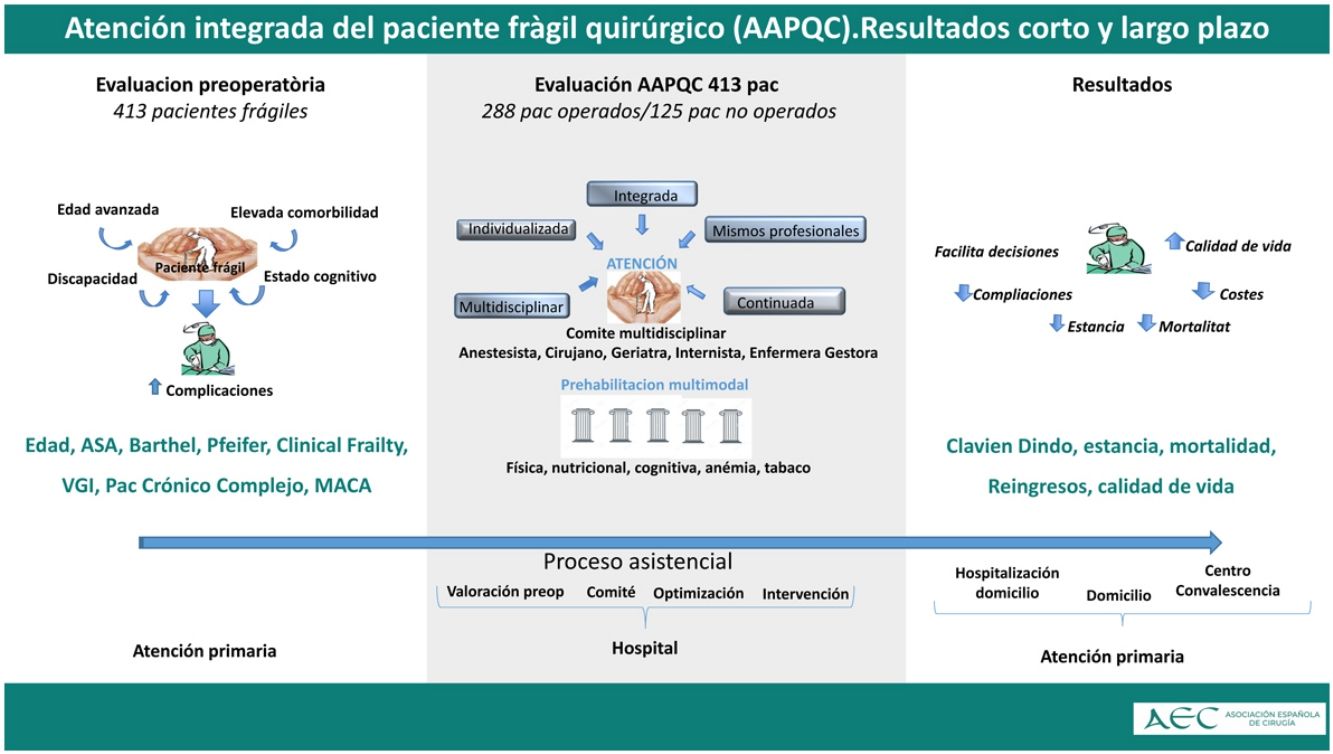
El objetivo fue analizar el funcionamiento y resultados a corto y largo plazo de un Área de atención integrada de pacientes frágiles que deben ser intervenidos quirúrgicamente.
MétodosEstudio observacional, descriptivo con recogida de datos prospectiva. 413 pacientes de diciembre 2016 a enero 2025 frágiles fueron incluidos en una Área Atención Integrada del Paciente Quirúrgico Complejo (AAPQC). Se analizó edad, sexo, servicio procedente, ASA, índice de fragilidad (VGI-Frail y Clinical Frailty scale), Barthel, Pfeiffer, paciente crónico complejo (PCC), modelo de atención crónica avanzada (MACA). Se compararon operados y no operados. Se evaluaron complicaciones (Clavien-Dindo), estancia media, mortalidad a 30 días, reingresos y calidad de vida a los 3 meses y al año.
ResultadosCuatrocientos trece pacientes, edad media 80 años, 251 varones (60,8%). El 91,8% eran ASA III-IV, 219 (53%) PCC y 61 (14,8%) MACA. Trescientos veintiuno (77,6%) procedían de cirugía general. El 7,3% vivían en centros de asistencia. Ciento veinticino (30,3%) se les recomendó no operarse. Edad, ASA, PCC, MACA, VGI-frail, Clinical Frailty Score, Barthel y Pfeiffer fueron significativamente (p<0,0001) mejores en los operados. Las complicaciones postoperatorias (Clavien-Dindo III-IV-V), reingresos y mortalidad fueron del 9,7, 13,2 y 3,1%, respectivamente. El 7,3% precisaron recurso de convalecencia al alta. El 82,5% de los operados estaba mejor o igual que antes de la intervención quirúrgica a 3 meses y al año. De los no intervenidos (n=125), el 48,3% fueron exitus durante el primer año.
ConclusionesLa instauración de un Área de atención integral al paciente frágil que debe ser intervenido facilita la toma de decisiones y podría reducir la morbimortalidad postoperatoria con una calidad de vida aceptable.
The objective was to analyze the functioning and short and long-term outcomes of an Integrated Care Area for frail patients requiring surgery.
MethodsObservational, descriptive study with prospective data collection. From December 2016 to January 2025, 413 frail patients were included in an Integrated Care Area for the Complex Surgical Patient (AAPQC). Age, sex, referring service, ASA, frailty index (VGI-Frail and Clinical Frailty scale), Barthel, Pfeiffer, Complex Chronic Patient (PCC), and Advanced Chronic care Model (MACA) were analyzed. Operated and non-operated patients were compared. Complications (Clavien-Dindo), mean length of stay, 30-day mortality, readmissions, and quality of life at 3 months and one year were evaluated.
ResultsFour hundred thirteen patients, mean age 80 years, 251 men (60.8%). The 91.8% were ASA III-IV, 259 (53%) PCC and 61 (14.7%) MACA. Two hundred ninety-eight (77.6%) came from general surgery. The 7.3% lived in care facilities. One hundred twenty-five (30.3%) were recommended not to undergo surgery. Age, ASA, PCC, MACA, VGI-frail, Clinical Frailty Score, Barthel and Pfeiffer were significantly (P<.0001) better in those operated. Postoperative complications (Clavien-Dindo III-IV-V), readmissions and mortality were 9.7%, 13.2% and 3.1% respectively. The 10% required convalescence resources at discharge. The 82.5% of operated patients were better or the same as before surgery at three months and one year. Of those not operated (n=125), 48.3% died during the first year.
ConclusionsThe establishment of an integrated care area for frail patients requiring surgery facilitates decision-making and reduces postoperative morbidity with acceptable quality of life.