metricas

Cirugía Española

Sugerencias
Cirugía Española Liver transplantation training and career interest among residents in related sp...
Información de la revista
Vol. 104. Núm. 9.
(Septiembre 2026)
Cita
Cita
Compartir
Descargar PDF
Más opciones de artículo
Visitas
414
Vol. 104. Núm. 9.
(Septiembre 2026)
Original article

Liver transplantation training and career interest among residents in related specialties: A national survey

Formación en trasplante hepático e interés profesional entre residentes de especialidades relacionadas: una encuesta nacional
Visitas
414
Gerardo Blanco-Fernándeza,b,c,1,
Autor para correspondencia
gerardoblanco@unex.es

Corresponding author.
, Isabel Campos-Varelad,e,1, Sara Lorentef, Sonia Pascualg, Patricia Ruizh, Gloria Sánchez-Antolíni,j, Maria Trapero-Marugánk, Laura Lladól
a Universidad de Extremadura, Facultad de Medicina y Ciencias de la Salud, Badajoz, Spain
b Department of Hepato-pancreatic Biliary Surgery and Liver Transplantation, Hospital Universitario de Badajoz, Badajoz, Spain
c Instituto Universitario de Investigación Biosanitaria de Extremadura (INUBE), Badajoz, Spain
d Liver Unit, Vall d’Hebron Hospital Universitari, Vall d’Hebron Institut of Research (VHIR), Vall d’Hebron Barcelona Hospital Campus, Universitat Autònoma de Barcelona, Barcelona, Spain
e Centro de Investigación Biomédica en Red de Enfermedades Hepáticas y Digestivas (CIBERehd), Instituto de Salud Carlos III, Madrid, Spain
f Hepatology and Liver Transplant Unit, Hospital Clínico Universitario Lozano Blesa, University of Zaragoza, Instituto de Investigación Sanitaria de Aragón (IIS Aragón), Zaragoza, Spain
g Unidad Hepática, Hospital General Universitario Dr Balmis, Alicante, ISABIAL, CIBERehd, Spain
h Department of Hepatobiliary Surgery and Liver Transplantation, Hospital Universitario Cruces, Bilbao, Spain
i Department of Gastroenterology and Hepatology, Hospital Universitario Río Hortega, Valladolid, Spain
j Instituto de Investigación Biosanitaria de Valladolid (IBioVALL), Spain
k Hepatobiliary and Liver Transplantation Unit, Hospital Universitario Puerta de Hierro, Segovia de Arana Research Institute (IDIPHISA), Madrid, Spain
l Department of Hepatobiliary Surgery and Liver Transplantation, Hospital Universitario de Bellvitge, University of Barcelona, IDIBELL, Barcelona, Spain
Ver más
Este artículo ha recibido
Información del artículo
Resumen
Texto completo
Bibliografía
Descargar PDF
Estadísticas
Abstract
Introduction

Liver transplantation (LT) is a demanding and highly specialized procedure requiring coordination among different specialists. Ensuring that future professionals acquire the necessary expertise is essential, yet a career in LT is often perceived by residents as inaccessible or unattractive. In Spain, LT training is not systematically integrated into residency programs. This study aimed to explore the training experiences, motivations and perceptions of medical residents from LT-related specialties.

Methods

A working group from the Spanish Society of Liver Transplantation (SETH) designed an online survey assessing demographics, LT exposure and attitudes toward LT, including perceptions of workload, burnout and motivation to pursue a future career in LT. The survey was sent through national scientific societies to residents in general and digestive surgery, gastroenterology, internal medicine and anesthesiology.

Results

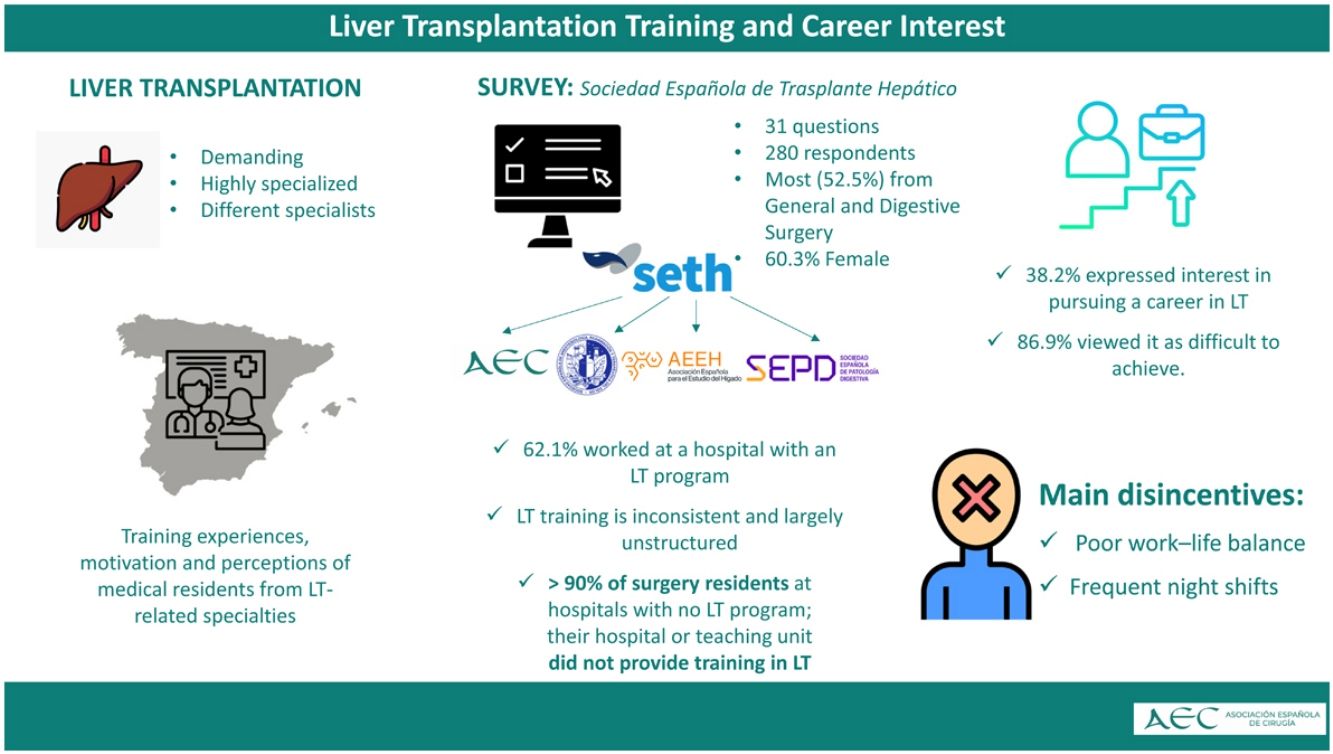
A total of 280 residents completed the survey (60.3% women). Most respondents (62.1%) trained at hospitals with an LT program, as LT training is significantly more common at these hospitals than at hospitals without LT programs (86.8% vs 41.5%; P < .001). Only 14.6% considered it an accessible career path. Although 38.2% expressed interest in pursuing a career in LT, 86.9% viewed it as difficult to achieve. The main disincentives were poor work–life balance and frequent night shifts.

Conclusions

LT training among Spanish residents remains inconsistent and largely unstructured. Despite recognizing its prestige and educational value, residents perceive LT as demanding and inaccessible. Establishing standardized LT training and offering targeted incentives may help attract future specialists to this critical field.

Keywords:
Hepatology
Liver transplantation
Surgery
Gastroenterology
Burnout
Training
Professional career
Abbreviations:
LT
SETH
AEC
AEEH
SEPD
SEDAR
IQR
UEMS
Resumen
Introducción

El trasplante hepático (TH) es un procedimiento exigente y altamente especializado que requiere la coordinación de distintos especialistas. Garantizar que los futuros profesionales adquieran la experiencia necesaria es fundamental; sin embargo, la carrera en TH suele percibirse por los residentes como inaccesible o poco atractiva. En España, la formación en TH no está integrada de forma sistemática en los programas de residencia. Este estudio tuvo como objetivo explorar las experiencias formativas, las motivaciones y las percepciones de los médicos residentes de las especialidades relacionadas con el TH.

Métodos

Un grupo de trabajo de la Sociedad Española de Trasplante Hepático (SETH) diseñó una encuesta que evaluaba variables demográficas, formación en TH y actitudes hacia esta área, incluyendo percepciones sobre la carga de trabajo, el burnout y la motivación para seguir una carrera profesional en TH. La encuesta se difundió a través de sociedades científicas nacionales entre residentes de cirugía general y digestiva, aparato digestivo, medicina interna y anestesiología.

Resultados

Un total de 280 residentes completaron la encuesta, de los cuales el 60,3% eran mujeres. La mayoría de los encuestados (62,1%) se formaban en hospitales con programa de TH, siendo la formación en TH significativamente más frecuente en estos centros que en aquellos sin programa (86,8% vs. 41,5%; p < 0,001). Solo el 14,6% consideró el TH como una opción profesional accesible. Aunque el 38,2% manifestó interés en seguir una carrera en TH, el 86,9% lo percibió como difícil de alcanzar. Los principales factores disuasorios fueron la mala conciliación entre la vida laboral y personal y la frecuente nocturnidad.

Conclusiones

La formación en trasplante hepático entre los residentes españoles sigue siendo heterogénea y en gran medida no estructurada. A pesar de reconocer su prestigio y valor formativo, los residentes perciben el TH como una disciplina exigente e inaccesible. El establecimiento de una formación estandarizada en TH y la oferta de incentivos específicos podrían ayudar a atraer a futuros especialistas a este campo crítico.

Palabras clave:
Hepatología
Trasplante hepático
Cirugía
Gastroenterología
Burnout
Formación
Carrera profesional
Resumen gráfico

Artículo

Opciones para acceder a los textos completos de la publicación Cirugía Española
Suscriptor
Suscriptor de la revista

Si ya tiene sus datos de acceso, clique aquí.

Si olvidó su clave de acceso puede recuperarla clicando aquí y seleccionando la opción "He olvidado mi contraseña".
Comprar
Comprar acceso al artículo

Comprando el artículo el PDF del mismo podrá ser descargado

Comprar ahora
Contactar
Teléfono para suscripciones e incidencias
De lunes a viernes de 9h a 18h (GMT+1) excepto los meses de julio y agosto que será de 9 a 15h
Llamadas desde España
932 415 960
Llamadas desde fuera de España
+34 932 415 960
E-mail
References
[1]
G. Sanchez-Antolin, et al.
Burnout among physicians of specialties dedicated to liver transplantation.
[2]
J. Ong, et al.
The prevalence of burnout, risk factors, and job-related stressors in gastroenterologists: a systematic review.
J Gastroenterol Hepatol, 36 (2021), pp. 2338-2348
[3]
L.S. Florence, et al.
Academic careers and lifestyle characteristics of 171 transplant surgeons in the ASTS.
Am J Transplant, 11 (2011), pp. 261-271
[4]
M. Thomas, et al.
Loss of liver transplant surgeons into alternate career paths.
Transpl Int, 27 (2014), pp. 1120-1124
[5]
G. Iaria, A. Cardillo.
Transplant surgeon formation: vocation, incentives, between old and new surgeon generations.
Transplant Proc, 38 (2006), pp. 1203-1204
[6]
T. Bohrer, M. Koller, H.J. Schlitt, H. Bauer, German Society of, S. Workload and quality of life of surgeons.
Results and implications of a large-scale survey by the German Society of Surgery.
Langenbecks Arch Surg, 396 (2011), pp. 669-676
[7]
S.M. Ordway, M.B. Singla, P.E. Young, R. Satoskar, R.M. Kwok.
Factors influencing decisions about a career in hepatology: a survey of gastroenterology fellows.
Hepatol Commun, 1 (2017), pp. 347-353
[8]
M.W. Russo, et al.
Modeling the hepatology workforce in the United States: a predicted critical shortage.
Hepatology, 72 (2020), pp. 1444-1454
[9]
M. Yilma, et al.
Examining the influence of a General surgery resident’s transplant experience on their pursuit of transplant surgery fellowship.
Clin Transplant, 38 (2024),
[10]
G. Blanco Fernandez, et al.
A survey of Heads of Surgery and Residents on accessibility and employment in liver transplant teams in Spain.
Cir Esp (Engl Ed), 97 (2019), pp. 560-567
[11]
M.L. Shiffman, D.C. Rockey.
Role and support for hepatologists at liver transplant programs in the United States.
Liver Transpl, 14 (2008), pp. 1092-1099
[12]
(BOE), B. O. d. E. BOE-A-2009-16993. Programa formativo de la especialidad de Aparato Digestivo, (2009),
[13]
C.A. Fleming, et al.
Career needs assessment for early career academic surgeons using a modified accelerated Delphi process.
Ann Surg, 278 (2023), pp. 655-661
[14]
J.E. Ellis.
Wellness in anaesthesia.
Curr Opin Anaesthesiol, 31 (2018), pp. 349-350
[15]
T. Hoff, D.R. Lee.
Burnout and physician gender: what do we know?.
Med Care, 59 (2021), pp. 711-720
asdasdasd
Opciones de artículo
Herramientas