metricas

Cirugía Española

Sugerencias
Cirugía Española Fallo de rescate tras una esofagectomía. La importancia de registrar las compli...
Información de la revista
Vol. 104. Núm. 9.
(Septiembre 2026)
Cita
Cita
Compartir
Descargar PDF
Más opciones de artículo
Visitas
634
Vol. 104. Núm. 9.
(Septiembre 2026)
Original

Fallo de rescate tras una esofagectomía. La importancia de registrar las complicaciones. Estudio retrospectivo a lo largo de 20 años

Failure to rescue after esophagectomy. The importance of recording complications. A 20-year retrospective study
Visitas
634
Silvia Carbonell-Morotea,1,
Autor para correspondencia
sayasilv@hotmail.com

Autora para correspondencia.
, Miriam Menéndez-Jiménezb,1, Marcos Bruna Estebanb, Roberto Adriano Castrob, Fabián Velázquez-Rebosab, Inmaculada Mesa-Ruizc, Javier Vaquéb, Fernando Mingol-Navarrob
a Sección de Cirugía Esofagogástrica, Hospital Universitario Dr. Balmis, Alicante, España
b Sección de Cirugía Esofagogástrica, Hospital Universitario y Politécnico la Fe, Valencia, España
c Departamento de Cirugía, Hospital Nuestra Señora del Prado, Talavera de la Reina, Toledo, España
Este artículo ha recibido
Información del artículo
Resumen
Texto completo
Bibliografía
Descargar PDF
Estadísticas
Resumen
Antecedentes

El cáncer esofágico es una neoplasia poco frecuente en nuestro medio, a pesar de lo cual supone la 7ª causa de muerte. Debido a su disposición anatómica, abarcando tres regiones, la cirugía esofágica es un procedimiento de elevada complejidad con una morbimortalidad asociada elevada, que requiere del abordaje multidisciplinar con el objetivo de disminuir las complicaciones asociadas a este procedimiento. El fallo de rescate (FAR) es un indicador de resultados quirúrgicos que define la capacidad de evitar una muerte una vez que se ha producido una complicación mayor. Es un buen indicador para comparar resultados entre centros.

Objetivo

Evaluar la tasa de FAR tras esofagectomía en un centro terciario de alto volumen en cirugía esofágica.

Material y métodos

Estudio retrospectivo que analiza el FAR, la mortalidad y morbilidad tras cirugía esofágica en un periodo desde 2003-2024. Se analizaron variables preoperatorias, intraoperatorias y posoperatorias entre el grupo con FAR y el grupo sin FAR. La comorbilidad se analizó según la escala de la Sociedad Americana de Anestesiólogos (ASA) y las complicaciones fueron registradas según la escala Clavien-Dindo.

Resultados

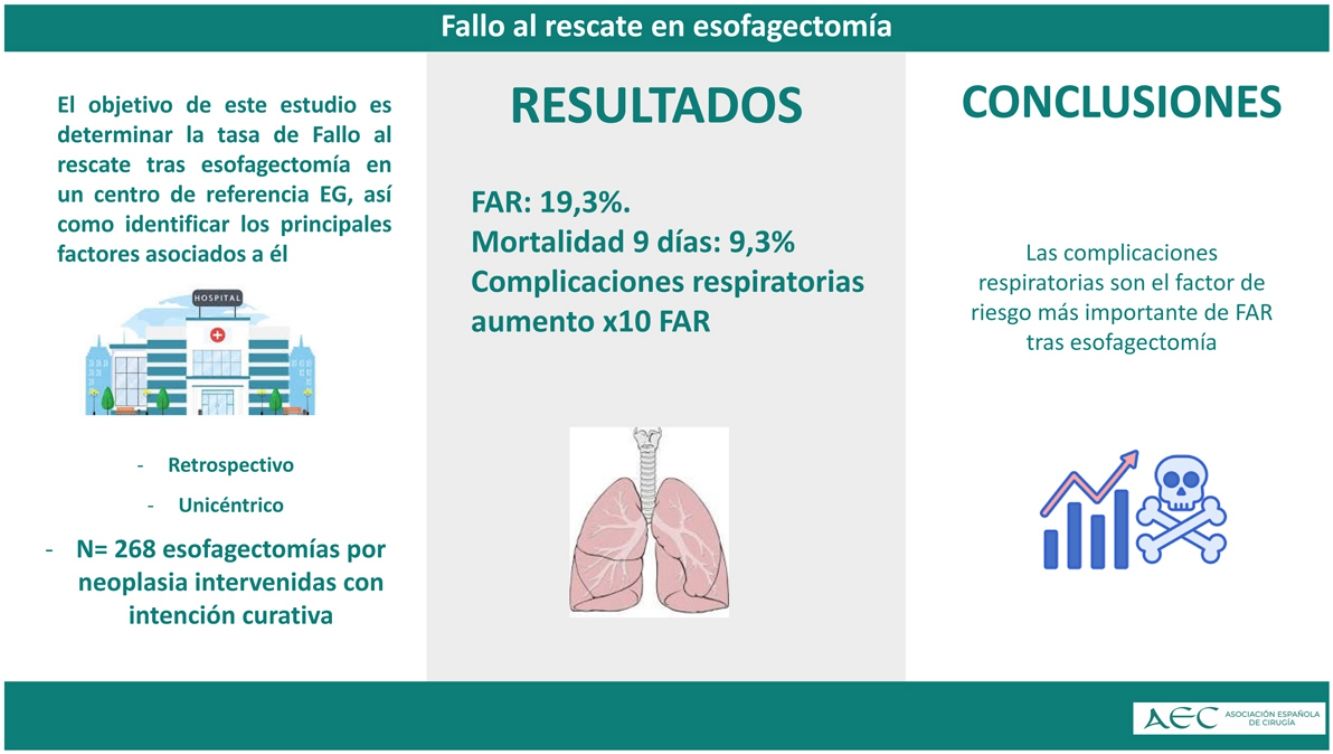
Se presentaron complicaciones mayores en 129 pacientes de los 268 pacientes intervenidos en el periodo de estudio. De ellos 25 presentaron mortalidad en los primeros 90 días postquirúrgicos. La tasa de FAR fue del 19,3%. La regresión logística uni y multivariante identificó las complicaciones respiratorias (neumonía y síndrome de distress respiratorio) como factores independientes asociados a FAR.

Conclusión

Las complicaciones respiratorias son el factor de riesgo más importante de FAR tras esofagectomía.

Palabras clave:
Cáncer de esófago
Complicaciones
Esofagectomía
Fallo al rescate
Morbilidad
Mortalidad
Abreviaturas:
FAR
nFAR
ASA
CD
RIC
UEG
SDRA
IMC
EPOC
Abstract
Background

Esophageal cancer is a rare type of neoplasm in Western countries, yet it ranks as the seventh leading cause of death. Due to its anatomical location, esophageal surgery is a highly complex procedure. The morbidity and mortality associated with esophagectomy are significant, highlighting the need for a multidisciplinary approach to minimize complications. The measure of failure to rescue (FTR) reflects surgical outcomes and indicates the capacity to prevent death after a major complication (MC). It serves as a valuable metric for comparing results among different medical centers.

Objective

To evaluate the failure to rescue rate following esophagectomy at a high-volume tertiary esophageal surgery center.

Methods

This retrospective study analyzed FTR, mortality, and morbidity rates following esophageal surgery from 2003 to 2024. Preoperative, intraoperative, and postoperative variables were assessed across patient groups. Comorbidities were evaluated using the ASA score, and complications were classified according to the Clavien-Dindo classification.

Results

268 patients underwent esophagectomy during the period of study. 129 (48%) experienced MC. Among these, 25 patients died within the first 90 days after surgery: FTR rate of 19.3%. Univariate and multivariate logistic regression analyses identified respiratory complications, including pneumonia and adult respiratory distress syndrome, as independent factors associated with FTR.

Conclusion

Respiratory complications are identified as the most significant risk factor for FTR following esophagectomy.

Keywords:
Esophageal cancer
Complications
Esophagectomy
Failure to rescue
Morbidity
Mortality
Resumen gráfico

Artículo

Opciones para acceder a los textos completos de la publicación Cirugía Española
Suscriptor
Suscriptor de la revista

Si ya tiene sus datos de acceso, clique aquí.

Si olvidó su clave de acceso puede recuperarla clicando aquí y seleccionando la opción "He olvidado mi contraseña".
Comprar
Comprar acceso al artículo

Comprando el artículo el PDF del mismo podrá ser descargado

Comprar ahora
Contactar
Teléfono para suscripciones e incidencias
De lunes a viernes de 9h a 18h (GMT+1) excepto los meses de julio y agosto que será de 9 a 15h
Llamadas desde España
932 415 960
Llamadas desde fuera de España
+34 932 415 960
E-mail
Bibliografía
[1]
H. Sung, J. Ferlay, R.L. Siegel, et al.
Global Cancer Statistics 2020: GLOBOCAN Estimates of Incidence and Mortality Worldwide for 36 Cancers in 185 Countries.
CA Cancer J Clin., 71 (2021), pp. 209-249
[2]
R. Obermannová, M. Alsina, A. Cervantes, et al.
Oesophageal cancer: ESMO Clinical Practice Guideline for diagnosis, treatment and follow-up.
Ann Oncol., 33 (2022), pp. 992-1004
[3]
D.E. Low, M.K. Kuppusamy, D. Alderson, et al.
Benchmarking complications associated with esophagectomy.
Ann Surg., 269 (2019), pp. 291-298
[4]
J.M. Aranaz, C. Moya.
Patient safety and health care quality.
Rev Calid Asist., 26 (2011), pp. 331-332
[5]
J.H. Silber, S.V. Williams, H. Krakauer, J.S. Schwartz.
Hospital and patient characteristics associated with death after surgery. A study of adverse occurrence and failure to rescue.
[6]
A. Bernard, J. Cottenet, P.B. Pagès, C. Quantin.
Mortality and failure-to-rescue major complication trends after lung cancer surgery between 2005 and 2020: A nationwide population-based study.
[7]
M.T. Grönroos-Korhonen, L.E. Koskenvuo, P.J. Mentula, S.K. Koskensalo, A.K. Leppäniemi, V.J. Sallinen.
Failure to rescue after reoperation for major complications of elective and emergency colorectal surgery: A population-based multicenter cohort study.
Surg (United States)., 172 (2022), pp. 1076-1084
[8]
J.L. Gribben, N. Ilonzo, S. Neifert, I.M. Leitman.
Predictors of reoperation and failure to rescue in bariatric surgery.
J Soc Laparoendosc Surg., 22 (2018),
[9]
M. Zago, S. Bozzo, G. Carrara, D. Mariani.
Failure to rescue, rescue surgery and centralization of postoperative complications: A challenge for general and acute care surgeons.
[10]
S. Minor, L. Allen, M.T. Meschino, et al.
Failure to rescue in emergency general surgery in Canada.
Can J Surg., 65 (2022), pp. E215-E220
[11]
A.M. Almoudaris, R. Mamidanna, A. Bottle, et al.
Failure to rescue patients after reintervention in gastroesophageal cancer surgery in England.
JAMA Surg., 148 (2013), pp. 272-276
[12]
P.A. Clavien, J. Barkun, M.L. De Oliveira, et al.
The clavien-dindo classification of surgical complications: Five-year experience.
Ann Surg., 250 (2009), pp. 187-196
[13]
D.E. Low, D. Alderson, I. Cecconello, et al.
International consensus on standardization of data collection for complications associated with esophagectomy: Esophagectomy Complications Consensus Group (ECCG).
Ann Surg., 262 (2015), pp. 286-294
[14]
A.A. Ghaferi, J.D. Birkmeyer, J.B. Dimick.
Hospital volume and failure to rescue with high-risk surgery.
Med Care., 49 (2011), pp. 1076-1081
[15]
Z.M. Abdelsattar, E. Habermann, B.J. Borah, J.P. Moriarty, R.L. Rojas, S.H. Blackmon.
Understanding Failure to Rescue After Esophagectomy in the United States.
Ann Thorac Surg., 109 (2020), pp. 865-871
[16]
E. von Elm, D.G. Altman, M. Egger, S.J. Pocock, P.C. Gøtzsche, J.P. Vandenbroucke.
The Strengthening the Reporting of Observational Studies in Epidemiology (STROBE) Statement: guidelines for reporting observational studies.
Int J Surg., 12 (2014), pp. 1495-1499
[17]
D.J. Doyle, E.H. Garmon.
American Society of Anesthesiologists Classification (ASA Class).
StatPearls Publishing;, (2018),
[18]
TNM Classification of Malignant Tumours, 8th Edition | Wiley. [consultado 18 Jun 2021]. Disponible en: https://www.wiley.com/en-ad/TNM+Classification+of+Malignant+Tumours%2C+8th+Edition-p-9781119263579.
[19]
E.P. Weledji, V. Verla.
Failure to rescue patients from early critical complications of oesophagogastric cancer surgery.
Ann Med Surg., 7 (2016), pp. 34-41
[20]
K.L. Uttinger, J. Diers, P. Baum, et al.
Mortality, complications and failure to rescue after surgery for esophageal, gastric, pancreatic and liver cancer patients based on minimum caseloads set by the German Cancer Society.
Eur J Surg Oncol., 48 (2022), pp. 924-932
[21]
D.Z. Liou, D. Serna-Gallegos, J. Mirocha, V. Bairamian, R.F. Alban, H.J. Soukiasian.
Predictors of Failure to Rescue After Esophagectomy.
Ann Thorac Surg., 105 (2018), pp. 871-878
[22]
L. Giulini, M. Kemeter, L. Thumfart, et al.
Impact of anastomotic leak vs pneumonia on failure to rescue after transthoracic esophagectomy for cancer.
Z Gastroenterol., 61 (2023), pp. e554-e555
[23]
M.G.R. Allaway, H. Pham, M. Zeng, et al.
Failure to rescue following oesophagectomy in Australia: a multi-site retrospective study using American College of Surgeons National Surgical Quality Improvement Program.
ANZ J Surg., 94 (2024), pp. 1710-1714
[24]
L.B. Harris, V. Vyas, K. Marino, A. Wells, H.K. Jensen, M.N. Mavros.
Mortality and failure-to-rescue after esophagectomy in the procedure-targeted National Surgical Quality Improvement Program registry.
World J Surg., 48 (2024), pp. 2235-2242
[25]
R.L. Arlow, D.F. Moore, C. Chen, J. Langenfeld, D.A. August.
Outcome-volume relationships and transhiatal esophagectomy: Minimizing “failure to rescue.
Ann Surg Innov Res., 8 (2014), pp. 1-7
[26]
G.O. Ogola, M.L. Crandall, K.M. Richter, S. Shafi.
High-volume hospitals are associated with lower mortality among high-risk emergency general surgery patients.
J Trauma Acute Care Surg., 85 (2018), pp. 560-565
[27]
D.G.A. Williams, J. Molinger, P.E. Wischmeyer.
The malnourished surgery patient: A silent epidemic in perioperative outcomes?.
Curr Opin Anaesthesiol., 32 (2019), pp. 405-411
[28]
A. Park, M.F. Orlandini, D.J. Szor, U.R. Junior, F. Tustumi.
The impact of sarcopenia on esophagectomy for cancer: a systematic review and meta-analysis.
[29]
D. Papaconstantinou, K. Vretakakou, A. Paspala, et al.
The impact of preoperative sarcopenia on postoperative complications following esophagectomy for esophageal neoplasia: A systematic review and meta-analysis.
Dis Esophagus., 33 (2020), pp. 1-11
[30]
H.Y. Deng, P. Zha, L. Peng, L. Hou, K.L. Huang, X.Y. Li.
Preoperative sarcopenia is a predictor of poor prognosis of esophageal cancer after esophagectomy: A comprehensive systematic review and meta-analysis.
Dis Esophagus., 32 (2019), pp. 1-10
[31]
Y. Hirano, H. Kaneko, T. Konishi, et al.
Impact of Body Mass Index on Major Complications, Multiple Complications, In-hospital Mortality, and Failure to Rescue After Esophagectomy for Esophageal Cancer: A Nationwide Inpatient Database Study in Japan.
Ann Surg., 277 (2023), pp. e785-e792
[32]
L.A. Busweiler, D. Henneman, J.L. Dikken, et al.
Failure-to-rescue in patients undergoing surgery for esophageal or gastric cancer.
Eur J Surg Oncol., 43 (2017), pp. 1962-1969
[33]
M. Weber, N. Jorek, P.-A. Neumann, et al.
Incidence and treatment of anastomotic leakage after esophagectomy in German acute care hospitals: a retrospective cohort study Incidence and treatment of anastomotic leakage after esophagectomy in German acute care hospitals: a retrospective cohort study, 111 (2025), pp. 2953-2961
[34]
S. Ubels, E. Matthée, M. Verstegen, et al.
Practice variation in anastomotic leak after esophagectomy: Unravelling differences in failure to rescue.
Eur J Surg Oncol., 49 (2023), pp. 974-982
[35]
J. Maier, A. Kandulski, N.E. Donlon, et al.
Endoscopic vacuum therapy significantly improves clinical outcomes of anastomotic leakages after 2-stage, 3-stage, and transhiatal esophagectomies.
Langenbeck's Arch Surg., 408 (2023), pp. 90
[36]
G. Tavares, F. Tustumi, L.S. Tristão, W.M. Bernardo.
Endoscopic vacuum therapy for anastomotic leak in esophagectomy and total gastrectomy: a systematic review and meta-analysis.
Dis Esophagus., 34 (2021), pp. 1-11
asdasdasd
Opciones de artículo
Herramientas
Material suplementario