metricas

Cirugía Española

Sugerencias
Cirugía Española Current status of robotic thoracic surgery in Spain: Results from a national sur...
Información de la revista
Vol. 104. Núm. 8.
(Agosto 2026)
Cita
Cita
Compartir
Descargar PDF
Más opciones de artículo
Visitas
443
Vol. 104. Núm. 8.
(Agosto 2026)
Original article

Current status of robotic thoracic surgery in Spain: Results from a national survey

Estado actual de la cirugía torácica robótica en España: resultados de una encuesta nacional
Visitas
443
Alejandra Libreros Niñoa,b, Anna Minasyanc, Carlos Martinez Barenysd, José Luis Recuero Díaze,f, Giovanna Foschini Martínezg, Carlos Déniz Armengolh, Alba María Fernández Gonzálezi, Patricia Carmona Sotoj, José Soro Garcíak, Lucía Milla Colladol, Rudith Guzmán Portillom, Paloma Rofso Raboson, Héctor Milián Goicoechean, Sergio Maroto Molinao, John A. Villamilp, Andrés Obesoq, Andrea Lora Ibarrae,r,
Autor para correspondencia
andre_lora@hotmail.com

Corresponding author.
a Department of Thoracic Surgery, Hospital de la Santa Creu i Sant Pau, Barcelona, Spain
b TRAIL Scientific Research Group, Research Institut Sant Pau, Barcelona, Spain
c Department of Thoracic Surgery and Lung Transplantation, Hospital Clínico Universitario de A Coruña, A Coruña, Spain
d Department of Thoracic Surgery, Hospital Universitari Germans Trias i Pujol, Badalona, Spain
e Department of Thoracic Surgery, Hospital Universitario Miguel Servet, Zaragoza, Spain
f Instituto de Investigación Sanitaria Aragón (IIS Aragón), Spain
g Department of Thoracic Surgery, Hospital Universitario de Girona Dr. Josep Trueta, Girona, Spain
h Department of Thoracic Surgery, Hospital Universitari de Bellvitge, L’Hospitalet de Llobregat, Spain
i Department of Thoracic Surgery, Hospital Universitario Puerta del Mar, Cádiz, Spain
j Department of Thoracic Surgery, Hospital Universitario Virgen de la Macarena, Seville, Spain
k Department of Thoracic Surgery, Hospital Clínico Universitario de Valladolid, Valladolid, Spain
l Department of Thoracic Surgery, Hospital Central de la Defensa Gómez Ulla, Madrid, Spain
m Department of Thoracic Surgery, Hospital Clínic de Barcelona, Barcelona, Spain
n Department of Thoracic Surgery, Hospital Universitario de la Princesa, Madrid, Spain
o Department of Thoracic Surgery, Hospital General Universitario Dr. Balmis, Alicante, Spain
p Biotechnological Processes Unit, IMDEA Energy, Madrid, Spain
q Heart, Vascular & Thoracic Institute, Cleveland Clinic, Abu Dhabi, United Arab Emirates
r Department of Thoracic Surgery, Hospital Clínico Universitario Lozano Blesa, Zaragoza, Spain
Ver más
Este artículo ha recibido
Información del artículo
Resumen
Texto completo
Bibliografía
Descargar PDF
Estadísticas
Abstract
Introduction

This study aimed to conduct the first national survey to characterize the current practice, training and perceived barriers associated with robotic-assisted thoracic surgery (RATS) among thoracic surgeons in Spain.

Methods

Between February and March 2025, a nationwide electronic survey was distributed to thoracic surgeons through a scientific society. The questionnaire assessed institutional demographic variables, the volume and types of robotic procedures, perceived benefits and barriers, training models and access to the technology.

Results

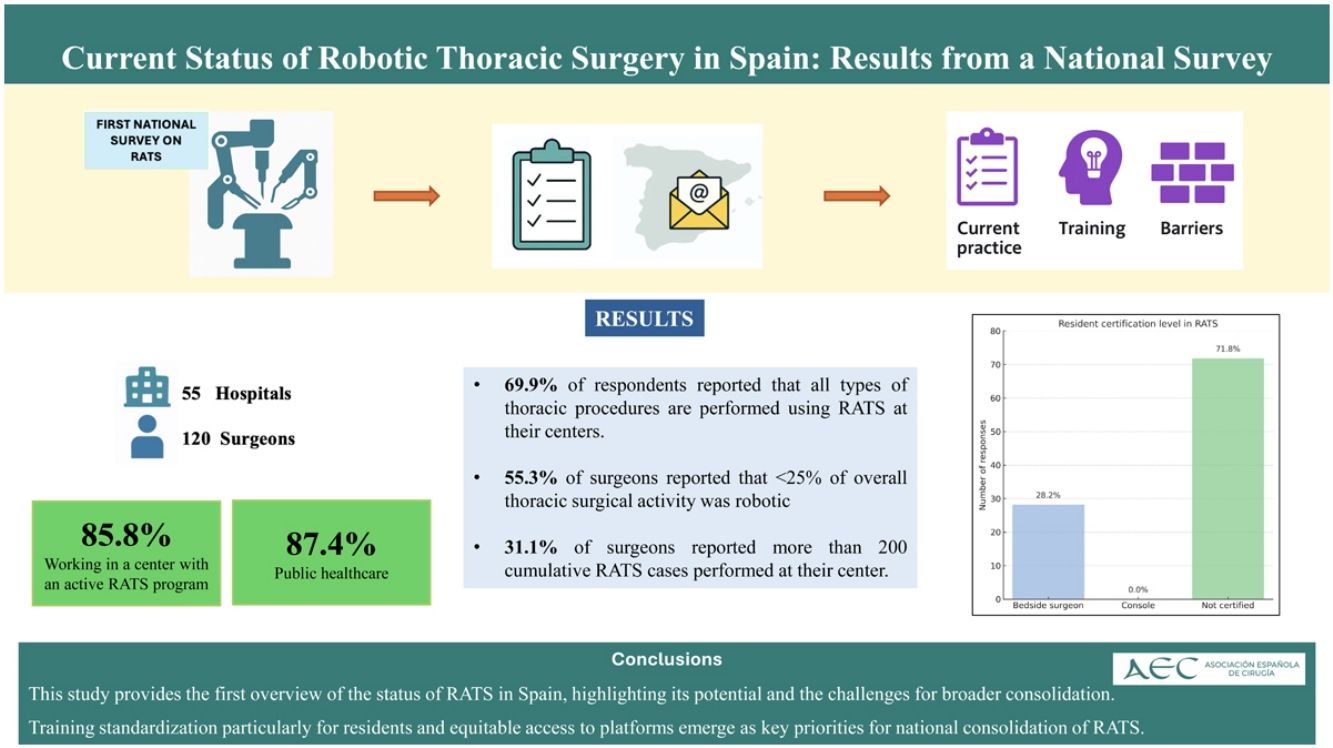
A total of 120 responses from thoracic surgeons representing 55 hospitals were analyzed. Among these, 103 respondents (85.8%) worked in centers with an active RATS program and were included in analyses related to robotic activity. Most respondents practiced within the public healthcare system (87.4%).

Although more than 63% of RATS programs had been established for at least 2 years, only 27.2% of survey participants reported that most surgeons in their department were trained as console surgeons. At the institutional level, 69.9% indicated that all types of thoracic procedures were performed using RATS, and 31.1% reported more than 200 accumulated robotic cases. However, in over half of the hospitals, robotic surgery accounted for less than 25% of total thoracic surgical activity.

Conclusions

This study provides the first national overview of the status of RATS in Spain, highlighting its potential as well as the challenges limiting broader clinical consolidation. Standardized training, particularly among residents, and equitable access to robotic platforms have emerged as key priorities for the nationwide consolidation of RATS.

Keywords:
Robotic-Assisted thoracic surgery (RATS)
National survey
Surgical training
Implementation
Spain
Abbreviations:
AATS
ESTS
FDA
GECT
RATS
SEPAR
STS
VATS
Resumen
Introducción

El objetivo de este estudio fue realizar la primera encuesta nacional para caracterizar la práctica actual, la formación y las barreras percibidas asociadas a la cirugía torácica asistida por robot (RATS) entre los cirujanos torácicos en España.

Métodos

Entre febrero y marzo de 2025 se distribuyó una encuesta electrónica de ámbito nacional a cirujanos torácicos a través de una sociedad científica. El cuestionario evaluó variables demográficas institucionales, el volumen y tipo de procedimientos robóticos, los beneficios y barreras percibidos, los modelos de formación y el acceso a la tecnología.

Resultados

Se analizaron un total de 120 respuestas de cirujanos torácicos procedentes de 55 hospitales. De ellos, 103 encuestados (85,8%) trabajaban en centros con un programa activo de RATS y fueron incluidos en los análisis relacionados con la actividad robótica. La mayoría de los participantes ejercía en el sistema sanitario público (87,4%).

Aunque más del 63% de los programas de RATS llevaba implantado al menos dos años, solo el 27,2% de los encuestados indicó que la mayoría de los cirujanos de su servicio estaba formada como cirujano de consola. A nivel institucional, el 69,9% señaló que todos los tipos de procedimientos torácicos se realizaban mediante RATS, y el 31,1% refirió más de 200 casos robóticos acumulados. Sin embargo, en más de la mitad de los hospitales, la cirugía robótica representó menos del 25% de la actividad quirúrgica torácica total.

Conclusiones

Este estudio proporciona la primera visión nacional del estado de la RATS en España, poniendo de manifiesto tanto su potencial como los desafíos que limitan una consolidación clínica más amplia. La formación estandarizada, especialmente a nivel de residentes, y un acceso equitativo a las plataformas robóticas emergen como prioridades clave para la consolidación nacional de la RATS.

Palabras clave:
Cirugía Torácica Asistida por Robot (RATS)
Encuesta nacional
Formación quirúrgica
Implementación
España
Abreviaturas:
AATS
ESTS
FDA
GECT
RATS
SEPAR
STS
VATS
Resumen gráfico

Artículo

Opciones para acceder a los textos completos de la publicación Cirugía Española
Suscriptor
Suscriptor de la revista

Si ya tiene sus datos de acceso, clique aquí.

Si olvidó su clave de acceso puede recuperarla clicando aquí y seleccionando la opción "He olvidado mi contraseña".
Comprar
Comprar acceso al artículo

Comprando el artículo el PDF del mismo podrá ser descargado

Comprar ahora
Contactar
Teléfono para suscripciones e incidencias
De lunes a viernes de 9h a 18h (GMT+1) excepto los meses de julio y agosto que será de 9 a 15h
Llamadas desde España
932 415 960
Llamadas desde fuera de España
+34 932 415 960
E-mail
References
[1]
A.L.G. Morrell, A.C. Morrell-Junior, A.G. Morrell, et al.
The history of robotic surgery and its evolution: when illusion becomes reality.
Rev Col Bras Cir [Internet], 48 (2021), pp. 1-9
[2]
F.M.A. Melfi, G.F. Menconi, A.M. Mariani, C.A. Angeletti.
Early experience with robotic technology for thoracoscopic surgery.
[3]
J. Bodner, H. Wykypiel, G. Wetscher, T. Schmid.
First experiences with the da VinciTM operating robot in thoracic surgery.
Eur J Cardio-Thoracic Surg [Internet], 25 (2004), pp. 844-851
[4]
M.Al Zaidi, G.M. Wright, K. Yasufuku.
Suggested robotic-assisted thoracic surgery training curriculum.
[5]
S. Gandhi, N.M. Novoa Valentin, A. Brunelli, et al.
Results of an exploratory survey within ESTS membership in 2022 on current trend of robotic-assisted thoracic surgery and its training perspectives.
Interdiscip Cardiovasc Thorac Surg [Internet], 38 (2024),
[6]
G.M.M. Shahin, G.J.B.B. Bruinsma, S. Stamenkovic, M.A. Cuesta.
Training in robotic thoracic surgery—the European way.
[7]
S.S. Kim, L. Schumacher, D.T. Cooke, et al.
The Society of Thoracic Surgeons Expert Consensus Statements on a Framework for a standardized national robotic curriculum for thoracic surgery trainees.
[8]
D.E. La, S. Bolufer, N. Unai, et al.
Mapa de los servicios de Cirugía Torácica y perspectivas futuras (planificación asistencial estratégica) en el sistema sanitario español. Libro Blanco de la Cirugía Torácica.
Sociedad Española de Cirugía Torácica (SECT) [Internet], (2018),
[9]
B. Shanahan, U.S. Kreaden, J. Sorensen, S. Stamenkovic, K.C. Redmond.
Is robotic lobectomy cheaper? A micro-cost analysis.
J Robot Surg [Internet], 16 (2022),
[10]
T. Hughes, B. Rai, S. Madaan, E. Chedgy, B. Somani.
The availability, cost, limitations, learning curve and future of robotic systems in urology and prostate cancer surgery.
[11]
R.M. Terra, P.H.C. Leite, A.J.M. Dela Vega.
Global status of the robotic thoracic surgery.
[12]
T. Möller, J.H. Egberts, M. Eichhorn, et al.
Current status and evolution of robotic-assisted thoracic surgery in Germany—results from a nationwide survey.
[13]
G.J. Kocher.
Robotic-assisted thoracoscopic surgery: state of the art and future perspectives.
[14]
Medtronic. Medtronic announces first procedure in Europe with HugoTM robotic-assisted surgery system [Internet]. [cited 2025 Oct 18]. Available from: https://news.medtronic.com/.
[15]
O.J. Harrison, A. Maraschi, T. Routledge, S. Lampridis, C. LeReun, A. Bille.
A cost analysis of robotic vs. video-assisted thoracic surgery: the impact of the learning curve and the COVID-19 pandemic.
Front Surg, 10 (2023),
[16]
V. Manolache, N. Motas, M.L. Bosinceanu, et al.
Comparison of uniportal robotic-assisted thoracic surgery pulmonary anatomic resections with multiport robotic-assisted thoracic surgery: a multicenter study of the European experience.
[17]
H. Clermidy, G. Fadel, B. Bottet, et al.
Robotic-assisted thoracic surgery training in France: a nation-wide survey from young surgeons.
Interdiscip Cardiovasc Thorac Surg [Internet], 39 (2024),
asdasdasd
Opciones de artículo
Herramientas
Material suplementario