

metricas

Cirugía Española

Sugerencias
Cirugía Española Abordaje robótico real para la hemihepatectomía izquierda extendida al caudado...
Información de la revista
Cita
Cita
Compartir
Descargar PDF
Más opciones de artículo
Visitas
1163
Innovación en técnica quirúrgica

Abordaje robótico real para la hemihepatectomía izquierda extendida al caudado con resección de vena porta por colangiocarcinoma hiliar extrahepático de Klatskin tipo Bismuth IIIb

Real robotic approach for the caudate lobe extended left hemihepatectomy with portal vein resection for Klatskin extrahepatic hilar cholangiocarcinoma subtype Bismuth IIIb
Visitas
1163
Jordi Navinés-López
Autor para correspondencia
drnavines@gmail.com

Autor para correspondencia.
, Alba Zárate Pinedo, Francisco Espin Alvarez, Esteban Cugat Andorrà
Unidad de Cirugía Hepato-bilio-pancreática, Servicio de Cirugía General y Digestiva, Hospital Universitari Germans Trias i Pujol, Badalona, Barcelona, España
Este artículo ha recibido
Información del artículo
Resumen
Texto completo
Bibliografía
Descargar PDF
Estadísticas
Resumen

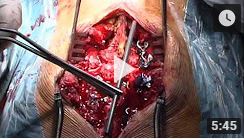
Se describe detalladamente la técnica quirúrgica de hepatectomía izquierda ampliada al caudado con resección venosa, con abordaje robótico real asistido con modelo 3D, en una paciente de 65 años por un tumor Bismuth 3b con infiltración del confluente portal. Mediante abordaje hiliar intraglissoniano, se procedió al control vascular prehepático total y la resección del confluente izquierdo portal, siendo reconstruido transversalmente según técnica de Heineke-Mikulicz. La transección parenquimatosa fue robótica real incluyendo la totalidad del lóbulo caudado, con hanging izquierdo tras piggy-back completo de la vena cava. El resultado patológico final fue de adenocarcinoma de células en anillo de sello G3 pT2bN1M0 (2/11). El abordaje robótico permitió un inicio inmediato del tratamiento adyuvante. No se registraron complicaciones mayores a 90 días, y la paciente fue dada de alta al 5° día.

Palabras clave:
Microfractura-coagulación
Transección parenquimatosa robótica real
Colangiocarcinoma hiliar
Cirugía robótica
Abstract

This article provides a detailed description of the robotic approach used to perform an extended left hepatectomy with venous resection in a 65-year-old female patient with a Bismuth-Corlette tumour type 3b infiltrating the portal confluence. A Glissonean pedicle approach was used to achieve total prehepatic vascular control and resection of the left portal confluence, followed by transverse reconstruction according to the Heineke-Mikulicz technique. The parenchymal transection, including the entire caudate lobe, was performed robotically, with left hanging manoeuvre after complete piggybacking of the vena cava. The final pathological result was G3 pT2bN1M0 (2/11) signet ring cell adenocarcinoma. The robotic approach enabled adjuvant treatment to be initiated immediately. No major complications were recorded within 90 days, and the patient was discharged on the 5th day.

Keywords:
Microfracture coagulation
Real robotic parenchymal transection
Hilar cholangiocarcinoma
Robotic surgery

Artículo

Opciones para acceder a los textos completos de la publicación Cirugía Española
Suscriptor
Suscriptor de la revista

Si ya tiene sus datos de acceso, clique aquí.

Si olvidó su clave de acceso puede recuperarla clicando aquí y seleccionando la opción "He olvidado mi contraseña".
Comprar
Comprar acceso al artículo

Comprando el artículo el PDF del mismo podrá ser descargado

Comprar ahora
Contactar
Teléfono para suscripciones e incidencias
De lunes a viernes de 9h a 18h (GMT+1) excepto los meses de julio y agosto que será de 9 a 15h
Llamadas desde España
932 415 960
Llamadas desde fuera de España
+34 932 415 960
E-mail
Bibliografía
[1]
A. Brolese, M. Rigoni, A. Pasquale, G. Viel, M. Brolese, F.A. Ciarleglio.
The role of robotic surgery for the treatment of hilar cholangiocarcinoma: A systematic review.
[2]
F.S. Dar, Z. Abbas, I. Ahmed, et al.
National guidelines for the diagnosis and treatment of hilar cholangiocarcinoma.
World J Gastroenterol, 30 (2024), pp. 1018-1042
[3]
M.A. D'Souza, V.T. Valdimarsson, T. Campagnaro, E-AHPBA scientific and research committee, et al.
Hepatopancreatoduodenectomy - A controversial treatment for bile duct and gallbladder cancer from a European perspective.
HPB (Oxford), 22 (2020), pp. 1339-1348
[4]
S. Dinant, M.F. Gerhards, O.R. Busch, H. Obertop, D.J. Gouma, T.M. van Gulik.
The importance of complete excision of the caudate lobe in resection of hilar cholangiocarcinoma.
HPB (Oxford), 7 (2005), pp. 263-267
[5]
H. Hartog, J.N. Ijzermans, T.M. van Gulik, B. Groot Koerkamp.
Resection of Perihilar Cholangiocarcinoma.
Surg Clin North Am, 96 (2016), pp. 247-267
[6]
Y.A. Kovalenko, Y.O. Zharikov, N.A. Konchina, B.N. Gurmikov, L.A. Marinova, A.V. Zhao.
Perihilar cholangiocarcinoma: A different concept for radical resection.
Surg Oncol, 33 (2020), pp. 270-275
[7]
A.J. Lee, Y.S. Chun.
Intrahepatic cholangiocarcinoma: The AJCC/UICC 8th edition updates.
Chin Clin Oncol, 7 (2018), pp. 52
[8]
L. Liang, C. Li, M.D. Wang, et al.
The value of lymphadenectomy in surgical resection of perihilar cholangiocarcinoma: A systematic review and meta-analysis.
Int J Clin Oncol, 26 (2021), pp. 1575-1586
[9]
J.C. Mansour, T.A. Aloia, C.H. Crane, J.K. Heimbach, M. Nagino, J.N. Vauthey.
Hilar cholangiocarcinoma: Expert consensus statement.
HPB (Oxford), 17 (2015), pp. 691-699
[10]
M. Miyazaki, H. Yoshitomi, S. Miyakawa, et al.
Clinical practice guidelines for the management of biliary tract cancers 2015: The 2nd English edition.
J Hepatobiliary Pancreat Sci, 22 (2015), pp. 249-273
[11]
A. Rebelo, J. Friedrichs, M. Grilli, et al.
Systematic review and meta-analysis of surgery for hilar cholangiocarcinoma with arterial resection.
HPB (Oxford), 24 (2022), pp. 1600-1614
[12]
P.C. Giulianotti, F. Sbrana, F.M. Bianco, P. Addeo.
Robot-assisted laparoscopic extended right hepatectomy with biliary reconstruction.
J Laparoendosc Adv Surg Tech A, 20 (2010), pp. 159-163
[13]
B.G. Koerkamp, J.K. Wiggers, P.J. Allen, et al.
Recurrence Rate and Pattern of Perihilar Cholangiocarcinoma after Curative Intent Resection.
J Am Coll Surg, 221 (2015), pp. 1041-1049
[14]
A.M. van Keulen, S. Franssen, L.G. van der Geest, Dutch Hepatocellular & Cholangiocarcinoma Group (DHCG), et al.
Nationwide treatment and outcomes of perihilar cholangiocarcinoma.
Liver Int, 41 (2021), pp. 1945-1953
[15]
Y. Xu, H. Wang, W. Ji, et al.
Robotic radical resection for hilar cholangiocarcinoma: Perioperative and long-term outcomes of an initial series.
Surg Endosc, 30 (2016), pp. 3060-3070
[16]
K. Matsuo, F.G. Rocha, K. Ito, et al.
The blumgart preoperative staging system for hilar cholangiocarcinoma: Analysis of resectability and outcomes in 380 patients.
J Am Coll Surg, 215 (2012), pp. 343-355
[17]
R.D. Mainwaring, F.L. Hanley.
Surgical Techniques for Repair of Peripheral Pulmonary Artery Stenosis.
Semin Thorac Cardiovasc Surg, 29 (2017), pp. 198-205
[18]
J. Navinés-López, F. Pardo Aranda, M. Cremades Pérez, F. Espin Álvarez, A. Zárate Pinedo, E. Cugat Andorrà.
Microfracture-coagulation for the real robotic liver parenchymal transection.
J Robot Surg, 18 (2024), pp. 101
asdasdasd
Opciones de artículo
Herramientas
Material suplementario
