


Uncomplicated urinary tract infections (UTIs) are among the most common infectious reasons for consultation in primary care. Their diagnosis is usually based on clinical presentation, urine dipstick testing and, in selected cases, urine culture.1–3 However, the quality of the urine sample directly affects the interpretation of test results. Sample contamination may lead to ambiguous findings, repeat testing and uncertainty in treatment decisions. Although collection of a midstream urine sample is recommended to minimise contamination, little is known about how women understand and experience this procedure in routine clinical practice.
We conducted a qualitative study using semi-structured interviews with adult women presenting with symptoms of UTI who had previously participated in the SCOUT clinical trial evaluating short-course antibiotic treatment.4 Participants were recruited from an urban primary care centre in Catalonia, Spain. Interviews were conducted between June and September 2025 and explored four topics: the purpose of urine sample collection, sample contamination, the midstream urine collection technique, and the relationship between urine test results and antibiotic prescribing. Interviews were audio-recorded, transcribed verbatim and analysed using thematic analysis following the approach described by Braun and Clarke.5 The study was approved by the IDIAP Jordi Gol Research Ethics Committee (reference 24/028-P).
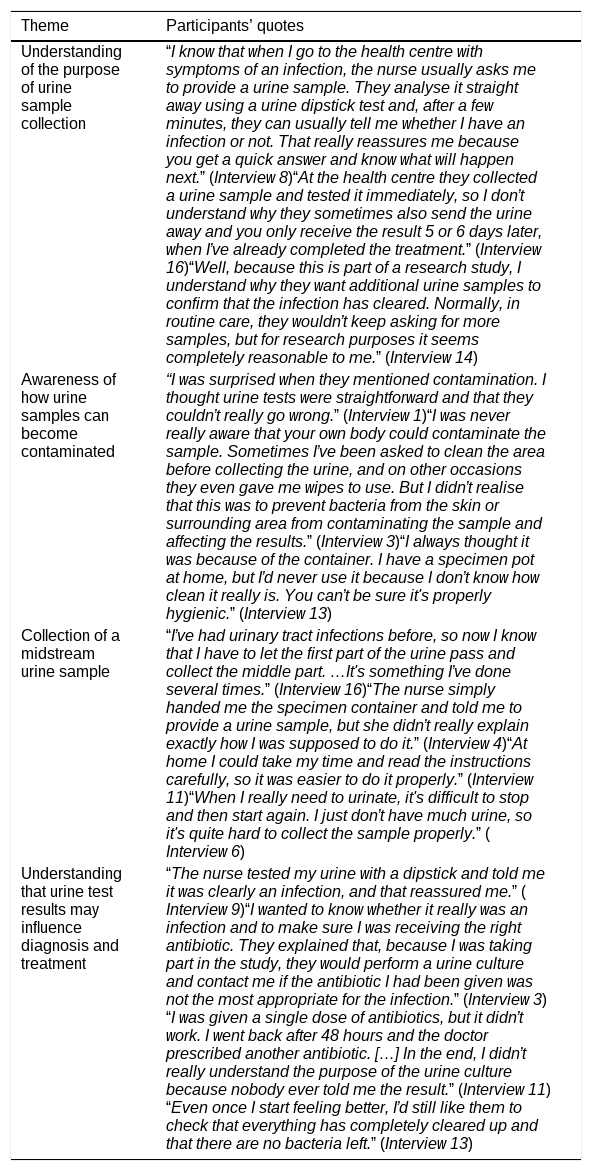
Seventeen women aged 20–86 years were interviewed until data saturation was achieved. Representative participant quotations illustrating the main themes and subthemes identified in the analysis are shown in Table 1. Overall, participants understood that urine samples were used to confirm infection and appreciated the rapid results provided by urine dipstick testing. However, several participants did not clearly distinguish between urine dipstick testing and urine culture or understand why both tests might sometimes be required. Some associated repeated urine sampling with participation in the research study rather than with routine clinical care.
Participants’ verbatim quotes on urine sample collection.
| Theme | Participants’ quotes |
|---|---|
| Understanding of the purpose of urine sample collection | “I know that when I go to the health centre with symptoms of an infection, the nurse usually asks me to provide a urine sample. They analyse it straight away using a urine dipstick test and, after a few minutes, they can usually tell me whether I have an infection or not. That really reassures me because you get a quick answer and know what will happen next.” (Interview 8)“At the health centre they collected a urine sample and tested it immediately, so I don’t understand why they sometimes also send the urine away and you only receive the result 5 or 6 days later, when I’ve already completed the treatment.” (Interview 16)“Well, because this is part of a research study, I understand why they want additional urine samples to confirm that the infection has cleared. Normally, in routine care, they wouldn’t keep asking for more samples, but for research purposes it seems completely reasonable to me.” (Interview 14) |
| Awareness of how urine samples can become contaminated | “I was surprised when they mentioned contamination. I thought urine tests were straightforward and that they couldn’t really go wrong.” (Interview 1)“I was never really aware that your own body could contaminate the sample. Sometimes I’ve been asked to clean the area before collecting the urine, and on other occasions they even gave me wipes to use. But I didn’t realise that this was to prevent bacteria from the skin or surrounding area from contaminating the sample and affecting the results.” (Interview 3)“I always thought it was because of the container. I have a specimen pot at home, but I’d never use it because I don’t know how clean it really is. You can’t be sure it's properly hygienic.” (Interview 13) |
| Collection of a midstream urine sample | “I’ve had urinary tract infections before, so now I know that I have to let the first part of the urine pass and collect the middle part. …It's something I’ve done several times.” (Interview 16)“The nurse simply handed me the specimen container and told me to provide a urine sample, but she didn’t really explain exactly how I was supposed to do it.” (Interview 4)“At home I could take my time and read the instructions carefully, so it was easier to do it properly.” (Interview 11)“When I really need to urinate, it's difficult to stop and then start again. I just don’t have much urine, so it's quite hard to collect the sample properly.” (Interview 6) |
| Understanding that urine test results may influence diagnosis and treatment | “The nurse tested my urine with a dipstick and told me it was clearly an infection, and that reassured me.” (Interview 9)“I wanted to know whether it really was an infection and to make sure I was receiving the right antibiotic. They explained that, because I was taking part in the study, they would perform a urine culture and contact me if the antibiotic I had been given was not the most appropriate for the infection.” (Interview 3)“I was given a single dose of antibiotics, but it didn’t work. I went back after 48 hours and the doctor prescribed another antibiotic. […] In the end, I didn’t really understand the purpose of the urine culture because nobody ever told me the result.” (Interview 11)“Even once I start feeling better, I’d still like them to check that everything has completely cleared up and that there are no bacteria left.” (Interview 13) |
Lack of awareness regarding sample contamination was common. Most participants were unaware that urine samples could become contaminated by bacteria originating from their own bodies, and those who recognised this possibility mainly attributed contamination to the collection container. Practical difficulties in obtaining a midstream urine sample during symptomatic episodes also emerged, particularly because of urinary urgency, pain or the passage of only small volumes of urine. Participants reported that the instructions they received were often brief, inconsistent or insufficient, and expressed a preference for clear verbal explanations supported by written or visual information.
Another important finding was uncertainty regarding the value of urine culture when results become available only after completion of antibiotic treatment. Some women expected a follow-up urine culture to confirm resolution of the infection, although current guidelines do not recommend routine post-treatment urine cultures following an uncomplicated first UTI with favourable clinical recovery.3 These findings are consistent with previous studies reporting unmet information needs among women regarding urine testing and the management of UTIs.6
In conclusion, this study identified important gaps in patients’ understanding of urine sample collection, sample contamination and the interpretation of urine test results. Improving communication during consultations and providing standardised, clear and accessible collection instructions may enhance sample quality, reduce unnecessary repeat testing, and support more informed and judicious antibiotic prescribing decisions.
Authors’ contributionsBoth authors made a significant contribution to the reported work – whether in the conception, study design, execution, data acquisition, analysis and interpretation, or all of these areas – participated in drafting, revising, or critically reviewing the article, approved the final version for publication, agreed on the journal to which the article was submitted, and accept responsibility for all aspects of the work.
Ethical considerationsThis study was approved by the Ethics Committee of the Institut de Recerca en Atenció Primària (IDIAP) Jordi Gol on February 28, 2024, under code 24/028-P. The Consolidated Criteria for Reporting Qualitative Research (COREQ) checklist was used to guide the study.
Informed consentThe women who agreed to participate received verbal and written information about the study prior to participation. All participants provided verbal informed consent.
Declaration of generative AI and AI-assisted technologies in the writing processArtificial intelligence has not been used to carry out this research work.
FundingThe SCOUT study received a research grant from the Carlos III Health Institute (ISCIII) (ICI20/00148) – part of the Spanish Ministry of Science and Innovation – awarded under the 2020 call for academic clinical trials (reference ICI20/00100), as well as funding from the European Union's ERDF (European Regional Development Fund).
Conflicts of interestThe authors declare no conflicts of interest.
The authors thank all the women who participated in this study for their valuable contribution.


