metricas

Actas Urológicas Españolas

Sugerencias
Actas Urológicas Españolas Incidencia, factores de riesgo e impacto pronóstico de la pielonefritis en paci...
Información de la revista
Vol. 50. Núm. 9.
(Noviembre 2026)
Cita
Cita
Compartir
Descargar PDF
Más opciones de artículo
Visitas
552
Vol. 50. Núm. 9.
(Noviembre 2026)
Artículo original

Incidencia, factores de riesgo e impacto pronóstico de la pielonefritis en pacientes oncológicos con nefrostomía percutánea por obstrucción ureteral maligna

Incidence, risk factors and prognostic impact of pyelonephritis in cancer patients with percutaneous nephrostomy for malignant ureteral obstruction
Visitas
552
M. Selman Merta, O. Murat Ipekb,
Autor para correspondencia
omipek@hotmail.com

Autor para correspondencia.
a Departamento de Urología, Hospital de Formación e Investigación de Taksim, Estambul, Turquía
b Departamento de Urología, Facultad de Ciencias de la Salud, Kartal Dr. Lütfi Kırdar City Hospital, Estambul, Turquía
Este artículo ha recibido
Información del artículo
Resumen
Texto completo
Bibliografía
Descargar PDF
Estadísticas
Resumen
Introducción y objetivos

La nefrostomía percutánea (NPC) se utiliza comúnmente para la obstrucción ureteral maligna, pero conlleva un riesgo significativo de infección en pacientes oncológicos inmunocomprometidos. Los datos sobre la incidencia de pielonefritis, los factores de riesgo y el impacto pronóstico en esta población siguen siendo limitados. Este estudio tuvo como objetivo determinar la incidencia, los factores de riesgo y el impacto pronóstico de la pielonefritis relacionada con la nefrostomía e identificar objetivos modificables para la prevención de infecciones.

Materiales y métodos

En este estudio observacional prospectivo, 115 pacientes adultos con hidronefrosis grado ≥2 asociada a malignidad que fueron sometidos a NPC primaria fueron seguidos durante dos años. Se registraron datos demográficos, oncológicos y procedimentales, la formación en higiene de manos y los parámetros de laboratorio. Se obtuvieron cultivos seriados de orina, pelvis renal, piel y punta del catéter. La pielonefritis se definió por fiebre, dolor en flanco y marcadores inflamatorios con urocultivo positivo. La supervivencia libre de pielonefritis y la supervivencia global se analizaron mediante modelos de Kaplan-Meier y regresión de Cox.

Resultados

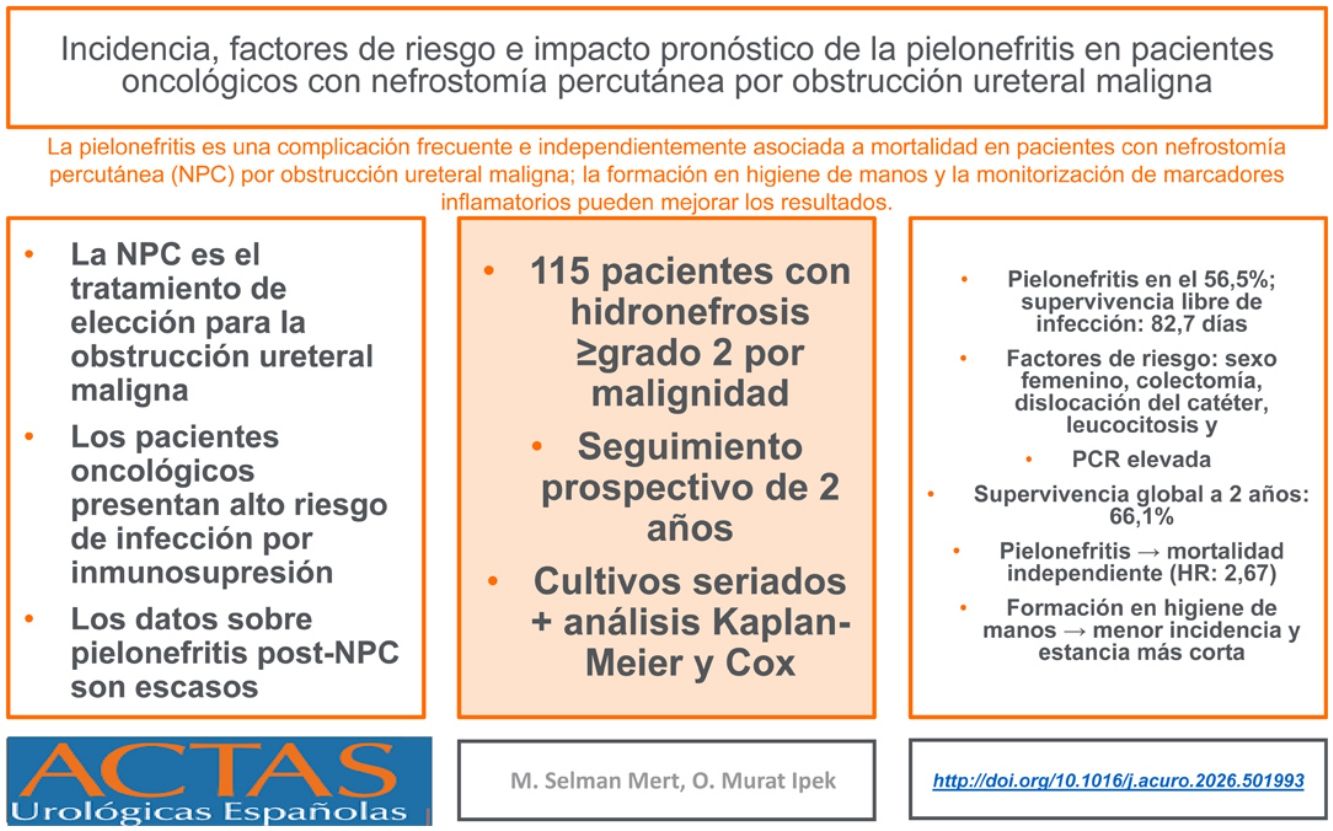
Durante el seguimiento, la pielonefritis ocurrió en 65 pacientes (56,5%), con una supervivencia media libre de pielonefritis de 82,7días. El sexo femenino, la colectomía previa, la dislocación del catéter, el recuento basal elevado de leucocitos y los niveles elevados de proteínaC reactiva se asociaron independientemente con la pielonefritis. La supervivencia global a dos años fue del 66,1%, y los niveles basales de albúmina (bajos), leucocitos (altos) y la presencia de pielonefritis predijeron independientemente la mortalidad. La formación en higiene de manos se asoció fuertemente con una menor incidencia de pielonefritis y una estancia hospitalaria más corta.

Conclusiones

En pacientes con obstrucción ureteral maligna que requieren NPC, la pielonefritis es una complicación frecuente con implicaciones pronósticas. La educación en higiene de manos, un mejor cuidado del catéter, la detección/tratamiento temprano y el seguimiento de marcadores de laboratorio de rutina pueden reducir la carga infecciosa y mejorar la supervivencia en esta población altamente vulnerable.

Palabras clave:
Pielonefritis
Nefrostomía
Percutánea
Obstrucción ureteral
Neoplasias urológicas
Factores de riesgo
Pronóstico
Abstract
Introduction and objectives

Percutaneous nephrostomy (PCN) is commonly used for malignant ureteral obstruction but carries significant infection risk in immunocompromised cancer patients. Data on pyelonephritis incidence, risk factors, and prognostic impact in this population remain limited. This study aimed to determine the incidence, risk factors, and prognostic impact of nephrostomy-related pyelonephritis and identify modifiable targets for infection prevention.

Materials and methods

In this prospective observational study, 115 adult patients with malignancy-associated grade ≥2 hydronephrosis who underwent primary PCN were followed for two years. Demographic, oncological and procedural data, handwashing education status and laboratory parameters were recorded. Serial urine, renal pelvis, skin and catheter tip cultures were obtained. Pyelonephritis was defined by fever, flank pain and inflammatory markers with a positive urine culture. Pyelonephritis-free survival and overall survival were analyzed using Kaplan-Meier and Cox regression models.

Results

During follow-up, pyelonephritis occurred in 65 patients (56.5%), with a mean pyelonephritis-free survival of 82.7days. Female sex, prior colectomy, catheter dislocation, higher baseline WBC and higher C-reactive protein levels were independently associated with pyelonephritis. Two-year overall survival was 66.1% and baseline levels of albumin (low), WBC (high) and pyelonephritis presence independently predicted mortality. Handwashing education was strongly associated with a lower incidence of pyelonephritis and shorter hospital stay.

Conclusions

In patients with malignant ureteral obstruction requiring PCN, pyelonephritis is a common complication with prognostic implications. Hand hygiene education, better catheter care, early detection/treatment, and follow-up of routine laboratory markers may reduce infection burden and improve survival in this highly vulnerable population.

Keywords:
Pyelonephritis
Nephrostomy
Percutaneous
Ureteral obstruction
Urologic neoplasms
Risk factors
Prognosis
Resumen gráfico

Artículo

Opciones para acceder a los textos completos de la publicación Actas Urológicas Españolas
Suscriptor
Suscriptor de la revista

Si ya tiene sus datos de acceso, clique aquí.

Si olvidó su clave de acceso puede recuperarla clicando aquí y seleccionando la opción "He olvidado mi contraseña".
Comprar
Comprar acceso al artículo

Comprando el artículo el PDF del mismo podrá ser descargado

Comprar ahora
Contactar
Teléfono para suscripciones e incidencias
De lunes a viernes de 9h a 18h (GMT+1) excepto los meses de julio y agosto que será de 9 a 15h
Llamadas desde España
932 415 960
Llamadas desde fuera de España
+34 932 415 960
E-mail
Bibliografía
[1]
P.L. Guachetá-Bomba, F. Echeverría-García, H.A. García-Perdomo.
Predictors for failure of endoscopic ureteric stenting in patients with malignant ureteric obstruction: systematic review and meta-analysis.
BJU Int., 127 (2021), pp. 292-299
[2]
T.M. Wah, M.J. Weston, H.C. Irving.
Percutaneous nephrostomy insertion: outcome data from a propspective multi-operator study at a UK training centre.
Clin Radiol., 59 (2004), pp. 255-261
[3]
W. Eshumani, M. Roumiguié, P. Black.
Percutaneous nephrostomy versus retrograde ureteral stent for management of malignant ureteral obstruction in adults: a systematic review of the literature.
Soc Int Urol J., 4 (2023), pp. 401-414
[4]
F.J. New, S.J. Deverill, B.K. Somani.
Outcomes related to percutaneous nephrostomies (PCN) in malignancy-associated ureteric obstruction: a systematic review of the literature.
J Clin Med., 10 (2021), pp. 2354
[5]
Z. Savin, H. Herzberg, R. Ben-David, S. Dekalo, I. Mintz, R. Marom, et al.
Long-term follow-up of yearly replaced double internal stents for extrinsic malignant ureteral obstruction.
J Endourol., 35 (2021), pp. 71-76
[6]
Percutaneous Nephrostomy: Technical Aspects and Indications. Seminars in Interventional Radiology,
[7]
P. Geavlete, D. Georgescu, R. Mulțescu, F. Stanescu, C. Cozma, B. Geavlete.
Ureteral stent complications-experience on 50,000 procedures.
J Med Life., 14 (2021), pp. 769-775
[8]
W. Eshumani, M. Roumiguié, P.C. Black.
Percutaneous nephrostomy versus retrograde ureteral stent for management of malignant ureteral obstruction in adults: a systematic review of the literature.
Soc Int Urol J., 4 (2023), pp. 401-414
[9]
A. Dosanjh, B. Coupland, J. Mytton, D.S. King, H. Mintz, A. Lock, et al.
High early mortality following percutaneous nephrostomy in metastatic cancer: a national analysis of outcomes.
BMJ Support Palliat Care., 14 (2024), pp. e004937
[10]
R. Mansoor, M. Faisal, S. Raza, H. Ali, O. Shakeel, Z. Shahid, et al.
The role of percutaneous nephrostomy for uretric obstruction due to advanced abdominopelvic malignancy: a retrospective analysis.
J Cancer Sci Clin Ther., 6 (2022), pp. 214-221
[11]
D. Mert, G. Iskender, S. Kolgelier, M. Ertek.
Evaluation of risk factors, causative pathogens, and treatment in recurrent percutaneous nephrostomy catheter-related urinary tract infections in cancer patients.
Medicine (Baltimore)., 102 (2023),
[12]
M. Young, S.W. Leslie.
Percutaneous nephrostomy.
StatPearls: StatPearls Publishing, (2025),
[13]
D. Batura, G. Gopal Rao.
A systematic review of the clinical significance of nephrostomy urine cultures.
World J Urol., 38 (2020), pp. 45-55
[14]
C. Tsigalou, A. Paraschaki, N.L. Bragazzi, K. Aftzoglou, E. Stavropoulou, Z. Tsakris, et al.
Alterations of gut microbiome following gastrointestinal surgical procedures and their potential complications.
Front Cell Infect Microbiol., 13 (2023),
[15]
I. Koliarakis, E. Athanasakis, M. Sgantzos, T. Mariolis-Sapsakos, E. Xynos, E. Chrysos, et al.
Intestinal microbiota in colorectal cancer surgery.
Cancers (Basel)., 12 (2020), pp. 3011
[16]
C.Y. Kang, O.O. Chaudhry, W.J. Halabi, V. Nguyen, J.C. Carmichael, S. Mills, et al.
Risk factors for postoperative urinary tract infection and urinary retention in patients undergoing surgery for colorectal cancer.
Am Surg., 78 (2012), pp. 1100-1104
[17]
A. Agnes, C. Puccioni, D. D’ugo, A. Gasbarrini, A. Biondi, R. Persiani.
The gut microbiota and colorectal surgery outcomes: facts or hype? A narrative review.
[18]
R.B. Dyer, M.Y. Chen, R.J. Zagoria, J.D. Regan, C.G. Hood, P.V. Kavanagh.
Complications of ureteral stent placement.
Radiographics., 22 (2002), pp. 1005-1022
[19]
M.T. Buhmann, D. Abt, O. Nolte, T.R. Neu, S. Strempel, W.C. Albrich, et al.
Encrustations on ureteral stents from patients without urinary tract infection reveal distinct urotypes and a low bacterial load.
[20]
A. Neheman, I.M. Sabler, I. Beberashvili, G. Goltsman, G. Verchovsky, E. Kord, et al.
Ureteral stent colonization and urinary tract infection in children undergoing minimally invasive pyeloplasty.
Eur J Pediatr Surg., 33 (2023), pp. 47-52
[21]
K.F. Al, J.D. Denstedt, B.A. Daisley, J. Bjazevic, B.K. Welk, S.E. Pautler, et al.
Ureteral stent microbiota is associated with patient comorbidities but not antibiotic exposure.
Cell Rep Med., 1 (2020),
[22]
U. Choi, E.J. Kim, D.H. Lyu, B.H. Park, H. Chung, C.H. Han, et al.
Ureteral stent induced urinary tract infection and microbial inconsistency between bladder and renal pelvis.
Urogenit Tract Infect., 16 (2021), pp. 61-66
[23]
F.A. Mahmoud, N.I. Rivera.
The role of C-reactive protein as a prognostic indicator in advanced cancer.
Curr Oncol Rep., 4 (2002), pp. 250-255
[24]
H.S. Oster, Y. Dolev, O. Kehat, A. Weis-Meilik, M. Mittelman.
Serum hypoalbuminemia is a long-term prognostic marker in medical hospitalized patients, irrespective of the underlying disease.
J Clin Med., 11 (2022), pp. 1207
[25]
M.D. Williams, L.A. Braun, L.M. Cooper, J. Johnston, R.V. Weiss, R.L. Qualy, et al.
Hospitalized cancer patients with severe sepsis: analysis of incidence, mortality, and associated costs of care.
Crit Care., 8 (2004), pp. R291-R298
[26]
D. Cheng, S. Pan, X. Fang, S. Wang, X. Zou, H. Shu, et al.
Association of cancers with the occurrence and 28-day mortality of sepsis: a Mendelian randomization and mediator analysis.
Sci Rep., 15 (2025), pp. 5600
[27]
O. Kubeček, P. Paterová, M. Novosadová.
Risk factors for infections, antibiotic therapy, and its impact on cancer therapy outcomes for patients with solid tumors.
[28]
D. Liu, S.Y. Huang, J.H. Sun, H.C. Zhang, Q.L. Cai, C. Gao, et al.
Sepsis-induced immunosuppression: mechanisms, diagnosis and current treatment options.
[29]
M. Tokunaga, Y. Kurokawa, R. Machida, Y. Sato, S. Takiguchi, Y. Doki, et al.
Impact of postoperative complications on survival outcomes in patients with gastric cancer: exploratory analysis of a randomized controlled JCOG1001 trial.
Gastric Cancer., 24 (2021), pp. 214-223
asdasdasd
Opciones de artículo
Herramientas