



Urology residents training programs across Europe are uneven and often unsatisfactory. The significance of resident mentoring should not be overstated and trainees should be mentored by training-trained attending urologist even in case of common procedures such transurethral resection of bladder tumor (TURBT). The goal of this study is to demonstrate the comparability in TURBT performance between supervised urology residents and attendings.
Materials and methodsThis study is a subanalysis of a prospective, randomized trial enrolling patients diagnosed with BC and undergoing endoscopic intervention. The trial (NCT04712201) was approved by the Institutional Review Board (2017/09c). Surgeons were either urology attendings or supervised residents of the 3rd–5th year. Primary outcome was to compare surgical and post-operative outcomes in both groups.
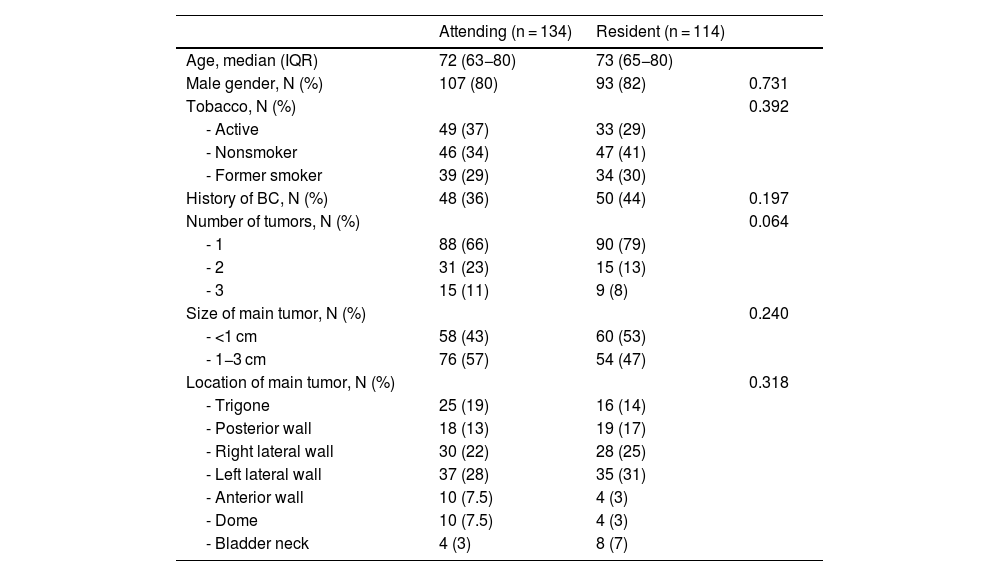
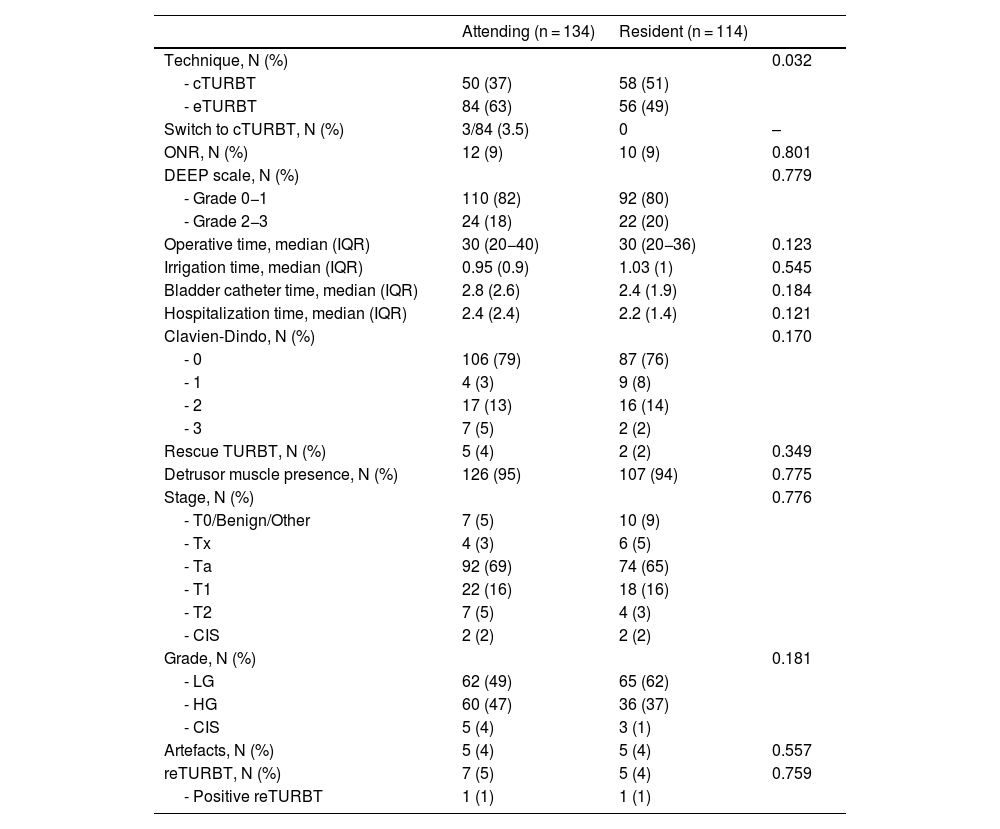
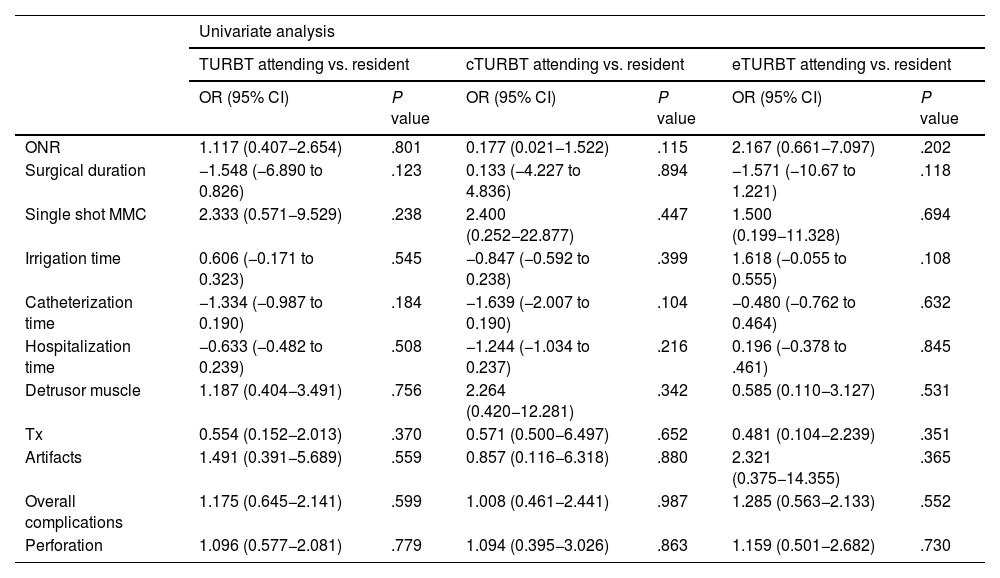
ResultsFrom 04/2018 to 06/2021, 300 patients met inclusion criteria and 248 (83%) of these underwent the assigned intervention. 200 (80.6%) patients were males and median (SD) age was 72.2 (11.2). No statistical differences were found in terms of intra and post-operative outcomes (all P > .05). Linear and logistic regression analysis resulted comparable for all variables (all P > .05).
ConclusionSupervised urology residents do not put the patient at an increased risk of complications neither perform a suboptimal procedure. Resident mentoring is fundamental in order to reach comparable results in surgical outcomes and pathological diagnosis. A structured standardized program with trained trainers and proficiency evaluations are warranted to gain and maintain these outcomes across Europe.
Los programas de residencia de Urología en Europa son heterogéneos y, con frecuencia, sus resultados generan preocupaciones. La importancia de la tutoría a los residentes no debe subestimarse, y los urólogos novatos deben ser guiados por urólogos expertos en formación docente, incluso en procedimientos comunes como la resección transuretral de tumores vesicales (RTUv). El objetivo de este estudio es demostrar la comparabilidad en la ejecución de la RTUv entre residentes de urología supervisados y médicos adjuntos.
Material y métodosEste estudio se basa en un subanálisis de un ensayo prospectivo y aleatorizado que incluyó pacientes diagnosticados de carcinoma vesical sometidos a intervención endoscópica. El estudio (NCT04712201) fue aprobado por el Comité de Ética Institucional (2017/09c). Los cirujanos fueron urólogos adjuntos o residentes supervisados de tercer a quinto año. El objetivo principal fue comparar los resultados quirúrgicos y postoperatorios en ambos grupos.
ResultadosEntre abril de 2018 y junio de 2021, 300 pacientes cumplieron con los criterios de inclusión y 248 (83%) fueron sometidos a la intervención asignada. De ellos, 200 (80.6%) eran hombres y la mediana (DE) de edad fue de 72.2 (11.2) años. No se observaron diferencias estadísticamente significativas en los resultados intraoperatorios ni postoperatorios (todos P > ,05). Los análisis de regresión lineal y logística mostraron resultados comparables para todas las variables (todos P > ,05).
ConclusiónLos residentes de urología supervisados no suponen un mayor riesgo de complicaciones para el paciente ni conlleva la realización subóptima de procedimientos. La tutoría de los residentes resulta fundamental para alcanzar resultados comparables tanto en los resultados quirúrgicos como en el diagnóstico anatomopatológico. Se considera necesario implantar un programa estructurado y estandarizado, con tutores formados y sistemas de evaluación de competencias, para garantizar y mantener estos resultados en toda Europa.

