



Stressful life events significantly influence the development and course of mental disorders in children and adolescents. The Stressful Life Events Schedule (SLES) is an instrument designed to evaluate these events. This study aims to validate the Spanish version of the SLES (Spanish SLES) for children, adolescents and parents by analysing its psychometric properties and discriminant validity.
MethodsParticipants were recruited from two cohorts. Cohort I comprised 188 offspring aged 6–17 years (50.0% female), including 114 offspring of patients with bipolar disorder or schizophrenia (high-risk group) and 74 offspring of control subjects (control group). Cohort II included 35 adolescents aged 14–18 years with a first-episode psychosis (FEP group) (62.9% female). The psychometric properties of the SLES were assessed, including internal consistency (IC) and test–retest reliability, discriminant validity across groups, and concurrent validity.
ResultsThe Spanish SLES demonstrated robust psychometric properties. In adolescents, IC was 0.87 for the total event count and 0.88 for interference with intraclass correlation coefficients (ICCs) of 0.74 and 0.70, respectively. In children, IC was also high (α=0.83 for events and α=0.85 for interference) with ICCs of 0.61 for both measures. In parents, IC was 0.78–0.86 for events and 0.78–0.87 for interference with ICCs of 0.80–0.84 and 0.75–0.82, respectively. Adolescents in the FEP group reported significantly more stressful events (p<0.001, ηp2=0.156) and greater interference (p<0.001, ηp2=0.190) compared with both the high-risk and control groups. Additionally, moderate correlations were found between parent and adolescent reports, with lower concordance observed in the child sample. These findings underscore the importance of integrating multiple informants when assessing stressful life events in clinical practice.
ConclusionsThe Spanish SLES is a valid and reliable instrument for assessing stressful life events in children, adolescents and their parents. It is an accessible and easy-to-administer tool, suitable for use in both clinical practice and research settings.
Extensive evidence suggests that mood and psychotic disorders are best understood from a biopsychosocial perspective. This model highlights how the onset, progression and prognosis of these disorders are influenced by interactions between genetic and socio-environmental factors.1–5 Given the heterogeneous nature of their development and course, environmental factors have received increasing attention.6 Among these, stressful life events stand out as key factors that may influence the trajectory of mental illness, with higher relapse rates observed in individuals with greater exposure.7–9 At the same time, advances in genetics and neurobiology also provide new insights into how environmental and genetic factors interact to shape the risk and course of mental disorders.10–12
Taken together, understanding that mood and psychotic disorders arise from a complex interplay of biological, psychological, and social factors highlights the need for a comprehensive approach to develop more effective and personalised treatment and prevention strategies. This integrative perspective is particularly relevant when considering the offspring of individuals with severe mental disorders, who represent an important population for prevention, as they are at particularly high risk of developing mental illnesses.13,14 Indeed, since children of parents with bipolar disorder (BD) or schizophrenia (SZ) are more likely to experience stressful events compatred to controls, studying these groups can provide valuable insights into modifiable environmental factors.15 Reducing exposure to stress and enhancing coping mechanisms from an early age can minimise the negative effects of stress. However, instruments for quantifying and characterising stressful life events in child and adolescent population are limited16 and few have been validated in Spanish.17 The available Spanish instruments, such as the Questionnaire of Stressful Life Events (QSLE)18 and the Life Events and Adversities Inventory for Adolescents (LEIA),17 are primarily checklist-based, focus on specific age ranges, and provide limited assessment of the subjective impact of events.
To address these limitations, Williamson et al. developed the Stressful Life Events Schedule (SLES) to assess the impact of stress occurring in the past 12 months, with versions for parents (SLES-P), adolescents aged>12 years (SLES-A) and children aged≤12 years (SLES-C).19 The SLES includes a self-administered questionnaire followed by an interview, covering 77 items (61 in the child version) that assess stressful life events and allowing for the inclusion of unlisted events.19 Events are categorised into domains covering education, work, money, housing, crime, health, deaths, romantic relationships and other relationships. The SLES was developed and validated in the United States, has excellent psychometric properties, and has been shown to be useful and cost-effective, even when using only the self-administered questionnaire.20 Given these strengths, adapting the SLES in Spanish is particularly relevant, as it addresses the limitations of existing tools and offers a comprehensive, psychometrically robust, multi-informant instrument for assessing stressful life events in children and adolescents. By enhancing the accuracy of stress assessment, the Spanish SLES supports early identification of psychosocial risk and informs the design of tailored preventive and therapeutic interventions.
Accordingly, this study aimed to validate the Spanish SLES in its child, adolescent, and parent-report versions in a Spanish sample. The validation process included: (a) evaluating internal consistency and test-retest reliability; (b) assessing concurrent reliability by examining the correlation between parents’ and children's perceptions of reported stressful life events; and (c) analysing discriminant validity by comparing differences in stressful life events among three cohorts of children and adolescents. The three cohorts were the offspring of patients with BD or SZ (high-risk group), the offspring of individuals without BD or SZ (control group), and adolescents experiencing first-episode psychosis (FEP group). Our hypothesis was that the Spanish SLES questionnaire would demonstrate adequate internal consistency and test-retest reliability across all versions. We expected a strong, though not perfect, correlation between the reports of parents and children, with stronger agreement in adolescents compared with younger children. The FEP group was expected to report a higher number of stressful life events and greater interference from these events compared with both the high-risk group and control group.
Material and methodsParticipantsParticipants for this study were recruited from two independent studies:
- -
Cohort I: Participants were recruited from the Bipolar and Schizophrenia Young Offspring Study (BASYS) at Hospital Clínic de Barcelona (Barcelona, Spain. The sample included a total of 114 offspring (53 adolescents and 61 children) of patients with BD or SZ (high-risk group) and 74 offspring (36 adolescents and 38 children) of individuals with no personal or first-degree family history of BD or SZ (control group). Participants aged 6–17 years were matched for age, sex and socioeconomic status.21
- -
Cohort II: Adolescents aged 14–18 years with a FEP were recruited from Hospital Clínic de Barcelona. The sample included 35 adolescents diagnosed with SZ, BD, schizoaffective disorder or unspecified psychotic disorder, according to DSM-IV criteria.22
Both cohorts were derived from studies previously reviewed and approved by the Comitè Ètic d’Investigació Clínica of Hospital Clínic de Barcelona. The study fully complied with the principles outlined in the Declaration of Helsinki and Spanish data protection regulations. Written informed consent was obtained from all parents or legal guardians and from participants aged 12 years and older; assent was sought from younger participants. Exclusion criteria included intellectual disability, organic disease of the central nervous system and a history of traumatic brain injury with loss of consciousness.
Procedure and assessment instrumentsTranslation of the three self-administered SLES questionnaires from English to Spanish was conducted by the research team with the permission and supervision of the original author.19 One member of the research team and one independent bilingual translator, who was unfamiliar with the instrument, independently translated the questionnaires into Spanish. These versions were then synthesised into a single preliminary draft. Any discrepancies were reviewed and resolved by consensus in a panel composed of research team members, all clinically experienced psychiatrists or psychologists, to ensure conceptual and semantic equivalence. The final version was produced collaboratively, with particular attention to conceptual accuracy, clinical relevance, and cultural appropriateness.
During initial evaluation, sociodemographic data were collected, psychopathology was ascertained, and all three versions of the Spanish SLES were administered. Parental SES was estimated using the Hollingshead Scale.23 Psychopathology was assessed using the Spanish version of the Schedule for Affective Disorders and Schizophrenia for School-Age Children – Present and Lifetime Version (K-SADS-PL).24 A trained clinician administered the Spanish SLES for children (SLES-C) and adolescents (SLES-A), who self-reported events that occurred in the past year (coded dichotomously as present/absent), and rated the interference of these events, conceptualized as ‘subjective stress’ and rated on a 4-point Likert scale (1–2: none or little/some impact; 3–4: moderate/high impact). Two total scores were derived: (a) the total number of events (event count), and (b) the total interference score, with higher values indicating greater exposure and/or perceived impact. Simultaneously, one parent completed the corresponding Spanish SLES for parents (SLES-P). Children/adolescents and their parents completed the SLES questionnaires independently and without consultation with each other, to avoid mutual influence on their responses.
Subsequently, to assess the test-retest reliability of the Spanish SLES, a second administration (retest) was conducted with a subsample of 69 adolescents and 39 children 2 weeks after the initial evaluation. Participants were consecutively selected from those who had agreed to a second assessment. Sociodemographic and clinical characteristics of the retested subsample did not differ significantly from those of participants who were not retested.
A comparative analysis was performed to assess differences in the total number of stressful events, their subcategories, and their perceived impact between adolescents/children with and without a psychiatric diagnosis according to the K-SADS-PL. Participants with at least one psychiatric diagnosis, identified at the time of evaluation, were included in this analysis regardless of study group. Diagnoses included—each affecting at least one participant—were major depressive disorder, dysthymic disorder, specific phobia, generalised anxiety disorder, separation anxiety disorder, attention-deficit/hyperactivity disorder (ADHD), oppositional defiant disorder, anorexia nervosa, enuresis, as well as FEP in adolescents.
Statistical analysisA descriptive analysis of sociodemographic variables and scale items was conducted. Internal consistency was assessed using Cronbach's alpha, with values>0.70 being considered indicative of good reliability. Test–retest reliability was evaluated using the intraclass correlation coefficient (ICC), interpreted as follows: 0.40–0.59=fair, 0.60–0.74=substantial, ≥0.75=excellent. Differences between clinical subgroups were analysed by analysis of variance (ANOVA). In addition, one-way ANOVA tests were used to compare parent reports across groups. Where significant differences were found, post-hoc Tukey tests were conducted to identify specific group contrasts. To further account for potential inflation of Type I error due to multiple testing, the False Discovery Rate (FDR) correction was applied, and both raw and adjusted p-values (p_FDR) are reported in the tables. Unless otherwise specified, statistical significance in the text refers to FDR-adjusted values. Before conducting parametric tests, assumptions of normality, homogeneity of variances, and linearity were verified. Pearson correlations were used to assess agreement between parent and child/adolescent perceptions of life events. No additional correction was applied to correlation analyses, as these were exploratory and intended to assess agreement between informants, which is consistent with conventions in psychometric validation studies. Correlation significance was set at p<0.05 and p<0.01, with r interpreted as follows: weak correlation, 0.1–0.3; moderate correlation, 0.3–0.5; and strong correlation, 0.5–1.0. Effect sizes were calculated for group comparisons: partial eta squared (ηp2) for ANOVA and Cohen's d for t-tests. All analyses were performed using SPSS version 29 for Windows.
ResultsAdolescent version of the Spanish SLESSociodemographic and descriptive resultsA total of 124 adolescents aged 12–18 years completed the Spanish SLES-A at the initial interview. Of these, 53 were in the high-risk group, 36 were in the control group, and 35 were in the FEP group. The mean age was 15.2±1.7 years, with 61 females (48.8%), and the average SES was 48.7±13.6. No significant differences were observed between groups. However, sex differences were observed regarding stressful life events: female adolescents reported a higher total number of negative life events, particularly in the categories of money, health, and other relationships, whereas male adolescents reported more negative life events in the category of crime (Supplementary Table 1).
Internal consistencyThe Spanish SLES-A showed high internal consistency across the entire sample, with Cronbach's alpha values of 0.87 (95% confidence interval [CI]: 0.82–0.92) for the total number of events and 0.88 (95%CI, 0.83–0.92) for the subjective stress scores. Internal consistency was high across all study groups.
Test–retest reliabilityTest-retest reliability was examined in a subsample of 69 adolescents (55% of the sample), including 45 from cohort I and 24 from cohort II. Scores from two administrations, conducted two weeks apart, were compared. Reliability, measured by ICC, was 0.74 (95%CI, 0.61–0.83) for total events and 0.70 (95%CI, 0.56–0.80) for total subjective stress (interference), and were comparable across all study groups. These values indicate substantial reliability, reflecting stable adolescent responses over time in both event reporting and perceived impact.
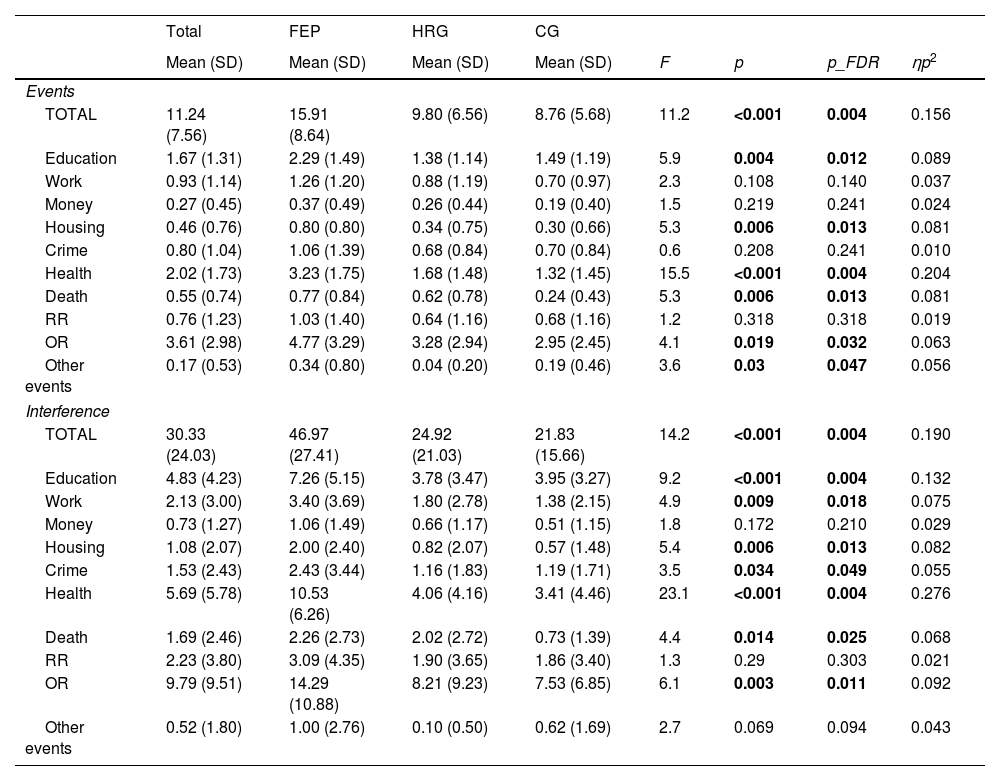
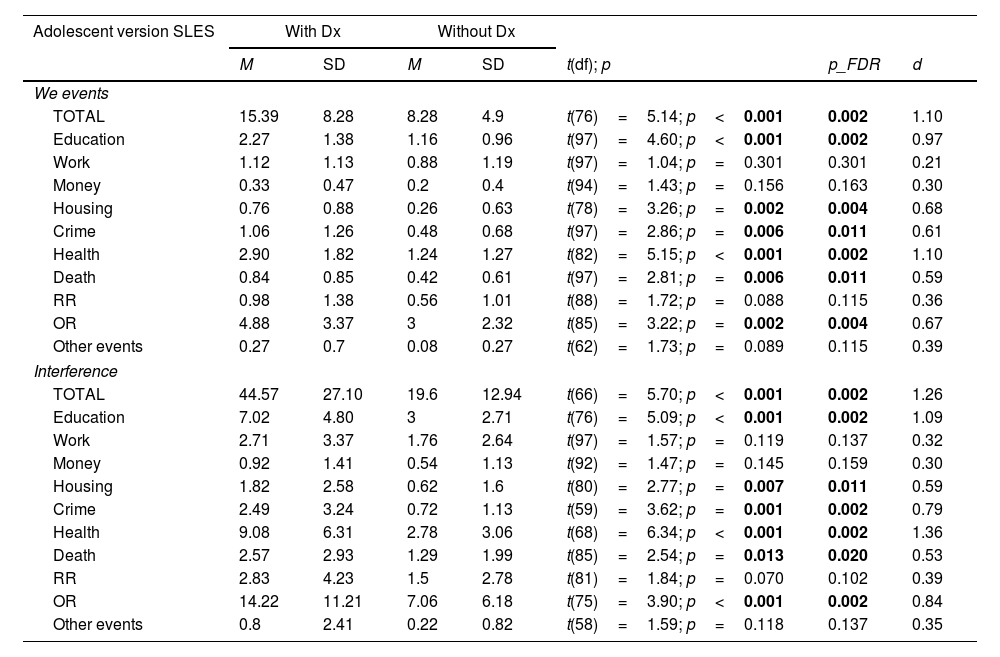
Differences across subgroupsSignificant differences were observed among groups (Table 1 and Supplementary Table 2). The FEP group exhibited a higher total number of stressful life events (p_FDR = 0.004; ηp2=0.156), with elevated counts across several subcategories (education, housing, health, deaths, other relationships, and additional events), as well as a higher level of interference (p_FDR = 0.004; ηp2=0.190), when compared to the high-risk and control groups, which did not differ significantly from each other. Furthermore, when comparing adolescents with and without a psychiatric diagnosis, just over half of the sample (n=50) had at least one diagnosis. Within this subset—and excluding psychotic disorders due to sample characteristics—the most common diagnosis was ADHD, present in 9 individuals (18.0%). Significant differences were found in the total number of stressful events (p_FDR = 0.002; d=1.18), in most subcategories, and in the perceived impact of these events (p_FDR = 0.002; d=1.40) between adolescents with and without mental disorders (Table 2). These main group differences in total events and interference remained significant after FDR correction.
Comparison of the total number and subcategories of stressful life events with the average subjective stress (interference) in adolescents among the 3 groups (FEP, high-risk, and control groups).
| Total | FEP | HRG | CG | |||||
|---|---|---|---|---|---|---|---|---|
| Mean (SD) | Mean (SD) | Mean (SD) | Mean (SD) | F | p | p_FDR | ηp2 | |
| Events | ||||||||
| TOTAL | 11.24 (7.56) | 15.91 (8.64) | 9.80 (6.56) | 8.76 (5.68) | 11.2 | <0.001 | 0.004 | 0.156 |
| Education | 1.67 (1.31) | 2.29 (1.49) | 1.38 (1.14) | 1.49 (1.19) | 5.9 | 0.004 | 0.012 | 0.089 |
| Work | 0.93 (1.14) | 1.26 (1.20) | 0.88 (1.19) | 0.70 (0.97) | 2.3 | 0.108 | 0.140 | 0.037 |
| Money | 0.27 (0.45) | 0.37 (0.49) | 0.26 (0.44) | 0.19 (0.40) | 1.5 | 0.219 | 0.241 | 0.024 |
| Housing | 0.46 (0.76) | 0.80 (0.80) | 0.34 (0.75) | 0.30 (0.66) | 5.3 | 0.006 | 0.013 | 0.081 |
| Crime | 0.80 (1.04) | 1.06 (1.39) | 0.68 (0.84) | 0.70 (0.84) | 0.6 | 0.208 | 0.241 | 0.010 |
| Health | 2.02 (1.73) | 3.23 (1.75) | 1.68 (1.48) | 1.32 (1.45) | 15.5 | <0.001 | 0.004 | 0.204 |
| Death | 0.55 (0.74) | 0.77 (0.84) | 0.62 (0.78) | 0.24 (0.43) | 5.3 | 0.006 | 0.013 | 0.081 |
| RR | 0.76 (1.23) | 1.03 (1.40) | 0.64 (1.16) | 0.68 (1.16) | 1.2 | 0.318 | 0.318 | 0.019 |
| OR | 3.61 (2.98) | 4.77 (3.29) | 3.28 (2.94) | 2.95 (2.45) | 4.1 | 0.019 | 0.032 | 0.063 |
| Other events | 0.17 (0.53) | 0.34 (0.80) | 0.04 (0.20) | 0.19 (0.46) | 3.6 | 0.03 | 0.047 | 0.056 |
| Interference | ||||||||
| TOTAL | 30.33 (24.03) | 46.97 (27.41) | 24.92 (21.03) | 21.83 (15.66) | 14.2 | <0.001 | 0.004 | 0.190 |
| Education | 4.83 (4.23) | 7.26 (5.15) | 3.78 (3.47) | 3.95 (3.27) | 9.2 | <0.001 | 0.004 | 0.132 |
| Work | 2.13 (3.00) | 3.40 (3.69) | 1.80 (2.78) | 1.38 (2.15) | 4.9 | 0.009 | 0.018 | 0.075 |
| Money | 0.73 (1.27) | 1.06 (1.49) | 0.66 (1.17) | 0.51 (1.15) | 1.8 | 0.172 | 0.210 | 0.029 |
| Housing | 1.08 (2.07) | 2.00 (2.40) | 0.82 (2.07) | 0.57 (1.48) | 5.4 | 0.006 | 0.013 | 0.082 |
| Crime | 1.53 (2.43) | 2.43 (3.44) | 1.16 (1.83) | 1.19 (1.71) | 3.5 | 0.034 | 0.049 | 0.055 |
| Health | 5.69 (5.78) | 10.53 (6.26) | 4.06 (4.16) | 3.41 (4.46) | 23.1 | <0.001 | 0.004 | 0.276 |
| Death | 1.69 (2.46) | 2.26 (2.73) | 2.02 (2.72) | 0.73 (1.39) | 4.4 | 0.014 | 0.025 | 0.068 |
| RR | 2.23 (3.80) | 3.09 (4.35) | 1.90 (3.65) | 1.86 (3.40) | 1.3 | 0.29 | 0.303 | 0.021 |
| OR | 9.79 (9.51) | 14.29 (10.88) | 8.21 (9.23) | 7.53 (6.85) | 6.1 | 0.003 | 0.011 | 0.092 |
| Other events | 0.52 (1.80) | 1.00 (2.76) | 0.10 (0.50) | 0.62 (1.69) | 2.7 | 0.069 | 0.094 | 0.043 |
FEP, First Episode of Psychosis; HRG, high-risk group; CG, control group; RR, romantic relationships; OR, other relationships.
Comparison of the total number and subcategories of stressful life events and interference between adolescents with and without a psychiatric diagnosis.
| Adolescent version SLES | With Dx | Without Dx | |||||
|---|---|---|---|---|---|---|---|
| M | SD | M | SD | t(df); p | p_FDR | d | |
| We events | |||||||
| TOTAL | 15.39 | 8.28 | 8.28 | 4.9 | t(76)=5.14; p<0.001 | 0.002 | 1.10 |
| Education | 2.27 | 1.38 | 1.16 | 0.96 | t(97)=4.60; p<0.001 | 0.002 | 0.97 |
| Work | 1.12 | 1.13 | 0.88 | 1.19 | t(97)=1.04; p=0.301 | 0.301 | 0.21 |
| Money | 0.33 | 0.47 | 0.2 | 0.4 | t(94)=1.43; p=0.156 | 0.163 | 0.30 |
| Housing | 0.76 | 0.88 | 0.26 | 0.63 | t(78)=3.26; p=0.002 | 0.004 | 0.68 |
| Crime | 1.06 | 1.26 | 0.48 | 0.68 | t(97)=2.86; p=0.006 | 0.011 | 0.61 |
| Health | 2.90 | 1.82 | 1.24 | 1.27 | t(82)=5.15; p<0.001 | 0.002 | 1.10 |
| Death | 0.84 | 0.85 | 0.42 | 0.61 | t(97)=2.81; p=0.006 | 0.011 | 0.59 |
| RR | 0.98 | 1.38 | 0.56 | 1.01 | t(88)=1.72; p=0.088 | 0.115 | 0.36 |
| OR | 4.88 | 3.37 | 3 | 2.32 | t(85)=3.22; p=0.002 | 0.004 | 0.67 |
| Other events | 0.27 | 0.7 | 0.08 | 0.27 | t(62)=1.73; p=0.089 | 0.115 | 0.39 |
| Interference | |||||||
| TOTAL | 44.57 | 27.10 | 19.6 | 12.94 | t(66)=5.70; p<0.001 | 0.002 | 1.26 |
| Education | 7.02 | 4.80 | 3 | 2.71 | t(76)=5.09; p<0.001 | 0.002 | 1.09 |
| Work | 2.71 | 3.37 | 1.76 | 2.64 | t(97)=1.57; p=0.119 | 0.137 | 0.32 |
| Money | 0.92 | 1.41 | 0.54 | 1.13 | t(92)=1.47; p=0.145 | 0.159 | 0.30 |
| Housing | 1.82 | 2.58 | 0.62 | 1.6 | t(80)=2.77; p=0.007 | 0.011 | 0.59 |
| Crime | 2.49 | 3.24 | 0.72 | 1.13 | t(59)=3.62; p=0.001 | 0.002 | 0.79 |
| Health | 9.08 | 6.31 | 2.78 | 3.06 | t(68)=6.34; p<0.001 | 0.002 | 1.36 |
| Death | 2.57 | 2.93 | 1.29 | 1.99 | t(85)=2.54; p=0.013 | 0.020 | 0.53 |
| RR | 2.83 | 4.23 | 1.5 | 2.78 | t(81)=1.84; p=0.070 | 0.102 | 0.39 |
| OR | 14.22 | 11.21 | 7.06 | 6.18 | t(75)=3.90; p<0.001 | 0.002 | 0.84 |
| Other events | 0.8 | 2.41 | 0.22 | 0.82 | t(58)=1.59; p=0.118 | 0.137 | 0.35 |
Dx, psychiatric diagnosis; M, mean; OR, other relationships; RR, romantic relationships; SD, standard deviation; t(df), t-test with degrees of freedom.
Overall, 99 children aged 6–11 years and one of their parents completed the Spanish SLES-C and SLES-P, respectively. Participants were drawn from the BASYS study because the FEP group only included adolescents; the sample included a total of 61 children in the high-risk group and 38 children in the control group. Their mean age was 9.1±1.8 years, 53 (52.7%) were female and the mean SES was 45.6±13.3. Significant sex differences were observed (p=0.019).
Internal consistencyThe Spanish SLES-C showed good internal consistency for the overall sample, with Cronbach's alpha values of 0.83 (95%CI, 0.72–0.91) for the total number of events and 0.85 (95%CI, 0.75–0.92) for subjective stress scores, indicating high overall internal consistency. These results were consistent across both the high-risk and control groups.
Test–retest reliabilityTest–retest reliability was examined in a subsample of 39 children (38% of the sample). The ICC was 0.61 (95%CI, 0.36–0.78) for the total number of events and 0.61 (95%CI, 0.36–0.78) for the overall subjective stress (interference), indicating substantial reliability and supporting the stability of children's responses over time.
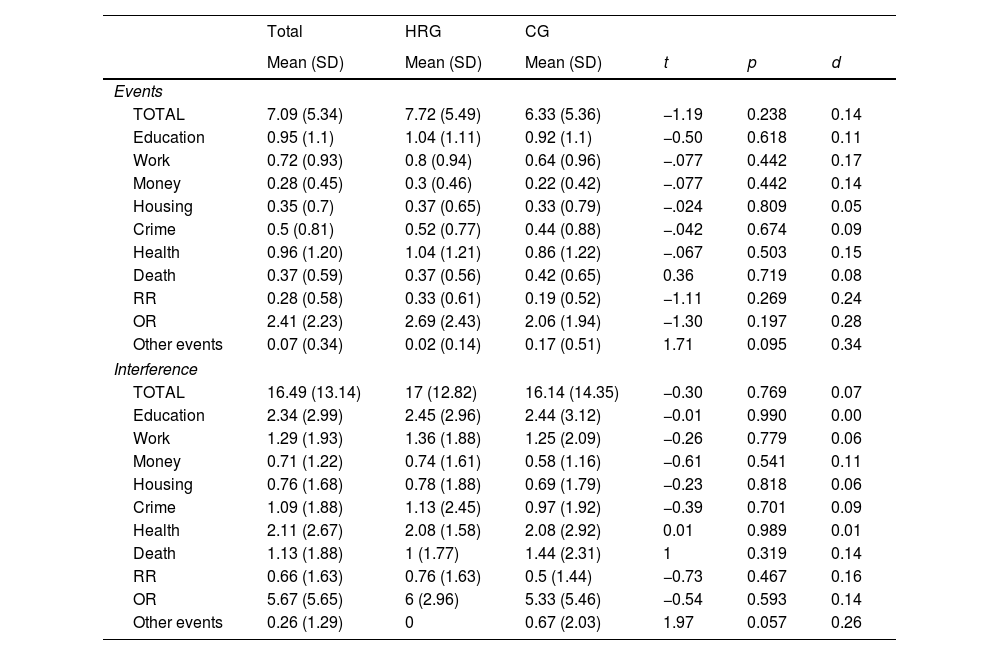
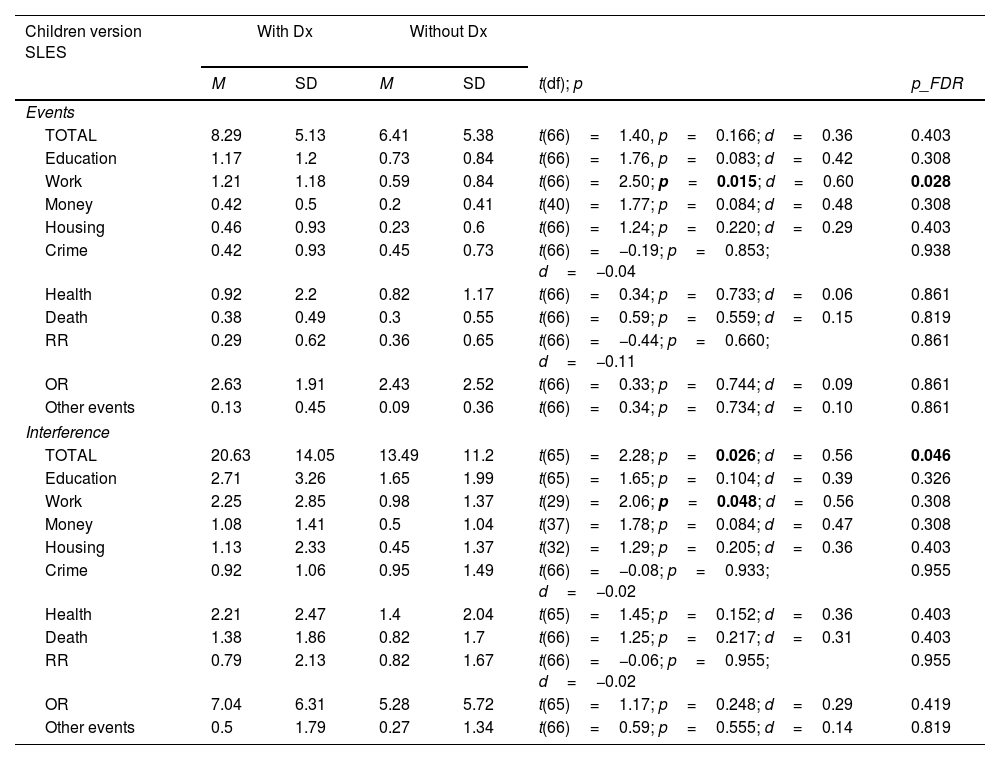
Differences across subgroupsNo significant differences were found when comparing the high-risk and control groups regarding the total number of stressful events, event subcategories, or associated interference (Table 3 and Supplementary Table 3). In total, 30 children were diagnosed with a psychiatric disorder, of whom 23 belonged to the high-risk group. The most common diagnosis was ADHD (n=19), followed by anxiety disorders (n=5). When comparing children with and without a psychiatric diagnosis, as determined by the K-SADS-PL, significant differences were observed only in the domain of work-related events and the associated interference, as well as in higher total interference scores (p_FDR = 0.046; d, 0.56). These differences were independent of whether participants belonged to the high-risk or control group (Table 4).
Comparison of the total number and subcategories of stressful life events with average subjective stress (interference) between the 2 groups of children (high-risk and control groups).
| Total | HRG | CG | ||||
|---|---|---|---|---|---|---|
| Mean (SD) | Mean (SD) | Mean (SD) | t | p | d | |
| Events | ||||||
| TOTAL | 7.09 (5.34) | 7.72 (5.49) | 6.33 (5.36) | −1.19 | 0.238 | 0.14 |
| Education | 0.95 (1.1) | 1.04 (1.11) | 0.92 (1.1) | −0.50 | 0.618 | 0.11 |
| Work | 0.72 (0.93) | 0.8 (0.94) | 0.64 (0.96) | −.077 | 0.442 | 0.17 |
| Money | 0.28 (0.45) | 0.3 (0.46) | 0.22 (0.42) | −.077 | 0.442 | 0.14 |
| Housing | 0.35 (0.7) | 0.37 (0.65) | 0.33 (0.79) | −.024 | 0.809 | 0.05 |
| Crime | 0.5 (0.81) | 0.52 (0.77) | 0.44 (0.88) | −.042 | 0.674 | 0.09 |
| Health | 0.96 (1.20) | 1.04 (1.21) | 0.86 (1.22) | −.067 | 0.503 | 0.15 |
| Death | 0.37 (0.59) | 0.37 (0.56) | 0.42 (0.65) | 0.36 | 0.719 | 0.08 |
| RR | 0.28 (0.58) | 0.33 (0.61) | 0.19 (0.52) | −1.11 | 0.269 | 0.24 |
| OR | 2.41 (2.23) | 2.69 (2.43) | 2.06 (1.94) | −1.30 | 0.197 | 0.28 |
| Other events | 0.07 (0.34) | 0.02 (0.14) | 0.17 (0.51) | 1.71 | 0.095 | 0.34 |
| Interference | ||||||
| TOTAL | 16.49 (13.14) | 17 (12.82) | 16.14 (14.35) | −0.30 | 0.769 | 0.07 |
| Education | 2.34 (2.99) | 2.45 (2.96) | 2.44 (3.12) | −0.01 | 0.990 | 0.00 |
| Work | 1.29 (1.93) | 1.36 (1.88) | 1.25 (2.09) | −0.26 | 0.779 | 0.06 |
| Money | 0.71 (1.22) | 0.74 (1.61) | 0.58 (1.16) | −0.61 | 0.541 | 0.11 |
| Housing | 0.76 (1.68) | 0.78 (1.88) | 0.69 (1.79) | −0.23 | 0.818 | 0.06 |
| Crime | 1.09 (1.88) | 1.13 (2.45) | 0.97 (1.92) | −0.39 | 0.701 | 0.09 |
| Health | 2.11 (2.67) | 2.08 (1.58) | 2.08 (2.92) | 0.01 | 0.989 | 0.01 |
| Death | 1.13 (1.88) | 1 (1.77) | 1.44 (2.31) | 1 | 0.319 | 0.14 |
| RR | 0.66 (1.63) | 0.76 (1.63) | 0.5 (1.44) | −0.73 | 0.467 | 0.16 |
| OR | 5.67 (5.65) | 6 (2.96) | 5.33 (5.46) | −0.54 | 0.593 | 0.14 |
| Other events | 0.26 (1.29) | 0 | 0.67 (2.03) | 1.97 | 0.057 | 0.26 |
CG, control group; HRG, high-risk group; OR, other relationships; RR, romantic relationships.
Note: No comparisons reached statistical significance; therefore, FDR correction did not alter results and is not shown (p_FDR>0.899 for all comparisons).
Comparison of the total number and subcategories of stressful life events with interference between children with and without a psychiatric diagnosis.
| Children version SLES | With Dx | Without Dx | ||||
|---|---|---|---|---|---|---|
| M | SD | M | SD | t(df); p | p_FDR | |
| Events | ||||||
| TOTAL | 8.29 | 5.13 | 6.41 | 5.38 | t(66)=1.40, p=0.166; d=0.36 | 0.403 |
| Education | 1.17 | 1.2 | 0.73 | 0.84 | t(66)=1.76, p=0.083; d=0.42 | 0.308 |
| Work | 1.21 | 1.18 | 0.59 | 0.84 | t(66)=2.50; p=0.015; d=0.60 | 0.028 |
| Money | 0.42 | 0.5 | 0.2 | 0.41 | t(40)=1.77; p=0.084; d=0.48 | 0.308 |
| Housing | 0.46 | 0.93 | 0.23 | 0.6 | t(66)=1.24; p=0.220; d=0.29 | 0.403 |
| Crime | 0.42 | 0.93 | 0.45 | 0.73 | t(66)=−0.19; p=0.853; d=−0.04 | 0.938 |
| Health | 0.92 | 2.2 | 0.82 | 1.17 | t(66)=0.34; p=0.733; d=0.06 | 0.861 |
| Death | 0.38 | 0.49 | 0.3 | 0.55 | t(66)=0.59; p=0.559; d=0.15 | 0.819 |
| RR | 0.29 | 0.62 | 0.36 | 0.65 | t(66)=−0.44; p=0.660; d=−0.11 | 0.861 |
| OR | 2.63 | 1.91 | 2.43 | 2.52 | t(66)=0.33; p=0.744; d=0.09 | 0.861 |
| Other events | 0.13 | 0.45 | 0.09 | 0.36 | t(66)=0.34; p=0.734; d=0.10 | 0.861 |
| Interference | ||||||
| TOTAL | 20.63 | 14.05 | 13.49 | 11.2 | t(65)=2.28; p=0.026; d=0.56 | 0.046 |
| Education | 2.71 | 3.26 | 1.65 | 1.99 | t(65)=1.65; p=0.104; d=0.39 | 0.326 |
| Work | 2.25 | 2.85 | 0.98 | 1.37 | t(29)=2.06; p=0.048; d=0.56 | 0.308 |
| Money | 1.08 | 1.41 | 0.5 | 1.04 | t(37)=1.78; p=0.084; d=0.47 | 0.308 |
| Housing | 1.13 | 2.33 | 0.45 | 1.37 | t(32)=1.29; p=0.205; d=0.36 | 0.403 |
| Crime | 0.92 | 1.06 | 0.95 | 1.49 | t(66)=−0.08; p=0.933; d=−0.02 | 0.955 |
| Health | 2.21 | 2.47 | 1.4 | 2.04 | t(65)=1.45; p=0.152; d=0.36 | 0.403 |
| Death | 1.38 | 1.86 | 0.82 | 1.7 | t(66)=1.25; p=0.217; d=0.31 | 0.403 |
| RR | 0.79 | 2.13 | 0.82 | 1.67 | t(66)=−0.06; p=0.955; d=−0.02 | 0.955 |
| OR | 7.04 | 6.31 | 5.28 | 5.72 | t(65)=1.17; p=0.248; d=0.29 | 0.419 |
| Other events | 0.5 | 1.79 | 0.27 | 1.34 | t(66)=0.59; p=0.555; d=0.14 | 0.819 |
Dx, psychiatric diagnosis; M, mean; OR, other relationships; RR, romantic relationships; SD, standard deviation; t(df), t-test with degrees of freedom.
A total of 105 parents of children (high-risk and controls) and 123 parents of adolescents (high-risk, controls, and FEP) completed the Spanish SLES-P. In the child sample, no significant differences were observed between high-risk and control parents (p=0.49). In the adolescent sample, parents of adolescents with FEP reported significantly more stressful events than both high-risk and control parents (p<0.001), while high-risk parents reported slightly more events than controls (p=0.029). These findings partly reflect adolescents’ self-reports, in which the FEP group consistently reported the highest number of events (Supplementary Table 4).
Internal consistencyThe Spanish SLES-P demonstrated good internal consistency for both the total number of events (Cronbach's alphas of 0.78 [95%CI, 0.64–0.89] for children and 0.86 [95%CI, 0.80–0.91] for adolescents) and the subjective stress scores (Cronbach's alphas of 0.78 [95%CI, 0.64–0.89] for children and 0.87 [95%CI, 0.81–0.92] for adolescents).
Test–retest reliabilityTest-retest reliability was examined in 36 parents of children and 67 parents of adolescents (34% and 54% of the original samples, respectively). The ICCs were 0.80 (95%CI, 0.64–0.89) for the total number of events for parents of children and 0.84 (95%CI, 0.75–0.90) for parents of adolescents. For the overall subjective stress score (interference), the ICC was 0.75 (95%CI, 0.56–0.87) for parents of children and 0.82 (95%CI, 0.72–0.89) for parents of adolescents, indicating excellent reliability and supporting the stability of parent reports over time.
Differences across subgroupsAnalysis of the agreement between parents and children regarding the perception of life events and their interference revealed that concordance varied by age and by the nature of the events (Supplementary Table 5A–D). Greater agreement was also observed between parents and adolescents compared with parents and children: correlations for the total number of events and overall perceived interference were stronger for adolescents (r=0.48 and r=0.60, respectively; p<0.01), but weaker for children (r=0.35 and r=0.34, respectively; p<0.01). Overall, agreement was lower for the occurrence of events than for the interference attributed to them.
DiscussionThe Spanish SLES demonstrated high internal consistency and test-retest reliability, with ICCs ranging from substantial to very good, as defined by Landis and Koch (1977)25; however, these categories should be interpreted with caution, as their validity remains debated in the psychometric literature. Additionally, significant agreement was observed between parental and child/adolescent perceptions in key areas, with the highest concordance found between parents and adolescents. A lower level of agreement was also observed regarding the occurrence of events compared to their perceived impact, suggesting that parents and children are more aligned in evaluating the subjective significance of events than in reporting their actual occurrence. Moderate correlations between informants—particularly lower in younger children (r=0.35 and r=0.34) compared to adolescents (r=0.48 and r=0.60)—highlight the limitations of relying solely on parental reports, where stress exposure may be incompletely captured or misinterpreted. A multi-informant approach that combines parent and child/adolescent perspectives can offer a more comprehensive understanding of the child's context and support more accurate case formulation and inform therapeutic approaches. The modest concordance may reflect developmental differences in insight and event salience, recall or social desirability biases, and limitations inherent to checklist-based and self-administered formats. Nevertheless, our results are consistent with Williamson et al. (2003),19 who reported parent–child agreement coefficients of r=0.32 and parent–adolescent agreement of around r=0.41 for the occurrence of events, and with19 Spanish studies using stressful events questionnaires,18 reinforcing the robustness and cross-cultural validity of the scale.
Adolescents in the FEP group reported a higher number of stressful events and greater interference than either the high-risk group or the control group, which did not differ significantly from each other. A similar pattern was observed among children. Specifically, events related to health and education were prevalent and generated the highest levels of interference in the FEP group. Previous research indicates an association between stressful events and psychosis; stressful life events have been associated with the onset of psychotic episodes, and psychosis per se may be associated with increased vulnerability to stress.7,26 Although groups were matched for age, sex, and SES, residual confounding cannot be excluded. Differences in comorbidities, illness severity, parental psychopathology, and treatment exposure may have influenced both exposure to and reporting of stressful events. Nonetheless, these clinical distinctions enhance the study by showing that the Spanish SLES performs consistently across distinct, clinically relevant subgroups.
Several factors may contribute to the substantial stress burden reported by adolescents with FEP, including heightened vulnerability to stress, functional deterioration, and adverse psychosocial conditions. These factors may reduce their capacity to cope with challenging situations and be associated with greater perceived impact of stressful events on daily lives, including education and health.27 Additional challenges stem from social pressures, academic transitions, family expectations and health issues that tend to intensify during adolescence.28
In contrast, although the high-risk group exhibited psychosocial vulnerabilities and a genetic predisposition, they experienced fewer stressful events and less interference than the FEP group. The absence of a psychotic disorder may have contributed to the preservation of some functional capacity. Although previous research has suggested that high-risk offspring experience more adverse events, we found no significant differences between the high-risk and control groups. This outcome may be explained by several factors. Subgroup analyses showed that high-risk offspring with a psychiatric diagnosis reported more events and greater interference than those without, indicating that heterogeneity within the high-risk group may obscure group-level differences. Age may also contribute, since stressful events and their interference accumulate with development, resulting in more pronounced differences in adolescents than in children. According to the stress generation model, psychiatric disorders increase exposure to behaviourally dependent life events, beyond familial risk alone.29 Moreover, participants were recruited from a longitudinal cohort with regular monitoring, which may have mitigated stress exposure, and control participants may not have been entirely free from adversity. Taken together, these factors help contextualise the apparent similarity between high-risk and control groups and support the validity of the Spanish SLES across populations with differing levels of vulnerability.
Finally, across most subcategories, adolescents with a psychiatric diagnosis reported a higher number of stressful events and greater perceived impact compared with their peers without a diagnosis. This pattern may reflect a greater accumulation of adversity and heightened stress sensitivity, consistent with the ‘diathesis–stress’ model.30 By contrast, differences in the child sample were less pronounced, possibly due to either lower exposure or a diminished ability to recognise stressful factors. Previous research has indicated that childhood exposure to adversity is associated with cumulative effects on mental health, contributing to increased vulnerability during adolescence.31,32
Clinical implications and psychometric validationThe Spanish SLES demonstrates strong psychometric properties of the Spanish SLES and the capacity to differentiate between clinical and non-clinical groups, indicating potential utility in both clinical and research settings. It is an accessible, easy-to-administer and time-efficient tool for assessing stressful life events in children and adolescents. While its use in clinical practice may help identify salient and previously unreported stressors and inform case formulation, its role in guiding preventive or therapeutic strategies requires longitudinal and intervention studies.
In adolescents experiencing a FEP, our findings suggest that early and multidisciplinary approaches may be valuable for supporting stress management and mitigate its impact. Future research should explore the role of protective factors, such as social support and coping strategies, in reducing stress and enhancing resilience in this population.32 The results also suggest the need for developmentally sensitive approaches, particularly for adolescents, who reported higher exposure to stressful events and greater perceived impact.33
Study limitationsThe present study has several limitations that should be taken into consideration when interpreting the results. First, although a sample of children was included, unlike in Pan et al. (2017),20 the number of adolescents was considerably larger due to the greater difficulty in recruiting younger participants. Moreover, the sample of children did not include a group with a FEP, which limited scope for comparison. Second, the subsample used for the test-retest analysis was relatively small, potentially affecting the generalisability of our findings. Third, the cross-sectional study design precludes determination of whether stressful events preceded or followed the onset of psychopathology, thereby limiting causal inference. However, an extensive body of literature supports the association between stressful life events and psychopathology. Additionally, families in which a parent has a mental disorder are reported to experience elevated stress levels.33,34 The psychopathology of both parents and children may have influenced the evaluation of stressful events, as evidence suggests that psychopathology can affect the perceived severity of self-reported experiences.35 Nonetheless, we observed positive correlations between parental and child reports. Fourth, clinicians administering the SLES were not blinded to participants’ diagnostic status or group allocation, which may have introduced assessment bias. However, this risk was likely minimised by the standardised, self-administered format of the questionnaire, with clinicians only recording participants’ responses. Finally, although the Spanish SLES underwent a rigorous translation process to ensure conceptual and cultural appropriateness, no formal pilot testing was conducted, and residual cultural adaptation challenges cannot be fully excluded. Furthermore, the absence of validation in an independent Spanish-speaking sample limits the generalisability of our findings and highlights the need for replication in diverse populations.
ConclusionsIn conclusion, the Spanish SLES is a valid and reliable instrument for assessing stressful life events, with significant implications for research and clinical practice, in child and adolescent mental health. The Spanish SLES demonstrated adequate internal consistency and good test–retest reliability, with significant correlation between parents and offspring; however, this agreement was higher among adolescents than children. Our findings reinforce the role of stressful life events in the development and course of mental disorders during adolescence, underscoring the need for further research into early, multidisciplinary interventions. In particular, adolescents experiencing a first episode of psychosis may benefit from strategies aimed at reducing stress exposure and strengthening coping skills. Future longitudinal studies are warranted to clarify potential causal relationships between stressful events and psychopathology, as well as their interaction with genetic and biological factors in the onset and progression of mental disorders.
FundingThis study was supported by the Pons-Bartran and Maria and Nuria Cunillera Legacies, the Spanish Ministry of Science and Innovation, and Instituto de Salud Carlos III (PI17/00741, PI18/00696, PI20/00654, PI21/00519, PI24/01052, PI24/00279, FORT23/00002_SUGR_G6) and European Commission (grant number 101057529). Additional support was provided by CIBER (Consorcio Centro de Investigación Biomédica en Red, CB/07/09/0023), co-financed by the European Union and ERDF funds from the European Commission (“A way of making Europe”), as well as by Fundació Marató TV3 (202210-10, 202232-30-31) and Fundación Alicia Koplowitz.
Conflicts of interestGS has received honoraria from Rubió Pharma for conference attendance, unrelated to the present work. The remaining authors declared no conflicts of interest whatsoever.
The authors declare that they have no known competing financial interests or personal relationships that could have appeared to influence the work reported in this paper.
The authors would like to thank the Pons-Bartran and Maria and Nuria Cunillera legacies, the Spanish Ministry of Science and Innovation, Instituto de Salud Carlos III (PI17/00741, PI18/00696, PI20/00654, PI21/00519, PI24/01052, PI24/00279, FORT23/00002_SUGR_G6) and European Commission (grant number 101057529) for their support. This study was also supported by CIBER – Consorcio Centro de Investigación Biomédica en Red – (CB/07/09/0023), co-financed by the European Union and ERDF Funds from the European Commission, “A way of making Europe”, Fundació Marató TV3 (202210-10, 202232-30-31) and Fundación Alicia Koplowitz. MS acknowledges previous grant support from the Alicia Koplowitz Foundation. IB would like to thank Pons-Bartran legacy (FCRB_IPB2_2023) for her support. We would like to thank Michael Maudsley for his valuable assistance with English language editing.
The followings are the supplementary data to this article:


articles
