Major depressive disorder is a major global public health issue.1 Sedentary behavior, defined as any waking behavior with an energy expenditure of 1.5 METs or less while sitting, reclining, or lying,2 has been linked to depression,3 yet not all sedentary behaviors relate equally to mental health.4,5 Mentally passive sedentary behaviors, such as television viewing, may increase depression risk by promoting rumination and negative self-focus, whereas mentally active sedentary behaviors, such as reading and hobbies, may protect mental health through engagement and mastery.6 Whether these associations follow nonlinear dose–response patterns, as reported for physical activity,7 the behavioral counterpart of sedentary behavior, remains unclear. Therefore, we examined the associations of total, mentally passive, and mentally active sedentary time with depressive symptoms, including potential nonlinear dose–response relationships.
In this cross-sectional study, adults aged 18 years or older completed semistructured interviews. Sedentary behavior was assessed using the 10-item LASA-SBQ and categorized as total, mentally passive (napping, listening to music, watching television, seated conversation, sitting during car, bus, or train travel, and attending church/theater), and mentally active sedentary time (reading, seated hobbies, computer use, and seated administrative tasks).8 The outcome was depressive symptoms, assessed using the 21-item Beck Depression Inventory (BDI; score range, 0–63), with higher scores indicating greater symptom severity. Dose–response associations were modeled using restricted cubic splines with 3 knots (10th, 50th, and 90th percentiles), and depressive symptoms were compared across sedentary-time quartiles using linear regression on log-transformed scores. Models were adjusted for moderate-to-vigorous physical activity, age, sex, race, family income, hypertension, type 2 diabetes mellitus, and obesity. This study was approved by the local ethics committee, and all patients provided written informed consent.
We included a total of 1237 participants (mean age, 58 years; 81.0% women). Total sedentary time was positively associated with BDI scores (overall P=.0049), increasing approximately linearly up to 7–8h/day before plateauing (P for nonlinearity=.1333). Mentally passive sedentary time was also associated with depressive symptoms (overall P=.0012) and showed significant nonlinearity (P=.0389), with a steep rise up to 6–7h/day followed by a plateau, suggesting a threshold effect. In contrast, mentally active sedentary time was not associated with depressive symptoms (overall P=.3362; P for nonlinearity=.2277). Linear models confirmed this pattern. Adjusted geometric mean BDI scores increased across total sedentary time quartiles (Q1=6.93 to Q4=7.97; P for trend=.0524) and mentally passive sedentary time quartiles (Q1=6.46 to Q4=8.28; P for trend=.0008), whereas no association was observed for mentally active sedentary time (P for trend=.6134) (Fig. 1).
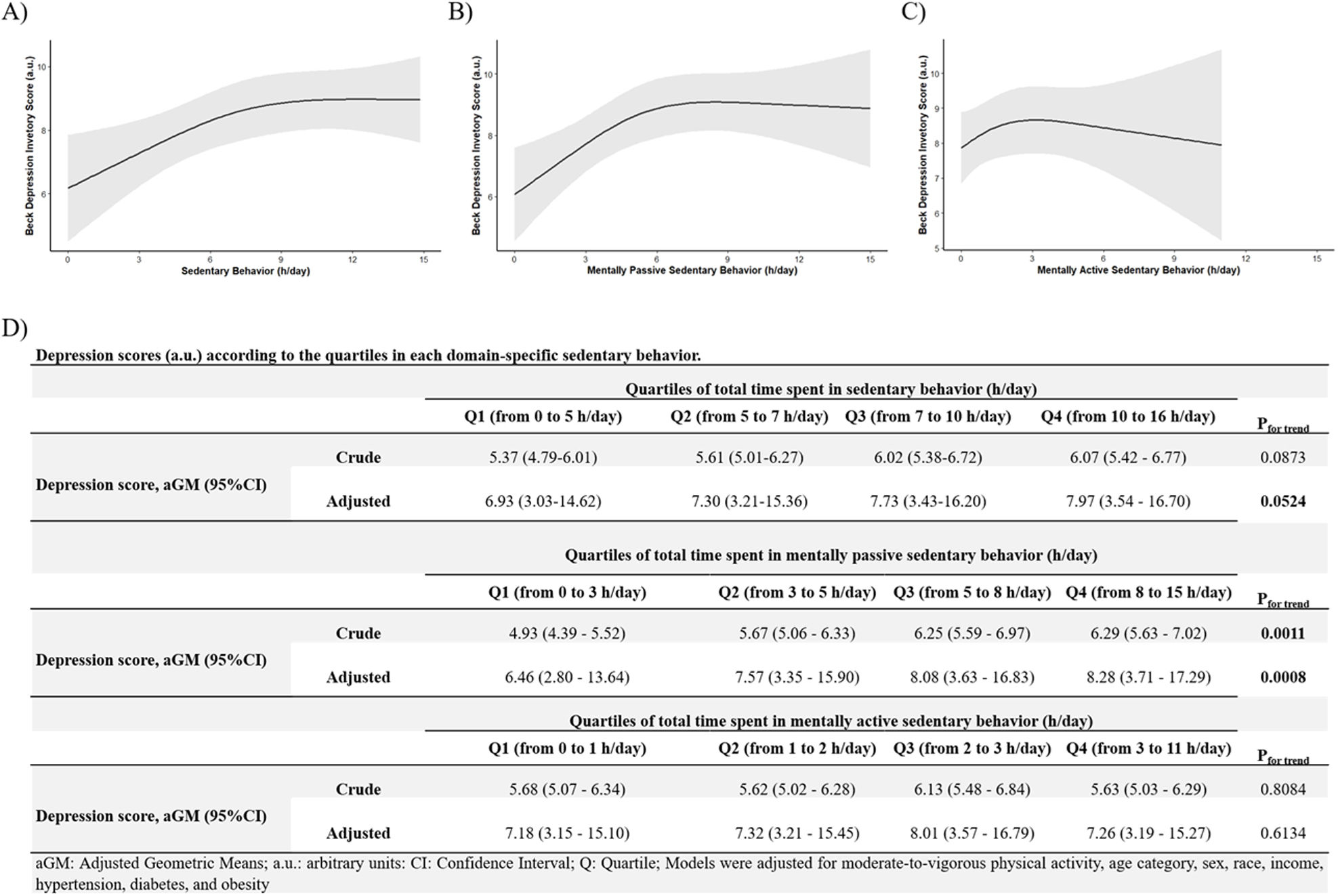
Adjusted associations between sedentary behavior domains and Beck Depression Inventory (BDI) scores. Panels A–C show the adjusted relationships between (A) total sedentary behavior, (B) mentally passive sedentary behavior, and (C) mentally active sedentary behavior (h/day) and BDI scores, estimated using restricted cubic spline models with 3 knots (10th, 50th, and 90th percentiles). Solid lines represent adjusted predicted mean BDI scores, and shaded areas indicate 95%CI. Panel D presents adjusted geometric mean (aGM) BDI scores (95%CI) across quartiles of total, mentally passive, and mentally active sedentary behavior, together with crude estimates and P values for trend. All models were adjusted for moderate-to-vigorous physical activity, age category, sex, race, income, hypertension, diabetes, and obesity.
These findings indicate that the association between sedentary time and depressive symptoms is driven largely by mentally passive behaviors. Both total and mentally passive sedentary time were associated with higher depressive symptoms up to approximately 6–8h/day, after which the association plateaued, whereas mentally active sedentary time showed no association. This supports the view that the mental engagement associated with sedentary activities, rather than sitting time per se, helps explain heterogeneity in its relationship with depression. Clinically, recommendations and interventions should distinguish between sedentary behavior domains. Reducing mentally passive sedentary time may be a more effective target for alleviating depressive symptoms than indiscriminately reducing total sedentary time.
This study has limitations. The cross-sectional observational design precludes causal inference, sedentary behavior and depressive symptoms were self-reported (introducing possible recall and reporting bias), and the predominantly female sample may limit generalizability. Longitudinal and experimental studies are needed to confirm causality and evaluate targeted interventions.
Ethical approvalThis study involving human participants was performed in full compliance with the principles outlined in the Declaration of Helsinki and was approved by the local Ethics Committee (Ethics Committee Approval No.: CAAE – 69886123.8.0000.0081).
Patient and public involvementPatients and/or the public were not involved in the design, conduct, reporting, or dissemination plans of this research.
Informed consent and patient detailsWritten informed consent to take part in the study and to publish the article has been obtained from all participants or their legal representatives. The privacy rights of participants have been observed.
Studies in humansThis study was performed in compliance with relevant laws, regulatory frameworks, and guidelines where the research took place.
This study was approved by the Ethics Committee from UNISA.
(Approval No. 69886123.8.0000.0081).
FundingS.G. (FAPESP 2023/15629-3; CNPq 301065/2025-0), A.L.M. (FAPESP 2025/12753-0), and L.M.N. (FAPESP 2024/15308-5, 2024/02369-6, 2024/05155-7; CNPq 312952/2023-6) are supported by the São Paulo Research Foundation and National Council for Scientific and Technological Development – CNPq – Brazil. B.S. is supported by an NIHR Advanced Fellowship (NIHR301206).
Conflicts of interestB.S. is on the Editorial Board of NPJ Exercise Medicine and Health, the Journal of Physical Activity and Health, Aging Research Reviews, Mental Health and Physical Activity, The Journal of Evidence Based Medicine, and The Brazilian Journal of Psychiatry. B.S. has received an honorarium from a co-edited book on exercise and mental illness (Elsevier), an associated education course, and unrelated advisory work from ASICS and FitXR LTD. The other authors have no conflicts of interest.
Data availabilityThe data that support the findings of this study are available from the corresponding author, S.G., upon reasonable request.