In recent years, neuromodulation techniques and therapeutic approaches have expanded worldwide, including transcranial magnetic stimulation (TMS), transcranial direct current stimulation (tDCS), and deep brain stimulation (DBS). In addition, treatments that had become relatively marginal in some settings, such as electroconvulsive therapy (ECT), have regained prominence in psychiatry.1,2
Although the expansion of available interventions is positive, it is also associated with several risks. These include insufficient formal training, unclear boundaries regarding which professionals should indicate and administer these treatments, and the absence of coherent clinical frameworks capable of integrating them into longitudinal psychiatric care. At the same time, the current ecosystem has often prioritized the visibility of specific techniques over the development of a coherent neuromodulation paradigm. Consequently, some interventions risk being used in a reductionist, quasi-procedural manner, sometimes for questionable indications or without an adequately robust psychopathological, neurophysiological, or clinical foundation.1–4
Interventional psychiatry and neuromodulation: state of the artThese concerns have contributed to an international debate regarding how the field should be structured. In the United States, this discussion has been articulated through the Brain Stimulation Subspecialty Summits (BraSSS), whose proceedings highlighted the need for more formalized training, clearly defined competencies, and a conceptual framework capable of integrating multiple techniques and clinical contexts.3 As a result, interventional psychiatry and neuromodulation have increasingly emerged as a subspecialty within brain medicine.2,4,10
The BraSSS discussion regarding the creation of interventional psychiatry and neuromodulation as a subspecialty is valuable precisely because it identifies both the risks and the opportunities involved. The principal risk is the absence of formal training, which could allow neuromodulation to be developed by professionals trained through brief, industry-linked educational programs that are inadequate for a clinically complex field.3 It could also lead to procedures being delivered according to isolated local traditions, resulting in inconsistent and insufficient training. The opportunity, by contrast, lies in the creation of a multimodal, multidisciplinary, and transdiagnostic framework in which advanced interventions are understood not as isolated procedures or devices but as components of a broader therapeutic model within psychiatry.4,9,10
Interventional psychiatry therefore emphasizes the need for advanced training in mechanisms of action, indications, contraindications, adverse effects, treatment sequencing, neuroimaging, neurophysiology, and ethics.4–8 Equally importantly, this framework prevents the field from being reduced to a device-based or technique-driven practice.
The appropriate use of these interventions continues to depend on accurate diagnosis, refined psychopathological formulation, suicide risk assessment, evaluation of cognition and comorbidity, an understanding of medication effects and interactions, and the integration of psychotherapy when appropriate. In clinical practice, response, remission, relapse, and functional recovery must be understood longitudinally rather than treated as isolated outcomes of technically well-delivered procedures.3,5,6,8
For the same reason, the field should not be limited to device-based treatments. A contemporary understanding of interventional psychiatry should encompass both device-based neuromodulation and interventional psychopharmacologic treatments, particularly those characterized by rapid onset, state-dependent effects, or administration within highly structured clinical settings.
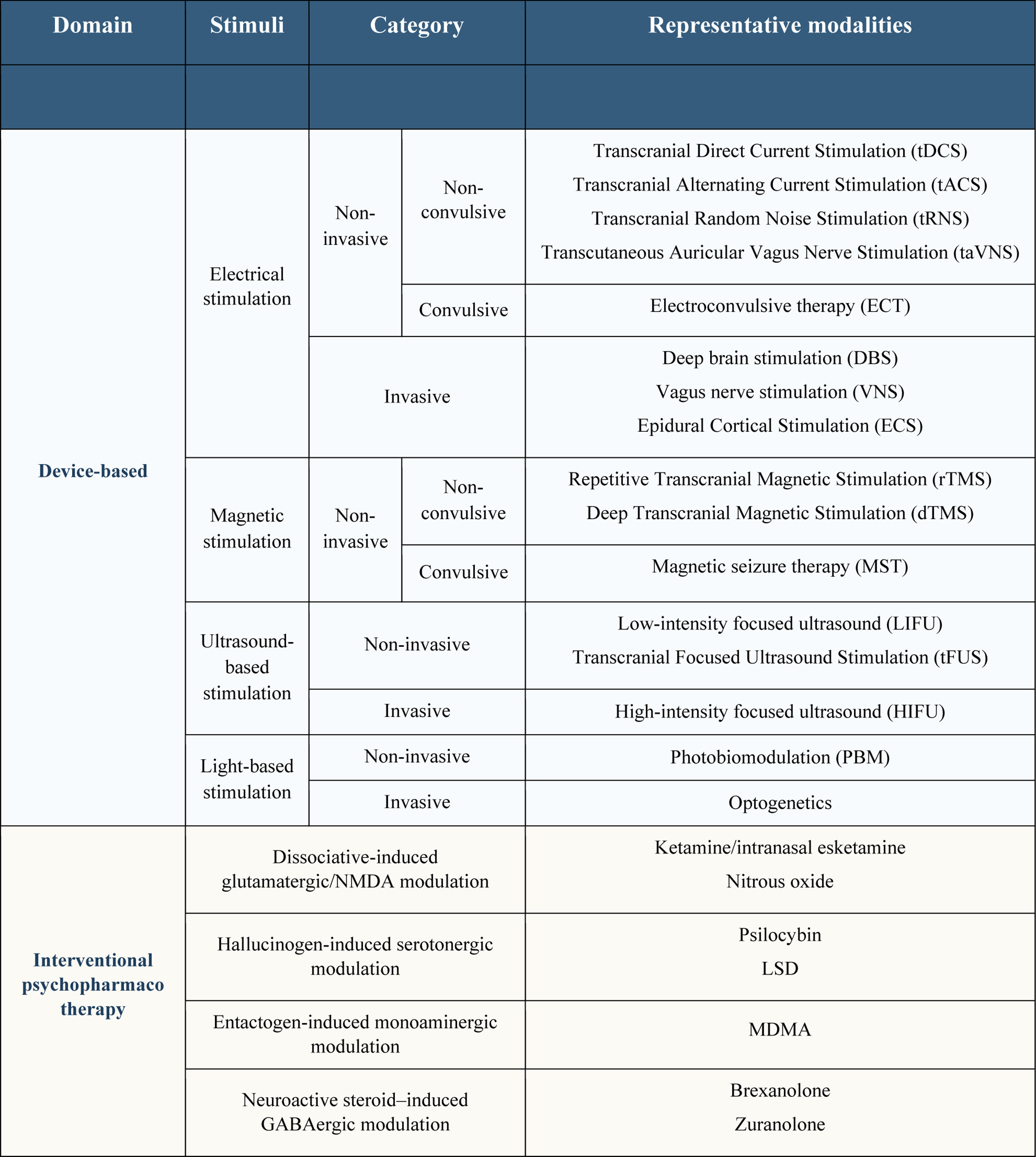
In practical terms, this includes glutamatergic and dissociative agents such as ketamine and esketamine, psychedelic-assisted therapies, and other rapidly acting neurobiological interventions3,10,11 (Fig. 1).

Figure 1 provides a conceptual overview of the principal therapeutic modalities currently included within interventional psychiatry and neuromodulation, encompassing both device-based neuromodulation and interventional psychopharmacology.
These advanced interventions must therefore remain embedded within comprehensive psychiatric care rather than being separated into an isolated procedural niche 4–8. BraSSS explicitly argued that additional certification in brain stimulation should not redefine a clinician's original specialty identity.3 When the target condition is major depressive disorder, obsessive-compulsive disorder, catatonia, or another primary psychiatric disorder, the decisive clinical act is not merely the administration of a stimulus or pharmacologic agent. It is the psychiatric judgment involved in selecting the appropriate treatment, integrating it into a broader therapeutic plan, and monitoring its benefits and harms over time.
A call to action in SpainThis debate should be introduced in Spain from a critical perspective because the Spanish context differs substantially from that of the United States and Canada, where the BraSSS initiative has developed.3,9 Spain does not have an equivalent landscape of academic–private collaboration, standardized fellowships, or established mechanisms for advanced credentialing in neuromodulation. Any proposal for the Spanish setting must therefore be realistic, incremental, and grounded in the current organization of specialist training.
The most realistic short-term objective is not the creation of a separate, fully regulated subspecialty but the establishment of a structured pathway for advanced competence within general psychiatry. The recent extension of psychiatry residency training to 5 years provides, for the first time, a genuine curricular opportunity.12 This opportunity should be used.
A feasible model would place this pathway in the final phase of residency, when trainees have acquired sufficient knowledge and clinical maturity to understand these interventions in context rather than in isolation. A mandatory 2-month rotation for all residents – covering indications, contraindications, safety, monitoring, therapeutic integration, and referral pathways – would establish a common foundation of knowledge. For trainees seeking more advanced expertise in interventional psychiatry and neuromodulation, an additional 4-month track in accredited units, including supervised experience across multiple techniques and clinical scenarios, would complete a coherent 2+4 pathway.4,6,7,9,12 This structure would be proportionate and would not require the creation of new institutions; instead, it would use the flexibility already provided by the reformed residency program.
Initially, only a limited number of centers would have the capacity to provide the advanced track because of the current shortage of appropriately trained professionals and specialized resources. The initial priority should be consistency of standards rather than breadth of coverage.
International experience provides both a foundation and a broader perspective. Across successive summits, the BraSSS process progressed from debating whether the field warranted formal recognition to developing the practical infrastructure required for accreditation, including a training content outline, minimum standards, and an independent professional society to guide the process.3,9 The first authors of this article have trained in some of the academic environments in which the field has developed most coherently. That experience is reflected in the proposals presented here, not as an argument from authority but as evidence that a rigorous, multimodal, and clinically integrated training model is not merely aspirational: it already exists, functions in practice, and can be adapted to the Spanish context.
For the field to develop coherently, it requires a credible institutional framework within psychiatry. In Spain, the absence of a specific organization comparable to the Brain Stimulation Society creates a genuine risk that neuromodulation may expand without a sufficiently coherent psychiatric and clinical perspective.3,9 The purpose is not to deny the multidisciplinary nature of the field but to ensure that its development for psychiatric indications remains overseen by a body with psychiatric legitimacy, scientific accountability, and national representativeness. Otherwise, the likely result will be fragmentation into device-driven microcultures, isolated local initiatives, informal credentialing, and the gradual displacement of clinical judgment by commercial interests.
In this context, the natural forum for this work is the Sociedad Española de Psiquiatría y Salud Mental (SEPSM), through a dedicated section, working group, or consensus platform on interventional psychiatry and neuromodulation. Such a structure could develop standards for training, clinical scope, accreditation, and quality with scientific continuity and national coordination.
In conclusion, Spanish psychiatry does not simply need more neuromodulation. It needs a framework that ensures that the field develops in a manner that is educationally rigorous, clinically grounded, and recognizably psychiatric in its model of care.