


Drowning is a preventable cause of infant mortality. In Catalonia, a high proportion of fatal drownings occur among people of non-Spanish nationality. The objective of this study was to describe fatal drownings of children under 18 years of age in Catalonia during the period 2019-2023, analyzing the differences between those who died with Spanish nationality and those of other nationalities.
MethodsThis was a retrospective observational study based on the autopsy records of the Institute of Legal Medicine and Forensic Sciences of Catalonia, including all cases of drowning deaths in children under 18 years of age between 2019 and 2023. Variables such as age, sex, nationality, location of drowning, and origin of the body were analyzed.
ResultsThirty-nine deaths were identified, with a mean age of 6.5 years; 74.4% were male. 56.4% of the deceased had foreign nationality, mainly from African countries. Drownings in swimming pools were more frequent among Spanish children, while drownings in natural waters predominated among foreign children.
ConclusionsThe high proportion of children of non-Spanish nationality reflects sociocultural and gender inequalities in access to safer aquatic environments and in the acquisition of aquatic skills. Along with other measures, health counseling can promote family supervision of children's swimming and encourage participation in swimming learning programs, especially in populations with less access to safe educational and recreational resources.
El ahogamiento es una causa prevenible de mortalidad infantil. En Cataluña, hay una proporción elevada de ahogamientos mortales entre personas de nacionalidad no española. El objetivo del estudio fue describir los ahogamientos mortales de menores de 18 años en Cataluña durante el período 2019-2023, analizando las diferencias entre los fallecidos con nacionalidad española y los de otras nacionalidades.
MétodosEstudio observacional retrospectivo a partir de los registros de autopsias del Instituto de Medicina Legal y Ciencias Forenses de Cataluña, incluyendo todos los casos de muertes por ahogamiento en menores de 18 años entre 2019 y 2023. Se analizaron variables como edad, sexo, nacionalidad, lugar del ahogamiento y procedencia del cuerpo.
ResultadosSe identificaron 39 muertes, con una edad media de 6,5 años; el 74,4% eran varones. El 56,4% de los fallecidos tenía nacionalidad extranjera, principalmente de países del continente africano. Los ahogamientos en piscinas fueron más frecuentes entre menores de nacionalidad española, mientras que en menores extranjeros predominaron los ahogamientos en aguas naturales.
ConclusionesLa elevada proporción de menores de nacionalidad no española refleja desigualdades socioculturales y de género en el acceso a entornos acuáticos más seguros y a la adquisición de habilidades para desenvolverse en el medio acuático. Junto a otras medidas, el consejo sanitario puede favorecer la supervisión familiar del baño infantil, estimular la participación en programas de aprendizaje de la natación, especialmente en poblaciones con menor acceso a recursos educativos y recreativos seguros.
Drowning is a leading cause of child mortality worldwide. According to the World Health Organisation, it accounts for around 7% of all injury-related deaths.1 In the USA, it is the second leading cause of unintentional injury-related deaths among children under 19.2
Rates of fatal drowning vary considerably across Europe, depending on geographical, climatic, and socio-economic factors. Catalonia has over 580 km of coastline and a climate that favours water-based activities for much of the year, particularly during the summer months.
Studies on child drowning have identified various risk factors, including insufficient supervision of children, particularly in swimming pools where there is often a greater perception of safety.3 Stevenson et al.4 found that 68% of drowning incidents involving children under five occurred in swimming pools without a complete perimeter fence, representing almost double the risk compared to fenced pools. Another significant factor is the lack of basic swimming skills and water safety education,5 which disproportionately affects low-income communities or those with limited access to training programmes in this area.
Analysing medico-forensic data improves the quality and comprehensiveness of data on drowning deaths. A recent study analysed some of the characteristics of 310 fatal drownings among people of all ages recorded by the Institute of Legal Medicine and Forensic Sciences of Catalonia (IMLCFC) between 2019 and 2022. A high proportion of cases involving non-Spanish nationals was observed, particularly among unintentional drownings and those of undetermined intent. This suggests that nationality may be a factor associated with the risk of fatal drowning.6
The aim of this study was to describe cases of fatal drowning among individuals under 18 years of age in Catalonia between 2019 and 2023, analysing differences between Spanish nationals and non-Spanish nationals, with the aim of proposing appropriate prevention measures tailored to different population groups.
MethodologyAn observational, retrospective study was conducted on fatal drownings of minors under the age of 18 that were recorded between 1 January 2019 and 31 December 2023.
Information was obtained from the IMLCFC autopsy register, which codes the cause of death in accordance with the 10th revision of the WHO International Classification of Diseases (ICD-10). Deaths assigned the codes W65–W74, X92, or Y21 were included in the study.
Demographic data (age, sex, and nationality), the aquatic environment in which the drowning occurred (natural waters, swimming pools, reservoirs, bathtubs, and others or unspecified), the municipality of death, the date of death, and the place of origin of the body (the scene of the drowning or a healthcare facility) were collected. The day of the week and month of death were determined from the full date, and the province of origin was determined from the municipality.
Version 18 of the SPSS package for Windows was used for statistical analysis. Categorical variables were compared using the χ2 test, while numerical variables such as age were analysed using the Mann–Whitney U test. The results were expressed as absolute and relative frequencies, and means and standard deviations were calculated for continuous variables. All analysed data referred to deceased individuals and were stripped of any personal identifiers. This study was approved by the Training and Research Committee of the Institute of Legal Medicine and Forensic Sciences of Catalonia (IMLCFC).
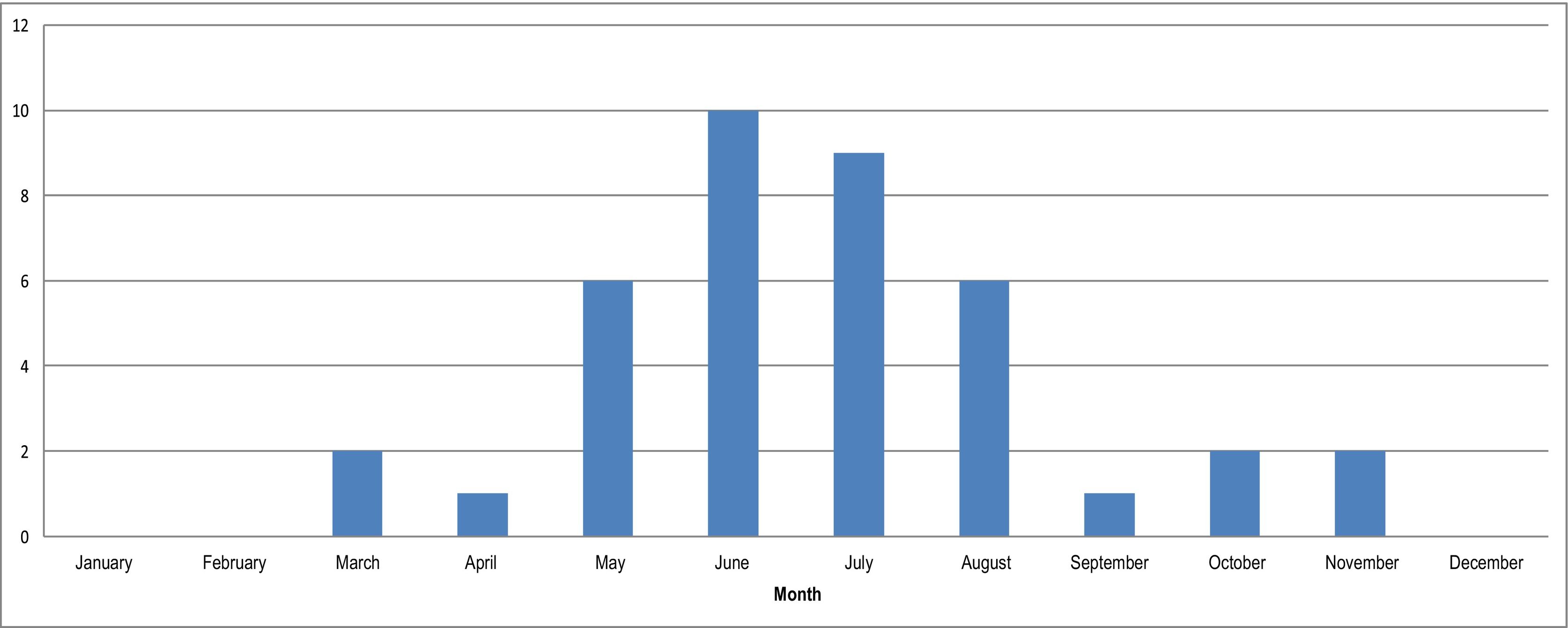
ResultsA total of 39 fatal drownings of minors were recorded during the study period: 5 cases (12.8%) in 2019, 7 (17.9%) in 2020, 8 (20.5%) in 2021, 10 (25.6%) in 2022, and 9 (23.1%) in 2023. The deceased had an average age of 6.5 years, and there were more boys (29 cases, 74.4%) than girls (10 cases, 25.6%). As shown in Fig. 1, the monthly distribution of fatal drownings was uneven, with the highest numbers occurring during the summer months. There were no deaths between December and January.

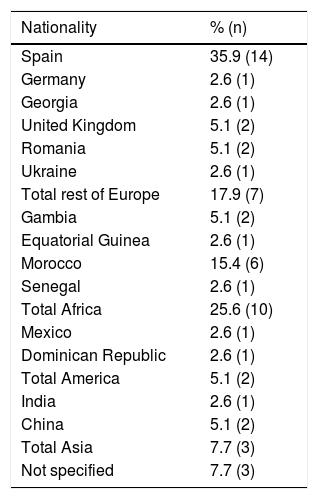
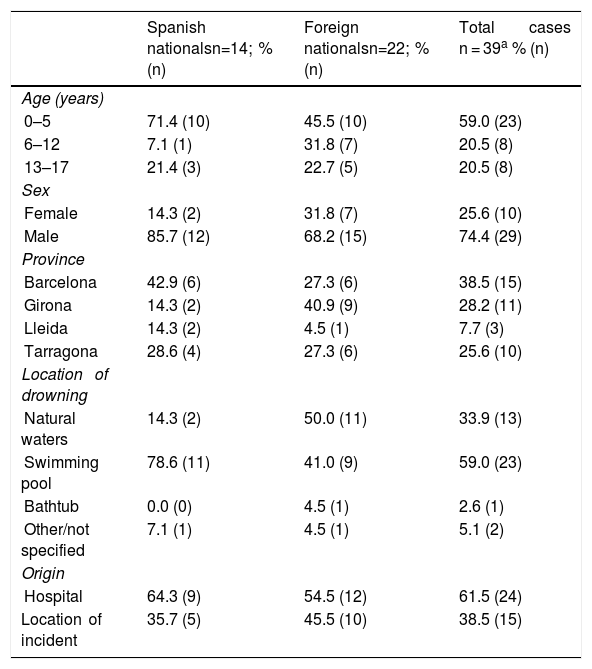
Table 1 shows the distribution of cases by nationality. Although the most common nationality was Spanish (14 cases, 35.9%), the majority of deceased children were foreign nationals (22 cases, 56.4%). Of these foreign nationals, by continent, 10 (25.6%) were from an African country, 7 (17.9%) from another European country, 3 (7.7%) from Asia, and 2 (5.1%) from the Americas. In 3 cases (7.7%), nationality could not be recorded. Table 2 shows the main characteristics of the recorded cases, distinguishing between Spanish nationals and other nationalities.
Fatal drownings among minors according to nationality. Catalonia 2019–2023.
| Nationality | % (n) |
|---|---|
| Spain | 35.9 (14) |
| Germany | 2.6 (1) |
| Georgia | 2.6 (1) |
| United Kingdom | 5.1 (2) |
| Romania | 5.1 (2) |
| Ukraine | 2.6 (1) |
| Total rest of Europe | 17.9 (7) |
| Gambia | 5.1 (2) |
| Equatorial Guinea | 2.6 (1) |
| Morocco | 15.4 (6) |
| Senegal | 2.6 (1) |
| Total Africa | 25.6 (10) |
| Mexico | 2.6 (1) |
| Dominican Republic | 2.6 (1) |
| Total America | 5.1 (2) |
| India | 2.6 (1) |
| China | 5.1 (2) |
| Total Asia | 7.7 (3) |
| Not specified | 7.7 (3) |
Characteristics of fatal drownings among minors according to nationality. Catalonia 2019–2023.
| Spanish nationalsn = 14; % (n) | Foreign nationalsn = 22; % (n) | Total cases n = 39a % (n) | |
|---|---|---|---|
| Age (years) | |||
| 0–5 | 71.4 (10) | 45.5 (10) | 59.0 (23) |
| 6–12 | 7.1 (1) | 31.8 (7) | 20.5 (8) |
| 13–17 | 21.4 (3) | 22.7 (5) | 20.5 (8) |
| Sex | |||
| Female | 14.3 (2) | 31.8 (7) | 25.6 (10) |
| Male | 85.7 (12) | 68.2 (15) | 74.4 (29) |
| Province | |||
| Barcelona | 42.9 (6) | 27.3 (6) | 38.5 (15) |
| Girona | 14.3 (2) | 40.9 (9) | 28.2 (11) |
| Lleida | 14.3 (2) | 4.5 (1) | 7.7 (3) |
| Tarragona | 28.6 (4) | 27.3 (6) | 25.6 (10) |
| Location of drowning | |||
| Natural waters | 14.3 (2) | 50.0 (11) | 33.9 (13) |
| Swimming pool | 78.6 (11) | 41.0 (9) | 59.0 (23) |
| Bathtub | 0.0 (0) | 4.5 (1) | 2.6 (1) |
| Other/not specified | 7.1 (1) | 4.5 (1) | 5.1 (2) |
| Origin | |||
| Hospital | 64.3 (9) | 54.5 (12) | 61.5 (24) |
| Location of incident | 35.7 (5) | 45.5 (10) | 38.5 (15) |
Fatal drownings among minors of foreign nationality accounted for a significantly higher proportion of deaths in natural waters (p = .036), at 50.0% of cases (11 out of 22), compared with 14.3% (2 out of 14) among minors of Spanish nationality. Conversely, deaths in swimming pools were more frequent among Spanish children, accounting for 78.6% of cases (11 out of 14), compared to 41.0% (9 out of 22) among foreign nationals.
Drowning deaths among minors of foreign nationality included a higher proportion of girls and with a mean age of 7.8 years, slightly higher – though not statistically significant – than the 6.5 years for all cases and the 5.5 years for Spanish children. The majority of fatal drownings among minors of Spanish nationality occurred in swimming pools (78.6%), whereas this proportion was lower among children of other nationalities (40.9%).
DiscussionThe findings show that the number of fatal drownings among minors in Catalonia—approximately 8 cases per year during the study period—was relatively low compared with global figures, given that the majority of child drownings occur in low- and middle-income countries. Nevertheless, child drowning constitutes a serious social and public health problem, particularly since all such deaths are preventable.7
Throughout childhood, the risk of drowning is particularly high in swimming pools and among children under the age of 6.
Measures that have proven effective in preventing child drowning must be strengthened, including supervising any child activity taking place in or near water, providing swimming instruction, and installing perimeter barriers and other mechanisms that prevent children from accessing swimming pools and other aquatic environments without adult supervision.8–10
More than half of the fatal cases investigated occurred in healthcare settings, highlighting the high fatality rate of submersion asphyxia among children, even when they receive care from emergency services. However, some studies suggest that drowning may have a better prognosis among those under 18, as these incidents are often witnessed and attended to promptly, with victims receiving cardiopulmonary resuscitation (CPR) more frequently than adults.11 A retrospective study of 1859 drowning cases treated by emergency medical services in the USA showed that pre-hospital care for paediatric patients who had suffered cardiac arrest as a result of drowning resulted in higher rates of return to spontaneous circulation than for adults.12 Furthermore, children aged 5–15 who received CPR following cardiac arrest due to drowning have been observed to have a better outcome in terms of both overall survival and neurologically favourable survival than adults.13
It is striking that over 56% of those who died were foreign nationals, despite the fact that only 15.7% of children under 18 registered as residents in municipalities in Catalonia in 2022 were foreign nationals.14 While some of the fatal drownings may have occurred while Spanish or foreign nationals were temporarily staying in Catalonia for tourism purposes, more than half of the foreign minors who died were Moroccan or from another African country.
The higher drowning mortality rate we have observed among foreign minors may be due to greater exposure to aquatic environments such as beaches and other natural bodies of water. These environments require a better understanding of the area, more adult supervision, and greater skills to avoid risky situations. Furthermore, foreign nationals, particularly girls and those who have arrived in Catalonia at a later age, may face greater difficulties in accessing programmes to learn water safety skills.
Published data show that the proportion of people able to swim unaided is much higher in Spain and other European and North American countries than in countries in the rest of the world. There is also a strong correlation between a country's income level and the percentage of people who can swim unaided.15 There are also gender differences in swimming ability; in many countries, the proportion of women who can swim unaided is lower than that of men. This gender gap in aquatic competence is more pronounced in lower-income countries. Regardless of their country or cultural background, girls and adolescents face specific barriers to accessing swimming lessons and practice related to body image, exposure of the body whilst swimming, misconceptions about menstruation, and certain religious or cultural norms. These gender inequalities may affect some foreign-born girls living in our community to a greater extent than Spanish girls. Other cultural factors may also influence a lack of experience in aquatic activities or low participation in swimming lessons, which could increase the risk in these groups.16
Various studies have indicated that groups with lower socioeconomic status tend to be more exposed to the risk of drowning in natural environments due to a lack of safe recreational options.3,17 These findings highlight the need for policies that ensure equal access to safe aquatic environments and prevention programmes that take into account socioeconomic and cultural backgrounds.2
The 2023 Census of Sports Facilities in Catalonia recorded a total of 1106 indoor swimming pools and 10,346 outdoor swimming pools.18 While various public authorities and sports clubs facilitate access to activities that promote swimming lessons for children throughout their school years, sometimes integrating these activities into the schools' physical education curriculum, many children of foreign nationality are likely unable to access them due to economic and cultural barriers, or because they have arrived in Spain at an age beyond that at which swimming courses are usually offered as part of school, extracurricular, or leisure activities. Some local councils have launched programmes to facilitate swimming among secondary school pupils of foreign origin who have not yet learnt to swim.19
Healthcare professionals, particularly paediatricians and paediatric nurses, play a vital role in providing health advice to families to promote safety and prevent drowning during childhood and adolescence.2 It has been proposed that families should be informed of the need for continuous supervision of children under the age of 2 whilst bathing or near bathtubs, swimming pools, or containers of water, and of the need for supervision while swimming at beaches and in swimming pools from the age of 2 onwards. Support for swimming lessons should also be provided, particularly from the age of 6.20 When providing health advice to migrant children, it should be recognised that they may not have had the opportunity to learn to swim and may have greater difficulty accessing swimming pools and other suitable bathing environments with adequate supervision and lifeguard services.
It is important to acknowledge the limitations of this study. The small number of cases – which is very limited in terms of statistical power – means that caution is required when interpreting the results and extrapolating them to other settings. The lack of data on contextual variables such as the use of flotation devices or supervision at the time of the incident—a limitation arising because this is a retrospective study based on medico-forensic data—limits our ability to identify certain specific risk factors. Future research should address these aspects to provide a more complete picture. Finally, the study period included the years of the SARS-CoV-2 pandemic, which affected many everyday activities.
Preventing drowning during childhood and adolescence requires a multifactorial and equitable approach combining education, regulation, and access to safety measures. Cooperation between public authorities, healthcare institutions, educational establishments, and community organisations is essential to reduce the incidence of drowning and ensure the protection of all children, regardless of their background or socio-economic status.
Ethical responsibilitiesThe authors declare that this study was approved by the Training and Research Committee of the Institute of Legal Medicine and Forensic Sciences of Catalonia. As it is a retrospective observational study based on anonymous data, it does not require review by an ethics committee.
FundingThe authors declare that no specific support from public sector agencies, commercial sector, or not-for-profit organisations was received for this research study.
Author contributionsAll the authors were involved in the conception, design, analysis, and interpretation of data, as well as the drafting and critical review of the manuscript, and the final approval of the submitted version.
Declaration of the use of artificial intelligenceThe authors declare that no artificial intelligence tools were used in drafting this manuscript.
Eneko Barbería is an associate editor of the Revista Española de Medicina Legal and Josep M. Suelves is a member of the journal's Scientific Committee. Both authors declare that they did not participate in the evaluation or editorial decision-making processes for this article. The remaining authors have no conflict of interests to declare.
Please cite this article as: Bernad S, Suelves JM, Casadesús JM, Barberia E. Fatal drownings of minors in Catalonia: differences according to the nationality of the victims. Revista Española de Medicina Legal. 2026. https://doi.org/10.1016/j.remle.2026.500515.

