Following McLeroy’s socio-ecological model, the present study tested whether school strategies based on information about substance use moderated the mediational effect of adolescent risk perception of alcohol use in the association between peers/parental alcohol use and adolescent drinking. Data were analyzed from a national representative survey that included 35,369 participants aged 14-18 (50.1% female). Data were weighted and standardized. Moderated mediation models were conducted. Across four models tested, school information had a significative effect increasing risk perception. Mediation models were significant at the two levels of the moderator, confirming the protective effect of high risk perception of alcohol use in the relation between peers/parental alcohol use and adolescent drinking. School information about substance use did not buffer the impact of parental alcohol use on adolescent risk perception. In contrast, school information about substance use potentiates the protective effect of risk perception in the relationship between peers drinking and adolescent alcohol use. School information about substance use moderates the impact of peer alcohol use on adolescent drinking by increasing the risk perception of alcohol consumption. Therefore, educational strategies are needed to weaken peer influences. The attenuation of parental influences might require intervention in other settings or including elements other than just giving information.
Siguiendo el modelo socio-ecológico de McLeroy, este estudio testa si las estrategias escolares basadas en información sobre sustancias moderan el efecto mediador de la percepción de riesgo en la asociación entre en consumo de alcohol parental y de los iguales y el consumo de alcohol de los adolescentes. Se analizan datos de una encuesta nacional representativa que incluye 35.369 participantes de entre 14 y 18 años (50.1% chicas). Los datos han sido ponderados y estandarizados. Se han llevado a cabo modelos de mediación moderada. Entre cuatro modelos ejecutados, la información escolar tiene un efecto significativo en el incremento de la percepción de riesgo. Los modelos de mediación son significativos para los dos niveles del moderador, confirmando el efecto protector de la percepción de riesgo en la relación entre consumo parental y de los iguales y consumo de los adolescentes. La información escolar sobre sustancias no modera el impacto del consumo parental en la percepción de riesgo de los adolescentes. Por contra, la información escolar sobre sustancias potencia el efecto protector de la percepción de riesgo en la relación entre el consumo de alcohol de los iguales y el consumo del adolescente. La información escolar sobre el consumo de sustancias modera la influencia de los iguales sobre el consumo de alcohol en adolescentes, mediante un incremento de la percepción de riesgo. Por tanto, se hacen necesarias estrategias psicoeducativas para paliar las influencias negativas de los iguales. La atenuación de la influencia del consumo de alcohol parental quizás requiera intervenir en otros contextos o incluir otros elementos más allá de dar información.
Substance use usually starts in adolescence (Ander et al., 2020) and its prevention is a priority for international organisms (United Nations Office on Drugs and Crime, 2018). Prevention requires an in-depth knowledge of individual and contextual factors that explain adolescent substance use. Socio-Ecological models are the ideal theoretical framework to understand how individual and contextual factors interact among them to explain human behavior. Like this, school emerges as an essential setting for substance use prevention, in light of its capacity to foster individual skills and attenuate the possible adverse impact of other contexts of socialization. Following a Socio-Ecological approach, the objective of this study is to analyze whether school information about substance use moderates the mediational effect of risk perception of alcohol use in the association between peers/parental alcohol use and adolescent drinking.
McLeroy’s socio-ecological modelThe socio-ecological theory was first posited by Bronfenbrenner (1979). It stated that human development was direct and indirectly influenced by a hierarchical set of systems, as well as their interaction. Empirical research explaining adolescent substance use from a Socio-Ecological perspective has been fruitful and it demonstrates that family (Todman & McLaughlin, 2024), peers (Watts et al., 2024) and school (European Monitoring Centre for Drugs and Drug Addiction, 2022) are essential environments that influence substance use patterns in adolescence. The initial Socio-Ecological Theory branched out into different models in an attempt to adapt this framework to different phenomena. In this sense, McLeroy’s socio-ecological model was developed to approach public health promotion (McLeroy et al., 1988). According to this model, there are five levels of analyses, three of which have the highest impact: individual level (personal beliefs, attitudes, knowledge, etc.), interpersonal level (close social networks), and institutional level (formal organizations in which the individual is involved).
So, McLeroy’s socio-ecological model is optimal to approach substance use, given that it was proposed to enhance the analysis of public health promotion and considers the interplay among cognitive, behavioral and social factors. For example, adolescent risk perception (individual level) has been identified as a protective factor against substance use (Lee et al., 2024). At the interpersonal level, peers and parental substance use are strong predictors of adolescent substance use (Marziali et al., 2022). Moreover, different school-related elements can protect students against consumption, even when they are surrounded by substance-using environments (De la Haye et al., 2013). Therefore, exploring interactions among risk perception, parental substance use, peer substance use, and school factors would contribute to a deeper understanding of adolescent substance use.
Parental substance use, peer substance use and risk perceptionFamily is the first context of socialization (Leidy & Parke, 2015). Parents are usually role models for their offspring and parental behaviors and attitudes tend to be transmitted (Atif et al., 2022). As children grow and move forward through adolescence, the impact of family influences decreases while peers become the first context of influence (Laursen & Veenstra, 2021). In this sense, there is a vast body of research demonstrating that parental substance use and peers substance use are the strongest contextual factors for adolescent substance use (Trucco, 2020). The identification of mediational mechanisms explaining this link between parental/peers substance use and adolescent substance use is imperative in order to break the transmission.
Risk perception of substance use is a candidate to explain the above described association. A number of studies have found that adolescents are more prone to use substances when their risk perception is low (González et al., 2019; Grevenstein et al., 2014; Lee et al., 2024). The fact of being surrounded by substance-using environments (e.g. parental substance use, peer substance use) might lead adolescents to normalize substance use and perceive it as less risky. Thus, it is plausible to hypothesize that the impact of peers and parental substance use on adolescent substance use is mediated by low levels of risk perception. However, this hypothesis needs to be empirically tested.
School as a protective settingSchool is another key context in which adolescents spend a considerable amount of time and have the potential to shape some behaviors and attitudes (Wentzel & Looney, 2007). Many school-related factors mitigate the impact of parental and peers substance use on adolescent substance use. For instance, disapproval of substance use from school significantly decreased the risk of substance use among adolescents whose peers reported consumption (Su & Supple, 2016). Schools could be ideal environments to foster substance use prevention, given that they can approach a large number of adolescents from diverse backgrounds at no cost (Zbukvic et al., 2024).
According to scientific evidence, school strategies that aim to reduce adolescent substance use through information are generally ineffective (Griffin & Botvin, 2010). Nevertheless, recent findings demonstrated that formal information about substances can increase health literacy and protects adolescent against substance use (de Andrés-Sánchez et al., 2024). From the perspective of the cognitive dissonance theory (Festinger, 1957), adolescents surrounded by drinking environments (e.g. peers/parental alcohol use) could engage in cognitive dissonance when they receive information about the risks of alcohol, taking into account the discrepancy between information and the behavior they actually observe. Rodriguez-Sanchez et al. (2018) showed that school information about substance use weakened the impact of parental alcohol use on adolescent drinking. This study found that the moderating effect of school information was unsignificant regarding the influence of peers substance use. Yet, there is a paucity of knowledge about the possible moderating effect of school information in more complex models that include the hypothetical mediational effect of risk perception.
The current studyAdolescents are more likely to report alcohol use when their parents and peers drink. Prevention strategies that aim at breaking the association between peers/parental substance use and adolescent consumption should be based on a deep understanding of factors that mediate and moderate this association. Greater exposure to substance-using environments can decrease adolescents risk perception, which is a key protective factor against substance use. Thus, low risk perception might mediate the link between peers/parental substance use and adolescent consumption. Besides, it is still to be explored if school information about substance use can moderate the above described mediational effect.
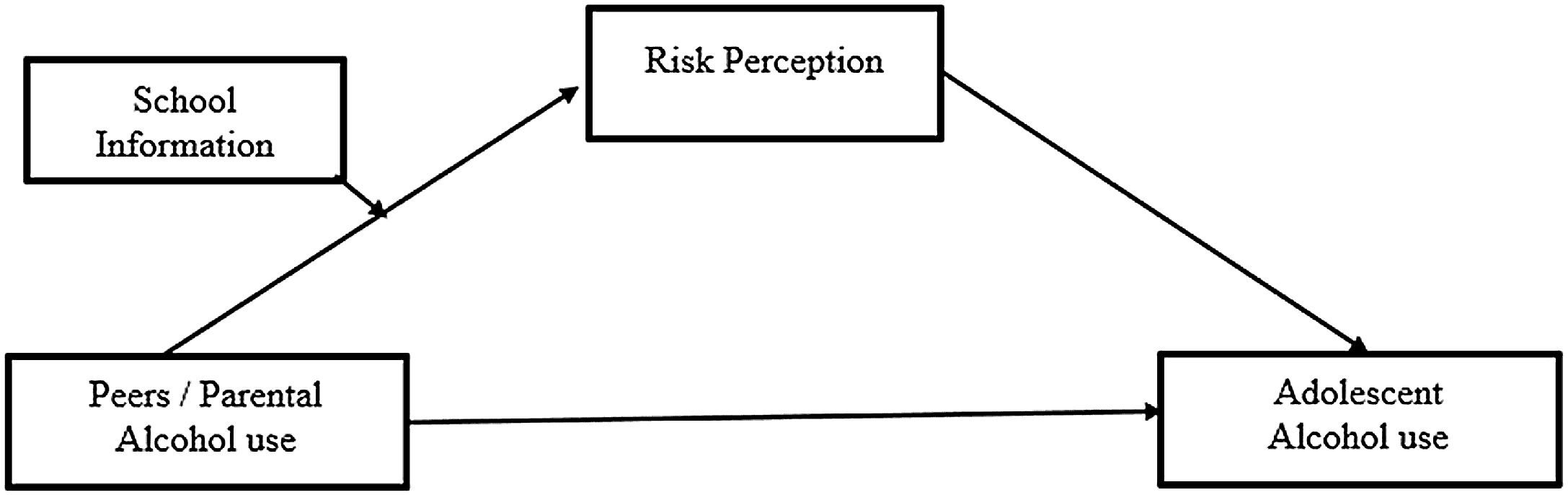
Taking all this into account, the general objective of the present study is to analyze whether the mediating effect of risk perception in the association between peers/parental drinking and adolescent alcohol use is moderated by school information about substance use. This model is represented in Figure 1. Specific objectives are: (1) to analyze if low risk perception mediates the link between peers/parental alcohol use and adolescent alcohol use; (2) to explore if school information about substance use increases adolescent risk perception of alcohol use; and (3) to test if school information about substance use moderates the relation between peers/parental alcohol use and adolescent risk perception. The corresponding hypotheses were (H1) the link between peers/parental alcohol use and adolescent alcohol use is mediated by low risk perception; (H2) school information about substance use increases adolescents risk perception; and (H3) school information about substance use moderates the relation between peers/parental alcohol use and adolescent risk perception.
MethodParticipantsParticipants were selected conducting a two-stage cluster random sampling procedure (CI = 95%), among adolescents aged 14-18 in Spain, that resulted in 863 schools and 1726 classrooms. Finally, 35369 participants (Mage = 15.57, SDage = 1.22) were included. Regarding sex, 50.1% self-identified as female a 49.9% as male. The majority of the sample was enrolled in public schools (68.9%) and about a third belonged to private schools (31.1%).
InstrumentsAdolescents reported frequency of last month alcohol use (adolescent alcohol use) (M = 1.88, SD = 1.93) with options ranging from 0 = never to 7 = more than 20 days. Three items measured risk perception of alcohol use (e.g. “how many problems can be associated with drinking 1 or 2 alcoholic drinks everyday”). Response options were 0 = few or no problems; 1 = many problems. Considering the dichotomous nature of responses to this scale, KR-20 coefficient was calculated to measure internal consistency. In this sample, KR-20 = .63.
Parental alcohol use (α = .72) was measured by asking participants “Which of the following statements best describe your mother’s/father’s alcohol use in the last 30 days?” They responded: 1 = she/he has never drunk, 2 = rarely, 3 = only on weekends, 4 = everyday or almost everyday, 5 = she/he has abused alcohol everyday or almost everyday.
Participants reported “how many of their usual friends had drunk alcohol in the last 30 days” (peers alcohol use; M = 2.25, SD = 0.75). The scale included: 0 = none, 1 = some, 2 = all or most of them.
School information about substance use (M = 0.66, SD = 0.47) was measured with the following item “Have you received information about drug use and its effects, as well as associated problems, in your current school”. Response options were 0 = No; 1 = Yes. Those who responded yes, were also asked for reporting the content of that information. Only the option effects of legal substances and associated problems was included as a moderator in the model.
ProcedureData were obtained from a secondary macro-survey, the ESTUDES Report, a research project carried out by the Spanish Ministry of Health, within the National Plan against Drugs. This study is conducted every two years with the objective of mapping drug use and related issues among Spanish adolescents enrolled in Secondary Education. The current study took data from the data collection between November 2016 and March 2017. Selected schools were informed about the aim and procedure of the study, and a date was scheduled to conduct the data collection. Participants filled out paper-pencil questionnaires in class under the supervision of the pollster in about 45-60 minutes. Participation was voluntary, anonymous and confidential, and participants could withdraw at any moment. The study adhered to national and international ethical standards, and it was approved by the Spanish Ministry of Health, Consumer Affairs and Social Welfare.
Data analysisData were analyzed using SPSS version 25. Associations among study variables were examined using Spearman bivariate correlations due to the non-normally distribution of data. Two mediation analyses were conducted using PROCESS macro version 4.2 (Model 4), to test whether adolescent risk perception of alcohol use (M) mediated the relation between peers/parental alcohol use (X) and adolescent alcohol use (Y). Also, two moderated mediation analyses were conducted using PROCESS macro version 4.2. (Model 7). Analyses tested if the relationship between peers alcohol use or parental alcohol use (X) and adolescent alcohol use (Y) was mediated by adolescent risk perception of alcohol use (M), and whether school information about substance use (Z) moderated the relation between X use and M (see Figure 1). Age and gender were added as control variables. For each model, conditional indirect effect and index of moderated mediation were estimated using 5000 bootstrap samples and 95% bias-corrected confidence intervals. Bootstrap confidence intervals are robust to non-normality, as they are based on a distribution generated empirically from the data (Hayes, 2017). All variables were standardized to facilitate interpretation.
Missing data were handled using listwise deletion. Across variables, the proportion of missing data ranged between approximately 5% and 10%. Although Little’s MCAR test indicated that data were not missing completely at random (χ² = 6133.742, df = 349, p < .001), inspection of the missingness patterns did not reveal substantively meaningful or systematic mechanisms. Before conducting the analyses, all continuous variables were standardized using the Z‑score transformation in SPSS. Therefore, the regression coefficients reported in the PROCESS models are based on pre‑standardized variables.
The national survey provides a sampling weight to correct for unequal selection probabilities and to ensure population representativeness. Prior to running the analyses, the sampling weight was applied to the dataset following the recommendations of the survey’s technical documentation. Analyses were conducted on the weighted dataset, a procedure commonly used in previous research applying PROCESS to complex survey data.
ResultsThe mediating role of risk perception in the relation between parental/peers alcohol use and adolescent substance useAccording to mediation analysis, adolescent risk perception of alcohol use had a significant indirect effect on the relation between parental alcohol use and adolescent alcohol use (β = .024; LLCI = .022: ULCI = .027). Similarly, the link between peers alcohol use and adolescent alcohol use was significantly mediated by adolescent risk perception of alcohol use (β = .021; LLCI = .019: ULCI = .024).
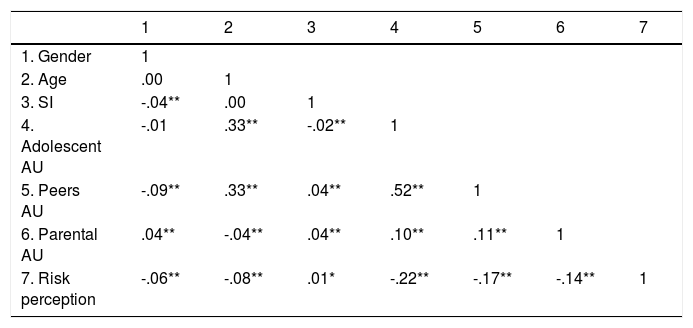
The impact of school information on adolescent risk perceptionTable 1 shows the correlation matrix for the main research variables. Following Spearman bivariate correlation results, school information about substance use and adolescent risk perception of alcohol use are positively and significantly correlated each other (r = .01, p < .05). This is risk perception of alcohol use tends to be higher when adolescents receive school information about substance use.
Correlation matrix of the study variables
| 1 | 2 | 3 | 4 | 5 | 6 | 7 | |
|---|---|---|---|---|---|---|---|
| 1. Gender | 1 | ||||||
| 2. Age | .00 | 1 | |||||
| 3. SI | -.04** | .00 | 1 | ||||
| 4. Adolescent AU | -.01 | .33** | -.02** | 1 | |||
| 5. Peers AU | -.09** | .33** | .04** | .52** | 1 | ||
| 6. Parental AU | .04** | -.04** | .04** | .10** | .11** | 1 | |
| 7. Risk perception | -.06** | -.08** | .01* | -.22** | -.17** | -.14** | 1 |
Note. *p < .05. **p < .01. SI = School Information; Adolescent AU = Adolescent Alcohol use; Peers AU = Peers Alcohol use; Parental AU = Parental Alcohol use.
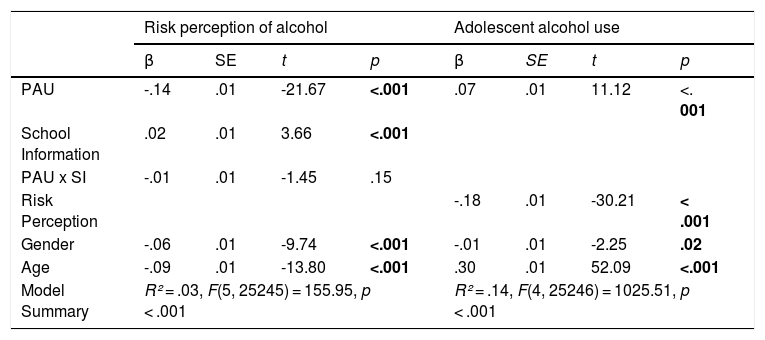
Table 2 reports the results of a moderated mediation model examining the relationship between parental alcohol use and adolescent alcohol use, where school information about substance use was a moderator and risk perception of alcohol use was a mediator. Higher parental alcohol use was related to lower risk perception of alcohol use (β = -.14, t = -21.67, p < .001). School information about substance use was linked to higher risk perception of alcohol use (β = .02, t = 3.66, p < .001). However, the interaction of parental alcohol use and school information about substance use was not significant (β = -.01, t = -1.45, p = .15). Female gender (β = -.06, t = -9.74, p < .001) and younger age (β = -.09, t = -13.80, p < .001) were related to higher risk perception of alcohol use.
Moderated mediation model: School information as a moderator and risk perception of alcohol use as a mediator on the relation between parental and adolescent alcohol use
| Risk perception of alcohol | Adolescent alcohol use | |||||||
|---|---|---|---|---|---|---|---|---|
| β | SE | t | p | β | SE | t | p | |
| PAU | -.14 | .01 | -21.67 | <.001 | .07 | .01 | 11.12 | <. 001 |
| School Information | .02 | .01 | 3.66 | <.001 | ||||
| PAU x SI | -.01 | .01 | -1.45 | .15 | ||||
| Risk Perception | -.18 | .01 | -30.21 | < .001 | ||||
| Gender | -.06 | .01 | -9.74 | <.001 | -.01 | .01 | -2.25 | .02 |
| Age | -.09 | .01 | -13.80 | <.001 | .30 | .01 | 52.09 | <.001 |
| Model Summary | R² = .03, F(5, 25245) = 155.95, p < .001 | R² = .14, F(4, 25246) = 1025.51, p < .001 | ||||||
| Conditional indirect effect | Effect | SE | LLCI | ULCI |
|---|---|---|---|---|
| School Information: No | .022 | .0023 | .0173 | .0264 |
| School Information: Yes | .025 | .0016 | .0223 | .0285 |
| Index of moderated mediation | .0035 | .0025 | -.0015 | .0085 |
Note. PAU = Parental Alcohol Use; SI = School Information; SE = Standard Error; LLCI = Lower Limit Confidence Interval; ULCI = Upper Limit Confidence Interval.
Parental alcohol use (β = .07, t = 11.12, p < .001), lower risk perception of alcohol use (β = -.18, t = -30.21, p < .001), female gender (β = -.01, t = -2.25, p = .02) and older age (β = .30, t = 52.09, p < .001) were significant predictors of adolescent alcohol use. Index of moderated mediation was not significant (β = 0.04, LLCI = -.002, ULCI = .009). Risk perception of alcohol use significantly mediated the relation between parental alcohol use and adolescent alcohol use when school information about substance use was not reported (β = 0.22, LLCI = .017, ULCI = .026) and school information about substance use was reported (β = 0.25, LLCI = .022, ULCI = .029).
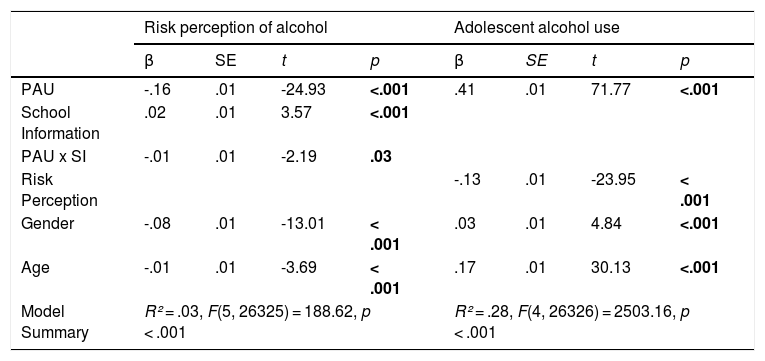
Lastly, a moderated mediation model testing the relation between peers alcohol use and adolescent alcohol use with school information about substance use as a moderator and risk perception of alcohol use as a mediator is presented in Table 3. Higher scores in peers alcohol use was related to low risk perception of alcohol use (β = -.16, t = -24.93, p < .001). School information about substance use was linked to more risk perception of alcohol use (β = .02, t = 3.57, p < .001). The interaction between peers alcohol use and school information about substance use was significant (β = -.01, t = -2.19, p = .03). Female gender (β = -.08, t = -13.01, p < .001) and younger age (β = -.01, t = -3.69, p < .001) were related to higher risk perception of alcohol use. An alternative model adding parental alcohol use as a covariate was tested. After controlling by parental alcohol use, the interaction between peers alcohol use and school information about substance use is not significant.
Moderated mediation model: School information as a moderator and risk perception of alcohol use as a mediator on the relation between peers and adolescent alcohol use
| Risk perception of alcohol | Adolescent alcohol use | |||||||
|---|---|---|---|---|---|---|---|---|
| β | SE | t | p | β | SE | t | p | |
| PAU | -.16 | .01 | -24.93 | <.001 | .41 | .01 | 71.77 | <.001 |
| School Information | .02 | .01 | 3.57 | <.001 | ||||
| PAU x SI | -.01 | .01 | -2.19 | .03 | ||||
| Risk Perception | -.13 | .01 | -23.95 | < .001 | ||||
| Gender | -.08 | .01 | -13.01 | < .001 | .03 | .01 | 4.84 | <.001 |
| Age | -.01 | .01 | -3.69 | < .001 | .17 | .01 | 30.13 | <.001 |
| Model Summary | R² = .03, F(5, 26325) = 188.62, p < .001 | R² = .28, F(4, 26326) = 2503.16, p < .001 | ||||||
| Conditional indirect effect | Effect | SE | LLCI | ULCI |
|---|---|---|---|---|
| School Information: No | .0185 | .0018 | .0151 | .0220 |
| School Information: Yes | .0222 | .0014 | .0196 | .0249 |
| Index of moderated mediation | .0038 | .0018 | .0002 | .0073 |
Note. PAU = Peers Alcohol Use; SI = School Information; SE = Standard Error; LLCI = Lower Limit Confidence Interval; ULCI = Upper Limit Confidence Interval.
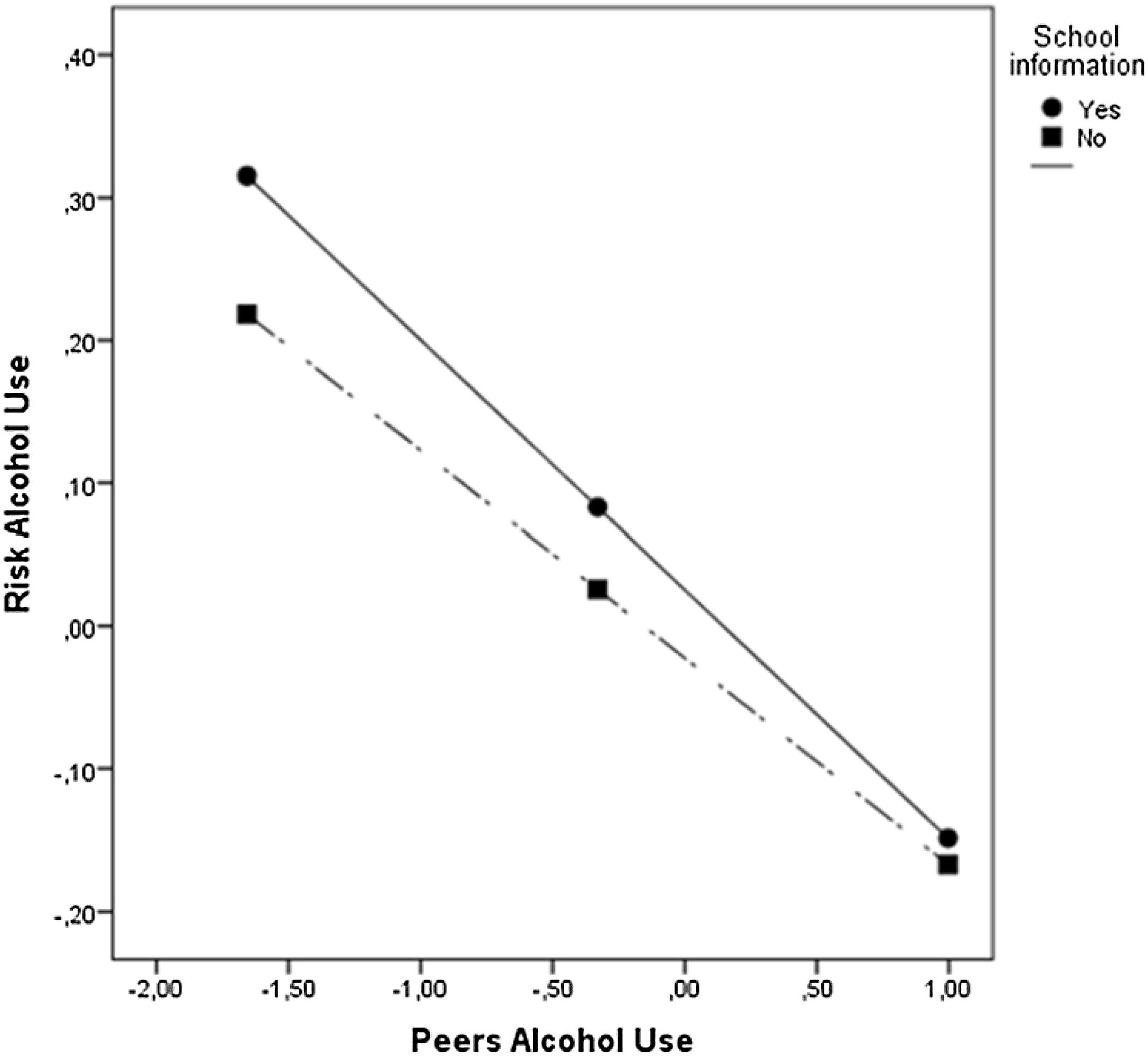
Peers alcohol use (β = .41, t = 71.77, p < .001), lower risk perception of alcohol use (β = -.13, t = -23.95, p < .001), male gender (β = .03, t = 4.84, p < .001) and older age (β = .17, t = 30.13, p < .001) significantly predicted adolescent alcohol use. Risk perception of alcohol use significantly mediated the relation between peers alcohol use and adolescent alcohol use both when school information about substance use was not reported (β = 0.19, LLCI = .015, ULCI = .022) and when school information about substance use was reported (β = 0.22, LLCI = .020, ULCI = .025). Index of moderated mediation was significant (β = 0.04, LLCI = .000, ULCI = .007]), indicating that the protective effect of risk perception of alcohol on adolescent alcohol use was strengthened by school information about substance use (see Figure 2).
DiscussionThere is a fruitful body of literature demonstrating that adolescents are at higher risk of alcohol consumption when their parents are peer are alcohol users. Therefore, strategies that aim at preventing adolescent alcohol use should specifically target adolescents surrounded by alcohol-using environments. This requires a comprehensive understanding of the interaction between individual and contextual protective factors against adolescent substance use. Based on this, the general objective of the current study was to analyze whether school information about substance use moderates the tentative mediational effect of risk perception of alcohol use in the association between peers/parental alcohol use and adolescent drinking.
The first specific objective sought to test if low levels of adolescent risk perception mediated the association between peers/parental alcohol use and adolescent drinking. The hypothesis linked with this objective (H1) was confirmed, given that low risk perception of alcohol is a significant mediator that drives to alcohol use when parents and peers drink. Individuals surrounded by alcohol-using environment could normalize this behavior, which decreases risk perception and makes drinking more likely. This is in line with previous research conducted with university students suggesting that changing perceptions about alcohol use could be a successful strategy to decrease drinking rates (Coskunpinar & Cyders, 2012). Indeed, scientific evidence shows that interventions that change risk perception are useful to promote healthy behavior (Ferrer & Klein, 2015). Thus, giving information to adolescents about the risks of alcohol could be a successful strategy to decrease alcohol use.
Hence, the second specific objective proposed to analyze whether school information about substances increased adolescent risk perception. Although prior work suggests that interventions based on information are not as effective as other types of interventions to decrease substance use (Griffin & Botvin, 2010), our results report a weak but significant effect of school information in increasing risk perception of alcohol, which confirms the second hypothesis. Given that peers and parental alcohol use decrease adolescent risk perception of alcohol, individuals exposed to school information can experience cognitive dissonance (Festinger, 1957; Harmon-Jones & Mills, 2019) if their peers and parents drink, due to the discrepancy between the information they receive and the behaviors they observe in their surrounding environments. The matter here is how adolescents deal with this dissonance. On the one hand, they can be congruent with their cognitive schema and reduce alcohol use. On the other hand, adolescents might ignore knowledge about risks and go on using alcohol likewise.
Because of that, the third specific objective was to explore if school information moderated the impact of peers and parental alcohol use on adolescent risk perception. In this sense, the third hypothesis was partially confirmed due to the differential result depending on the context of socialization. School information attenuated the influence of peers drinking on adolescent risk perception, but the moderating effect was not significant in the case of parental alcohol use. This is somehow contrary to previous research conducted by Rodriguez-Sanchez et al. (2018) reporting that school information moderated the effect of parental but no peers alcohol use. Nevertheless, Rodriguez-Sanchez et al. (2018) analyzed adolescent binge drinking as dependent variable, while the current study analyzed the impact on adolescent risk perception. It is still to be investigated if the moderating effect of school information on risk perception drives to a decrease in adolescent drinking. Additionally, different parental factors beyond parental substance use itself influence adolescent risk perception. So, future studies should consider elements such as parental norms, supervision, parental styles or family communication in the interplay between parental influences, school information and adolescent substance use.
Finally, in order to test the general objective, a global moderated mediation model was run to test if school information moderated the link between peers/parental alcohol use and adolescent risk perception, which in turn decreased adolescent drinking. Again, the moderated mediation effect was significant for peers, but not parental alcohol use. It can be explained due to differences in stability between these contexts. Family (parents in this case) is a long-term stable setting, where socialization follows a vertical structure (Arranz & Oliva, 2010) and parental behaviors are difficult to be changed by children. So, despite adolescents receive information about substances at school, the continuous exposure to drinking at home can lead to avoid this information. In contrast, peer groups are more flexible, and adolescents can even change from one group to another with different habits. Thus, adolescents whose peers use alcohol can benefit from school information and decide to relate with other non-drinking peers when they become aware of the risks of using alcohol.
The present study has some strengths and limitations that should be acknowledged. Research objectives built upon a solid theoretical model: McLeroy’s Socio-Ecological Model, whose complexity and broad approach provides strong model to analyze public health issues. In addition, a large and national representative sample of adolescents was surveyed, which makes these results generalizable to the general population. However, our analyses relied on a secondary macro-survey, which measured some variables, such us school information, using a single item. Chronological associations among variables are not possible given the cross-sectional design. Thus, terms like impact or effect does not suggest causal relationships, but support theoretical interpretations. It would be useful if future research explores longitudinal relationships among these factors.
Even with some limitations, these findings have important implications for research and practice. Regarding implications for research, our results provide empirical support to the McLeroy’s socio-ecological model, showing the importance of considering the interplay among the individual level (risk perception), the interpersonal level (peers/parental alcohol use) and the institutional level (school information) to get a complex understanding of adolescent alcohol use. Although this is a solid theoretical model, there is a dearth of research based on this approach, which has demonstrated to be a good model to guide substance use related research. The incorporation of community (e.g. neighborhood conditions) and policy (e.g. legislation about substance use) factors related to adolescent substance use in future studies would enrich the scientific comprehension of adolescent alcohol use. With regards to implications for practice, this investigation shows that school strategies based on information about substances have a weak but significant effect in increasing adolescents risk perception. Indeed, these strategies increase risk perception even in adolescents who relate with drinking peers and protect against alcohol use, which is the strongest insight this study provides to scientific knowledge on the field. Therefore, including content related to alcohol harm in school-based prevention strategies is useful to buffer peer influences on adolescent drinking. Unfortunately, school information was ineffective to increase risk perception among adolescents whose parents use alcohol. Perhaps, schools need to find the way to include parents as well to effectively increase their offspring risk perception.
CRediT authorship contribution statementJoaquín Rodríguez-Ruiz: conceptualization, methodology, formal analysis, data curation, writing – original draft, writing – review & editing, visualization. Raquel Espejo-Siles: methodology, formal analysis, data curation, writing – review & editing.
Funding for open access chargeUniversidad de Huelva / CBUA.