


Obese patients present challenging airway conditions, including reduced functional residual capacity and rapid desaturation during apnoea. Videolaryngoscopy improves glottic visualisation, but evidence comparing it with direct laryngoscopy in bariatric patients managed by experienced anaesthesiologists remains limited. We conducted a prospective randomised trial comparing these techniques.
Methods256 adult patients (BMI > 35 kg/m²) were randomised to intubation with a standard Macintosh laryngoscope or a hyperangulated videolaryngoscope (INSIGHT iS3-L), with a stylet routinely used in the videolaryngoscopy group. All received a standardised opioid-free anaesthesia protocol. The primary outcome was time to intubation (TOF = 0 to capnographic confirmation). Secondary outcomes included first-attempt success rate, number of intubation attempts, and bougie use.
ResultsOverall intubation success was achieved in all 256 patients; however, 4 patients (3.1%) in the Macintosh group required conversion to videolaryngoscopy as rescue. Median time to intubation was significantly shorter in the Macintosh group (35 [IQR 30–47.5] s vs 46 [IQR 35–62] s; P < .001), a difference partly attributable to operator familiarity and unlikely to be clinically relevant given comparable safety outcomes. No significant differences were observed in first-attempt success, intubation attempts, or bougie use. No airway injury or oxygen desaturation below 90% occurred; one prolonged Macintosh-group intubation was associated with peri-intubation bradycardia and hypotension. Neither Mallampati classification nor neck circumference > 43–44 cm reliably predicted intubation difficulty.
ConclusionsIn this single-centre study of selected obese patients managed by experienced anaesthesiologists, direct laryngoscopy achieved shorter intubation times than a hyperangulated videolaryngoscope with comparable safety outcomes; however, the 11-second difference in median times is unlikely to be clinically relevant. The 3.1% conversion rate underscores that videolaryngoscopy must always be immediately available. Videolaryngoscopy remains essential in anticipated difficult airway management.
Los pacientes obesos presentan condiciones de la vía aérea difíciles, que incluyen reducción de la capacidad residual funcional y desaturación rápida durante la apnea. El videolaringoscopio mejora la visualización glótica, pero es limitada la evidencia que lo compara con el laringoscopio directo en pacientes bariátricos manejados por anestesiólogos experimentados. Realizamos un ensayo aleatorizado prospectivo comparando ambas técnicas.
MétodosAleatorizamos 256 pacientes adultos (IMC > 35 kg/m²) en un grupo de intubación con laringoscopio Macintosh estándar o en un grupo de videolaringoscopio hiperangulado (INSIGHT iS3-L), con estilete habitualmente utilizado en el grupo videolaringoscopio. Todos recibieron un protocolo anestésico estandarizado sin opioides. El resultado primario fue el tiempo hasta la intubación (TOF = 0 hasta la confirmación capnográfica). Los resultados secundarios incluyeron la tasa de éxito al primer intento, el número de intentos de intubación, y el uso de introductor (Bougie).
ResultadosEl éxito global de la intubación se logró en los 256 pacientes; sin embargo, cuatro pacientes (3,1%) del grupo Macintosh requirieron conversión a videolaringoscopio como rescate. El tiempo medio hasta la intubación fue significativamente menor en el grupo Macintosh (35 [RIC 30–47,5] s vs 46 [RIC 35–62] s; P < ,001), una diferencia parcialmente atribuible a la familiaridad del operador, que no fue clínicamente relevante dados los resultados de seguridad comparables. No se observaron diferencias significativas en cuanto a éxito al primer intento, intentos de intubación, o uso de introductor. No se produjeron lesión de la vía aérea ni desaturación de oxígeno inferior al 90%; una intubación prolongada del grupo Macintosh estuvo asociada a bradicardia e hipotensión periintubación. Ni la clasificación de Mallampati ni el perímetro del cuello> 43–44 cm predijeron fiablemente la dificultad de la intubación.
ConclusionesEn este estudio unicéntrico de pacientes obesos seleccionados manejados por anestesiólogos expertos, el laringoscopio directo logró tiempos de intubación más breves que el videolaringoscopio hiperangulado, con resultados de seguridad comparables; sin embargo, es improbable que la diferencia de 11 segundos en los tiempos medios times sea clínicamente relevante. La rata de conversión del 3,1% destaca que debe disponerse de inmediato de videolaringoscopio. El videolaringoscopio sigue siendo esencial en el manejo de la vía aérea difícil prevista.
Obesity is one of the most prevalent and rapidly growing health problems worldwide, contributing to reduced quality of life and shortened life expectancy through obesity-related comorbidities.1 The World Health Organization defines obesity as a body mass index (BMI) exceeding 30 kg/m², and morbid obesity as a BMI exceeding 40 kg/m². From an anaesthetic perspective, obese patients frequently present challenging airway characteristics, including difficult mask ventilation and a higher incidence of difficult laryngoscopy and intubation compared with non-obese patients.2–4 Critically, their reduced functional residual capacity renders them particularly susceptible to rapid arterial desaturation during apnoea, making efficient and successful tracheal intubation especially important.4
The standard Macintosh laryngoscope remains the most widely used device for visualising the laryngeal inlet. Over the past 2 decades, videolaryngoscopy has emerged as an important alternative, enabling indirect laryngeal visualisation via a camera mounted on the blade tip.5 Contemporary international guidelines and meta-analyses increasingly support videolaryngoscopy not only as a rescue technique but also as a first-line or routine intubation strategy in many clinical settings, particularly for anticipated difficult airways and for less-experienced operators.6–9 Videolaryngoscopes differ substantially in blade geometry (Macintosh-style versus hyperangulated), which have important implications for tube delivery mechanics and operator learning curve.10,11 Despite improved glottic visualisation, successful tube delivery is not always straightforward — a phenomenon described as “can see, cannot intubate”. In other words, an improved laryngeal view does not automatically translate into shorter intubation time or higher first-pass success.11
Numerous clinical parameters have been proposed to predict difficult laryngoscopy in obese patients, including the Mallampati classification12 and neck circumference.13 However, evidence suggests that no single anthropometric measure reliably predicts difficult intubation in this population, underscoring the need for a multiparametric approach to preoperative airway assessment.
Although several studies have compared videolaryngoscopy and direct laryngoscopy in obese patients, many have been limited by small sample sizes and heterogeneous operator experience.14 In this context, we conducted a prospective randomised controlled trial to compare a hyperangulated videolaryngoscope with the standard Macintosh laryngoscope in a selected cohort of obese patients undergoing bariatric surgery. Our primary endpoint was time to successful intubation, a factor that is particularly important in obese patients given their susceptibility to rapid desaturation.
MethodsStudy designThis was a single-centre, prospective randomised controlled trial conducted at the University Hospital in Cracow between March 2024 and December 2024 in patients with obesity (BMI > 35 kg/m²) undergoing laparoscopic bariatric surgery (laparoscopic sleeve gastrectomy). The study was designed and reported in accordance with the CONSORT 2010statement. Ethics approval was granted by the Bioethics Committee of the Jagiellonian University in Cracow on 17 January 2024 (approval code: 1072.6120.135.2023), and the study was prospectively registered at ClinicalTrials.gov (NCT07004621). All methods adhered to the principles of the 2013 Declaration of Helsinki, and all participants provided written informed consent prior to enrolment.
Inclusion and exclusion criteriaInclusion criteria: Adult patients (>18 years) with BMI > 35 kg/m² scheduled for laparoscopic sleeve gastrectomy (ASA physical status < IV).
Exclusion criteria:
- •
Refusal to participate.
- •
Known or anticipated difficult airway.
- •
Requirement for rapid sequence induction.
- •
Cervical tumours, goitre, or prior cervical radiotherapy.
- •
Facial or cervical fractures or maxillofacial abnormalities.
- •
Known allergy to drugs used during anaesthesia.
- •
Chronic pain syndromes or chronic opioid use.
It is important to emphasise that the exclusion of patients with known or anticipated difficult airway, rapid sequence induction requirements, and significant anatomical abnormalities limits the study population to relatively optimised bariatric patients. The findings therefore cannot be generalised to patients with truly complex or anatomically challenging airways.
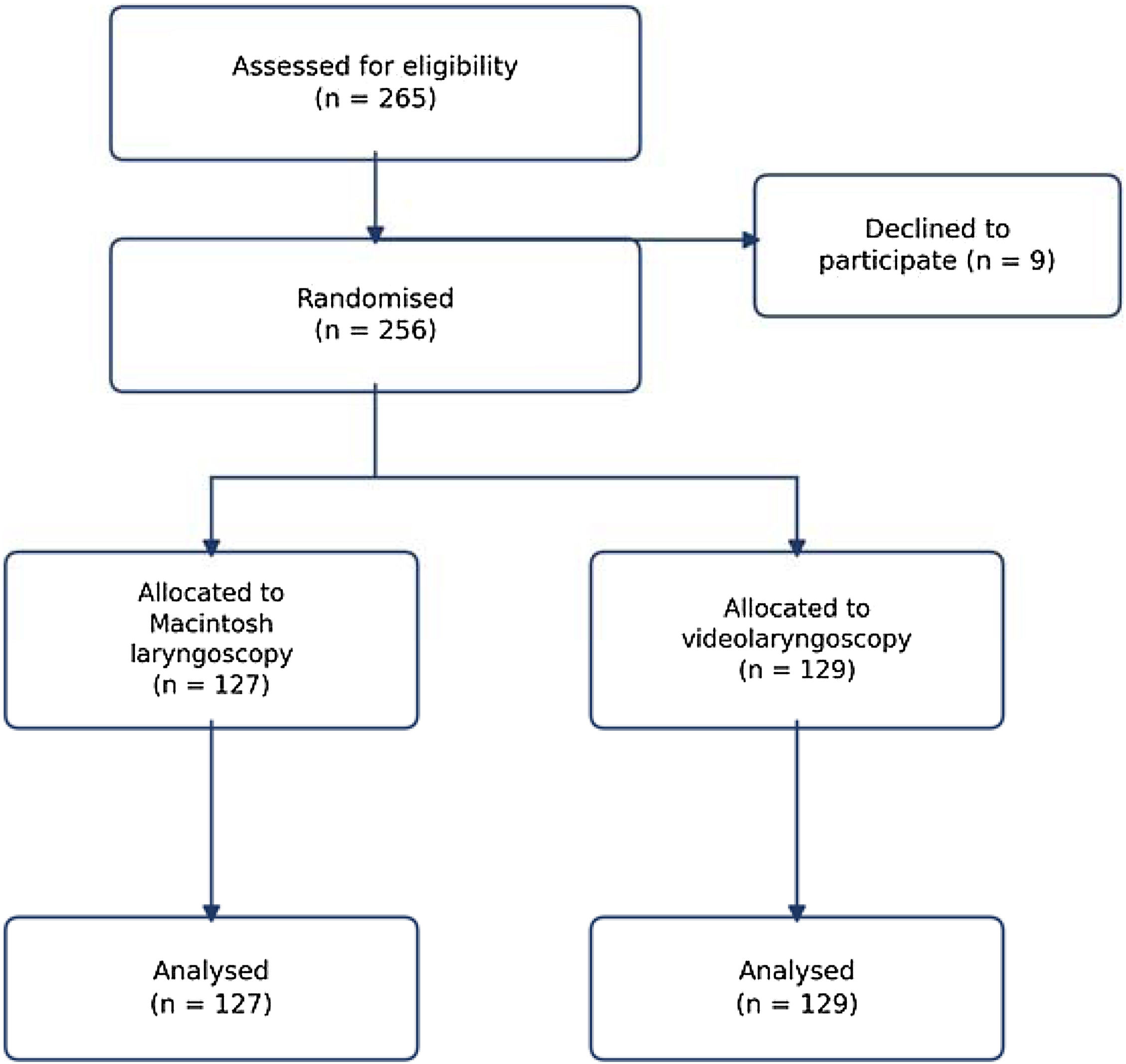
Randomisation and blindingAfter obtaining informed consent, patients were randomly assigned (1:1) to either the Macintosh group or the videolaryngoscopy group using a computer-generated randomisation list produced in Microsoft Excel 2016. Allocation was performed by a designated research coordinator using sequentially numbered sealed envelopes. The attending anaesthesiologists were aware of the assigned device (open-label design), while outcome assessors evaluating postoperative variables remained blinded to group allocation. The patient flow is shown in Fig. 1.
Devices and intubation methodologyIn the Macintosh group, intubation was performed using a standard curved Macintosh laryngoscope blade (size 3 or 4 according to operator preference). In the videolaryngoscopy group, the INSIGHT iS3-L videolaryngoscope (Shenzhen Insighters Medical Technology Co., Shenzhen, China) was used. This device features a hyperangulated blade that provides an enhanced view of the laryngeal inlet but requires a stylet for tube delivery; a stylet was therefore routinely used in the videolaryngoscopy group. A standard preformed endotracheal tube mounted on a stylet was used in all videolaryngoscopy group patients.
All intubations were performed by 6 consultant anaesthesiologists, each with a minimum of 5 years of experience in direct laryngoscopy. All 6 operators had already used the INSIGHT iS3-L videolaryngoscope in routine clinical practice for approximately 5 years, and prior to the study each had performed at least 50 videolaryngoscope-assisted intubations. Although this number exceeds the threshold for basic proficiency with hyperangulated devices,22 it falls substantially short of the extensive direct laryngoscopy experience accumulated over many years of high-volume bariatric practice. No formal structured familiarisation programme was conducted prior to study commencement. This disparity in cumulative experience between devices represents an important potential source of performance bias.
An intubation attempt was defined as insertion of the laryngoscope blade into the oral cavity. If intubation with the initially assigned device was unsuccessful or abandoned at the operator’s discretion, rescue with the alternative device was permitted. Permitted optimisation manoeuvres included external laryngeal manipulation (BURP), head repositioning, and bougie use. A bougie was available from the first attempt in both groups, and was used at the operator’s discretion. Cormack–Lehane grade, POGO score and difficult tracheal tube delivery were not collected systematically as study variables; this is a methodological limitation that is discussed further in the Limitations section. The Cormack–Lehane grades reported below for the 4 rescue cases were obtained retrospectively from the anaesthesia charts and do not constitute prospectively collected study data.
Preoperative assessment and perioperative managementIn the preoperative period, demographic data and airway characteristics were recorded, including Mallampati classification and neck circumference. All patients were place in the “ramp” position (horizontal alignment of the external auditory meatus and the sternal notch) prior to induction. Standard monitoring included non-invasive arterial blood pressure, pulse oximetry, electrocardiography, TOF neuromuscular monitoring, and bispectral index (BIS). No sedative premedication was administered.
A standardised opioid-free anaesthesia (OFA) protocol was used throughout. Before induction, all patients received dexmedetomidine 20 μg IV over 10 min, paracetamol 1 g IV, metamizole 2.5 g IV, dexketoprofen 50 mg IV, dexamethasone 10 mg IV, and magnesium sulphate 20 mg/kg IBW IV. Induction consisted of propofol 1.5–2 mg/kg LBW, ketamine 1 mg/kg LBW (maximum 50 mg), lidocaine 1.5 mg/kg LBW, and rocuronium 0.6 mg/kg IBW. Intubation was performed when TOF reached 0 and BIS was 40–60.
Anaesthesia was maintained with sevoflurane (0.8–1.5 MAC) or propofol TCI (Schnider model) titrated to BIS 40–60. Mechanical ventilation was delivered in pressure-controlled volume-guaranteed mode (PCV-VG) at tidal volumes of 6–8 mL/kg IBW, with EtCO2 target 35–45 mmHg and individually titrated PEEP. Neuromuscular blockade was reversed with sugammadex 2 mg/kg corrected body weight targeting TOF ratio ≥ 0.9.
Statistical analysisThe sample size was determined based on a pilot study (n = 5 per group) that estimated a mean difference of 34 s in intubation time with a standard deviation of 14 s. Power analysis (two-sided α = 0.05, power = 0.80) indicated a minimum of 30 patients per group. To increase statistical power, the planned sample was increased fourfold to approximately 120 patients per group (256 patients ultimately enrolled). We acknowledge that basing the sample size calculation on only 5 patients per group carries inherent uncertainty, and the fourfold increase was a pragmatic rather than a formally powered decision.
The distribution of the primary outcome was markedly right-skewed; accordingly, quantitative variables are described as median (interquartile range, IQR), with mean ± standard deviation (SD) provided for reference. The Mann–Whitney U test was used to compare quantitative variables between groups, and qualitative variables were compared using the chi-square test (with Yates’ correction for 2 × 2 tables) or Fisher’s exact test, as appropriate. Spearman’s correlation was used for correlations between quantitative variables. Logistic regression was used for univariate analysis of quantitative predictors of dichotomous outcomes, expressed as odds ratios (OR) with 95% confidence intervals (CI). Cut-off values were determined using ROC analysis (maximum distance from the upper-left corner). A two-sided significance level of α = 0.05 was used throughout. All analyses were performed in R v4.4.2.15
OutcomesPrimary outcome: Time to intubation (T), defined as the interval from TOF reaching 0 (complete neuromuscular blockade) to the first upstroke of the capnographic trace confirming tracheal intubation, measured in seconds. This interval included all procedural steps taken between these time-points, including ventilation between attempts, optimisation manoeuvres, bougie manipulation, and device exchange where applicable.
Secondary outcomes: First-attempt intubation success; overall tracheal intubation success; need for rescue videolaryngoscopy; total number of intubation attempts; use of an introducer (bougie); and peri-intubation adverse events (including airway injury, oxygen desaturation below 90%, haemodynamic events such as bradycardia or hypotension, and other procedure-related complications). Mallampati classification and neck circumference were analysed as predictors of intubation difficulty.
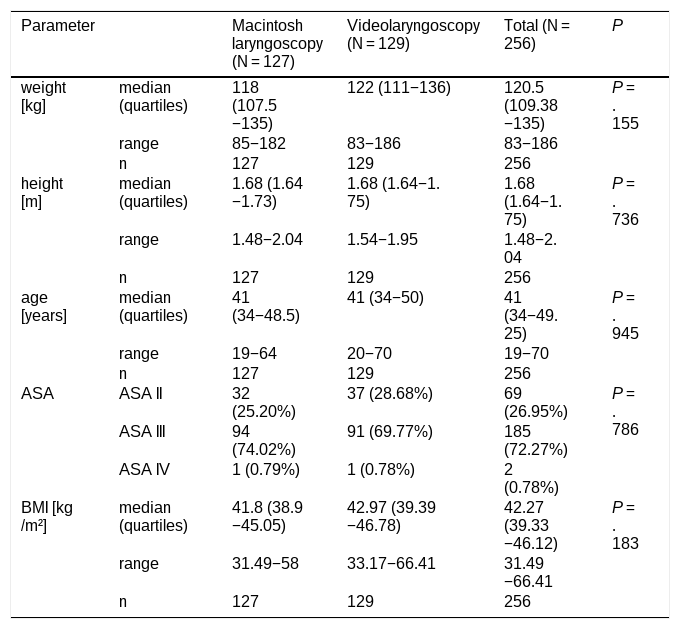
ResultsA total of 265 patients were assessed for eligibility; 9 declined participation. The final analysis included all 256 randomised patients (Fig. 1); 127 were allocated to the Macintosh group and 129 to the videolaryngoscopy group, with no post-randomisation exclusions. Demographic and baseline characteristics were comparable between groups (Table 1).
Demographic parameters.
| Parameter | Macintosh laryngoscopy (N = 127) | Videolaryngoscopy (N = 129) | Total (N = 256) | P | |
|---|---|---|---|---|---|
| weight [kg] | median (quartiles) | 118 (107.5−135) | 122 (111−136) | 120.5 (109.38−135) | P = .155 |
| range | 85−182 | 83−186 | 83−186 | ||
| n | 127 | 129 | 256 | ||
| height [m] | median (quartiles) | 1.68 (1.64−1.73) | 1.68 (1.64−1.75) | 1.68 (1.64−1.75) | P = .736 |
| range | 1.48−2.04 | 1.54−1.95 | 1.48−2.04 | ||
| n | 127 | 129 | 256 | ||
| age [years] | median (quartiles) | 41 (34−48.5) | 41 (34−50) | 41 (34−49.25) | P = .945 |
| range | 19−64 | 20−70 | 19−70 | ||
| n | 127 | 129 | 256 | ||
| ASA | ASA II | 32 (25.20%) | 37 (28.68%) | 69 (26.95%) | P = .786 |
| ASA III | 94 (74.02%) | 91 (69.77%) | 185 (72.27%) | ||
| ASA IV | 1 (0.79%) | 1 (0.78%) | 2 (0.78%) | ||
| BMI [kg/m²] | median (quartiles) | 41.8 (38.9−45.05) | 42.97 (39.39−46.78) | 42.27 (39.33−46.12) | P = .183 |
| range | 31.49−58 | 33.17−66.41 | 31.49−66.41 | ||
| n | 127 | 129 | 256 |
p - Qualitative variables: chi-square test or Fisher's exact test. Quantitative variables: Mann-Whitney test.
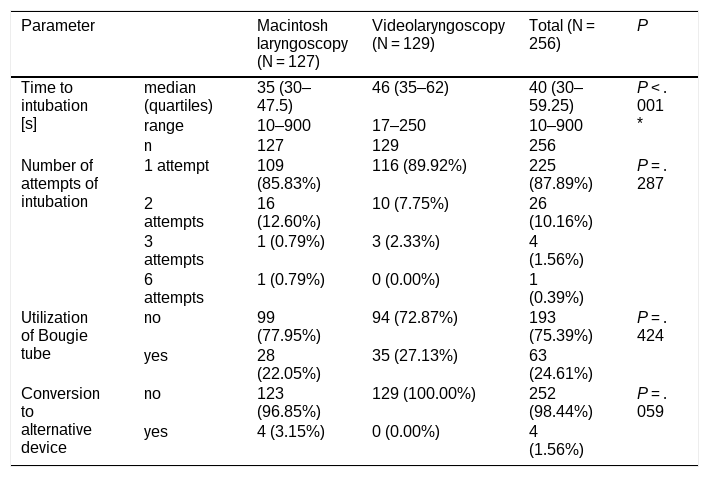
Primary outcome – Time to intubation: The distribution of intubation times was markedly right-skewed (range 10–900 s in the Macintosh group, 17–250 s in the videolaryngoscopy group). The median (IQR) time to intubation was 35 (30–47.5) s in the Macintosh group versus 46 (35–62) s in the videolaryngoscopy group (P < .001; Table 2). The absolute difference in median intubation time between groups was 11 s. In the context of comparable safety outcomes and no episodes of desaturation in either group, this is unlikely to be of clinical significance. For reference, mean ± SD values were 53.57 ± 84.85 s versus 58.01 ± 39.0 s respectively; however, these should be interpreted with caution given the skewed distribution, particularly the large standard deviation in the Macintosh group driven by outlier cases.
Differences regarding the time to intubation, number of intubation attempts, utilization of Bougie tube.
| Parameter | Macintosh laryngoscopy (N = 127) | Videolaryngoscopy (N = 129) | Total (N = 256) | P | |
|---|---|---|---|---|---|
| Time to intubation [s] | median (quartiles) | 35 (30–47.5) | 46 (35–62) | 40 (30–59.25) | P < .001 * |
| range | 10–900 | 17–250 | 10–900 | ||
| n | 127 | 129 | 256 | ||
| Number of attempts of intubation | 1 attempt | 109 (85.83%) | 116 (89.92%) | 225 (87.89%) | P = .287 |
| 2 attempts | 16 (12.60%) | 10 (7.75%) | 26 (10.16%) | ||
| 3 attempts | 1 (0.79%) | 3 (2.33%) | 4 (1.56%) | ||
| 6 attempts | 1 (0.79%) | 0 (0.00%) | 1 (0.39%) | ||
| Utilization of Bougie tube | no | 99 (77.95%) | 94 (72.87%) | 193 (75.39%) | P = .424 |
| yes | 28 (22.05%) | 35 (27.13%) | 63 (24.61%) | ||
| Conversion to alternative device | no | 123 (96.85%) | 129 (100.00%) | 252 (98.44%) | P = .059 |
| yes | 4 (3.15%) | 0 (0.00%) | 4 (1.56%) |
p - Qualitative variables: chi-square test or Fisher's exact test. Quantitative variables: Mann-Whitney test.
The maximum recorded intubation time of 900 s occurred in a single patient in the Macintosh group who required 6 intubation attempts. The was a case of difficult intubation in which repeated direct laryngoscopy attempts by an experienced operator were complicated by operator fixation, ultimately requiring conversion to videolaryngoscopy with bougie assistance. The patient had a Mallampati class 3 airway and a neck circumference of 58 cm, and presented peri-intubation bradycardia and hypotension. The total time from TOF 0 to capnographic confirmation, including all attempts and device exchange, was recorded as the primary outcome value. This case was a clinical outlier that disproportionately influenced the mean + SD of the Macintosh group. In addition to this case, 3 further patients in the Macintosh group required conversion to videolaryngoscopy as a rescue technique: one had a Cormack–Lehane grade 4 view on direct laryngoscopy, one had a Cormack–Lehane grade 3 view requiring bougie assistance after conversion, and one additional case of failed direct laryngoscopy. In total, 4 patients (3.1%) assigned to the Macintosh group ultimately required videolaryngoscopy for successful intubation (Table 2), underscoring the essential role of videolaryngoscopy as an immediately available rescue technique even when direct laryngoscopy is the primary approach.
Secondary outcomes: No statistically significant differences were found in the number of intubation attempts (P = .287) or bougie use (P = .424) (Table 2). No dental injury, airway trauma or oxygen desaturation below 90% occurred; one prolonged Macintosh-group intubation was associated with peri-intubation bradycardia and hypotension. Notably, the videolaryngoscopy group showed numerically higher first-attempt success with the assigned device (89.92% vs 85.83%) despite longer overall intubation times, a finding consistent with the “can see, cannot intubate” phenomenon: improved glottic visualisation with a hyperangulated blade but more challenging tube delivery. It should be noted that first-attempt success rates reflect performance with the initially assigned device and do not account for the 4 patients in the Macintosh group who ultimately required conversion to videolaryngoscopy. Overall bougie use was 24.61%, likely reflecting a combination of institutional practice and difficulty with tube advancement in addition to any visualisation challenges.
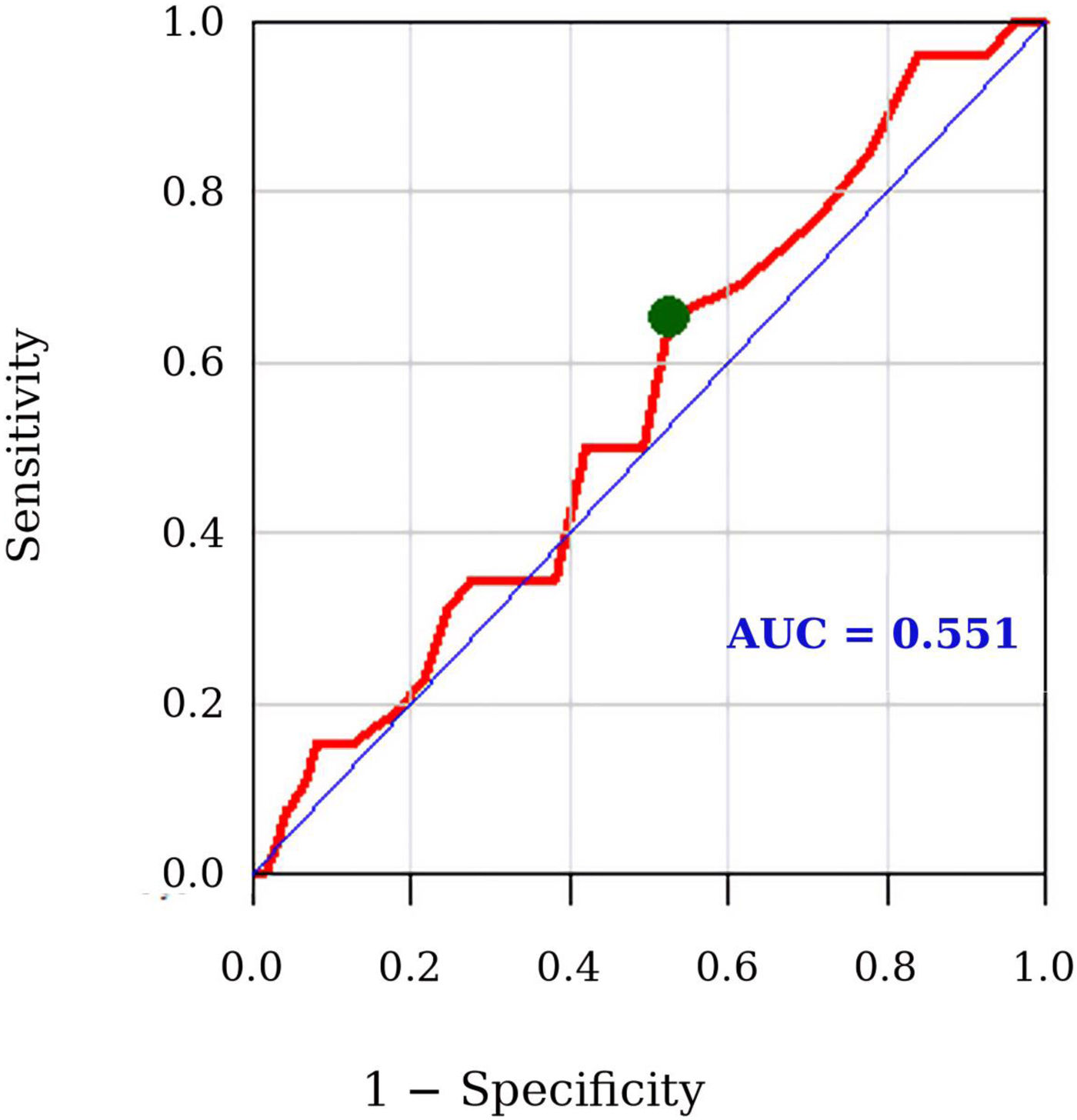
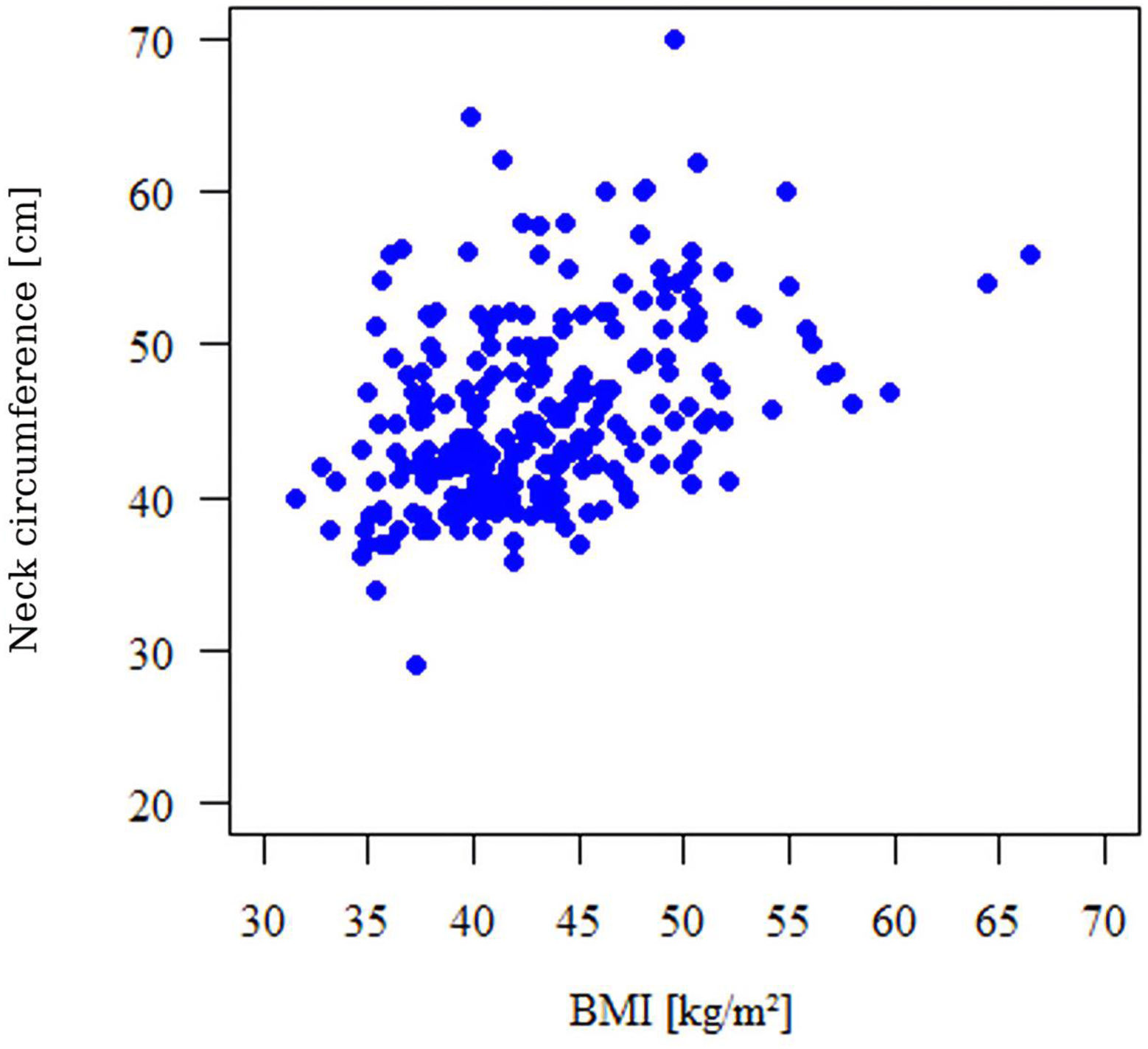
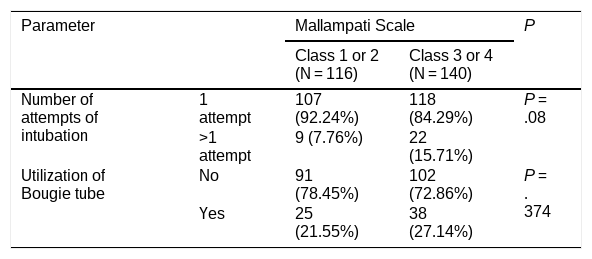
Airway prediction variables: Neither Mallampati class 3–4 nor neck circumference > 43 cm was significantly associated with the number of intubation attempts or bougie use (Table 3). The AUC for neck circumference as a predictor of difficult intubation was 0.551, indicating poor discriminative ability. The optimal ROC-derived cut-off was 44 cm (sensitivity 65.38%, specificity 47.39%; Fig. 2). A significant positive correlation was found between BMI and neck circumference (Spearman r = 0.416, P < .001; Fig. 3).
Airway assessment variables and intubation difficulty.
| Parameter | Mallampati Scale | P | ||
|---|---|---|---|---|
| Class 1 or 2 (N = 116) | Class 3 or 4 (N = 140) | |||
| Number of attempts of intubation | 1 attempt | 107 (92.24%) | 118 (84.29%) | P = .08 |
| >1 attempt | 9 (7.76%) | 22 (15.71%) | ||
| Utilization of Bougie tube | No | 91 (78.45%) | 102 (72.86%) | P = .374 |
| Yes | 25 (21.55%) | 38 (27.14%) | ||
| Parameter | Neck circumference | P | ||
|---|---|---|---|---|
| ≤ 43 cm (N = 118) | > 43 cm (N = 138) | |||
| Number of attempts of intubation | 1 attempt | 107 (90.68%) | 118 (85.51%) | P = .284 |
| >1 attempt | 11 (9.32%) | 20 (14.49%) | ||
| Utilization of Bougie tube | No | 92 (77.97%) | 101 (73.19%) | P = .46 |
| Yes | 26 (22.03%) | 37 (26.81%) | ||
p - chi-square test or Fisher's exact test.
In this prospective randomised trial of 256 obese patients undergoing bariatric surgery, direct Macintosh laryngoscopy was associated with a statistically shorter time to intubation compared with a hyperangulated videolaryngoscope. Overall, however, intubation was successful with both techniques in all patients, with no peri-intubation airway complications and no significant differences in first-attempt success, number of intubation attempts, or bougie use. Notably, 4 patients (3.1%) in the Macintosh group required conversion to videolaryngoscopy as a rescue technique – an event that is discussed further below. These findings should be interpreted carefully within the specific context of this study: a single high-volume bariatric centre, 6 experienced anaesthesiologists with substantially greater familiarity with direct laryngoscopy, a selected patient population without anticipated difficult airways, and a single hyperangulated videolaryngoscope model.
There is broad consensus in the literature that videolaryngoscopy improves glottic visualisation compared with direct laryngoscopy.6,7 Contemporary international guidelines increasingly support videolaryngoscopy as a first-line intubation strategy, particularly in anticipated difficult airways, and several meta-analyses demonstrate clear benefits for less-experienced operators.6–9,16,17 In obese patients specifically, Hoshijima et al.18 found in a systematic review of 13 randomised trials that videolaryngoscopy was associated with higher overall success rate and shorter intubation time. Against this background, our finding of shorter intubation times with direct laryngoscopy requires careful contextualisation rather than generalisation.
The most plausible explanation for our findings is operator familiarity. All 6 intubating anaesthesiologists had accumulated extensive experience with direct laryngoscopy over many years in a high-volume bariatric centre, while their experience with the specific hyperangulated videolaryngoscope, although exceeding the threshold for basic proficiency (at least 50 intubations per operator),22 was substantially less than their cumulative direct laryngoscopy experience. Although Ott et al. demonstrated that proficiency with a hyperangulated blade can be achieved after approximately 12 attempts in clinicians experienced with direct laryngoscopy,22 proficiency and expertise are not equivalent: the automaticity and speed associated with years of daily direct laryngoscopy practice likely conferred a significant performance advantage that 50 videolaryngoscope-assisted intubations could not fully offset. This is further supported by the established principle that the advantage of videolaryngoscopy is greater in less-experienced operators and diminishes in the hands of highly experienced direct laryngoscopists.8,17 Nandakumar et al.19 similarly found no clear advantage of videolaryngoscopy in obese patients where operators were highly experienced with direct laryngoscopy. It is important to note that the observed difference in median intubation time in the present study was 11 s — a magnitude that, while statistically significant, is unlikely to translate into a clinically meaningful difference in patient safety, particularly given the comparable rates of desaturation, complications, and intubation success between groups. Statistical significance should not be equated with clinical superiority.
An important concept in the videolaryngoscopy literature is the dissociation between glottic visualisation and successful tracheal tube delivery, sometimes referred to as “can see, cannot intubate”.11 An improved Cormack–Lehane grade does not automatically translate into faster or easier intubation, particularly with hyperangulated devices where tube delivery requires a specific technique that differs substantially from direct laryngoscopy. In our study, the numerically higher first-attempt success rate but longer overall intubation times observed in the videolaryngoscopy group is consistent with this phenomenon, i.e., better visualisation but more challenging and time-consuming tube delivery with the hyperangulated blade. The relatively high overall bougie use rate (24.61%) likely reflects a combination of institutional practice and difficulty with tube advancement rather than poor glottic visualisation per se.
It is important to bear in mind that not all videolaryngoscopes are the same. Devices differ substantially in blade geometry (Macintosh-style versus hyperangulated), screen design, ergonomics, stylet requirements, and tube delivery mechanics.10,21 The INSIGHT iS3-L used in this study features a hyperangulated blade, so results cannot be extrapolated to Macintosh-type videolaryngoscopes, which have different intubation dynamics and a different relationship between visualisation and tube delivery. Studies comparing direct laryngoscopy with Macintosh-type videolaryngoscopy explore a different clinical question.
Regarding airway prediction variables, neck circumference has been proposed as a useful predictor of difficult intubation in obese patients, with thresholds of 42–44 cm commonly cited in the literature.13,20 In our cohort, the optimal ROC-derived cut-off was 44 cm but demonstrated poor discriminative ability (AUC 0.551), corroborating the notion that single anthropometric measures are insufficient for reliable difficult airway prediction in obese patients and that a multiparametric approach is required.
Our findings do not contradict the established value of videolaryngoscopy, nor do they support replacing it with direct laryngoscopy as a general recommendation for obese patients. Rather, they suggest that in a specific context — 6 experienced anaesthesiologists, a selected bariatric population without anticipated difficult airways, and a hyperangulated videolaryngoscope with limited operator familiarity — direct laryngoscopy achieved faster intubation with equivalent safety outcomes. Videolaryngoscopy remains an essential tool for anticipated difficult airway management and a critically important rescue technique whenever direct laryngoscopy fails or is anticipated to be difficult.6–9,16,17 Notably, in the present study, 4 patients (3.1%) assigned to the Macintosh group ultimately required conversion to videolaryngoscopy for successful intubation, confirming that even in experienced hands and in a selected patient population, videolaryngoscopy must always be immediately available regardless of the primary intubation strategy chosen.
LimitationsThis study has several limitations. First, all intubations were performed by 6 experienced anaesthesiologists in a single high-volume bariatric centre, substantially limiting external generalisability to other settings and less-experienced operators. Second, only one videolaryngoscope model was used (INSIGHT iS3-L, hyperangulated blade), so findings cannot be generalised to Macintosh-type videolaryngoscopes or other hyperangulated devices. Third, videolaryngoscopy-specific visualisation variables — including Cormack–Lehane grade and POGO score — were not formally recorded, limiting our ability to determine whether longer intubation times in the videolaryngoscopy group were a result of poorer visualisation, more difficult tube delivery, hyperangulated blade geometry, or operator unfamiliarity with the device. Fourth, operator experience with the specific videolaryngoscope, while meeting the threshold for basic proficiency (at least 50 intubations per operator),22 was substantially less than their cumulative direct laryngoscopy experience; no structured familiarisation programme was conducted prior to the study, likely introducing a performance bias favouring direct laryngoscopy. Fifth, the sample size calculation was based on a pilot study with only 5 patients per group, which provides inherently unstable estimates; the fourfold increase in sample size was a pragmatic rather than a formally powered decision. Sixth, difficulty of mask ventilation was not assessed. Seventh, patients with known or anticipated difficult airways were excluded, meaning the study population represents relatively optimised bariatric patients, and findings cannot be applied to complex difficult airway scenarios. Eighth, the decision to convert to the rescue device was made entirely at the operator’s discretion and did not follow a pre-specified formal protocol. This may have introduced variability in conversion thresholds between operators. Finally, time to intubation, while clinically relevant in obese patients due to rapid desaturation risk, does not capture all dimensions of airway management quality; current airway guidelines prioritise first-pass success, safety, and avoidance of hypoxaemia, all of which were comparable between groups in this study.
ConclusionsIn this single-centre randomised trial of selected obese patients managed by experienced anaesthesiologists, direct Macintosh laryngoscopy achieved shorter intubation times than a hyperangulated videolaryngoscope. Overall, tracheal intubation was successful in all patients in both groups, although 4 patients (3.1%) assigned to direct laryngoscopy required conversion to videolaryngoscopy, and no peri-intubation airway complications occurred. The 11-second difference in median intubation time is unlikely to be clinically relevant and most likely reflects operator familiarity rather than device superiority. Direct laryngoscopy, therefore, remains an efficient first-line option in experienced hands in this population; however, videolaryngoscopy must always be immediately available as a rescue technique, and remains essential in anticipated difficult airways.
ContributionConcept and design: P. Maciejewski, T. Skladzien.
Acquisition of data: Łukasz Tabin, Michał Cicio, Tomasz Klimczyk, Tomasz Lonc, Anna Kwinta, T. Drygalski, P. Maciejewski, T. Skladzien.
Analysis and interpretation of data: P. Maciejewski, T. Skladzien, P. Major.
Drafting of the manuscript: P. Maciejewski, T. Skladzien.
Critical revision of the manuscript for important intellectual content: T. Drygalski, P. Major, M. Terlecki.
Statistical analysis: P. Maciejewski, T. Skladzien.
Supervision: T. Drygalski, P. Major, M. Terlecki.
Final approval of the version to be published: all authors.
Ethical approvalApproved by the Bioethics Committee of the Jagiellonian University in Cracow on 17/01/2024 (No. 1072.6120.135.2023).
ClinicalTrials.gov Identifier: NCT07004621 (retrospectively registered).
Declaration of Generative AI and AI-assisted technologies in the writing processDuring the preparation and revision of this manuscript, the authors used Microsoft 365 Copilot solely to support language editing, improve readability, and refine the wording of author-drafted text, including responses to reviewers. The tool was not used to generate scientific content, analyze data, interpret results, draw conclusions, or create or modify figures, images, or artwork. After using this tool, the authors carefully reviewed and edited the content as needed and take full responsibility for the content of the manuscript.
FundingNo funding source.
The authors declare that they have no competing interests.


