metricas
Revista Argentina de Microbiología / Argentinean Journal of Microbiology Last published articles
Journal Information

Last published articles

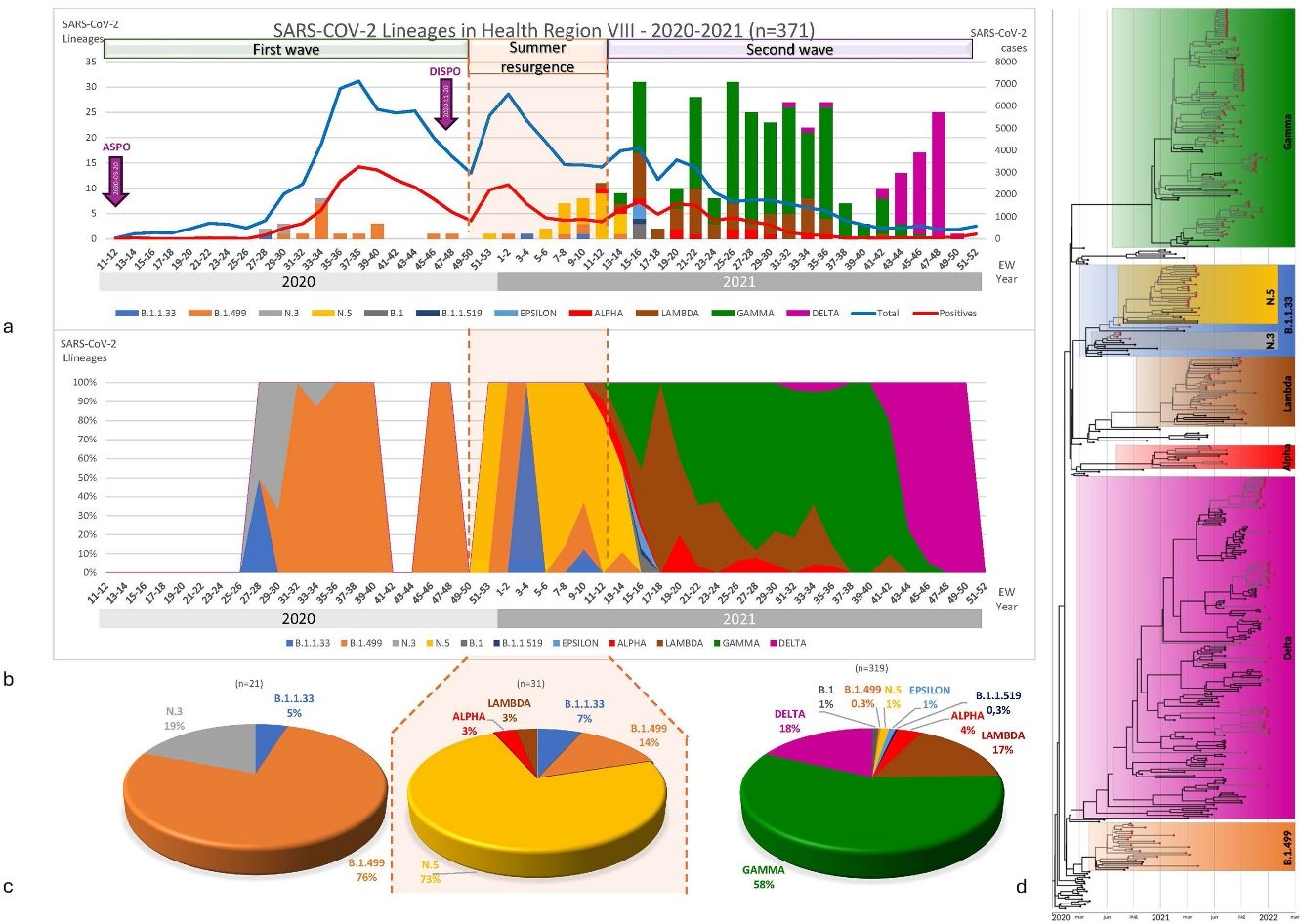
Tracking SARS-CoV-2: Molecular epidemiology and surveillance in Health Region VIII, Buenos Aires, Argentina (2020–2021)
Carlos Cimmino, Andrés Culasso, Andrea Lerman, Rodolfo Campos, Osvaldo Uez, Débora Natalia Marcone
Rev Argent Microbiol. 2027;59:
Highlights

  • •

    We analyzed 120421 respiratory samples from Health Region VIII for SARS-CoV-2.

  • •

    Viral positivity was higher in 2020; trends differed in travelers vs. residents.

  • •

    The first wave was dominated by lineages B.1.1.33, N.3, and B.1.499.

  • •

    Summer resurgence included lineage N.5 and emerging Alpha and Lambda variants.

  • •

    Second wave showed Gamma and Lambda co-circulation, later displaced by Delta.

  • •

    Genomic surveillance in decentralized regions tracks introductions and evolution.

Full text access
Immunoproteomic profiling identifies a type 1 fimbrial antigen in clinical isolates of Klebsiella pneumoniae
Ulises Vega-Castillo, Jesús Salvador Velarde-Félix, Evangelina Beltrán-López, Héctor Samuel López-Moreno
Rev Argent Microbiol. 2027;59:
Highlights

  • •

    Immunoproteomics identified 66 immunoreactive proteins in Klebsiella pneumoniae.

  • •

    An 18kDa antigenic type 1 fimbrial protein was identified by LC–MS.

  • •

    Type 1 fimbriae represent potential diagnostic biomarkers and vaccine candidates.

Full text access
Dynamics of emm types in invasive Streptococcus pyogenes isolates from Argentina, 2018–2024
Lucía Cipolla, Ricardo A. Gianecini, Melisa Laurora, Carla Voto, Carlos Giovacchini, Monica Prieto
Rev Argent Microbiol. 2027;59:
Highlights

  • •

    One thousand one hundred twenty-seven invasive Streptococcus pyogenes isolates were analyzed in Argentina, 2018–2024.

  • •

    emm1 predominated overall, with marked temporal fluctuations in clone diversity.

  • •

    A sharp decline in diversity in 2023 coincided with dominance of emm1/emm12.

  • •

    Hypervirulent lineages (M1-UK, M1-ST1319, M4NL22) were detected but showed limited expansion.

  • •

    Re-diversification of emm types in 2024 highlights the value of sustained genomic surveillance.

Full text access
Misdiagnosed herpetic whitlow
Jesús Iván Martínez-Ortega, Arely Gissell Ramirez Cibrian
Rev Argent Microbiol. 2027;59:
Full text access
Bacillus subtilis strain BS-QS1 promotes tomato growth and induces systemic resistance against Fusarium wilt in Shaqra, Saudi Arabia
Abeer M. Alghamdi
Rev Argent Microbiol. 2027;59:
Highlights

  • •

    Bacillus subtilis suppressed Fusarium oxysporum causing wilt disease in tomato.

  • •

    B. subtilis significantly enhanced plant growth and performance under pathogen stress.

  • •

    ISR evidenced by increased antioxidant enzymes and defense responses.

  • •

    Root colonization by B. subtilis reduced disease and promoted growth.

  • •

    The study demonstrates a sustainable, eco-friendly approach to manage tomato Fusarium wilt.

Full text access
Isolation and PCR detection of Mycoplasma spp. in calves with respiratory disease from selected dairy herds in central Mexico
Laura Jaramillo-Meza, Anabelle Manzo-Sandoval, Fernando Díaz-Otero, María Guadalupe Villa García, Naxhielli Hernández Santiago, Luis Galicia-López, Laura Hernández-Andrade
Rev Argent Microbiol. 2027;59:
Highlights

  • •

    Integrated PCR and culture improved detection of Mycoplasma spp. in BRD calves.

  • •

    Detection frequencies of individual Mycoplasma species varied among herds.

  • •

    Mycoplasma bovis and M. dispar were the most frequently detected species.

  • •

    Mycoplasma bovis was the predominant pathogen in affected calves.

  • •

    rpoB and uvrC genes were highly conserved and supported species identification.

Full text access
High prevalence of Rickettsia felis in fleas from pets in central Argentina
Dante Frati, Estefanía Raquel Boaglio, Julia Marina Brignone, Silvina Goenaga
Rev Argent Microbiol. 2026;58:
Highlights

  • •

    Rickettsia felis was detected in C. f. felis from four provinces in central Argentina.

  • •

    The minimum infection rate was 13.2% for R. felis.

  • •

    Samples of R. sanguineus sensu lato tested negative for Rickettsia DNA.

  • •

    Our results expand the known geographic distribution of R. felis in Argentina.

Full text access
First detection of methicillin-susceptible Staphylococcus aureus clonal complex CC398 carrying ermT in processed foods from northeastern Argentina
Adriana Griselda Barboza, Lucia Rago, Sabrina Di Gregorio, Marta Eugenia Mollerach, Sandra Liliana Grenón, Martha Helena von Specht
Rev Argent Microbiol. 2026;58:
Highlights

  • •

    First report of CC398-MSSA-ermT+ in processed foods from northeastern Argentina.

  • •

    All 14 phenotypically selected isolates were positive for sau1-hsdS1 and ermT by PCR.

  • •

    iMLSb phenotype increased from 2.8% (2009–2010) to 46% (2020–2024) in food isolates.

  • •

    CC398-MSSA-ermT+ circulated in the region since at least 2009–2010.

  • •

    Food chain identified as potential reservoir of macrolide resistance determinants.

Full text access
asdasdasd