metricas
Revista Argentina de Microbiología / Argentinean Journal of Microbiology
Journal Information
Issue
Cover Vol. 59. Issue 1. (In progress) Vol. 59. Issue 1. (In progress)
(January - March 2027)
This issue is in progress but contains articles that are final and fully citable.
Basic microbiology
Immunoproteomic profiling identifies a type 1 fimbrial antigen in clinical isolates of Klebsiella pneumoniae
Ulises Vega-Castillo, Jesús Salvador Velarde-Félix, Evangelina Beltrán-López, Héctor Samuel López-Moreno
Rev Argent Microbiol. 2027;59: 100755
Highlights

  • •

    Immunoproteomics identified 66 immunoreactive proteins in Klebsiella pneumoniae.

  • •

    An 18kDa antigenic type 1 fimbrial protein was identified by LC–MS.

  • •

    Type 1 fimbriae represent potential diagnostic biomarkers and vaccine candidates.

Full text access
Clinical microbiology and infectious diseases
Isolation and PCR detection of Mycoplasma spp. in calves with respiratory disease from selected dairy herds in central Mexico
Laura Jaramillo-Meza, Anabelle Manzo-Sandoval, Fernando Díaz-Otero, María Guadalupe Villa García, Naxhielli Hernández Santiago, Luis Galicia-López, Laura Hernández-Andrade
Rev Argent Microbiol. 2027;59: 100742
Highlights

  • •

    Integrated PCR and culture improved detection of Mycoplasma spp. in BRD calves.

  • •

    Detection frequencies of individual Mycoplasma species varied among herds.

  • •

    Mycoplasma bovis and M. dispar were the most frequently detected species.

  • •

    Mycoplasma bovis was the predominant pathogen in affected calves.

  • •

    rpoB and uvrC genes were highly conserved and supported species identification.

Full text access
Misdiagnosed herpetic whitlow
Jesús Iván Martínez-Ortega, Arely Gissell Ramirez Cibrian
Rev Argent Microbiol. 2027;59: 100752
Full text access
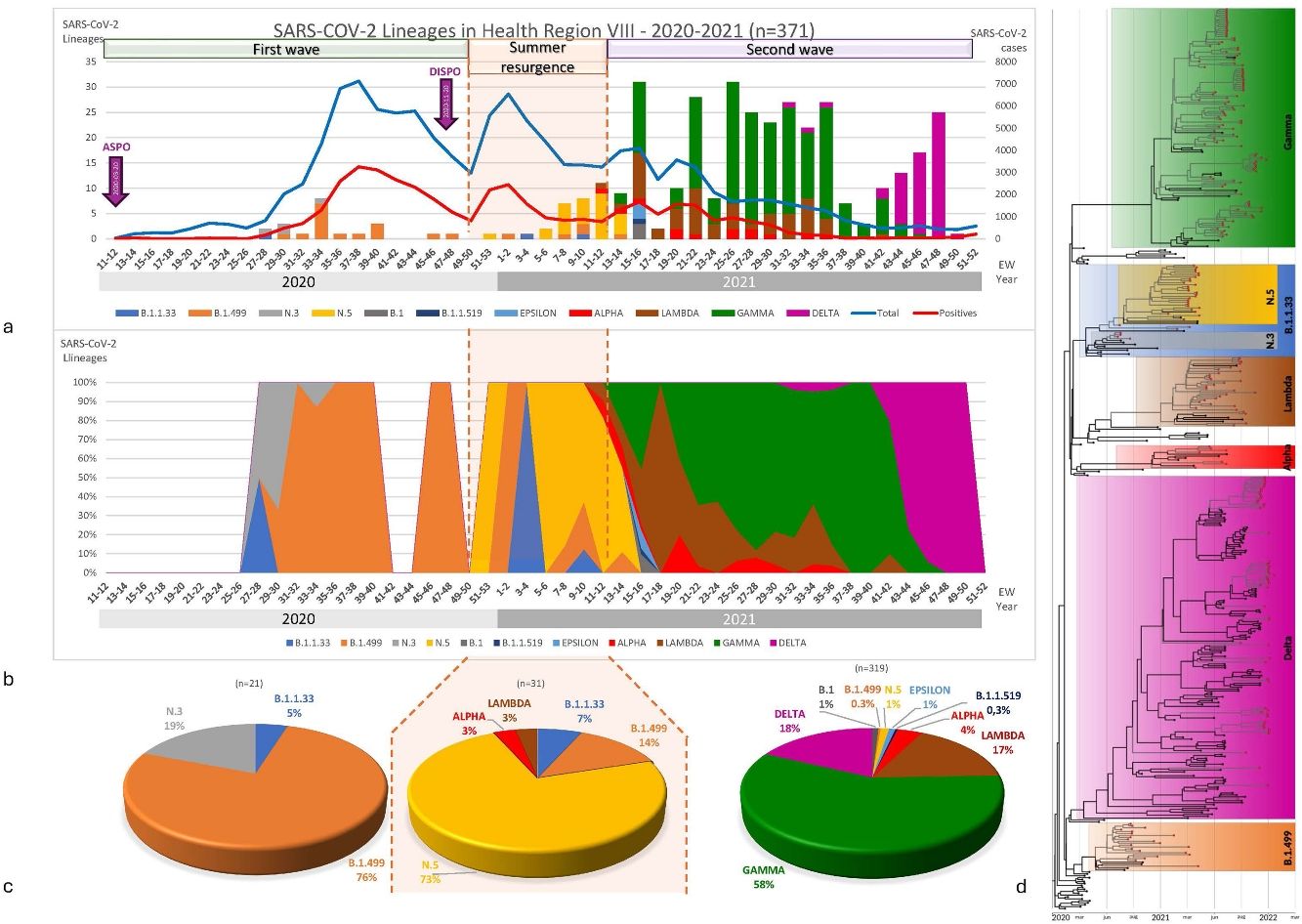
Tracking SARS-CoV-2: Molecular epidemiology and surveillance in Health Region VIII, Buenos Aires, Argentina (2020–2021)
Carlos Cimmino, Andrés Culasso, Andrea Lerman, Rodolfo Campos, Osvaldo Uez, Débora Natalia Marcone
Rev Argent Microbiol. 2027;59: 100756
Highlights

  • •

    We analyzed 120421 respiratory samples from Health Region VIII for SARS-CoV-2.

  • •

    Viral positivity was higher in 2020; trends differed in travelers vs. residents.

  • •

    The first wave was dominated by lineages B.1.1.33, N.3, and B.1.499.

  • •

    Summer resurgence included lineage N.5 and emerging Alpha and Lambda variants.

  • •

    Second wave showed Gamma and Lambda co-circulation, later displaced by Delta.

  • •

    Genomic surveillance in decentralized regions tracks introductions and evolution.

Full text access
Dynamics of emm types in invasive Streptococcus pyogenes isolates from Argentina, 2018–2024
Lucía Cipolla, Ricardo A. Gianecini, Melisa Laurora, Carla Voto, Carlos Giovacchini, Monica Prieto
Rev Argent Microbiol. 2027;59: 100754
Highlights

  • •

    One thousand one hundred twenty-seven invasive Streptococcus pyogenes isolates were analyzed in Argentina, 2018–2024.

  • •

    emm1 predominated overall, with marked temporal fluctuations in clone diversity.

  • •

    A sharp decline in diversity in 2023 coincided with dominance of emm1/emm12.

  • •

    Hypervirulent lineages (M1-UK, M1-ST1319, M4NL22) were detected but showed limited expansion.

  • •

    Re-diversification of emm types in 2024 highlights the value of sustained genomic surveillance.

Full text access
Antimicrobial resistance and antibiotic therapy in patients with urinary tract infections and asymptomatic bacteriuria: A Peruvian perspective
Nancy V. Castilla-Torres, Jeanette Castilla, Nilda A. Apayco-Espinoza, Alexandra A. Urrutia-Zegarra, Jimmy H. Ango, Pablo W. Común-Ventura, Gabriela Bellido, Maycol J. Yanasupo, ... Yesica G. Cabrera
Rev Argent Microbiol. 2027;59: 100760
Highlights

  • •

    The study compares UTI and ASB, revealing overdiagnosis and unnecessary treatment of ASB.

  • •

    High resistance in E. coli and K. pneumoniae to TMP/SMX, cephalosporins, and ampicillin.

  • •

    Diabetes and hypertension were the most frequent comorbidities.

Full text access
Surveillance of high-priority enterococci and factors associated with clinical enterococcal infections in a Reference Hospital in northern Nigeria
Aisha Muhammad Auwal, Idris Nasir Abdullahi, Islem Trabelsi, Shamsu Almustapha, Attahiru Muhammad, Shamsuddeen Abdurrazaq, Musa Mohammed, Kabir Umar
Rev Argent Microbiol. 2027;59: 100761
Highlights

  • •

    Resource-limited countries suffer from inadequate testing capacity to detect enterococci.

  • •

    Enterococcus was identified in 23.3% clinical samples, of which 42.9% were E. faecium.

  • •

    Age of 31–40 years, unemployment and the use of pit latrines were significant risk factors for enterococci infection.

  • •

    About 83.3% strains exhibited an MDR phenotype, and 7.1% were vancomycin-resistant E. faecium.

  • •

    There is a need for selective media and special considerations for VRE to minimise misdiagnosis.

Full text access
Exploring normality: Mapping the endometrial microbiome in healthy reproductive-aged women from Argentina
Constanza Nazario, Leticia Solari, Mariela Sciara, Carlos Daniel de la Vega Elena
Rev Argent Microbiol. 2027;59: 100763
Highlights

  • •

    This study provides the first regional characterization of the normal endometrial microbiome in healthy Argentine women.

  • •

    The endometrial microbiome was dominated by Lactobacillus species, particularly Lactobacillus iners and Lactobacillus helveticus/crispatus.

  • •

    Overall microbial richness and alpha diversity remained stable across reproductive age groups.

  • •

    A progressive increase in Gardnerella, Prevotella, and Megasphaera was observed with advancing age, still dominated by Lactobacillus species.

  • •

    These findings establish a local baseline for future studies on endometrial dysbiosis and reproductive disorders.

Full text access
Antimicrobial agents
Bacillus subtilis strain BS-QS1 promotes tomato growth and induces systemic resistance against Fusarium wilt in Shaqra, Saudi Arabia
Abeer M. Alghamdi
Rev Argent Microbiol. 2027;59: 100743
Highlights

  • •

    Bacillus subtilis suppressed Fusarium oxysporum causing wilt disease in tomato.

  • •

    B. subtilis significantly enhanced plant growth and performance under pathogen stress.

  • •

    ISR evidenced by increased antioxidant enzymes and defense responses.

  • •

    Root colonization by B. subtilis reduced disease and promoted growth.

  • •

    The study demonstrates a sustainable, eco-friendly approach to manage tomato Fusarium wilt.

Full text access
Antibacterial and cytotoxic evaluation of Jatropha dioica extract for periodontal coadjutant treatment
Alejandro Luis Vega-Jiménez, Patricia González-Alva, Miryam Martínez-Hernández, Alma Delia Hernández-Fuentes, Adriana-Patricia Rodríguez-Hernández
Rev Argent Microbiol. 2027;59: 100757
Highlights

  • •

    There is limited information reporting the antibacterial and cytotoxic properties of J. dioica.

  • •

    It is in the global population's interest to give scientific support for the use of J. dioica phytotherapy.

  • •

    In low-income rural communities, phytotherapy represents an option for periodontitis treatment.

Full text access
Agricultural, environmental and industrial microbiology
Antifungal potential of Capsicum annuum var. glabriusculum on Moniliophthora roreri in response to fruit maturity and shading during fruit growth
Dario De la Cruz-Ricardez, Luz del Carmen Lagunes-Espinoza, Carlos Fredy Ortiz-García, Ramón Marcos Soto-Hernández, Edith Hernández-Nataren, Naybi Rosario Muñoz-Cázares
Rev Argent Microbiol. 2027;59: 100758
Highlights

  • •

    Immature C. annuum var. glabriusculum fruits methanolic extract inhibits the growth and sporulation of M. roreriin vitro.

  • •

    In vivo antifungal efficiency of the extracts on M. roreri was greater than 50%, when tested with cacao pods in the field.

  • •

    The extract applied three days before inoculation has a preventive effect by improving antifungal efficiency.

Full text access
asdasdasd