



What was once a technical discipline, interventional vascular radiology (IVR) has now developed into a patient-centred clinical-surgical speciality. The integration of outpatient consultation and inpatient care within IVR units enhances safety, improves clinical outcomes and consolidates the speciality’s role within the healthcare system. However, barriers such as lack of time, resources and recognition hinder its implementation. This SERVEI position statement defines the core principles of clinical care in IVR, examines the legal frameworks underpinning it and identifies viable models for hospitalisation, ranging from day units to dedicated inpatient wards. Progressive levels of healthcare provision are proposed, and an organisational model based on homogeneous functional groups (HFGs) is advocated to achieve greater efficiency and visibility. Outpatient consultation plays a central role in accreditation, the training of future specialists and the sustainability of the speciality in an evolving healthcare landscape.
La radiología vascular e intervencionista (RVI) ha evolucionado de una disciplina técnica hacia una especialidad clínico-quirúrgica centrada en el paciente. La integración de la consulta clínica y la hospitalización en las unidades de RVI mejora la seguridad, los resultados clínicos y consolida su papel en el sistema sanitario. Sin embargo, barreras como la falta de tiempo, recursos y reconocimiento dificultan su implementación. Este posicionamiento de la SERVEI define los principios esenciales de la atención clínica en RVI, analiza los marcos legales que la sustentan e identifica modelos viables de hospitalización, desde unidades de día hasta plantas propias. Se proponen niveles progresivos de prestación asistencial y se aboga por un modelo organizativo basado en grupos funcionales homogéneos (GFH) para lograr mayor eficiencia y visibilidad. La consulta clínica se establece como eje fundamental para la acreditación, la formación de futuros especialistas y la sostenibilidad de la especialidad en un entorno sanitario en transformación.
Interventional vascular radiology (IVR) has transformed modern medicine by providing minimally invasive treatments for complex diseases. However, there are still obstacles to fully incorporating IVR into everyday clinical practice across all hospital units.
Although interventional radiologists have refined their technical skills, there is room for improvement in terms of even basic clinical practice—including pre- and post-procedural consultation. Today, IVR has evolved towards providing holistic patient care. This approach aims to combine technical skill with clinical decision making, pre- and post-procedural decision making, inpatient hospital care (hospitalisation) and long-term clinical and radiological follow-up.
These practices have a positive impact on clinical outcomes, increase patient safety and consolidate the role of IVR in the health system. In short, a significant improvement to care overall.
While progress has been made, barriers remain such as a lack of awareness of the need for clinical consultation, lack of time, and restrictions to admitting patients under IVR care. A recent survey of interventional radiologists in Spain highlights the importance of adopting a proactive clinical role. The results indicate that most interventional radiologists (62.5%) dedicate only a small proportion (<10% of their working day) to clinical practice. The barriers to greater clinical participation identified were: limited time, heavy workloads and limited staff resources.1 At European level, the Cardiovascular and Interventional Radiological Society of Europe (CIRSE) survey revealed that approximately half of those surveyed have a structured clinical consultation setup. However, clinical practice takes many forms, such as ward visits, outpatient care and inpatient care management.2 We must consider these issues to guarantee quality medical care, as well as the sustainability of IVR as a clinical and surgical speciality.
This document, drafted by the Spanish Society of Vascular and Interventional Radiology (SERVEI), defines the core principles in the clinical management of patients undergoing IVR interventions, analyses the legal framework governing consultations and specifies the personnel requirements and infrastructure necessary to implement and improve both clinical consultation and inpatient care.
Evolution of IVR: from mastering the technique to the patient-centred approachIVR, a pioneering field developed by Charles Dotter in the 1960s, has undergone a transcendental metamorphosis. The field initially focused on developing and perfecting minimally invasive image-guided techniques, aimed at diagnosing and treating a broad range of pathologies. Milestones such as Seldinger’s vascular access technique in 1953 and the later introduction of stents, angioplasty and selective haemorrhage control during the 1970s and 1980s are key examples of this primarily technical phase.
IVR has progressively moved towards a patient-centred approach. This shift involves a holistic approach that goes beyond the mere execution of procedures. The expansion of interventional radiology into non-vascular interventions and developments in vascular care, with innovations like the transjugular intrahepatic portosystemic shunt (TIPS), percutaneous drainage and image-guided biopsies marked a turning point at the end of the 20th century.
In the 21st century, interventional oncology has further consolidated this transformation. Therapies such as thermal tumour ablation and radioembolisation, integrated within multidisciplinary treatment plans, show that IVR can offer clinical outcomes comparable to those of conventional surgery.
This paradigm shift means that interventional radiologists must adopt a more active role in holistic clinical care of patients, alongside other specialists in multidisciplinary teams.
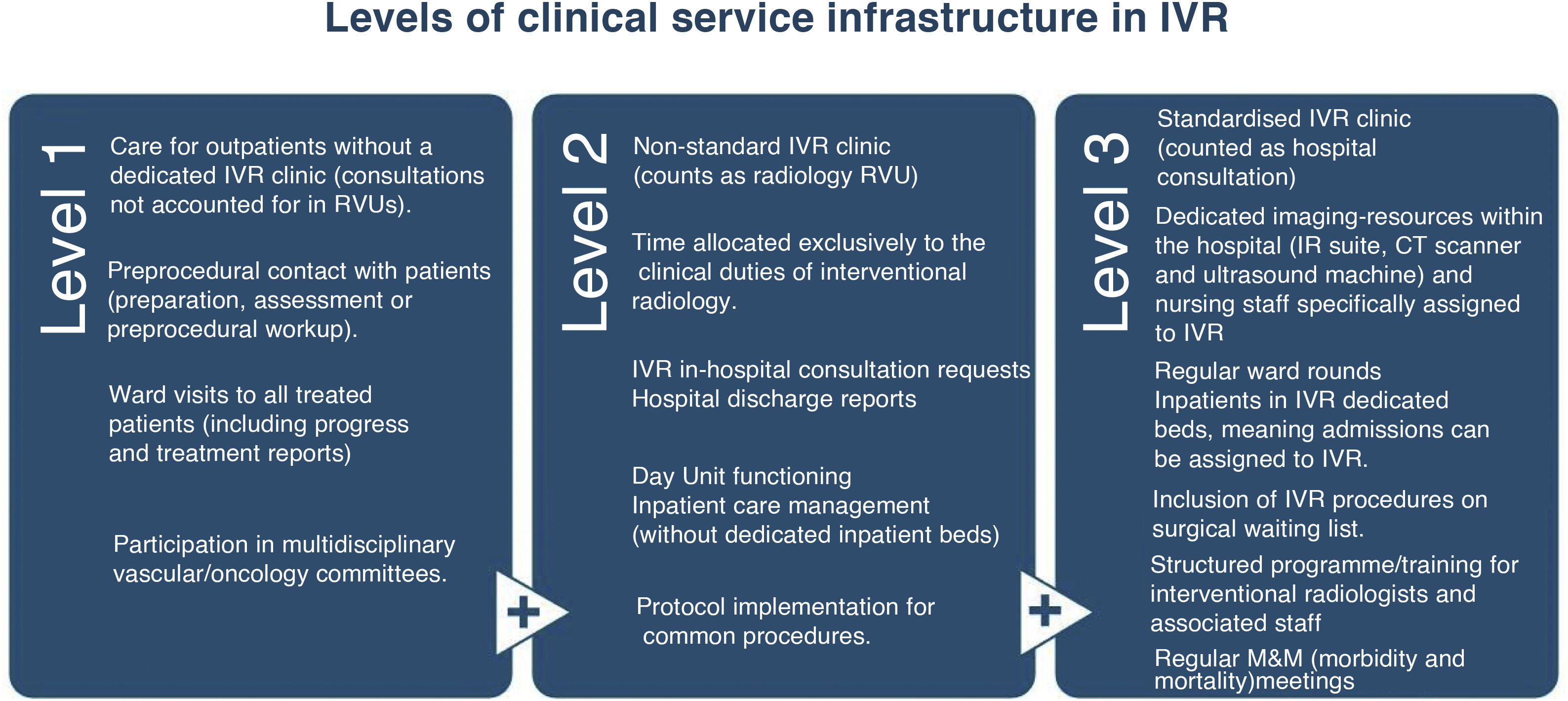
In this regard, the CIRSE Clinical Services in IR Task Force has published a guide to implementing clinical services for IVR units, through three incremental levels. SERVEI has adapted this to the Spanish setting and created a three-level classification for IVR clinical service infrastructure, aiming to raise awareness that different levels of service can be offered, which represent incremental goals to work towards. Interventional radiologists can also use this system as a benchmark for their own work and to set their own individual goals for developing services at their centre and in their future practice (Fig. 1).

Incremental levels of clinical infrastructure. Access to each level may be independent, although the levels reflect an incremental progression in care quality.
Uncounted consultation: consultation excluded from the RVU calculation for the interventional vascular radiology (IVR) unit.
Non-standard consultation: a consultation that does not meet the infrastructure, operational or legal standards of those conducted in the hospital’s outpatient department.
RVU (relative value unit): artificial standardised unit of measure used to quantify the complexity and cost of a radiological procedure against a benchmark procedure.
These levels vary depending on whether IVR has its own clinic (level 3), if IVR clinical practice counts towards IVR workload (level 2) or if clinical practice activities do not appear in the IVR work schedule (level 1). The levels are not additive but incremental, moving from lower to higher complexity.
Principles of clinical practice in IVRIVR is defined as a medical speciality centred on diagnosis, treatment and clinical management of patients by means of image-guided minimally invasive procedures.3 The fundamental principles for IVR clinical practice are:
- •
Professional competency and clinical preparedness. Clinical training must be integrated into speciality/subspeciality, fellowships and academic master’s programmes. Clinical rotations in outpatient consultations and inpatient care at all stages of training is key. Continuous professional development is necessary, preferably in the form of certified courses.
- •
Clinical care and responsibility. The active participation of the patient in decision making about their illness and treatment it to be prioritised. Interventional radiologists must be responsible for clinical duties throughout the process, including providing information on therapeutic options, informed consent, treatment plans, hospital admission procedures, pre- and post-intervention care as well as outpatient follow-up.
- •
Inter- and multidisciplinary collaboration. Effective communication and teamwork with referring physicians and specialists, consulting with relevant specialists in complex cases and participation in multidisciplinary committees. Working as a team with nursing and imaging technician staff is fundamental.
- •
Adequate infrastructure and resources. Interventional radiologists must have dedicated time for clinical care, as well as appropriate infrastructure for consultations, outpatient medical clinics and inpatient care. Support from core radiology departments is key to ensure effective care, as well as support from the hospital management.
- •
Accident and Emergency cover 24/7. Round the clock access to IVR units should be ensured, without delay and without bureaucratic barriers to referral.
- •
Empathetic and transparent communication. It is essential that interventional radiologists establish clear, empathetic and continuous communication with their patients. This includes explaining procedures, their risks, benefits and possible complications in an understandable way to patients, as well as responding to their questions and concerns in an honest and open way. This enhances trust and mutual understanding throughout the care process.
Any intervention, whether outpatient or requiring admission, should be previously assessed in a consultation.4 All patients from different hospital departments who require an assessment prior to undergoing any of the interventions included in the radiology catalogue should have a prior consultation.
Justification and objectives of IVR consultations- 1
To assess and accept patients for interventional treatments.
- ◦
To act as the lead consultant for referred patients who require interventions, undertaking an exhaustive assessment to evaluate if the patient is suitable for the intervention.
- ◦
To establish inclusion and exclusion criteria based on scientific evidence to guarantee the security and efficacy of treatment.
- ◦
- 2
Patient information and informed consent submission.
- ◦
Provide detailed information to referred patients about the available IVR therapeutic options as well as alternatives.
- ◦
Offer minimally invasive treatments where appropriate and desirable for the patient, ensuring written informed consent is acquired before booking any intervention.
- ◦
Ensure the patient understands the risks and benefits of the procedures.
- ◦
- 3
Treatment planning.
- ◦
Routinely establish and execute diagnostic and therapeutic plans, minimising the need for intervention from other specialists where possible and within IVR competencies.
- ◦
Request the necessary imaging and laboratory tests for the interventions, preoperative preparations, consultation with anaesthesia and other specialists.
- ◦
Adjust medications on the day of the surgery.
- ◦
Decide on the ideal imaging technique for the day of the intervention and acquire the material resources necessary for the surgery.
- ◦
- 4
Comprehensive inpatient care management.
- ◦
Manage patient admission for those undergoing therapeutic procedures that require hospital admission.
- ◦
Optimise hospital stay lengths, improving efficiency.
- ◦
- 5
Patient follow-up.
- ◦
Provide longitudinal care and undertake clinical/imaging follow-up of the intervention performed.
- ◦
Establish a follow-up protocol and refer the patient to other specialists where necessary, ensuring comprehensive and coordinated care.
- ◦
Audit intervention outcomes.
- ◦
Radiodiagnostics consultants who specialise mainly or exclusively in IVR, ideally with specific accredited training (e.g. IVR fellowship, SERVEI, EBIR, master’s programme). Consultants should have both technical and clinical skills for performing assessments, determining indications, obtaining informed consent and undertaking peri-procedural management.5
IVR work planning involves creating a programme and detailed plan for interventional radiologist activities, including procedures, diagnostic work, clinical consultation, administrative tasks, committees and scientific training/activity.6
The planning process is crucial to guarantee that resources are used efficiently, workload is properly managed and patient care is of high quality. The requirement for and number of interventional radiologists in an IVR unit should be based on both the volume of procedures and clinical activity.
The optimal length of a consultation depends highly on context (first consultation, follow-up, diagnostic phase (e.g. ultrasound) or minor interventions (e.g. FNA, wound care procedures, etc.).
Taking the SERVEI interventions catalogue timings as a guide, one interventional radiologist dedicated solely to clinical consultations would be needed to care for 10–14 patients/day.
With some pathologies, IVR care may take the form of one-stop outpatient clinics.7
Clinical assistantA clinical assistant may be sufficient to assist the interventional radiologist in consultations and provide patients with the necessary care. Assistants will oversee correct patient appointment allocation, activity recording and cleaning and preparation of the equipment necessary for the activity.
NursingNursing personnel have a primary role in follow-up after interventions, wound care procedures and patient education. Setting up an IVR nursing clinic in tandem with the IVR medical clinic is recommended.
Structural resourcesInterventional clinical practice requires a dedicated, high-quality space. Holding consultations in rooms adjacent to radiology or in improvised, multipurpose falls completely outside the standards of regulated practice.
Clinics should be designed in accordance with hospital outpatient clinics, with a proper waiting room, a reception area and a private and confidential atmosphere that makes patients feel comfortable.
Consultation rooms should be equipped with the typical furniture (bed, table, two chairs and office IT equipment).
A Doppler ultrasound unit should be available.
It is recommendable that the necessary materials for wound care procedures, suture removal and all other typical consultation activities be available.
Quality assurance and formal recognition of medical consultationsInfrastructure for radiology clinics should be comparable and measured against the same criteria as that for any hospital speciality, complying with:
- •
Professional standards.
- ◦
Ensure every consultation is performed with the same level of professionalism as any other in-person consultation in the hospital.
- ◦
Comply with all current clinical protocols and standards.
- ◦
- •
Legal and ethical compliance.
- ◦
Strict compliance with the Organic Law for Data Protection (LOPD) in all interactions with patients, including call management and information confidentiality.8
- ◦
- •
Activity registration and assessment.
- ◦
Implement a detailed recording system that means each consultation can be accounted for as a clinical activity equivalent to any other in-person consultation, to support productivity analysis and care quality.
- ◦
- •
Different levels of care.
- ◦
Guarantee the ability to offer one-stop clinics, both for initial visits as well as follow-ups, tailored to the specific needs of each patient.
- ◦
- •
Consultation area optimisation.
- ◦
Create an environment that prioritises efficiency, patient comfort and confidentiality, both in person and remotely.
- ◦
- •
Analysis and continuous improvement.
- ◦
Undertake periodic analysis of waiting times and consultation duration to identify areas for improvement and optimise the efficiency of the service.
- ◦
Regardless of the medical report, once the intervention is completed, a discharge report must be prepared if the patient was admitted under RVI care or used beds from another speciality, provided that no other specialist was significantly involved in the process. The hospital IT system should have forms available for each stage of the IVR process (intervention report, progression report and discharge report).
To guarantee quality clinical reports in IVR, every consultation report must include full patient details, a detailed description of the procedures undertaken and patient status, an accurate clinical diagnosis, follow-up appointments or future procedures, as necessary. Quality controls must be implemented, such as regular audits, in which all processes, including consultations, are duly documented with clear, accurate and complete reports.
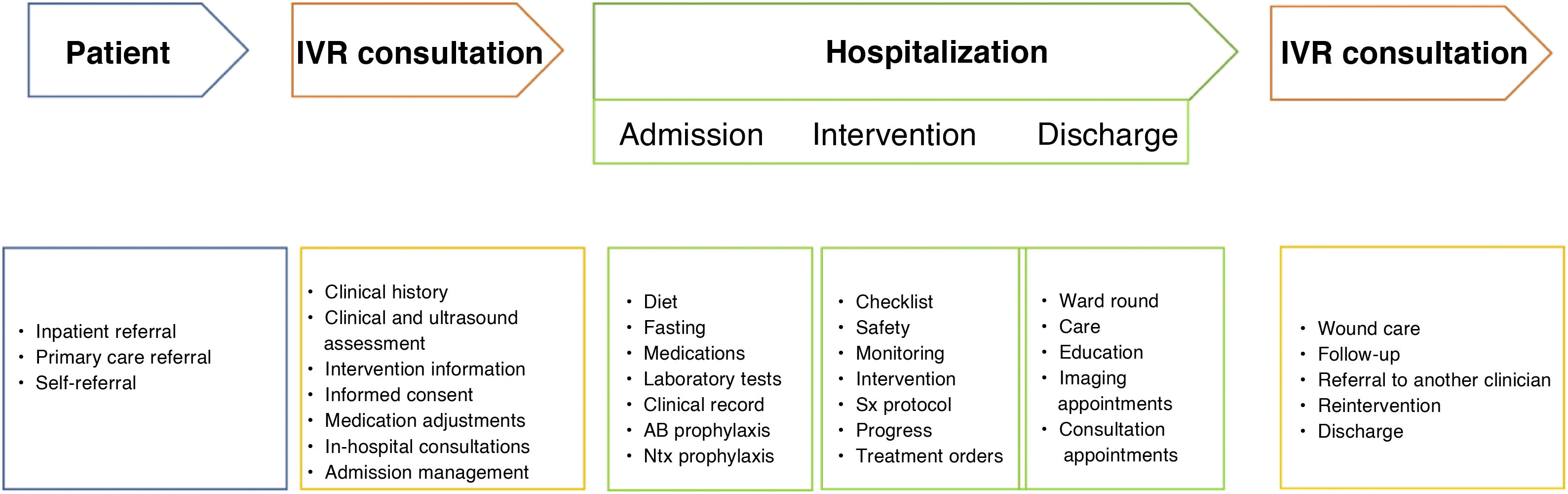
Analysis of the clinical care process within IVR unitsAnalysis of the clinical care process within IVR units is crucial to optimise patient care. This analysis involves a detailed evaluation of the longitudinal care for each stage, from the first consultation, the different phases of inpatient care and outpatient follow-up.9 Fundamentally, the analysis aims to identify possible bottlenecks, areas for improvement in coordination between professionals, as well as ensure efficient use of resources and adherence to clinical practice guidelines. A rigorous analysis enables the implementation of strategies to improve care quality, patient safety and experience within an IVR unit (Fig. 2)
Legal imperative of IVR consultations
IVR holds a crucial and inescapable duty in ensuring proper informed consent for IVR invasive procedures. This duty includes the obligation to provide clear, understandable and sufficient information about the procedure itself, its technical elements, the risks and possible complications of an intervention and expected benefits. Consultants must ensure they provide a safe space for patients to ask questions, and that these questions are properly answered.
Spanish legislation, and primarily Law 41/2002, establishes a clear legal imperative for doctors undertaking interventions (in this case IVR) to explain to patients the nature, aim, risks and consequences of the intervention, and to receive the informed consent documentation prior to proceeding.10 This duty is based on the fundamental right of patients to information and autonomy in making decisions about their health. Article 4 enshrines the right to information, article 8 regulates informed consent, specifying in which cases consent must be written, article 9.1 obliges doctors to provide basic information prior to obtaining written consent. The Community of Madrid complements this national legislation with Law 3/2005 and Order 410/2010.11,12 Failure to comply with this obligation may have serious legal (civil, criminal and administrative) consequences for doctors. Therefore, compliance with these legal requirements is not merely a bureaucratic formality, it is a fundamental element of ethical and responsible medical practice in Spain. It is essential to protect the autonomy of the patient, foster patient-doctor trust and avoid potential litigation.
Additionally, European legislation reinforces the need for interventional vascular radiologists to ensure that patients understand the information provided and give voluntary consent prior to any procedure.13,14
These legal imperatives, as well as documents from scientific associations, may be used to justify setting up an IVR clinic.9
Inpatient IVR careThere are various models of inpatient care in IVR. They can be divided into two main categories: those in which IVR controls inpatient care management and those in which third parties manage it. Each centre should adapt its resources and setting to accommodate the different models.
Comprehensive management by IVRShort stay day case unitsImplementing dedicated IVR day case units is probably the model that is best adapted to IVR practice. It is justified by its capacity to optimise patient care and hospital efficiency. Many interventional radiology procedures are carried out on an outpatient basis, which reduces the need for hospital admissions. This frees up beds and reduces costs, optimising the use of resources. Proximity of the unit to the IR department facilitates workflow, from pre-assessment to post-operative follow-up, improving specialised and personalised patient care. The unit should have long operating hours (e.g., 08:00 to 18:00), with continuous nursing presence for monitoring. It is necessary to define the portfolio of interventions that would benefit from this short-stay pathway.
This model is implemented with much success in many European IVR units.15
IVR ward or bedsManaging a ward or a group of beds specifically dedicated to IVR has its own peculiarities. On the one hand, it assigns the interventional radiologist the role of lead consultant, consolidating IVR’s authority and improving the perception patients have of the speciality. It also offers greater flexibility and makes cost allocation easier. On the other hand, this approach is only viable in large-volume hospitals, as a ward with low occupation leads to excessive relative costs. IVR units must be sufficiently staffed to manage these processes smoothly. There is the risk that some referring doctors may interpret the unit as competition, negatively impacting collaboration.
There may be hospital management-level difficulties with this model in terms of allocating costs and assigning resources because IVR belongs to the Radiology department, itself an intermediate service.
Management through third partiesShort stay admissions to day surgery units, post-anaesthesia care units or day hospitalsThis model, similar to the IVR day case units, is advantageous in that it reduces personnel costs, principally in terms of specialised nursing, making use of existing hospital structures.
It is the simplest, most viable model for IVR units starting to take responsibility for managing hospital admissions. IVR will be responsible for visiting patients, follow-up and delivering the corresponding hospital discharges.
An important consideration for this model is that patients from different specialties will converge, making it difficult to have specialist nurses attending to IVR patients.
Admission to beds under other specialtiesThis model may be a first step in bed management and is the first step in taking responsibility for patients who have undergone IVR. Patients are admitted to beds under the care of the referring consultant, based on their diagnosis. This may result in admission overload for other departments and limited knowledge among specialists from other areas regarding patient care. Therefore, it is crucial that interventional radiologists visit patients and support the preparation of or write the hospital discharge report.
Healthcare management for establishing IVR outpatient consultations and inpatient careComprehensive management of outpatient consultations and inpatient care in IVR is an area that presents considerable challenges and innovations in contemporary healthcare management. It can be optimised by implementing ‘homogeneous functional groups’ (HFGs). HFGs represent the smallest management unit within healthcare organisations, designed to group interrelated activities and resources that share a common objective and similar operational characteristics.
This management methodology enables more accurate measurement of performance, facilitates efficient allocation of resources, drives continuous improvements in care quality and underlies informed decision making. Within IVR, implementing FHGs enables structured and efficient management of complex processes, encompassing everything from pre-procedural consultations and patient preparation to interventions and post-hospitalisation follow-up. This makes HFGs an essential tool for optimising patient care and clinical results in IVR.
HFGs can be classified into different types, with intermediate and final groups being the most relevant for our field. Intermediate HFGs offer healthcare services necessary to deliver the final output—namely, improvements to the patient’s health. A Radiology department is considered an intermediate HFG.
Final HFGs are directly linked to patients and the final healthcare outcome (e.g. teaching or research within a department).
The key for a department like IVR to gain more visibility and influence in the clinical care management setting lies in being considered an intermediate-final or final HFG within the care process. This directly influences risk adjustment systems and hospital funding.
The transition from an intermediate to a final HFG requires a shift in how the service is managed and valued within the hospital structure. This may require a redefinition of care processes, the identification of specific final outputs generated by interventional radiology (beyond simple diagnosis) and a justification of its direct impact on patient health outcomes.
Necessary steps include an exhaustive evaluation of the department as it stands; the development of a strategic plan with clear objectives and a timeline; gradual improvements to equipment; protocols; staff training; and efforts to obtain relevant accreditation and certification. Benefits include improving accessibility and equity in care, increasing service efficiency and quality, fostering professional and scientific development, and guaranteeing service sustainability and performance.
Clinical consultations as a fundamental pillar in accrediting and training interventional radiologistsThe Society of Interventional Radiology (SIR), CIRSE and SERVEI consider the availability of IVR clinical consultations essential when accrediting departments as centres of excellence for training radiology specialist trainees and fellows. These associations consider clinical consultations a key criterion for excellence, promoting their integration into training programmes. They are necessary for speciality trainees and fellows to develop clinical skills, such as patient communication and management. It is a fundamental requirement to becoming competent and responsible specialists.
For SERVEI, having a IVR clinic is a core requirement for accreditation as a fellow training unit. Therefore, promoting and ensuring the existence of high-quality IR clinical consultations is crucial for advancing the speciality, ensuring excellent patient care and training future generations of interventional radiologists.
ConclusionIVR has developed beyond its initial technical focus to grow into a comprehensive medical and surgical speciality, centred on holistic patient care. Integration of pre- and post-intervention consultations and inpatient care management by interventional radiologists is not merely a necessary development, but also an essential step to optimise clinical outcomes, increase patient security and consolidate the position of IVR within the health system. Despite existing barriers, such as lack of time and resources, SERVEI’s position statement highlights the urgency to establish robust clinical infrastructure. Adopting management models such as HFGs and complying with the legal requirements for informed consent are crucial steps to ensure the quality of care and sustainability of IVR. Ultimately, IVR’s development to encompass a more clinical care role is fundamental to guarantee excellent patient care and to train future generations of competent specialists.
CRediT authorship contribution statementAll authors have contributed to developing, writing and reviewing the document.
FundingThis research has not received funding support from public sector agencies, the business sector or any non-profit organisations.
The authors declare that they have no conflicts of interest relating to the content of the manuscript. The authors include the president (lead author) and vice-president (fifth author) of the Spanish Society of Vascular and Interventional Radiology (SERVEI), and all authors are active interventional vascular radiologists. This reflects the institutional and professional character of the paper, drafted by consensus by the SERVEI Managing Board.



