Sotatercept is a drug approved for pulmonary arterial hypertension (PAH) that improves mortality, right ventricular function, functional class, NT-proBNP, and 6-minute walk distance. However, no clinical trials support its use in patients with pulmonary hypertension (PH) and interstitial lung disease (ILD), and respiratory adverse effects have been reported due to the development of intrapulmonary shunts. We report a 65-year-old woman with stable fibrotic ILD associated with Sjögren–antisynthetase overlap syndrome who developed severe precapillary PH. Despite treatment with inhaled treprostinil and tadalafil, she showed no clinical or hemodynamic improvement. Sotatercept and macitentan were initiated to improve hemodynamics and serve as a bridge to transplantation. After three months, the patient achieved functional class I, BNP reduction, normalization of echocardiographic PH findings, and marked hemodynamic improvement. Despite concerns regarding sotatercept-associated intrapulmonary shunts and hypoxemia, basal oxygen saturation improved from 93% to 96%. Bilateral lung transplantation was performed without immediate complications. This case supports further evaluation of the efficacy and safety profile of sotatercept in PH with concomitant ILD.
Sotatercept es un fármaco aprobado para la hipertensión arterial pulmonar (HAP) que mejora los parámetros clínicos, ecocardiográficos, hemodinámicos y de mortalidad. Sin embargo, no existen ensayos clínicos en pacientes con hipertensión pulmonar (HP) y enfermedad pulmonar intersticial (EPI), y se han notificado efectos adversos respiratorios por el desarrollo de shunts intrapulmonares. Presentamos el caso de una mujer de 65 años con EPI fibrótica estable asociada a síndrome de Sjögren-antisintetasa que desarrolló HP precapilar grave. A pesar del tratamiento con treprostinil inhalado y tadalafilo, no mostró mejoría clínica ni hemodinámica. Se inició sotatercept y macitentán para mejoría hemodinámica y como puente al posterior trasplante bipulmonar. Tras tres meses, la paciente alcanzó clase funcional I, reducción del BNP, normalización de los hallazgos ecocardiográficos y una marcada mejoría hemodinámica. Pese al riesgo de desarrollar shunts intrapulmonares, la saturación basal mejoró de 93% a 96%. Este caso apoya la investigación de la eficacia y seguridad del sotatercept en HP con EPI concomitante.
Pulmonary hypertension (PH) is a life-threatening disease whose treatment, as well as the characteristics of the population in which it is diagnosed, has evolved over the past 10 years.1 The current classification subdivides PH into 5 groups according to the etiology underlying the pulmonary vasculopathy.2 Despite this theoretical classification, in real-world practice, patients diagnosed today are older and more comorbid and may therefore present features of more than one group.
We present a 65-year-old woman referred to the PH Unit from the multidisciplinary Rheumatology–Pulmonology interstitial lung diseases (ILD) Unit. This patient was diagnosed in 2019 with fibrotic ILD with a non-UIP pattern associated with a Sjögren-antisynthetase overlap syndrome. From the time of diagnosis, she showed no radiological or spirometric progression (Fig. 1), for which reason antifibrotic therapy was not initiated, although she was receiving maintenance immunosuppressive therapy for her connective tissue disease (CTD). Pulmonary function tests at the time of referral showed FVC 50%, FEV1 53%, FEV1/FVC 84%, DLCO 51%, TLC 55% and a baseline oxygen saturation of 93%.
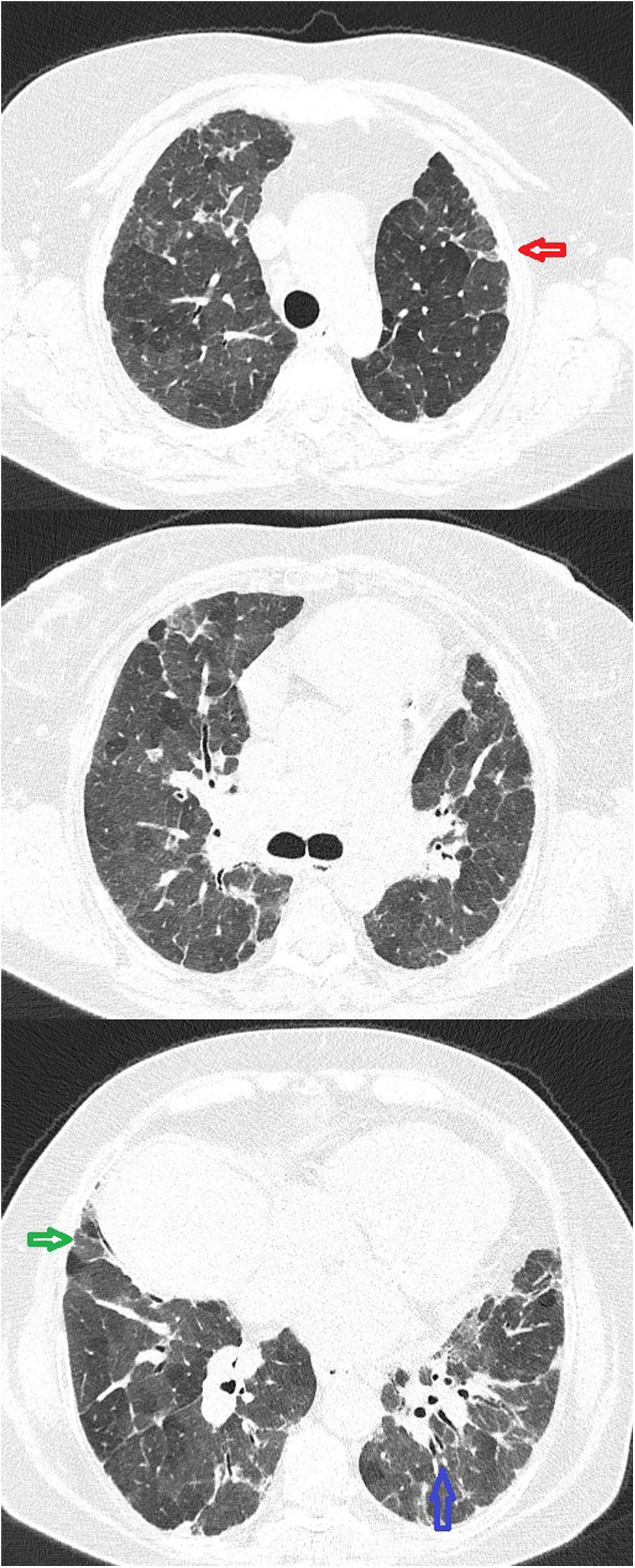
Fibrotic ILD secondary to Sjögren-antisynthetase overlap syndrome; images of the upper lobes, mid lung fields, and lower lobes. Bilateral subpleural reticulation (red arrow) with associated ground-glass opacities (green arrow) and traction bronchiectasis (blue arrow) is identified, along with a mosaic attenuation pattern. The distribution is symmetric and lower lobe predominant, with no honeycombing.
At the time of first evaluation at the PH Unit, the patient reported a functional class (WHO-FC) of II. Echocardiography showed high probability of PH, with a peak tricuspid regurgitation velocity (TRV) of 4.7m/s, a dilated right atrium, and a mildly dilated right ventricle with preserved systolic function and a TAPSE/sPAP of 0.24mm/mmHg. Brain natriuretic peptide (BNP) was 268pg/mL, and the patient walked 352 meters on the 6-minute walk test (6MWT). Given the suspicion of PH, a right heart catheterization (RHC) was performed, demonstrating a mean pulmonary artery pressure (mPAP) of 46mmHg, pulmonary capillary wedge pressure (PCWP) of 6mmHg, pulmonary vascular resistance (PVR) of 6.9 WU, right atrial pressure (RAP) of 7mmHg, and cardiac index (CI) of 3.9L/min/m2.
Based on these results, inhaled treprostinil was initiated and titrated up to 12 inhalations (72μg) four times daily. Given the hemodynamic severity, tadalafil 40mg was also added, supported by retrospective data on the use of PDE5 inhibitors in ILD and a caution recommendation of the current ERS/ESC guidelines.3,4 After 6 months of stable treatment, functional class remained at WHO-FC II, the 6MWT showed a mild decline to 336 meters, and BNP remained stable at 250pg/mL. Reassessment RHC at that point showed hemodynamic values similar to those obtained before treatment (mPAP 46mmHg, PCWP 6mmHg, PVR 6.9 WU, RAP 7mmHg, CI 3.9L/min/m2). Follow-up echocardiography one month later showed worsening findings, including mild pericardial effusion and further dilation of the right heart chambers. Given the lack of clinical and hemodynamic improvement, together with worsening echocardiographic parameters, the absence of ILD progression over the years, and the disproportion between the severity of the PH and the radiological extent of the ILD, a careful reassessment of the case was conducted within the PH committee. The patient was referred to the lung transplant unit, and treatment was switched to a regimen based on the current pulmonary arterial hypertension (PAH) therapeutic algorithm to improve hemodynamics and serve as a bridge to transplantation. A probable diagnosis of multifactorial PH was established, with a mixed respiratory and Group I component, particularly considering the underlying CTD.5 Macitentan 10mg and Sotatercept 0.3mg/kg were started simultaneously, given that the probability of hemodynamic improvement with macitentan alone was considered low given the lack of improvement with dual therapy using tadalafil and inhaled treprostinil. Following the initiation of macitentan and titration of sotatercept to 0.7mg/kg (week 3), the patient improved clinically to WHO-FC I, with a decrease in BNP to 108pg/mL. Due to concerns regarding reports of intrapulmonary shunts with sotatercept use,6,7 particularly in one case leading to de novo respiratory failure,7 daily home pulse oximetry measurements were performed as well as at every outpatient visit. Contrary to expectations, baseline oxygen saturation improved to 96% without oxygen therapy at the 3 and 6-months reassessment after initiation of both drugs. After three months of stable quadruple therapy, the patient was reassessed with echocardiography and RHC. Echocardiography showed a clear improvement, with normalization of right heart chambers size, complete resolution of the pericardial effusion, and a peak TRV not measurable due to trivial tricuspid regurgitation. RHC demonstrated significant hemodynamic changes: mPAP 27mmHg, PCWP 5mmHg, PVR 2.9 WU, RAP 6mmHg and CI 4.3L/min/m2. Following completion of the pretransplant work-up, the patient underwent bilateral lung transplantation without immediate complications (2-month follow-up). The decision to proceed with transplantation was based on the severity of the underlying ILD, the patient's age and the uncertainty regarding progression of both PH and ILD over the years.
Sotatercept is a drug approved for the treatment of PAH that acts as an ActRIIA-Fc fusion protein, functioning as a ligand trap for select members of the TGF-β superfamily, specifically activins (A and B) and growth differentiation factors (GDF8, GDF11), which are involved in cellular proliferation regulation pathways. In PAH, this pathway is dysregulated, with increased activin-A levels leading to vascular cell hyperproliferation, causing pathological remodeling of the pulmonary arterial wall characteristic of patients with PAH.8 Interestingly, PAH and ILD share mechanisms involved in vascular and parenchymal remodeling, including endothelial dysfunction, inflammation, and alteration of TGF-β/BMPR2 pathway signaling; therefore, sotatercept could theoretically have a beneficial role in ILD beyond the treatment of PH, although there is no evidence in this regard to date.9 In pooled meta-analyses of clinical trials, sotatercept has demonstrated reductions in mortality, right ventricular dysfunction, and improvements in functional class, NT-proBNP, and 6MWT. The most frequent adverse effects reported were epistaxis, telangiectasias, increased hemoglobin, and systemic hypertension.10
Although it was not reported in the pivotal trials,10 cases of intrapulmonary shunts detected by bubble study on echocardiography and hypoxemia have been described in the literature.6,7 It has been theorized that this is due to sotatercept-induced reductions in BMP-9 and BMP-10.8 These proteins have been associated with the development of telangiectasias, progressive hypoxemia, and intrapulmonary shunts in BMP-9 and BMP-10 knockout rats.6 Furthermore, these proteins have also been found to be reduced in patients with hepatopulmonary syndrome.11 Daghe et al., in 2025, reported a retrospective study including 7 patients evaluating sotatercept use in PAH associated with CTD (4 patients diagnosed with systemic sclerosis and 3 patients diagnosed with mixed CTD) and concomitant ILD, showing good tolerability, no significant respiratory adverse effects, and improvement in clinical, echocardiographic, and hemodynamic parameters.12 Interestingly, the mean supplemental oxygen requirement measured in liters per minute decreased from 3L/min to 1.14L/min (p<0.001), which is consistent with the improvement in baseline saturation observed in our patient. There are some limitations to the interpretation of this case: the simultaneous initiation of macitentan together with sotatercept may have contributed to the patient's improvement, particularly from a hemodynamic standpoint. Likewise, a 6-month follow-up does not guarantee the absence of long-term adverse effects on vascular remodeling, particularly given that a bubble study was not performed on echocardiography in light of the improvement in baseline oxygen saturation.
In conclusion, the use of sotatercept in PH associated with CTD and ILD warrants further exploration, given the reported cases showing clinical, hemodynamic, and even oxygen saturation improvement without respiratory adverse effects.
Ethical considerationsThis work has been carried out in accordance with The Code of Ethics of the World Medical Association (Declaration of Helsinki) and it is in line with the Recommendations for the Conduct, Reporting, Editing and Publication of Scholarly Work in Medical Journals.
Artificial intelligence involvementDuring the preparation of this work the authors used Claude in order to improve the language and readability of the manuscript. After using this tool/service, the authors reviewed and edited the content as needed and take full responsibility for the content of the publication.
Informed consentAuthors confirm that informed consent was obtained for the publication of this manuscript.
FundingNo.
Authors’ contributionsAll authors have made substantial contributions to the conception and design of the study, including the acquisition of data, the analysis and interpretation of data, the writing and revision of the manuscript and final approval of the version submitted.
Conflicts of interestThe authors declare not to have any conflicts of interest that may be considered to influence directly or indirectly the content of the manuscript.